
Integral momentum equation Created 2026-09-24 Updated 2026-11-05
The integral momentum equation applies momentum conservation to a chosen control volume. For a fixed region with outward unit normal , its vector form isThe first term is accumulation inside the region; the second is net outward momentum transport. External forces include pressure, viscous traction, gravity and any force exerted by a wall.
In steady flow through a pipe bend, accumulation vanishes but momentum flux changes direction, so the fluid requires a resultant force. This makes the equation useful even when the detailed internal velocity field is unknown. Pressure must be included on the inlet and outlet faces; using only the speed change can miss the dominant load. The displayed flux uses a fixed control volume; a moving boundary requires relative transport velocity.
Bernoulli equation Created 2026-09-24 Updated 2026-11-05
The Bernoulli equation relates speed, pressure and height along a streamline of a steady inviscid flow. For constant mass density in uniform gravity,where is constant along that streamline. Each term has units of energy per unit mass. In a barotropic compressible fluid, the pressure term is instead .
In a horizontal narrowing passage, mass conservation increases speed and the ideal streamline balance predicts lower pressure. Pressure taps connected to a manometer can test this prediction. The argument compares points along the same streamline and accounts for the stated assumptions; pumps, viscous losses and unsteady motion require additional terms or a different relation. Equal values of on different streamlines require extra structure, such as a connected irrotational flow with a conservative body force.
Clebsch-potential variational derivation of incompressible Euler flow Created 2026-09-24 Updated 2026-11-05
For , the densitygives incompressibility and material conservation of and . Differentiating the Clebsch representation then yields the Euler momentum equation with
Unsteady Bernoulli equation Created 2026-09-24 Updated 2026-11-05
For time-dependent irrotational flow with , constant mass density, and no body force, the Euler equations for an inviscid fluid integrate toA time-dependent change of gauge in may set .
This is the unsteady potential-flow version of Bernoulli's principle, with a time-dependent potential gauge.
Lattice polygon Created 2026-09-24 Updated 2026-09-24
A lattice polygon has all vertices in the integer lattice; triangulation shows that its area is a half-integer.
Spherical cap Created 2026-09-24 Updated 2026-09-24
Regular polygon Created 2026-09-24 Updated 2026-10-14
Right angle Created 2026-09-24 Updated 2026-10-14
A right angle is an angle of radians; two nonzero vectors meet at a right angle exactly when their inner product is zero.
Perpendicular bisector Created 2026-09-24 Updated 2026-10-03
The perpendicular bisector of a line segment is the line through its midpoint at a right angle to the segment.
Ellipse Created 2026-09-24 Updated 2026-10-18
An ellipse is the locus of points whose Euclidean distances from two fixed foci of a conic have constant sum . If the distance between the foci of a conic is , the semi-major and semi-minor axes are and . Writing gives the conventional relation .[ref]
10.1 The Ellipse. Precalculus 2e, §10.1, ellipse definition and Deriving the Equation of an Ellipse Centered at the Origin, Figure 5
For an original calculation, choose , , and hence . The ellipsehas foci of a conic and . The point lies on it since . Its focal distances areIts eccentricity of a conic is . The matching directrix of a conic for is , and the perpendicular distance from to that straight line is . Therefore the ratio of focal distance to directrix distance is , agreeing with .
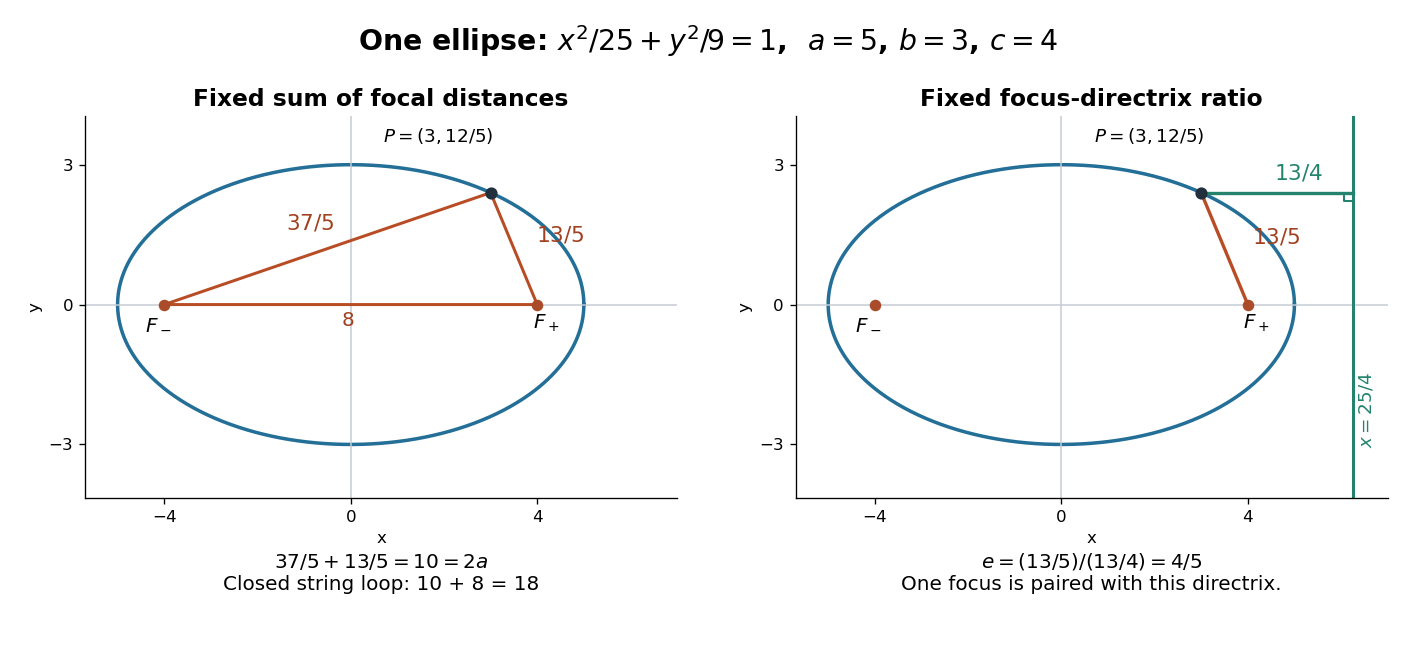

The constant sum can be turned into a construction. Fix a pin at each focus of a conic and pull a closed string loop taut with a pencil. In this example the segment between the pins has length , so a loop of length leaves for the two pencil-to-pin segments. Moving the pencil while keeping that loop taut traces the ellipse. This is a geometric prediction from the length constraint, not an assertion about a measured drawing.
The parametrization , maps the unit circle onto this ellipse. It makes plotting easy, but is an affine map rather than an isometry: horizontal and vertical lengths have different scale factors. An ellipse is not a circle under the original Euclidean metric merely because this map exists. Its two semiaxes and eccentricity of a conic retain the metric information lost by that equivalence.
A useful proof outline begins with . Isolate one square root, square, and then repeat; the resulting quadratic equation is . Since , the quantities isolated before squaring have the required signs, so the reverse implication introduces no extra branch. The condition is essential: at equality the focal-distance locus becomes the line segment between the foci of a conic.
Cyclic quadrilateral Created 2026-09-24 Updated 2026-10-14
A cyclic quadrilateral has all four vertices on one circle. Among quadrilaterals with fixed cyclically ordered side lengths, a cyclic quadrilateral has maximal area.
Planar isoperimetric inequality Created 2026-09-24 Updated 2026-10-14
This is the planar case of the isoperimetric inequality. Every bounded planar domain with a sufficiently regular boundary of length and area satisfiesEquality holds exactly for circular domains.
Unit disk Created 2026-09-24 Updated 2026-09-24
Borsuk conjecture Created 2026-09-24 Updated 2026-09-24
Triangular prism Created 2026-09-24 Updated 2026-11-05
A triangular prism is a prism whose two bases are congruent parallel triangles. One base is a translation of the other by a vector not parallel to its plane. Joining corresponding vertices of a polygon gives three parallelogram side faces, nine edge of a polyhedron segments and six vertices of a polyhedron.
The triangular prism is right when the translation vector is perpendicular to the base plane. Only in that case is it an orthogonal Cartesian product of a triangle with a line segment. An oblique triangular prism still has volume , where is its base area and the perpendicular separation of the base planes; equal parallel cross sections give this formula by integration.
Triangle Created 2026-09-24 Updated 2026-10-14
A triangle is the convex hull of three noncollinear points: the three vertices must not lie on one line. Its boundary consists of the three joining line segments; depending on context, "triangle" can mean this boundary or the filled region it encloses. Here a triangle's area refers to the filled region. The noncollinearity assumption excludes a collapsed shape with zero area, for which ordinary interior angles are not defined.
For example, the positions , and form a right triangle with a right angle at the origin. Taking the side of length as its base gives perpendicular height , so its area is . The height is measured at a right angle to the chosen base; it is not generally the length of another side. In this example it happens to be a side because the triangle is a right triangle.
By contrast, side lengths define a valid triangle: each side is shorter than the sum of the other two, as required by the strict triangle inequality. But , so this is not a right triangle and the Pythagorean theorem cannot calculate its longest side from the other two. The law of cosines instead gives the opposite interior angle throughThis example separates the definition of a triangle from the additional assumption of a right angle.
Every triangle in the Euclidean plane has interior angles summing to radians, a result proved in Euclid's Elements I.32.[ref] It lets two measured angles determine the third, and underlies the angle-angle criterion for similar triangles. The qualification "Euclidean plane" matters: the earlier spherical triangle demonstrates a different sum.
Sphere Created 2026-09-24 Updated 2026-09-24
Linear Diophantine equation Created 2026-09-24 Updated 2026-11-05
A linear Diophantine equation in two variables is with integer coefficients and unknown integers . Assume are not both zero, and put .
The linear Diophantine equation solvability criterion gives a solution exactly when : every integer linear combination is divisible by , and Bézout's identity supplies a combination equal to which can be multiplied by . The extended Euclidean algorithm constructs the coefficients. All solutions of a linear Diophantine equation then describes the complete one-parameter family when both coefficients are nonzero.
For example, has , and all its solutions are , with . There is no solution with both coordinates nonnegative, since those inequalities require and . Thus an integer-solvability test does not automatically settle a problem requiring nonnegative integers. If both coefficients are zero, the separate equation has every integer pair as a solution when , and none otherwise.
Quasi-steady-state approximation Created 2026-09-24 Updated 2026-11-05
When enzyme complexes relax much faster than substrate concentrations, the quasi-steady-state approximation sets the time derivatives of the fast complexes to zero and solves their algebraic balance equations.
It approximates the fast intermediate by a steady state balance without requiring the entire chemical system to be at equilibrium.
Michaelis-Menten equation Created 2026-09-24 Updated 2026-11-05
The Michaelis-Menten equation describes a saturating enzyme reaction rate:Here is free substrate concentration, is the limiting rate at large , and the Michaelis constant is the concentration giving .
For the elementary mechanism , use binding rate constant , dissociation rate constant and turnover number . The quasi-steady-state approximation sets the fast enzyme-substrate complex balance towhere is total enzyme concentration and . Solving givesThis modern steady-state derivation does not require substrate binding to be in chemical equilibrium. In particular, is not generally the binding dissociation constant.
At , ; at , the enzyme approaches saturation. The simple model assumes an appropriate timescale separation and negligible reverse product reaction; additional binding sites or inhibition can change the rate law.
L. Michaelis and Maud L. Menten investigated invertase acting on sucrose. They compared early reaction rates at different substrate concentrations using optical rotation, controlled temperature and acidity, and accounted for the separate optical change caused by sugar mutarotation. These controls helped distinguish catalytic conversion from changes in the measurement signal. [ref]
The Kinetics of Invertase Action by L. Michaelis and Maud L. Menten. English translation of the 1913 paper, printed pp. 1–3, experimental motivation and initial-rate measurements
There are unlisted articles, also show them or only show them.