
Polarized muon decay 2026-10-14
For a negative muon with rest-frame spin vector , the leading massless-electron distribution is , where . Its final-spin sum is . The spin vector is axial whereas the electron direction is polar, so their scalar product reverses under parity. Its occurrence demonstrates parity violation by the left-chiral weak charged current.
Derivative along a curve 2026-10-14
If is differentiable at the point of a differentiable parametric curve, the multivariable chain rule givesThe gradient supplies the local spatial rates; the velocity vector supplies the direction and rate of movement. Their dot product is the change in the sampled scalar field per unit parameter. If the parameter is time, this is a rate per unit time; a directional derivative per unit distance instead uses a unit vector.
Take and the unit circle path . Along the path,At , the gradient is , the velocity vector is , and their dot product is . The sampled value is and increases at rate one, even though one coordinate is decreasing. This is why a moving observation must combine every coordinate's contribution.
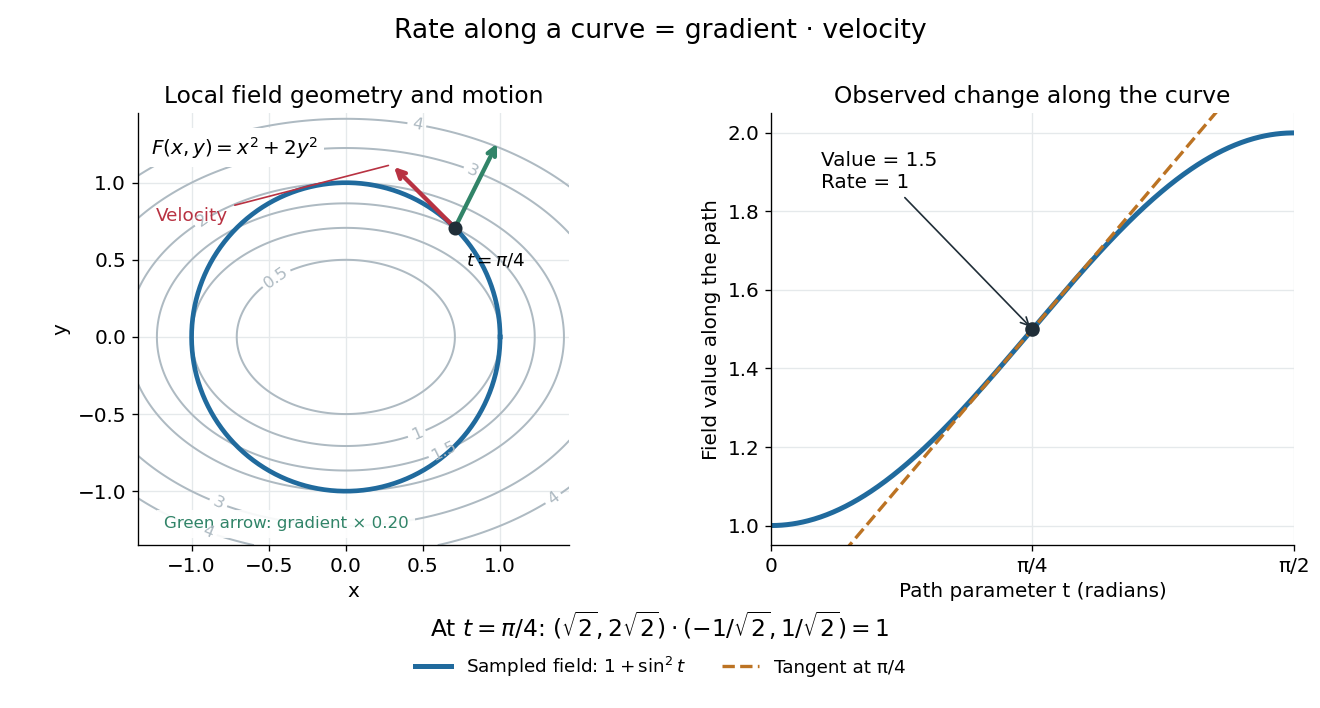

For a level curve, is constant, so the derivative along a curve is zero and its velocity vector is orthogonal to the gradient. Along other paths, the same formula combines a field's geometry with the observer's motion. [ref].
Double root 2026-10-14
A root of a polynomial is double when its multiplicity of a root is exactly two. Equivalently, with . A generic small perturbation splits it according to square-root splitting of a double polynomial root.
For independent multinomial distributions with fixed stratum totals and baseline logits , the sufficient statistics are the displayed response-specific design-weighted counts, . Expanding the log-likelihood gives , plus a data-only term. The Fisher-Neyman factorization theorem therefore proves sufficiency; with an unrestricted identifiable canonical parameter, a likelihood-ratio argument proves minimal sufficiency. Factor indicators give the corresponding response/covariate margins.
Continuation-ratio logits 2026-10-14
For ordered response categories, model each displayed conditional probability by a grouped-binomial logistic regression. The multinomial likelihood factors exactly into successive conditional binomial likelihoods, using the remaining category total as each stage's denominator. This is a different regression parameterization from baseline-category logits or cumulative odds. Separate cumulative binary indicators from the same person are dependent and cannot be treated as independent likelihood contributions.
Classical multidimensional scaling 2026-10-14
For a symmetric zero-diagonal dissimilarity matrix , square each entry to obtain and put . Take the eigenvectors of corresponding to its largest positive eigenvalues. Multiplying them by square roots of these eigenvalues gives coordinates. If contains Euclidean distances, is a centered Gram matrix, so retaining all positive eigenvalues reconstructs those distances exactly. Retaining fewer approximates the Gram matrix, not generally the sum of squared errors in raw distances. Negative eigenvalues signal failure of an exact Euclidean representation. Coordinates are unchanged in meaning by orthogonal transformations.
Morse oscillator 2026-10-14
The quantum Hamiltonian with kinetic energy and Morse potential has bound energies of the displayed form, where , and . Adjacent energy differences are , distinct and positive over the physical bound-level range. A finite truncation with nonzero adjacent dipole couplings therefore satisfies connected nondegenerate transition chain generates special unitary control. Controllability of such a truncation does not by itself prove controllability on the full space including dissociation states.
Morphism of finite type 2026-10-14
Kähler differential 2026-10-14
Fiber product of schemes 2026-10-14
Monotone test 2026-10-14
An upper-tail monotone test in a real statistic has rejection probability , with ; the constant tests correspond to infinite cutoffs. For a family with positive densities on a common support and a monotone likelihood ratio in , its power function can cross that of an arbitrary competing test only from below to above as the parameter increases. If and , choose a positive number between the ratios on opposite sides of the cutoff. The signs of and agree away from , and at a boundary with positive mass. Therefore . In particular strict positivity at propagates to . Positivity of the densities matters for this strict conclusion; with changing supports only a weak conclusion may remain.
For a family with a monotone likelihood ratio in , a prior density and cutoff , the posterior odds of against are nondecreasing in . To prove it, write the unnormalized masses as and . For , the difference is the double integral over of . Each integrand is nonnegative by the likelihood-ratio ordering. Common factors in the full-data likelihood cancel from the odds, so the same argument works when is a statistic rather than the complete observation. Interpret zero denominators by extended odds whenever the posterior is defined.
Transformation monoid 2026-10-14
A transformation monoid is a collection of self-maps of a fixed set that contains the identity function and is closed under function composition. The associative property comes from function composition. A monoid action describes transformations of a set that obey a monoid's multiplication and identity laws.
Rossby-wave PV mixing and zonal momentum 2026-10-14
In zonally averaged barotropic quasi-geostrophic approximation flow with zero mean meridional transport, the Taylor identity for quasi-geostrophic flux relates the meridional potential vorticity flux to the convergence of Reynolds stress. A local downgradient closure , with , therefore gives westward mean acceleration where the background gradient is positive. Rossby wave breaking can stir PV into fine filaments; coarse-graining or weak diffusion produces the inferred mixing. Globally the momentum-flux convergence integrates to boundary stresses, so localized westward changes need compensating transport or momentum changes elsewhere in an isolated system.
Semisimple moment-map equivariance 2026-10-14
For a semisimple Lie algebra, its nondegenerate Killing form turns a two-cocycle into an operator through . The cocycle identity makes a derivation. Choose by . Using and cyclicity of trace gives , so . Consequently is a coboundary. This proves that component Hamiltonians can be normalized to a Lie algebra homomorphism.
Suppose a symplectic Lie group action on a connected symplectic manifold has global component Hamiltonians and a common fixed point . Choose their constants linearly so . The difference has zero Hamiltonian vector field because fundamental fields and Hamiltonian fields have compatible Lie-bracket conventions; it is therefore constant. At , all fundamental fields vanish, so both terms in vanish. Thus everywhere and the Poisson brackets of the components reproduce the group Lie algebra. For a connected group this also yields coadjoint equivariance. A linear unitary action on a vector space has the origin as such a fixed point.
Module automorphism 2026-10-14
A module automorphism is an invertible module endomorphism. Equivalently, it is a bijective module homomorphism from a module to itself; its inverse is automatically a module homomorphism. They form a group under composition.
For with positive coefficients, linearize around using real amplitude and phase perturbations. Their two-by-two dispersion relation gives the displayed equation. The modulational instability band is , with maximum growth rate at .
Benjamin-Feir instability 2026-10-14
For the complex Ginzburg–Landau equation , the uniform oscillation has a neutral phase mode whose growth rate is . Negative phase diffusion therefore causes a long-wavelength modulational instability. The Benjamin-Feir stability condition is the complementary positive-diffusion condition. On a finite domain an unstable wavenumber must actually be allowed by the boundary conditions.
Weight-two discriminant root at level eleven 2026-10-14
The effective group is torsion-free, has index twelve and has two regular cusps. If its weight-two cusp form space is one-dimensional, any nonzero member has order one at each cusp and no interior zeros by the regular-cusp valence formula on a torsion-free modular curve. Its twelfth power and have the same weight and divisor. Their ratio is a holomorphic function without poles on the compactified modular curve, hence a nonzero constant. Normalizing the leading Fourier coefficient to one proves the displayed formula, with the holomorphic root chosen to start with . It equals .
There are unlisted articles, also show them or only show them.