
Subtract the first three values of the probability mass function of the Poisson distribution from one:
For a Poisson distribution with parameter , the probability mass function isand is zero at all other values. Its normalization follows from the exponential series .
Let count the ringed birds among the two captures, and let be the event that the detector records at least one ring. The hypergeometric distribution gives the prior probabilitiesUnder the usual additional assumption of independent per-ring detection, with no false records, the likelihoods are , , and . Therefore . Applying Bayes' theorem yields . Storing only the last detected number means that a stored record does not identify how many rings were present. By label symmetry, the identity of that stored ring does not further alter this distribution.
The text specifies each ring's marginal detection probability, but does not explicitly specify independence of the detection errors. To keep this modelling qualification visible, let . The marginal detection rate only implies . Without the extra independence assumption, the full family of possible posterior distributions isIn particular . The displayed numerical answer corresponds to ; the general answer exposes exactly what the detector's marginal specification alone establishes.
The two captures form a uniform ordered sample of distinct birds, that is, sampling without replacement. By exchangeability, each of the ten birds has the same chance of occupying the second position, so the probability is . Equivalently, conditioning on the first capture gives .
The finite-partition form of the law of total expectation statesBecause the events form a partition of a sample space of the sample space, pointwise. Multiply by and use linearity of expectation to obtainAn event of zero probability contributes zero to the middle expression and is omitted from the final expression, so no undefined conditional expectation is multiplied by zero.
Using the indicator random variable, sum over the values of the discrete random variable :Dividing by the positive probability proves . On the product vanishes, so no additional contribution is omitted.
For an integrable discrete random variable, the conditional expectation given an event of positive probability isThe sum ranges over the possible values of ; integrability ensures absolute convergence.
Set , so . Differentiate once and evaluate at , using , , :A second differentiation gives , henceThe derivatives of a probability generating function give and . Consequently . The earlier geometric tail bound from a uniform escape probability ensures the needed moments are finite.
Write . The initial possibilities are with probability , after which a fresh wait begins; with probability , after which a fresh wait begins; or with probability , which ends the experiment. Accounting for the flips already made in each case gives the probability generating function equationTherefore for . In particular, and there is no mass below two flips, as required.
Let be the expected additional flips when there is no immediately preceding tail, and the expectation when the preceding flip is a tail. A one-step first-step analysis givesSolving gives and . To justify finiteness before manipulating these expectations, split the flips into independent two-flip blocks. Each block has probability of being ; hence . This geometric tail bound from a uniform escape probability makes the expectation finite. The state is essential because successive possible pairs overlap: the waiting time is not itself a geometric distribution with parameter .
Write for a positive integer moment index. The moment isThis improper integral converges exactly when , namely . For those indices,At the divergence is logarithmic; for it is a power divergence. Thus, in the source's moment notation, the positive integers allowed are exactly . If , no positive integer moment is finite.
For , the cumulative distribution function is zero. For , integrate the normalized probability density function:It is continuous at , increases to one, and is the cumulative distribution function of the stated Pareto distribution.
Call the normalization constant to distinguish it from the moment index used later. A probability density function must have total integral one, soTherefore , the value denoted in the density. This is the Pareto distribution with scale and shape .
A small difference between successive secant method iterates alone does not certify a small absolute error. Instead use a residual root error bound. On ,and , so there is a unique root . For an iterate , the mean value theorem givesTherefore stop when and . This guarantees the desired absolute error in exact arithmetic; the evaluated residual of a root equation should include an allowance for its much smaller roundoff error. A safeguarded implementation can retain the bracket and use bisection if a proposed secant method step leaves it.
Use . Then , , and the secant method givesWriting , the next step isThus the requested approximation is to three significant figures. All intermediate logarithms should be retained at higher precision before this final rounding.
The secant method starts from two approximations . Replace the function near its zero of a function by the secant line through and ; the zero of that line is the next approximation:Stop immediately if ; otherwise the denominator must be nonzero. Each further step needs one new function evaluation and no derivative. There is no automatic bracketing or global convergence guarantee.[ref]
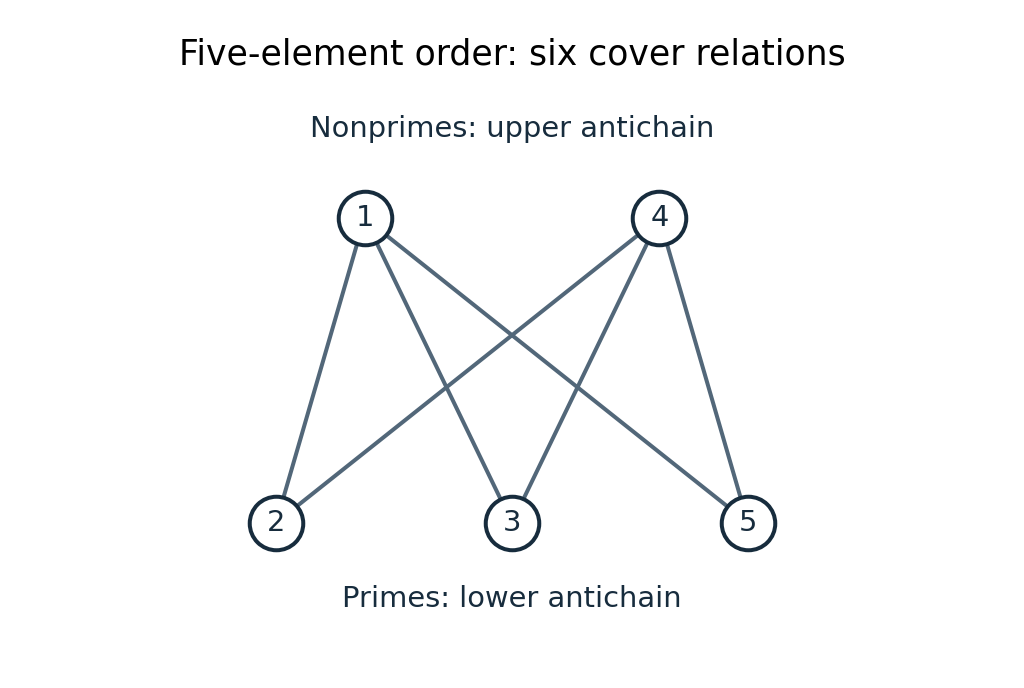
Write for the prime numbers in and for its nonprime elements. Since , both antichains have at least two elements: and . Every element of is below every element of . We can classify a subset by its intersection with these two levels of the two-level partial order.
- If , every element of is an upper bound. There is no maximum, because has no elements, and no least upper bound, because the distinct elements are incomparable minimal elements of .
- If with , its upper bounds are ; its maximum and least upper bound are both .
- If has at least two elements, its upper bounds are exactly . There is no maximum in and no least upper bound, because has at least two incomparable elements.
- If , its only upper bound is : no different element is above this nonprime element. Since every remaining element of is a prime number, belongs to and dominates all of it. Thus is both its maximum and its least upper bound.
- If contains at least two elements of , these distinct nonprime elements have no common upper bound, and has neither a maximum nor a least upper bound.
Consequently an upper bound exists exactly when ; a maximum or least upper bound exists exactly when or is a singleton subset of . The exhaustive cases also justify why the last two existence criteria coincide here.
The prime numbers form the lower antichain; the nonprime elements form the upper antichain. In particular, is not a prime number. Each lower element is below each upper element, and no third element can lie strictly between them. Therefore the six cover relations are , represented by the following Hasse diagram. Upward movement represents increasing order; crossing lines do not add elements.

False. On every odd positive integer , . Given any proposed Big O notation constant and threshold , choose an odd . Then , contradicting the required bound. The behavior on even integers cannot repair this failure on an unbounded subsequence.
There are unlisted articles, also show them or only show them.