
Under the specified evolution rule, conditional on the entire history, the next event's probability distribution depends only on the current population size. This is the time-homogeneous Markov property. Birth and immigration both increase the size by one, while death decreases it by one. Writing , the transition probabilities on areand all other entries are zero. In particular and . The row sum is . Every neighboring pair communicates, so this is an irreducible Markov chain, specifically a birth-death-immigration jump chain.
For the countable-state Markov chain ergodic theorem, let the Markov chain be irreducible and positive recurrent, with its unique stationary distribution . From any initial state, for every real satisfying ,In particular, almost surely. This time-average conclusion requires no aperiodicity.
The countable-state Markov chain convergence theorem adds the hypothesis of an aperiodic Markov chain and concludesIt also follows that for every initial probability distribution . For an irreducible recurrent chain, the occupation-frequency theorem can also be stated as a limit , interpreted as zero for a null recurrent state; in the positive recurrent case this equals .
The assumed identities are the detailed balance equations. Summing over and using the row sums of the transition matrix gives, for every ,All summands are nonnegative, so these countable sums are justified. Thusand is an invariant distribution.
A probability distribution on the countable state space is precisely a row vector satisfyingA transition matrix is a stochastic matrix, meaningEvery row therefore gives the conditional probability distribution of the next state given the present state. These conditions do not require to be an invariant distribution of .
First take integers . For independent copies of , defineThe two blocks involve disjoint families of independent random variables, so and are independent. The assumed strictly stable distribution gives , , andTherefore, on any fixed probability space carrying and an independent copy , their joint probability distribution givesNow fix an arbitrary and choose rationals tending to . Continuity of the real powers gives, on that fixed probability space,The left sides all have the probability distribution of . Since almost sure convergence implies convergence in distribution, their limit has that same probability distribution. HenceThis proves strict stability implies self-decomposability. The limit argument uses no moment-generating function or finite moments, which is essential for general stable distributions.
For independent and identically distributed random variables , the linear combination of independent normal random variables has expected value zero and variance . ThusThis is exactly the requested -stability. The paper's definition is a strictly stable distribution, since it allows no centering term.
For , integration gives for . For , the candidate remainder moment-generating function isThis is the moment-generating function of the mixture distributionConstruct it by taking an exponential random variable of rate and a Bernoulli random variable with , with mutually independent, and setting . Then is independent of , andon a neighborhood of zero. By the uniqueness theorem for moment-generating functions, , so the exponential distribution is a self-decomposable distribution.
Fix . Since , . Using independence of random variables and the Tonelli theorem for the positive exponential integrands gives the extended-real identityThe left side is finite and the first factor is finite and strictly positive. Consequently is finite andThe same reasoning applies to , so their moment-generating functions are finite and equal throughout . The uniqueness theorem for moment-generating functions yieldsThis proves uniqueness of a self-decomposition remainder while also checking the required finiteness; no independence between and is needed.
Fix and choose , independently of , with the normal distributionThe linear combination of independent normal random variables is normal. Its expected value is and its variance is . Hence for every , proving that every specified normal distribution is a self-decomposable distribution.
Under independence of random variables, the law of a random variable is the mixed probability distribution . For negative , only the uniform component can contribute to ; at zero the probability mass is included. Thus its cumulative distribution function isThe sketch consists of a horizontal segment at height zero before , a line of slope ending at the open point , a jump of size to the closed point , another line of slope ending at , and a horizontal segment thereafter. The cumulative distribution function is right-continuous at the jump.
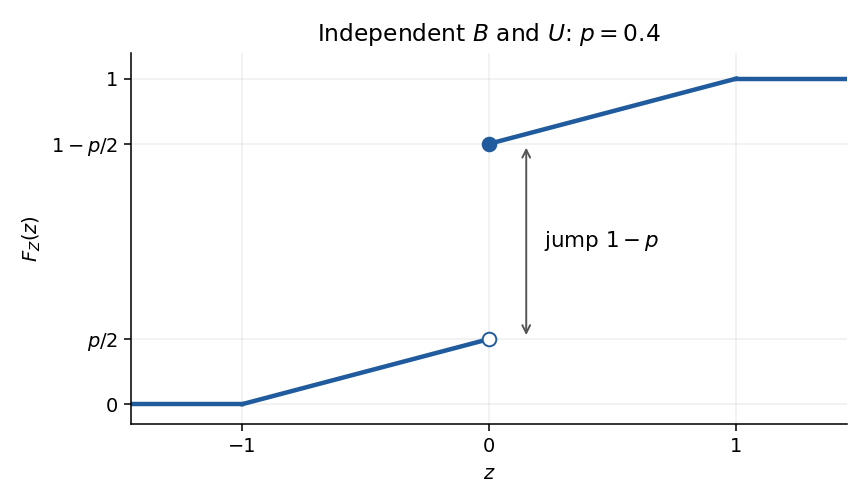
Cumulative distribution function of the independent Bernoulli-uniform product, illustrated at
. Details. 
Under the literal assumptions, write . The general answer is , so the continuous part of the sketch is undetermined. The jump at zero is still exactly , because . In the dependent counterexample from (ii), for , for , and for .
If and are independent random variables, conditioning on the Bernoulli random variable giveswith the continuous value . Indeed when , while the conditional probability distribution of given is the original uniform distribution.
Under the literal assumptions alone, the law of total expectation gives onlyThis is not determined by and . For an explicit counterexample, put and . Then has the required Bernoulli distribution, butwhich differs from the independent-case formula.
The uniform distribution has probability density function on . Therefore, for ,The value at zero follows either directly from the definition of the moment-generating function or by continuity. This answer needs no assumption about .
Taking logarithms of the product givesBy part (d)(i), in probability distribution, where has the exponential distribution of rate one. Thus and . The strong law of large numbers givesIf , choose . Eventually , so . If , choose ; eventually . ThereforeIn particular, the second range cannot have almost sure convergence to zero. This is the almost-sure growth rate of independent products. At the logarithmic limit is zero, which by itself decides neither behavior; that boundary case is not requested.
The inverse transformation of a random variable is , with absolute derivative . The condition becomes . The change of variables for probability densities givesEquivalently, has the exponential distribution of rate one. Applying a separate measurable transformation of a random variable to each independent preserves independence of random variables, so the are independent and identically distributed.
For , integration and independence of random variables giveBy the fractional moment criterion for convergence in probability,The parenthesized factor is less than one precisely when . This expression vanishes at and has derivative there. If , the derivative is negative, so some sufficiently small makes the factor strictly less than one. The bound then tends to zero geometrically, proving
If , then almost surely. Intersecting these events over all still gives an event of probability one. On it, , so the products have a finite nonnegative limit .
For every , the inclusion and part (c)(i) imply . Taking for positive integers proves almost surely. ThusThe monotonicity is the extra ingredient that upgrades convergence in probability to almost sure convergence here.
Direct integration of the uniform distribution yields and . The expectation of a product of independent random variables givesSubtracting the square of the expected value gives the variance:Since , Markov's inequality implies, for every ,Hence The first moment suffices: the variance need not tend to zero throughout this range.
The restriction is a finite Markov chain that is an irreducible Markov chain. It is aperiodic, because its upper states have self-transition probability , and the period is constant on a communicating class. We now find its stationary distribution.
Every column of sums to one. Here is the full incoming-mass check, with each total measured in units of . For , the incoming contributions are from and from the self-transition. For , they are from and from the self-transition.
For , the upward predecessor lies in exactly when , contributing units. When , that predecessor is replaced by resets from all states of , again contributing units. Independently, the downward predecessor contributes units when ; when , resets from the states of contribute those units instead. Thus every column total is units.
Therefore is a doubly stochastic matrix, and the uniform distribution on is stationary:The countable-state Markov chain convergence theorem, applied to the finite closed class , gives for every . Its hypotheses hold: is finite and irreducible, hence positive recurrent, and it is aperiodic.
If , the hitting time of has . If , the corresponding tail is . Thus almost surely from every exterior initial state. Conditioning on and , use convergence within after entrance and the bounded convergence theorem; equivalently, first restrict to and then let . This proves, for every ,The limiting distribution is independent of .
DefineAn interior jump cannot go below or above , and every exterior reset lands in . Thus is closed.
To prove that it is one communicating class, start anywhere in . From or , a reset can reach with positive probability. From any state of , repeated steps reach some state of , after staying in up to the last step. A reset from this state can reach every point of the consecutive blockEvery integer has the form for some and an integer . Repeated steps from reach , with all departure states in until a possible last step into . This gives access to all of . Finally, each can be reached from . Every path described has strictly positive probability. Therefore every state in reaches every other state in .
Each state outside can only stay put or reset into , and no transition from returns to it. Different states outside cannot reach one another. Hence the complete list of communicating classes isThe finite class is the unique closed communicating class. The exterior singleton classes are transient communicating classes, since their self-transition probabilities are strictly less than one. Notice that this reachability proof does not require to be coprime.
First identify the recurrence type, rather than infer an occupation limit from a one-time probability. At time , return to zero requires exactly upward steps. The binomial distribution giveswhere the last step is Stirling's approximation. At all other positive times the return probability is zero. Hence . The recurrence criterion by return probabilities proves the recurrent property; by the irreducible Markov chain property established in (i), every state is recurrent. The equivalence of positive recurrence and existence of a stationary distribution for an irreducible Markov chain on a countable state space, together with (iii), makes this chain null recurrent.
For completeness, the zero occupation proportion follows directly by treating returns as a renewal process. Let be successive strictly positive return-cycle lengths to zero. The Strong Markov property makes them independent and identically distributed, the recurrent property makes them finite almost surely, and the null recurrent property gives . For each positive integer , the strong law of large numbers applied to givesTake a common event of probability one for these countably many . By the monotone convergence theorem, the right side increases to infinity. Thus the number of completed return cycles by time , divided by , tends to zero. Counting the initial visit changes this ratio by at most . Consequently,The walk visits zero infinitely often, but the asymptotic fraction of time spent there is zero.
There are unlisted articles, also show them or only show them.