
The Fourier cosine series converges to the continuous even -periodic extension. If represents modulo , its value isIt has value zero at , rises linearly with distance from these points until height , and then stays flat until the next descending ramp. Thus the sketch on has minima at , and plateaux centred at the odd multiples of . Its large partial sums round the corners and closely follow the whole graph.
The Fourier sine series converges, away from the odd multiples of , to the odd -periodic extensionAt every odd multiple of its value is zero, the midpoint of the jump from to . At even multiples of it passes continuously through zero. Thus on every interval it has a negative plateau, a rising linear segment through , and a positive plateau. The jump size is .
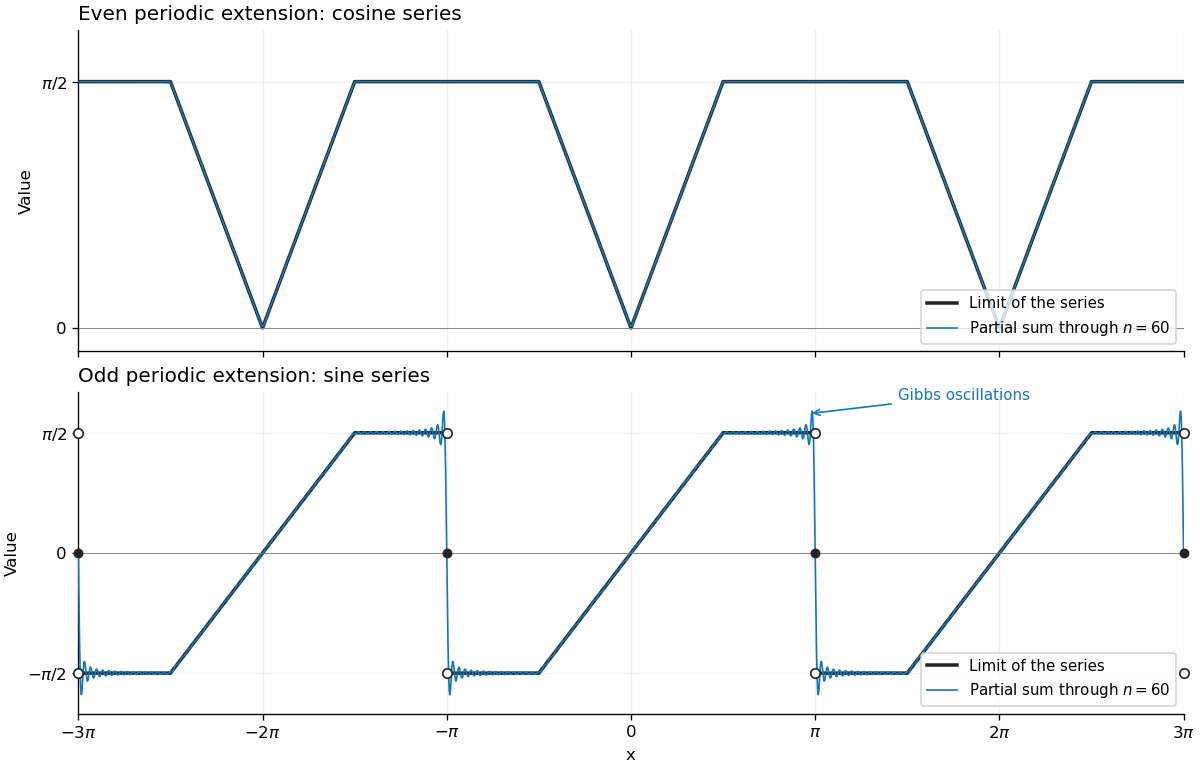
Periodic limits and 60-term Fourier partial sums
. Details. 
The blue curves are the partial sums through . The open endpoint circles and filled zero dots in the lower panel distinguish the one-sided limits from the value of the Fourier sine series at each jump. Near these jumps the partial sums exhibit the Gibbs phenomenon: the oscillations become concentrated in narrower regions as the number of terms grows, while their limiting overshoot remains about times the jump, here about .
Put . The constant Fourier coefficient isFor , integration by parts givesThe terms cancel. ThusThis Fourier cosine series has when is divisible by four, when , and when is odd.
Using the usual piecewise smooth interpretation of the derivative hypothesis, Dirichlet's theorem on Fourier series gives the average of the two one-sided limits of the appropriate periodic extension. The even extension is continuous at and at the identified endpoints , so the Fourier cosine series converges toFor the odd extension, the one-sided limits at zero are and , while at the periodic one-sided limits are and . Hence the Fourier sine series converges toAt an endpoint this equals precisely when is zero there. One can also see the zero endpoint values directly: every partial sum consists of sines that vanish at both endpoints.
For the Fourier cosine series, first take the even extension on , and then its -periodic extension. Evenness eliminates the sine terms. With the constant term written as , the Fourier coefficients and series areFor the Fourier sine series, take the odd extension for and for , and extend with period . Values assigned at isolated endpoints do not change the Fourier coefficients. Oddness eliminates the constant and cosine terms, leavingBoth formulas follow by orthogonality on and the parity of the extensions.
Parametrize the straight segment by , . Then the line integral isThe three different answers are possible because this vector field is not a conservative vector field; for example whereas .
For the parametric curve , , the vector field and the tangent vector areConsequently the line integral is
An orientation-preserving reparametrization has the form , where is an increasing, piecewise smooth change of parameter with , . For regular parametrizations one may take and its inverse continuously differentiable on each piece. The chain rule gives . The change of variables therefore yieldsThis proves reparametrization invariance of a vector line integral. If is decreasing, the endpoints in the final integral are reversed and the sign changes. Thus the same direction and the same multiplicity of traversal are essential.
For a continuous vector field along an oriented piecewise continuously differentiable parametric curve , define its line integral byadding the integrals over the smooth pieces when necessary. The value refers to the specified traversal: going around a curve twice counts twice.
The displayed vector field is defined on the punctured plane ; it is undefined at the origin. Take the counterclockwise unit circle , . Along it,By the fundamental theorem for line integrals, it has no single-valued potential of a conservative vector field on . In particular it cannot be the restriction of the gradient of a smooth function on all of .
For , direct differentiation givesThere is no contradiction with Green's theorem: is not defined, let alone continuously differentiable, throughout the disk enclosed by . On an annulus the theorem does apply; the counterclockwise outer integral is , and the clockwise inner integral is , so their sum is zero. The hole prevents this curl-free vector field from being a conservative vector field on its entire domain.
For an oriented piecewise smooth parametric curve and a continuous vector field along it, the vector-field line integral isFor a piecewise smooth curve, sum these integrals over its smooth pieces. The dot product selects the component of the vector field in the direction of motion.
If for a smooth function , the multivariable chain rule givesThe fundamental theorem of calculus, with cancellation at intermediate endpoints, therefore proves the fundamental theorem for line integrals:On a closed curve , so .
In polar coordinates, put and . Differentiating along the curve givesThe cardioid has and is traversed once counterclockwise as increases from to . Its cusp at causes no difficulty: split the line integral there, or exclude a small arc and take its limit. Thus signed area as a boundary integral gives
Let be a bounded planar region with a piecewise smooth, simple closed boundary , oriented counterclockwise, and let have continuous first partial derivatives on an open neighbourhood of its closure. Green's theorem states thatFor a region with holes, orient every boundary component with on its left: the outer component is counterclockwise and the inner components are clockwise.
Choose and . Their indicated partial derivatives differ by one, so the area isThis is signed area as a boundary integral; reversing the direction of changes the sign of the integral.
The gradient and constant Hessian matrix areAt , and . Hence one multivariable Newton iteration givesAt this point the gradient vanishes, so every subsequent iterate is . The one-step result follows because the gradient of a quadratic polynomial is affine and its linearization is exact. Since the leading principal minors of are and , it is a positive-definite matrix. Alternatively,directly proves that is the unique global minimum, with value .
For a twice continuously differentiable function , its gradient and Hessian matrix areA critical point solves . The Jacobian matrix of this vector equation is , so the multivariable Newton iteration isEquivalently when the Hessian matrix is invertible. Solving the linear system is the direct computational form. A critical point found in this way need not be a local minimum; its type requires a separate check.
Back-substitution in the Euclidean algorithm gives the Bezout identityMultiplying by five produces a particular solution . Since and are coprime integers, all solutions of the linear Diophantine equation areReplacing by gives the smaller equivalent starting solutionIndeed . Conversely, subtracting this solution from any other gives . Coprimality forces to divide , and then is the corresponding multiple of . This proves completeness of the family.
For a fixed attachment ratio , making the disc much heavier than the rod givesIf the disc is also small relative to the attachment distance, , its moment of inertia about its own center is negligible compared with . ThusThis is a simple pendulum with a point mass at the disc's center and effective length ; it is length only if . Even before the small-angle approximation, its equation tends to .
If is allowed to tend to zero together with the other parameters, the bare conditions and do not alone justify that reduction. The needed dominance conditions are , , and , so that the rod contributes negligible gravitational torque and moment of inertia, and the disc behaves as a point mass. They follow automatically in the combined limit with fixed .
The small-angle approximation reduces ii to , whereThe coefficient is positive, so the solution is simple harmonic motion, . Here is the angular frequency; the ordinary frequency and period are
The rod and disc contribute restoring torques and , respectively. Using i in the rotational equation of motion givesOnly the disc's center of mass enters its gravitational torque; its finite radius enters its moment of inertia. The formula is also regular at , although the source happens to exclude that value.
There are unlisted articles, also show them or only show them.