
The disc is rigidly attached, so its rotation axis is perpendicular to its face. Its moment of inertia about its center is : with surface mass density , an annulus of radius contributes , whose integral is . The parallel axis theorem adds at the pivot. Adding the rod's moment of inertia gives
With , one has . Since , ii proves boundedness. Write the positive rational number in lowest terms. The radius and its angular derivative repeat after . After such radial oscillations,so both the position and the radial and transverse velocities return to their initial values. The elapsed time iswhich is finite and positive because is bounded above and below by positive constants. Thus the motion is periodic. The orbit is a closed, generally self-intersecting rosette orbit, with radial oscillations during complete revolutions; for integral it has evenly spaced lobes around the origin. It never reaches the origin and is not a circular orbit.
The oscillatory numerator has amplitude . Therefore the reciprocal radius stays bounded away from zero exactly whenIn this case the radial bounds areFor completeness, the potential energy per unit mass is , and conservation of mechanical energy givesThis effective potential diverges positively at zero, has one minimum at , and tends to zero from below at infinity. Since the initial radial velocity is negative, the particle first reaches an inner turning point. If , the subsequent outward motion has no finite outer turning point and escapes. At equality the escape speed tends to zero, but the radius is still unbounded; infinity is approached only as time tends to infinity. HenceThe minimum of permits a circular orbit for other initial data, but the nonzero initial radial velocity here excludes that exceptional solution.
The initial transverse velocity gives . From , the initial conditions are and . DefineThe Binet equation becomes the constant-coefficient linear ordinary differential equationIts particular solution is . Applying the two initial conditions to the complementary solution givesThe physical branch is the connected range containing on which the right-hand side is positive. A zero corresponds to escape to infinite radius, rather than continuation to negative .
The rotation axis is . The distance of the generating function graph from this axis is , so a parametrization isThe surface of revolution therefore has equation : it is a circular elliptic paraboloid opening along the positive direction, with its vertex and its rim at excluded. Translating the axis does not change the surface area formula, soThe cancellation makes the improper integral finite at the vertex. Neither the missing vertex nor the missing boundary circle changes the surface area, and no cap is included.
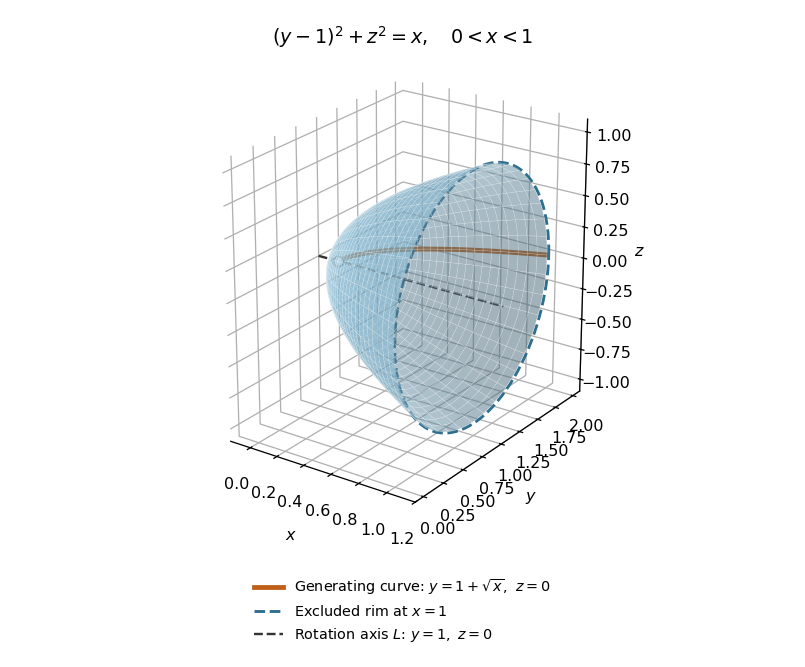
A parametrization of the surface of revolution isIts tangent vectors are orthogonal, with norms and . ThusThe absolute value is necessary if the function graph passes below the axis. The formula gives the curved surface area; it adds no end discs. Zeros of can be treated by splitting the integral into regular portions and taking limits.
Parametrize the function graph by . Its two tangent vectors are and . A small parameter rectangle maps, to first order, to a tangent parallelogram with area . Sincethe surface area of a graph isFor example, ensures a regular surface chart; more general domains can be handled by the corresponding convergent improper integral.
For the cardioid, . The expression under the square root simplifies toSince , the cosine is nonnegative. ThereforeThe upper half of the cardioid starts at , passes through , bends to negative , and ends at the cusp when . Its full upper-half arc length is ; reflecting gives for the full cardioid.
The fundamental theorem of calculus givesThis decreases from to zero, so the arc length increases fastest at , interpreted as the right-hand rate at the initial endpoint. If only positive endpoints are allowed, the rate has supremum as , rather than an attained interior maximum.
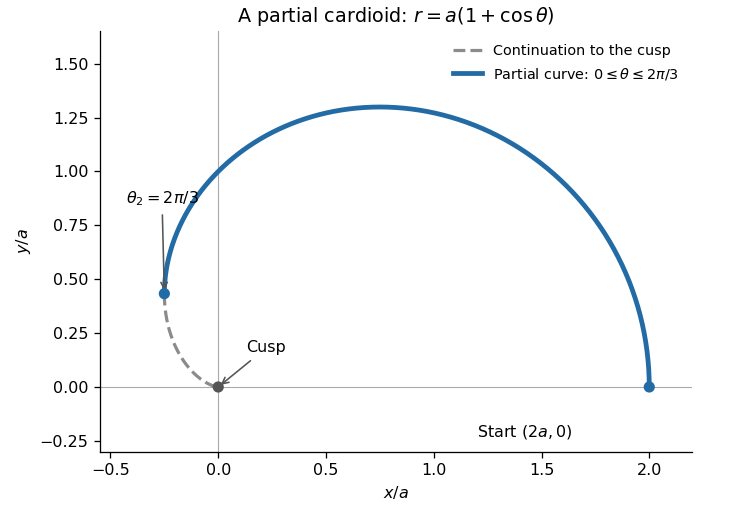


In polar coordinates, and . The product rule givesSquaring and adding cancels the mixed terms and gives . Hence the arc length is
For a piecewise continuously differentiable parametric curve, the arc length is the integral of speed:The Pythagorean theorem gives the length of an infinitesimal displacement as . Integration counts traversal length, including repeated portions if the parametrization retraces them. Piecewise continuous derivatives, or suitable absolute continuity, justify the formula; mere differentiability as stated in the source is not by itself the usual sufficient regularity hypothesis.
The vector triple product identity givesEliminate with iii to obtain the reciprocal basis involution:This formula actually holds without the unit-length assumptions. Under those assumptions it also says ; normalizing this cross product alone would lose the sign of and could return .
Apply the squared scalar triple product from cyclic cross products proved in c:Hence the reciprocal basis has scalar triple product , with its sign retained.
The cross product is perpendicular to both factors. ThusCyclic permutations give all the off-diagonal dot products between the original basis and its reciprocal basis.
Let . The scalar triple product is invariant under a cyclic permutation, so the definitions of the reciprocal basis give
The new score columns are orthogonal, since is diagonal. This decouples the slope normal equations; with positive eigenvalues and the stated error covariance, the two estimated score coefficients are uncorrelated. It also makes variance explained and possible dimension reduction explicit.
The trade-off is interpretation: each principal component is a mixture of the original variables, so its regression coefficient is less directly connected to changing one original input. Keeping both components is an invertible reparameterization and gives exactly the same fitted values and residual sum of squares. It does not repair a zero eigenvalue or remove instability associated with a very small one. Dropping a low-variance component may improve numerical stability and reduce estimator variance, but changes the model and can discard predictive information, since principal component analysis uses predictor variance rather than the response. This is the distinction between a full rotation and principal component regression with truncation.
Here both regressor columns are already centered, so and . Writing , the linear predictor is . ThusThe intercept stays , because centering made the transformation a rotation of the regressor columns without an added translation.
The principal component scores are the projections of centered observations onto the loading directions:If the symbol already denotes centered data, this simplifies to . The principal component loadings are directions; the principal component scores are coordinates of individual observations in those directions.
Let be the column-centered data matrix. Its sample covariance matrix is . The loadings matrix has orthonormal eigenvectors of as columns, ordered by nonincreasing eigenvalues:Each principal component loading specifies the coefficients of a principal direction in the original variables. Signs are arbitrary, and equal eigenvalues permit orthogonal changes of basis within their eigenspaces.
Principal component analysis finds orthogonal directions of greatest sample variation, ordered by the variance explained. It can summarize correlated variables, reveal lower-dimensional structure, and provide a reduced representation by retaining only the first few principal components. Centering is standard; scaling may also be appropriate when the variables have incomparable units.
There are unlisted articles, also show them or only show them.