At room temperature, electrons require quantum mechanics, including their occupied orbitals or bands and Fermi statistics. Heavy nuclei can often be treated as distinguishable particles near classical equilibrium lattice sites, because their exchange wavelengths are short. Their coupled displacements form phonons, however, and the occupation of a vibrational mode is classical only if kBT≫ℏω for that mode. Even at room temperature some high-frequency modes remain quantum mechanical.
At the electron overlap threshold, λe=d, the nuclear wavelength is about 7.0pm/A, far below the 0.3 nm spacing. Nuclear exchange effects are consequently much less important than electron exchange effects. This statement about nuclear overlap does not meanlattice vibrations are always classical.
Comparison with aconfinement length or interparticle spacing d gives the criterion T≲h2/(MkBd2). Numerical factors depend on the convention: the statistical thermal de Broglie wavelength is usually h/2πMkBT, while a three-component root-mean-squaremomentum introduces a factor 3. The question's specified one-component convention is used consistently here. Once degeneracy becomes important, classical equipartition itself ceases to describe the electrons accurately.
where bn is chosen so that Re encloses half the light. Classical bright elliptical galaxies are often approximated by the de Vaucouleurs's law case n=4, with b4≃7.67. Real ellipticals span a range of Sérsic indices, so R1/4 is not universal.
The integrated spectrum combines stars moving toward and away from us within the galaxy, broadening their absorption by Doppler shifts. Assuming instrumental and individual-stellar widths have been removed or are negligible, the line-of-sightvelocity dispersion is
AK-star-like integrated spectrum indicates that old or intermediate-age cool stars, often luminous red giants, dominate the observed optical/near-infraredlight. It suggests little ongoing formation of very luminous hot O and B stars. It does not imply that every star is K type: faint low-mass dwarfs and remnants can contribute substantial mass while contributing little light.
The simple radiative Kramers scaling estimates a luminosity contrast but does not uniquely identify one evolutionary state or predict a real subdwarf luminosity precisely. A similarly low-mass heliumwhite dwarf would be a cooling, degenerate object rather than the sustained high-temperaturehelium-burning configuration assumed here.
Use characteristic stellar values in the supplied radiative temperaturegradient: Tc/R∼κρL/(R2Tc3). Hence L∝Tc4R/(κρ). With Kramers opacity, κ=κ0ρTc−3.5,
with a structural coefficient independent of mass only under the homology assumption. As mass rises, radiation becomes increasingly important. A rough solar interior normalization of 10−3-10−2 suggests equality after a mass increase by tens, while realistic radiation-dominated structure and composition shift the scale; stars of order 102M⊙ are auseful estimate for strong radiationsupport. The very small photosphericratio must not be used asa universal normalization for their whole interiors.
A fully ionized, nonrelativistic monatomic gas has γ=5/3, provided gas rather than radiation or degeneracy dominates the thermal equation of state. It then obeys 2U+Ω=0 and E=U+Ω=−U=Ω/2.
Added nuclear heat initially raises pressure and causes expansion. The expansion makes gravitational energy less negative and can lower the temperature of the self-gravitating gas, reducing the temperature-sensitive fusion rate. Conversely, a small contraction can raise the core temperature and increase burning. This negative feedback explains stable main-sequence burning in an ordinary nondegenerate stellar core; a degenerate core need not respond the same way.
The effective adiabatic response varies with ionization, molecular dissociation, radiation pressure and degeneracy. Partial ionization can absorb compression energy and lower the local first adiabatic exponent below 4/3, encouraging compressibility, convection and pulsational instability. A local outer layer with γ≤4/3 does not by itself prove global collapse: ordinary stars have ionization layers of that kind. The dynamical stability criterion concerns a suitable pressure-weighted global response and its coupling to the eigenmode; an extended star with an effectively global exponent below 4/3 can be dynamically unstable.
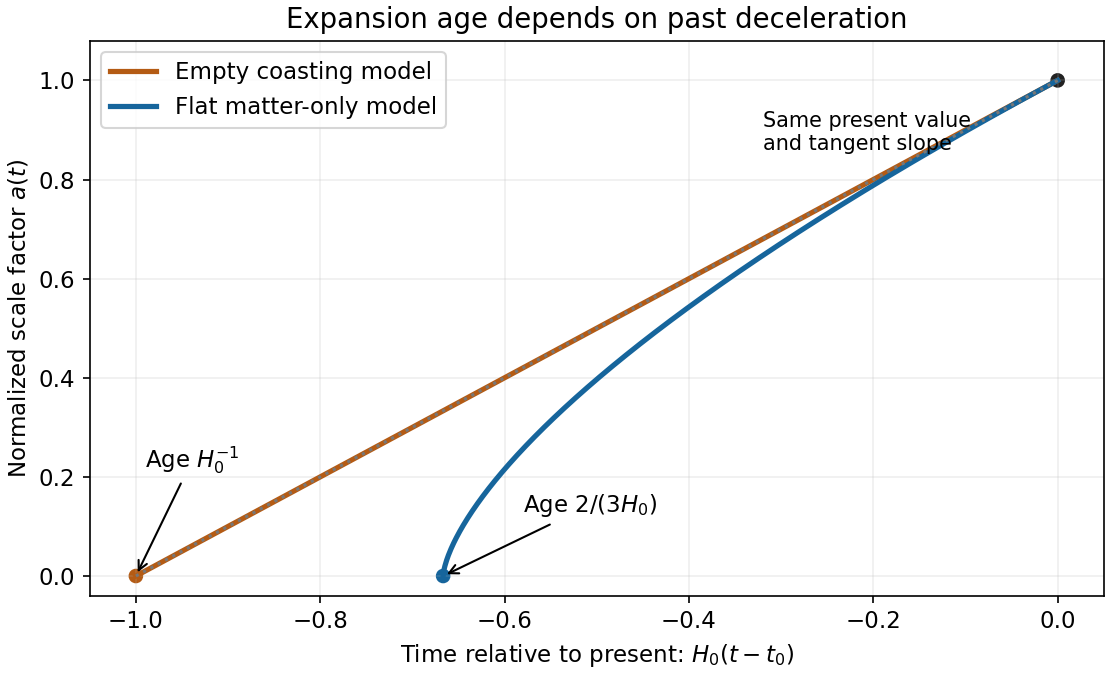
The elementary travel-distance estimate is ctrec≃8.4×10⁴ pc, whose corresponding comoving scale today is about 84 Mpc. In an expanding universe, however, that is not the exact proper particle-horizon radius. Integrating the null geodesic gives
for dust. Thus the proper horizon at this epoch is about 0.25 Mpc and its present comoving size about 250 Mpc. The factor three accounts for expansion during light propagation. These scales describe the limited causal domain in the simple decelerating model. The near-uniform CMB temperature across much more widely separated last-scattering regions motivates the horizon problem; the question's rough ct estimate and the exact dust horizon should not be conflated.
The source writes the dimensionless normalized factor as R in its final expression; this is equivalent to setting R0=1 consistently in the curvaturecoefficient. Evaluating today gives ΩM+Ωk+ΩΛ=1. Here the printed Λ already has dimensions of inverse time squared. If the cosmological constant is instead defined geometrically with inverse-length-squared units, replace this Λ by Λgeomc2.