
Krylov dimension from spectral components 2026-10-14
For a diagonalizable finite-dimensional operator, write with nonzero in distinct eigenspaces of eigenvalues . Then . The Vandermonde matrix of the first powers is invertible for distinct eigenvalues, so these powers span exactly the independent components . Thus the stabilized Krylov subspace dimension is . It counts distinct spectral components, not the number of nonzero coefficients in an arbitrary eigenbasis: , has Krylov dimension one. Equivalently it is the minimum number of eigenvectors needed when those vectors may be chosen freely.
Nonisomorphic colex shadow minimizers 2026-10-14
Minimum-shadow families need not be unique up to permutation. Four edges of a four-cycle and the first four pairs in colexicographic order both have four vertices in their lower shadow, but the latter graph has a triangle. For triples, the six sets consisting of two points from and one from have a nine-pair shadow. The initial six colex triples also have shadow size nine, but their point degrees are instead of .
Trace-preserving and unital Kraus conditions 2026-10-14
For a Kraus representation , trace preservation is equivalent to the first identity, by cyclicity of the trace. The second says , namely unitality, and is a distinct constraint. For , the amplitude damping channel has operators and and is trace-preserving but not unital. Taking the adjoints as Kraus operators instead gives a unital completely positive map whose output trace on is .
Spectral measure of a Koopman observable 2026-10-14
The finite positive measure representing an observable's autocorrelation sequence by the Bochner–Herglotz theorem. For a probability measure-preserving system, the Koopman operator is an isometry, so its forward autocorrelations, extended by complex conjugation to negative indices, form a positive-definite function on . The measure has mass , and its atoms are squared norms of projections onto Koopman operator eigenspaces, including for noninvertible transformations.
Kolmogorov two-thirds law 2026-10-14
The second-order longitudinal structure function has the displayed form in the idealized inertial range of Kolmogorov 1941 theory. It predicts that the typical longitudinal velocity increment grows as the cube root of separation. Unlike the Kolmogorov four-fifths law, its exponent and coefficient are not exact consequences of the Navier-Stokes equation.
A shared coin prevents a zero-one conclusion 2026-10-14
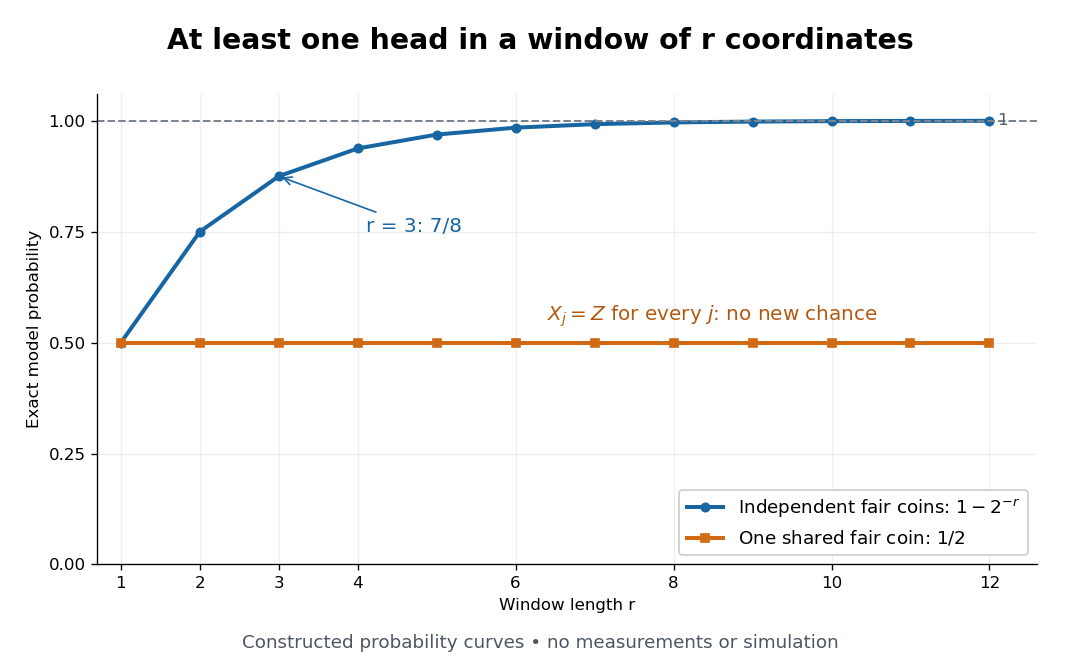
More independent trials increase the chance of a head; repeated copies of one coin do not
. Exact constructed probabilities for at least one head in a window of coordinates. The independent curve is and tends to one; the shared-coin curve stays at . These are calculations from the two specified probability measures, not measurements or simulated frequencies. Details.
Kolmogorov length scale 2026-10-14
The Kolmogorov length scale is the length among the Kolmogorov microscales. Kinematic viscosity and mean energy dissipation per unit mass give the displayed dimensional scale. The associated speed is , so the Reynolds number formed at this length is one.
The abelianization of a knot group is infinite cyclic. Nielsen changes of a two-generator free basis reduce its exponent vector to . In the cyclic-cover cellular chain complex, the first boundary is then , whose kernel is a free rank-one Laurent module. Quotienting by the lifted relator boundaries gives a cyclic module, regardless of the number of relators. A noncyclic Alexander module therefore obstructs every two-generator knot-group presentation.
The integer matrices and generate a discrete subgroup. For every nonzero integer , sends into , while sends , including infinity, into . The ping-pong lemma identifies their subgroup as the free product of two infinite cyclic groups. This separates the proof of discreteness from the proof of freeness.
Gaussian-integer parabolic construction 2026-10-14
For and a nonzero integer , the displayed determinant-one matrix has trace two and represents a nonidentity parabolic Möbius transformation fixing . Its fixed-point equation is . These parabolic fixed points are dense in the Riemann sphere, proving that the Gaussian-integer determinant-one Kleinian group has full limit set.
Limit set of a Kleinian group 2026-10-14
For a discrete isometry group of hyperbolic space, its limit set is the boundary accumulation set of one interior orbit. All interior base points give the same set: corresponding orbit points stay a fixed hyperbolic distance apart, and bounded-distance sequences approaching the boundary have the same endpoint. This definition does not require finite generation.
Non-elementary Kleinian group 2026-10-14
A Kleinian group whose Kleinian limit set contains at least three points. A discrete group fixing a common boundary point has at most two limit points and is therefore elementary.
A nontrivial finite-order elliptic Möbius transformation fixes an axis in hyperbolic space. The quotient metric has cone angle along that axis for a stabilizer of order , so it is locally an orbifold metric rather than a smooth hyperbolic-manifold metric. The underlying topological quotient may nevertheless be a manifold.
A divergent sequence of Möbius transformations has a subsequence converging uniformly on compact subsets of the Riemann sphere outside one exceptional point to a constant. Represent the transformations by determinant-one matrices and divide each by its matrix norm. A convergent subsequence has a nonzero rank-one limit: its determinant tends to zero because the original norms tend to infinity. The kernel line is the exceptional point, and the image line is the constant limit. This converts the limit set of a Kleinian group into a tractable boundary dynamics problem.
Schottky group 2026-10-14
A Schottky group is a free, discrete group of Möbius transformations constructed by pairing disjoint Jordan curves on the Riemann sphere, taking the exterior of one bounded disk to the interior of its partner. For round circles it is classical. Strictly separated defining disks give a Cantor set as the limit set of a Kleinian group. The tangent-disk extension permits parabolic elements and is often called a noded or T-Schottky group; its Kleinian limit set need not be a Cantor set.
Jørgensen's inequality 2026-10-14
For a non-elementary discrete subgroup generated by , the displayed inequality is a necessary trace constraint. Failure of it proves nondiscreteness when non-elementarity has independently been checked. It is not a sufficient condition for discreteness and must not be applied to an elementary pair without its hypothesis.
Gaussian Bianchi group 2026-10-14
The Gaussian Bianchi group is the Kleinian group of determinant-one two-by-two matrices over the Gaussian integers, modulo . Its matrix entries lie in a discrete subring of , so it is a discrete subgroup of . The Borromean link group is a torsion-free subgroup of index 24.
The valence formula for the modular group shows that has no zeros in the half-plane. For every , the weight-twelve form has total weighted zero order one. At its sole zero is the order-three zero at the cubic elliptic orbit; at its sole zero is the order-two zero at the quadratic elliptic orbit. Otherwise it has one simple ordinary zero orbit. Thus each value of the Klein j-invariant occurs on exactly one modular orbit and classifies one homothety of complex lattices.
Hindered-settling flux inflection 2026-10-14
For hindered settling with normalized particle volume fraction , upward coordinate and downward isolated settling velocity magnitude , the scalar conservation law has conservation law flux . For , its convexity changes at when this lies in the physical interval. This change distinguishes spreading rarefaction waves from compressing characteristic curves; a flux with an inflection can produce both a shock wave and a rarefaction wave in one transition. At the flux is linear and the profile simply translates.
Flat-top kernel for density estimation 2026-10-14
Choose a real even smooth compactly supported Fourier transform equal to one near zero and let be its inverse Fourier transform. Repeated integration by parts makes a Schwartz function. It is real, integrable and square-integrable, with unit integral. Moment differentiation of the Fourier transform gives for every positive integer . Such a kernel for density estimation therefore satisfies arbitrary finite-order moment cancellation, and necessarily takes negative values. If the transform plateau contains the frequency support of a bandlimited function , the convolution theorem proves .
There are unlisted articles, also show them or only show them.