
Compact isospectral sets of closed surfaces 2026-10-14
For a fixed closed orientable Riemannian surface, the smooth metrics with a specified scalar Laplace-Beltrami operator spectrum form a compact set modulo diffeomorphisms, in the smooth topology. This is a compactness assertion, not uniqueness or finiteness of the number of Riemannian isometry classes. It restricts geometric degeneration within an isospectral set and uses more information than the leading heat invariants alone. The theorem was established in the 1988 compactness paper.
A finite group of Euclidean isometries has a common fixed point: average any orbit. Each isometry is an affine map and therefore preserves this finite affine average; applying a group element merely permutes the orbit terms. To see that an isometry is affine, subtract its value at zero and use the polarization identity to show that the resulting map preserves inner products. Images of a standard orthonormal basis then determine a linear orthogonal map.
Myers-Steenrod theorem 2026-10-14
The isometry group of a smooth connected Riemannian manifold is a finite-dimensional Lie group, and its action is smooth. An isometry is determined by its value and derivative at one point, since it preserves the exponential map and continuation along geodesics. The stabilizer embeds in , giving dimension at most . For a compact manifold the isometry group is compact.
Isometry group of a Riemannian quotient 2026-10-14
For a complete simply connected Riemannian manifold and a free properly discontinuous deck group , each isometry of lifts to an isometry of normalizing . Conversely such a normalizing isometry descends; two lifts differ by a deck transformation. This proves the formula, including orientation-reversing isometries if the full normalizer is used.
Isometry dimensions in dimension three 2026-10-14
For a connected three-dimensional Riemannian manifold, the Myers-Steenrod theorem bounds the dimension of its isometry group by six. Dimension five cannot occur: isotropy embeds in , whose Lie subalgebras have dimensions zero, one or three. A five-dimensional action would require three-dimensional isotropy and a two-dimensional orbit; full rotational isotropy has no invariant tangent two-plane. The maximal dimension six forces transitivity and isotropy, hence constant sectional curvature. Each of the six listed dimensions is attained by a suitable metric.
A finite group of orientation-preserving isometries of the Euclidean plane or hyperbolic plane is a cyclic group. Take one orbit and its unique minimum-radius enclosing disc. Every group element preserves the orbit and therefore the disc's centre. The orientation-preserving stabilizer of a point acts as planar rotations, so the group embeds in the circle group. In a nontrivial finite subgroup, the least positive rotation angle generates all angles by division with remainder, proving cyclicity. Orientation reversal changes the conclusion: reflection groups need not be cyclic.
Error-function isobaric cooling front 2026-10-14
For conductivity , no cooling in the hot phase and a zero-temperature boundary at , the mass-coordinate equation is linear diffusion. Its similarity profile solves , , , giving the displayed error function. The thermal layer broadens as the square root of time. Conducted energy enters the cold radiating reservoir at rate per area , hence .
Frobenius-Schur indicator 2026-10-14
For an irreducible complex character of a representation, the indicator is for real type, for quaternionic type and for complex type, the latter meaning . It detects the invariant bilinear form on an irreducible representation. For an odd-order group, squaring permutes its elements, so every nontrivial irreducible character has indicator zero by character orthogonality.
Partition regularity of IP sets 2026-10-14
Every finite coloring of an IP set has a color class that is an IP set. Here is a reduction to the ordinary Hindman theorem. Given in the original set, color an integer by the color of , where the support consists of positions of its nonzero digits in the binary expansion. The Hindman theorem produces with monochromatic . Replace the by consecutive, disjoint finite block sums with separated binary supports: after a block has been chosen, take above all previously used positions; two of partial sums of a fresh tail agree modulo , so their positive difference supplies the next block sum divisible by . Now binary addition of distinct has no carries. Therefore generates a monochromatic finite-sums set in the original IP set.
IP-star set 2026-10-14
Let be the union of integer intervals for . Every nonempty sum of distinct has largest summand and lies in , since the sum of all smaller summands is . Thus . Doubling gives . Both sides are IP sets. Each can be adjoined to the IP-star filter while preserving the finite intersection property, yielding two distinct IP ultrafilters.
Burgers Riemann problem with positive flux 2026-10-14
Consider the Riemann problem on with initial condition for and for . No endpoint boundary conditions are imposed. When , its entropy solution is a shock wave with constant speed . In the original example , , the Rankine-Hugoniot condition givesThe left characteristic speed is and the right characteristic speed is , so : both sides enter the entropy shock. The Viscous Burgers travelling shock gives an exact smooth family tending to this solution.
Reversing the states to , still gives a Rankine-Hugoniot condition speed of , but now characteristic curves move away from the discontinuity. That expansion jump is a weak solution and fails entropy admissibility. For general , the selected entropy solution is the continuous self-similar solutionThis rarefaction wave fills the expanding gap between the two exterior characteristic curves. Inside its fan, and , verifying the Inviscid Burgers equation; its values agree continuously with both exterior states. For to , the fan occupies . If , the solution is constant.[ref]
Burgers' equation. Rarefaction wave, full piecewise solution; expansion-shock example; The entropy condition
Burgers characteristic breaking 2026-10-14
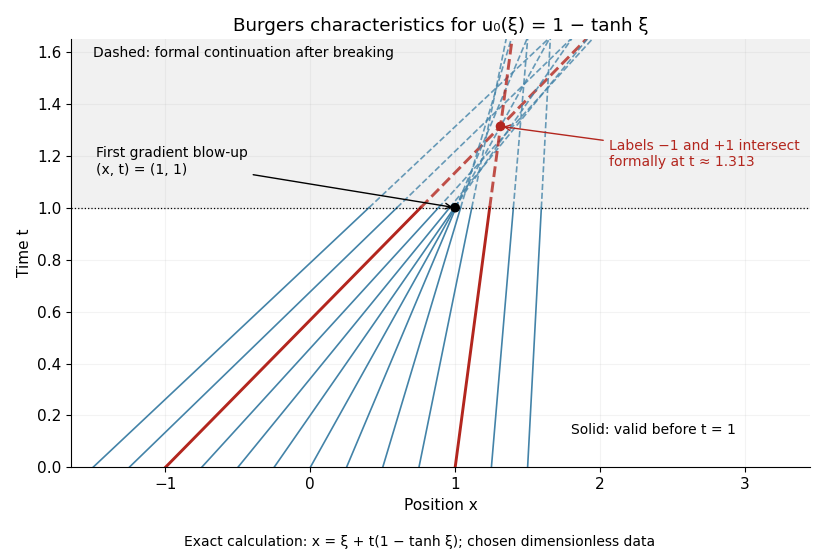
Before characteristic crossing, the method of characteristics for the Inviscid Burgers equation transports each initial value without changing it:Here labels the starting position. Suppose is a bounded continuously differentiable function with bounded derivative. As long as for every label, the characteristic flow map is invertible and differentiating it gives the displayed formula for .[ref]
If the negative minimum is attained, the first breaking time is . Two labels with have formal intersection timeTheir neighboring-label limit explains why the most negative initial slope breaks first. As , the amplitude remains bounded but diverges: this is gradient blow-up. Continuing intersecting lines would assign incompatible values at one position; the post-breaking entropy solution instead uses shock waves. Nondecreasing data have no forward characteristic crossing by this mechanism.
For a concrete calculation in dimensionless quantities on the infinite line, choose , with limiting states and . Then has minimum at , so and the breaking point is . Along the central characteristic curve , and before breaking. The labels give intersecting formal lines at , after the classical solution has already broken.
Base change of invertible modules 2026-10-14
For a ring homomorphism , extension of scalars takes an invertible module to an invertible -module. A direct-summand presentation in a finite free module remains a direct-summand presentation after tensoring. At a prime contracting to , localization gives . Compatibility with tensor products, identities and composition makes the Picard group of a ring a covariant functor.
Inverse Gaussian sum closure 2026-10-14
In the parametrization with density proportional to , the Inverse Gaussian distribution has cumulant-generating function . For independent copies, the average has this same family with parameters , while the sum has parameters . These assertions follow by multiplying moment-generating functions and scaling the density. The more usual mean parameter is , so the sum has mean and shape .
For the Inverse Gaussian distribution parametrized by shape and mean , the joint maximum-likelihood estimators are and . With known , the shape estimator is instead . Parameter orthogonality gives the same Wald test formula in both fits. The two estimators differ by under regular model sampling, so the test statistics agree to first order under the null; they need not be numerically equal in finite samples.
Let . The identityand completing the square give, when the current boundary integral vanishes,For flux , the lower bound is , saturated by the two first-order Bogomolny equations. Division by is interpreted in the finite-energy sense at its zeros.
Write away from its zeros and use the oriented planar Hodge star with . The first Bogomolny equation gives . A zero of multiplicity contributes and phase winding . Combining the smooth magnetic field with these delta sources gives the displayed equation and the topological boundary condition . Prescribed zero positions and multiplicities reduce multi-vortex construction to this scalar elliptic problem; a regular solution reconstructs both smooth fields.
Geodesics on a circular cylinder 2026-10-14
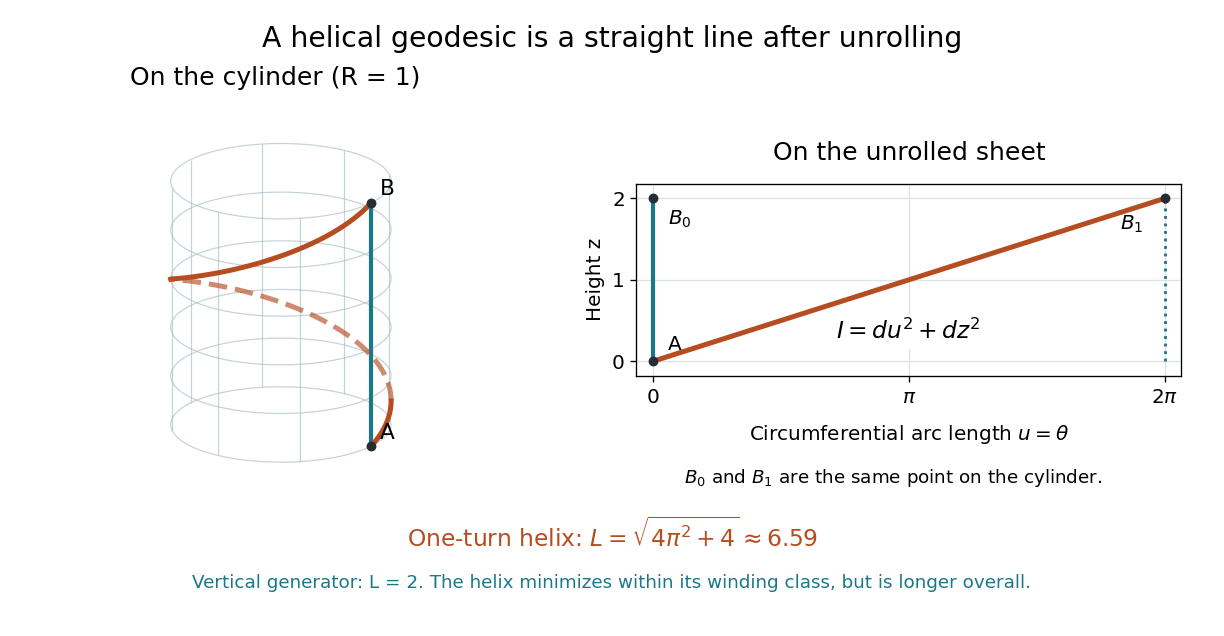
In coordinates on a circular cylinder of radius , the induced metric is . Its coefficients are constant, so the Christoffel symbols vanish and the affinely parametrized geodesic equation is . The nonconstant solutions are generators when , circular parallels when , and helices when both are nonzero. Unrolling the cylinder with coordinate makes all these curves straight lines in the Euclidean metric. Unit-speed parametrization additionally requires .
For a worked helix on a circular cylinder of radius , choose for . Unrolling gives the straight segment , so its arc length is . Its acceleration in space points normally to the surface, consistent with the geodesic equation.
This geodesic is not globally shortest between its endpoints: they share the same angular position, and the vertical generator has length . The helix minimizes length among paths with the same endpoints and one full winding, because their unrolled lifts join to . In general, geodesics minimize sufficiently short subarcs; changing winding can produce a shorter route. Keeping this local/global distinction makes unrolling useful without mistaking every straight lift for an unrestricted shortest path.


For , an intersection inside a disk requires at least two lines to meet that disk. The latter count is Poisson with mean , giving the non-strict bound first. It is strict because two lines with nearby normal angles but separated perpendicular distances can both hit the disk while intersecting outside. Choose two positive-measure parameter boxes forcing this configuration; the event of exactly one line in each box and no other disk-hitting line has positive probability. This also yields a void probability too large to equal that of a Poisson point process with the intersection process's intensity measure.
There are unlisted articles, also show them or only show them.