
This quartic has no primitive integral solution. If , reduction modulo five makes , impossible. If , coprimality gives and ; dividing by twenty-five then gives , again impossible. It excludes the square class two in two-isogeny descent on . The point supplies class five, so the subgroup property excludes class ten as well.
For , the two-isogeny descent classes and have no rational covering points. Their primitive integral quartics are respectively and , with .
For the first equation, reduction modulo forces and , since is not a square modulo and a nonzero fourth power is . Put . Dividing by gives , again a nonsquare modulo because . For the second equation, a primitive pair has nonzero modulo : it is or . The right side has five-adic valuation exactly , impossible for a square. Since lies on , its square-class image is exactly . Combined with the rank bound for a prime congruent-number elliptic curve computation, the two-isogeny rank formula yields rank exactly for .
For with and , the square class in a two-isogeny descent would require coprime integers and an integer with . If is odd and even, the right side is modulo ; if is even and odd, it is ; if both are odd, it is . None is a square modulo . Therefore does not occur in the two-torsion square-class homomorphism image.
This quartic covering in a two-isogeny descent has no solution with coprime integers not both zero. If precisely one is odd, the right side is modulo four. If both are odd, their fourth powers are one modulo sixteen and modulo sixteen, so the right side is twelve modulo sixteen. Neither residue is a square. Coprimality excludes the remaining parity case. Consequently the negative unit square class is absent from the two-torsion square-class homomorphism for .
The continuous functional calculus of a bounded normal operator is a representation of , with . The Riesz-Markov-Kakutani representation theorem represents by a positive regular measure . The assignment is isometric for the norm, and extends to a unitary map onto the closed cyclic subspace it generates. Multiplication by and represent and . Orthogonal decomposition into cyclic reducing subspaces, allowing an uncountable family, constructs the Borel functional calculus for a normal operator without requiring separability.
With beta numbers, the staircase has set . Lowering a bead by a positive even number either hits an occupied bead or a negative position, so no even-size rim hook can be removed. The adjoint of multiplication by under the Hall inner product of symmetric functions is . The power-sum border-strip multiplication formula therefore gives zero derivative with respect to every even power sum. Since the rational symmetric-function algebra is freely generated by the power sums, the stated conclusion follows.
Good-letter matching in a tableau word 2026-10-14
Read a word of type from the left. Every is good; an is good when the number of previous good 's exceeds the number of previous good 's. The set contains words with at least good 's for each . Their matched chains yield independent marked-column polytabloids; column antisymmetrization and the add-or-raise recursion give over every field.
If a projective complete intersection is cut out by a homogeneous regular sequence of degrees , then and . The classes of the defining equations form the conormal basis: the first syzygies of a regular sequence are the Koszul complex relations, whose coefficients vanish modulo the defining ideal. Thus the generator classes have no residual linear relations. Dualizing gives the stated normal sheaf.
Pieri rule Created 2026-10-14 Updated 2026-11-05
In the induction ring of ordinary symmetric-group characters, is the sum, with multiplicity one, of for which is a horizontal strip of cells. Here is the trivial representation of . In the Littlewood–Richardson rule, content means every skew entry is ; strict column increase is possible exactly when there is at most one new cell in every column. This proves the rule.
Littlewood–Richardson coefficient Created 2026-10-14 Updated 2026-11-05
The nonnegative integer is the multiplicity of in in characteristic zero. The Littlewood–Richardson rule counts it by Semistandard Young tableaux of skew shape , content , and lattice word in right-to-left, top-to-bottom reading order. For example : the two new top cells must be ones, and the remaining reading letters can be . This coefficient also multiplies Schur functions in the induction ring of symmetric-group characters.
Generating series of the Kostant partition function Created 2026-10-14 Updated 2026-11-05
The Kostant partition function counts nonnegative integer combinations of the positive roots of a root system, without ordering the summands. Multiply the formal geometric series for every positive root. The coefficient of counts precisely these combinations. Every coefficient is finite because a linear functional strictly positive on the positive roots bounds every participating integer coefficient. The sign of each exponent in the cancelling product must agree with that of this series.
Let be positive and a closed smooth hypersurface in a complex torus. The semipositive canonical bundle of a submanifold of a complex torus makes positive. Since , the restriction of the -th ambient twist is when . Apply the Kodaira vanishing theorem on , and use and its long exact sequence to induct from the positive bundle on the torus. No unproved ambient positivity of is needed.
Killing-normalized SU(2) quadratic Casimir 2026-10-14
With Hermitian angular-momentum generators , the Killing form is and its inverse contraction is . Equivalently the anti-Hermitian basis has Killing form and gives the same operator. In the complex highest-weight basis, . It acts on spin by , so it differs in normalization from the usual angular-momentum quadratic Casimir operator.
Latent heat from a vapor-pressure slope Created 2026-10-14 Updated 2026-10-20
Within the ideal-vapor Clausius-Clapeyron approximation, a local slope of the natural logarithm of saturation pressure against inverse temperature estimates the molar latent heat:In the stipulated vapor-pressure calculation, the slope is , which recovers . For variable , a two-point estimate gives an average weighted by , rather than the latent heat at an arbitrary midpoint. Differentiating noisy pressure measurements amplifies their errors. Outside the ideal-vapor regime, use independently determined molar volumes in ; a straight-looking graph alone cannot establish that the gas is ideal.
Stipulated vapor-pressure calculation Created 2026-10-14 Updated 2026-10-20
Consider an unnamed model substance with molar latent heat and saturation pressure at . Stipulate the ideal-vapor Clausius-Clapeyron approximation throughout , constant , and . These parameters define an illustrative model, not a measured dataset or a fit to water. At ,At the reference state the gas molar volume is , and the local slope is . The tangent estimate is much lower than the integrated result: a local derivative should not be extrapolated over this whole interval. By contrast, over a small temperature increment, the fractional sensitivity is .
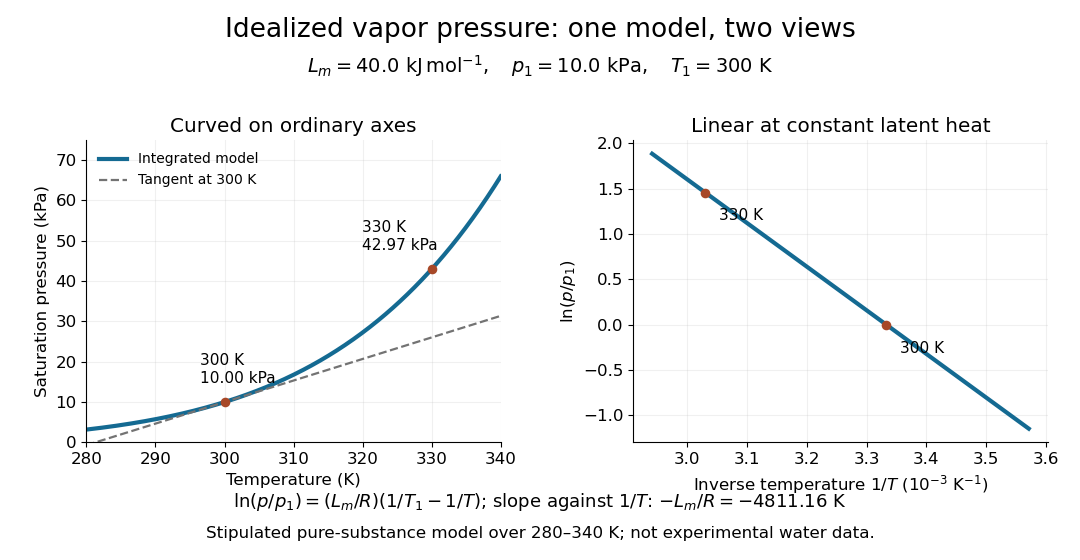
Stipulated saturation pressure versus temperature and its linear logarithm versus inverse temperature
. Details. 
Coordinate-integral primitive on a polydisc 2026-10-14
For a closed holomorphic one-form on a polydisc, the displayed coordinate-path integral is a holomorphic function. Differentiating in gives the endpoint term; for use and integrate that derivative. The resulting sum telescopes to . Thus , giving an explicit degree-one proof of the holomorphic Poincaré lemma.
Additivity of analytic divisor line bundles 2026-10-14
If and are local meromorphic equations for two divisors on a complex manifold, then defines their sum. With local frames satisfying , the transition functions of a vector bundle for the tensor product are the products of the two ratios, exactly those for . Multiplication of local frames therefore gives the displayed holomorphic line bundle isomorphism.
For reduced local equations with a holomorphic unit, the holomorphic line bundle associated to a divisor has local generators and transition . Differentiation along gives . Sending the restricted local generator to gives the conormal isomorphism. The term disappears only after restricting to .
For a root reflection on the weight lattice, with . A finite anti-invariant element of the group ring of a weight lattice is a sum of terms ; fixed weights have zero coefficient. Each pair is divisible by , because is divisible by in for every integer . Thus the quotient has finite support.
The formal expression is interpreted coefficientwise. Along each coset of , only finitely many coefficients of are nonzero and their total is zero by reflection anti-invariance. Partial coefficient sums therefore vanish before and after that finite interval. The result has finite support, even though the individual summands do not eventually vanish.
// Target: lie-algebra.bigb
Ordinary reduction of an elliptic curve 2026-10-14
A good reduction in characteristic is ordinary when the geometric -torsion has points, equivalently its formal group of an elliptic curve has height one. For a CM elliptic curve, a good prime split in its CM field is ordinary. One of the two roots of is a -adic unit, enabling the bounded ordinary p-adic L-function.
There are unlisted articles, also show them or only show them.