
Spintronics Created 2026-10-18 Updated 2026-11-05
Spintronics uses electron spin and spin-dependent transport in electronic materials and devices. In a magnetic multilayer, the relative magnetization directions can change resistance because electrons of different spin scatter differently. Giant magnetoresistance and tunnel magnetoresistance turn this dependence into electrical readout. Spin accumulation instead describes a nonequilibrium imbalance of spin populations. The field connects quantum angular momentum to transport and information storage; spin polarization need not imply that the entire material is a permanent magnet.[ref]
Nobel Lecture: Origin, development, and future of spintronics by Albert Fert. discussion of spin-dependent conduction and giant magnetoresistance
Coaxial cable Created 2026-10-18 Updated 2026-11-05
A coaxial cable has an inner conductor surrounded by a concentric outer conductor, with dielectric between them. In the ideal homogeneous lossless Transverse electromagnetic mode, electric field is radial and magnetic field circles the axis; the return current flows on the outer conductor. For inner radius and inner shield radius , its characteristic impedance isFor air dielectric this is approximately ohms. A cable's characteristic impedance describes travelling waves, not its DC wire resistance. Finite conductivity, imperfect shielding and higher modes limit the ideal description.
Transformer (electrical engineering) Created 2026-10-18 Updated 2026-11-05
An electrical transformer transfers energy between electromagnetic coils through electromagnetic induction. A changing shared magnetic flux produces an electromotive force in each coil. In the ideal model, both coils link the same flux ; for and turns, Faraday's law of induction gives induced voltages proportional to and . Their relative signs depend on the winding orientations.[ref]
For sinusoidal operation, the ideal root mean square voltage magnitudes satisfyThe ideal lossless model also conserves transferred power. With negligible excitation electric current, its electric current magnitudes obey . For a load electrical impedance , combining the voltage and electric current ratios gives the input electrical impedanceThus an electrical transformer changes the voltage-current relationship seen by a source as well as the voltage.[ref]
University Physics Volume 2 by Samuel J. Ling and others. Section 15.6, equations 15.20–15.22; impedance formula derived here
For an ideal 10:1 turns ratio, a 230 V sinusoidal input produces 23 V at the secondary. A 23 ohm resistive load draws 1 A, corresponding to 0.1 A at the primary: both sides transfer 23 W. These are ideal-model calculations. Winding electrical resistance, magnetic hysteresis, eddy currents and incomplete shared flux introduce losses or departures from those ratios in a real electrical transformer. A constant flux produces no sustained induced secondary voltage.
Electric arc Created 2026-10-18 Updated 2026-11-05
An electric arc is a sustained electrical discharge through an ionized gas, carrying substantial electric current in a conducting plasma channel. Heating and ionization maintain conductivity after the initial breakdown. An arc can join electrodes even though the cold gas between them is normally a poor conductor. In arc welding, the discharge supplies heat to a joint; in a switch, an unintended arc can prolong current after contacts separate. Its current-voltage characteristic can differ strongly from an ordinary resistor, so replacing it by one fixed resistance can miss the discharge dynamics.
Transmission line 2026-10-18
A transmission line guides travelling voltage and current waves. Its distributed electrical properties determine its characteristic impedance. A mismatch at a terminal produces reflected waves; available power, delivered power and returned power are distinct quantities.
Analog-to-digital converter Created 2026-10-18 Updated 2026-10-20
An analog-to-digital converter produces a discrete numerical code from an input voltage. Its specifications include input range, resolution, conversion rate, input impedance, offset, gain error and nonlinearity. A uniform -bit converter covering voltage span has nominal spacing . The uniform-quantization error bound applies to rounding inside the range, while clipping is a different error. Sampling and quantization are separate operations: neither sufficient sampling rate nor a large bit count alone guarantees accurate reconstruction.
Artificial intelligence Created 2026-10-18 Updated 2026-11-05
Artificial intelligence studies computational systems that perform tasks involving inference, learning, planning, perception or action under uncertainty. A classifier can learn to map measured features to labels; a planning system can search for a sequence of actions satisfying a goal. The capabilities depend on the model, training information and evaluation setting. Success on one benchmark does not by itself establish general competence or human-like understanding. Machine learning, symbolic reasoning and search algorithms offer different, sometimes combined, ways of building such systems.
Quantum computing Created 2026-10-18 Updated 2026-11-05
Quantum computing processes quantum information through controlled physical transformations and quantum measurements. In the quantum circuit model, an initial quantum state evolves through quantum gates, and the Born rule predicts the final outcome probabilities. Quantum interference makes the relative quantum phases of amplitudes computationally useful. David Deutsch's 1985 paper developed a model of universal quantum computation.[ref]
A one-qubit example shows why amplitudes matter. Starting from , a Hadamard gate gives ; a second Hadamard gate returns . Insert a Pauli Z gate between the two Hadamard gates and the final state is instead : the intermediate relative sign changes how amplitudes combine. Measuring the intermediate state alone would give equal probabilities in both cases. A useful quantum algorithm arranges such transformations to make information about the required answer accessible through the final quantum measurement.
Distillation 2026-10-18
Distillation separates a mixture by producing vapor from a liquid and collecting the condensed liquid, called the distillate. The more volatile component can have a higher mole fraction in the vapor. Simple distillation collects this condensate directly; fractional distillation adds repeated contact in a fractionating column.[ref]
Distillation introduction. Chem2O06 Laboratory Manual by McMaster University; General Principles; A Mixture of Ideal Liquids; Fractional Distillation
Two questions must be kept separate. Vapor-liquid equilibrium describes which compositions can coexist. A distillation material balance accounts for how much of each component leaves in each product. A product can be enriched without containing all the original component, and even a feasible distillation material balance does not establish that an apparatus can make those products.
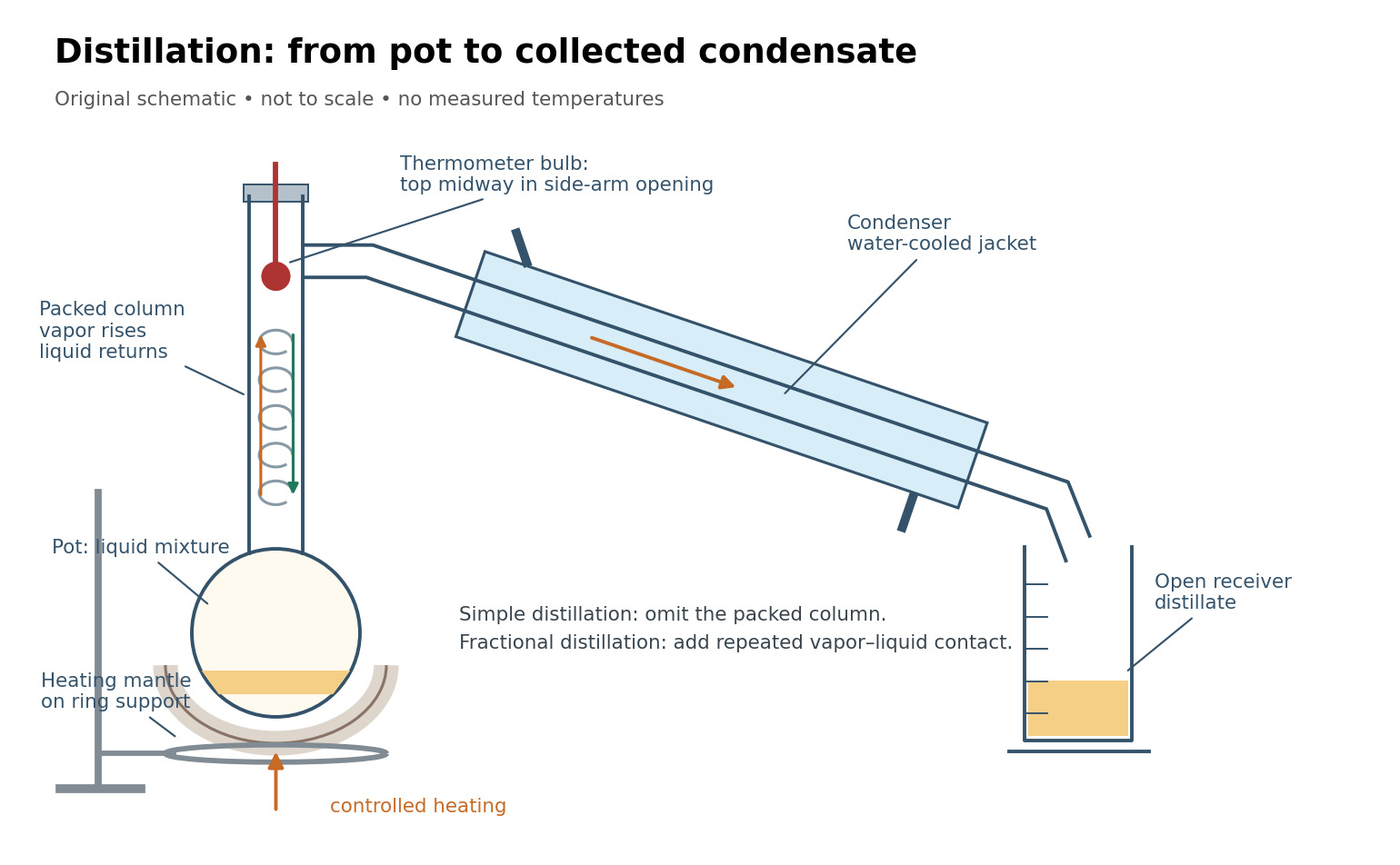
Distillation connects a heated pot, a fractionating column, a thermometer, a laboratory condenser, and a receiver
. Original schematic, not a scale drawing. Bulb position and mantle support follow the paired simple and fractional distillation experiment; blue marks the cooling jacket. Details.
Antibiotic Created 2026-10-18 Updated 2026-11-05
A substance that kills susceptible bacteria or inhibits their growth through a biological target such as cell wall synthesis or translation. The effect depends on organism and exposure; growth inhibition, killing and selection of resistant survivors are different experimental outcomes.
Anatomy Created 2026-10-18 Updated 2026-11-05
Anatomy studies the structure and spatial organization of organisms. It connects the shapes of organs, the arrangement of tissues and the geometry of individual biological cells to the functions studied in physiology. Dissection, imaging and histology reveal complementary scales of organization.
A useful anatomical explanation makes relations explicit: a nerve passes through a canal, a tendon crosses a joint, or a thin epithelium separates two exchanging fluids. These relations explain why the same region can contain structures with different functions and why damage at one location can affect several systems.[ref]
Anatomy and Physiology training modules by the National Cancer Institute. Introductory organization and body-system modules
Microinjection Created 2026-10-18 Updated 2026-11-05
Microinjection introduces material through a fine needle into a biological cell or one of its compartments.
Entomology Created 2026-10-18 Updated 2026-11-05
The study of insects, including their diversity, physiology, development and interactions. Medical entomology connects insect life cycles and behavior with transmission of disease, while agricultural work examines effects on crops and pollination.
Virus Created 2026-10-18 Updated 2026-11-05
Biology laboratory technique Created 2026-10-18 Updated 2026-11-05
Botany Created 2026-10-18 Updated 2026-11-05
Botany studies plants: their structure, physiology, genetics, reproduction, evolution and interactions with other organisms. A question such as how a plant survives drought connects several scales: guard cells regulate water loss, xylem transports water, and inherited variation changes performance across environments.
Botany combines observations of natural diversity with experiments on defined mechanisms. Comparing root pressure with water flow during transpiration, for example, distinguishes a positive pressure generated below from a pulling force associated with evaporation above.
Eclipse Created 2026-10-18 Updated 2026-11-05
An eclipse occurs when an alignment of astronomical bodies obscures a source of light or places an illuminated body in another body's shadow. During a solar eclipse, the Moon interrupts the view of the Sun; during a lunar eclipse, the Moon enters Earth's shadow.
The monthly sequence of Moon phases is insufficient to produce monthly eclipses. The Moon's orbital inclination usually carries it above or below the required alignment. Eclipses become possible when the relevant phase occurs sufficiently near an orbital node.[ref]
Why Do Eclipses Happen? by NASA. Geometry: the inclined lunar orbit, eclipse seasons and the distinction between solar and lunar alignments
The finite apparent size of the Sun makes shadow geometry richer than a single dark cone: the umbra excludes the entire solar disk, whereas the penumbra excludes only part. An extended lamp and an opaque ball reproduce this distinction on a screen, allowing the shadow's sharp central region and softer surroundings to be compared without astronomical distances.
History of science 2026-10-18
Green operator potential for ddbar exactness 2026-10-14
For a -closed pure-type form orthogonal to harmonic forms on a compact Kähler manifold, let be the inverse of the Dolbeault Laplacian on the harmonic complement, zero on the harmonic space. The Kähler Laplacian identity makes it commute with and . Thus and . The mixed anticommutator gives . This is an explicit potential for the ddbar lemma, with one lower degree of each type; using the inverse of the Hodge Laplacian instead multiplies the displayed expression by four.
On a compact Kähler manifold, the difference of cohomologous Kähler forms is a real, de Rham cohomology exact -form. The ddbar lemma gives . Reality implies , so is real and has the displayed potential equation. The difference of two real potentials is a pluriharmonic function, hence constant on each connected component. On a connected manifold the only ambiguity is one additive constant.
There are unlisted articles, also show them or only show them.