
LIGO Created 2026-10-18 Updated 2026-11-05
LIGO measures gravitational wave-induced changes in the relative lengths of widely separated interferometer arms. Laser light travels along perpendicular arms, reflects from suspended mirrors and recombines; a change in relative optical phase alters the detected signal. Arm optical cavities increase the interaction time, while vibration isolation and mirror suspension reduce unwanted motion.[ref]
Advanced LIGO by J. Aasi and others. Abstract and detector configuration: Michelson geometry, arm cavities and noise-control systems
Virgo Collaboration 2026-10-18
The scientific collaboration associated with the Virgo gravitational-wave detector.
Quantum information science Created 2026-10-18 Updated 2026-10-20
Quantum information science studies the storage, processing and transmission of quantum information, including the physical implementation of the tasks described by quantum information theory.
Microphotograph 2026-10-18
Photographic processing 2026-10-18
In photography, photographic processing uses chemical reactions to develop and stabilize an exposed photographic emulsion.
Photographic emulsion 2026-10-18
A photographic emulsion is a coating that responds to light to record an image in photography, for example on a photographic plate. Silver halide crystals, commonly silver bromide, are dispersed in gelatin. Exposure leaves a latent image. A developer produces dark silver grains and fixing removes remaining sensitive material. A microscope can reveal a charged particle's path through the coating: the basis of nuclear emulsion particle detection.[ref]
Research Profile: Cecil Powell by Luisa Bonolis. Luisa Bonolis, Research Profile: Cecil Powell, “A new visual method: nuclear emulsions”, paragraphs describing composition, coating, development, fixing and microscope observation
Camera Created 2026-10-18 Updated 2026-11-05
A camera combines an image-forming arrangement with a surface that records the incident light. An optical lens collects many light rays from each object point and directs them toward a corresponding image point; a photographic emulsion or photodetector then records the image. The optical camera is the imaging part of this arrangement.
The simplest demonstration replaces the optical lens with an optical pinhole. In NASA's two-card activity, foil containing a small hole covers a window in one card, and a second white card receives the projected image of the Sun. Increasing the separation enlarges the image; making several holes produces several images. The receiving card is viewed from the side, rather than looking through the hole at the Sun.[ref]
An optical pinhole selects narrow bundles of light rays without refraction. A finite hole also produces geometric blur, and an extremely small hole makes diffraction important. These competing effects explain why reducing the hole indefinitely does not produce unlimited spatial resolution.
Stereoscopy Created 2026-10-18 Updated 2026-11-05
Stereoscopy uses images from different viewpoints to convey or recover depth. In scientific photography, identifying the same feature in two calibrated views permits stereoscopic triangulation: intersecting the directions inferred from the two images.[ref]
What Is Stereo Reconstruction? by MathWorks. How Does Stereo Reconstruction Work? and Stereo Camera Calibration
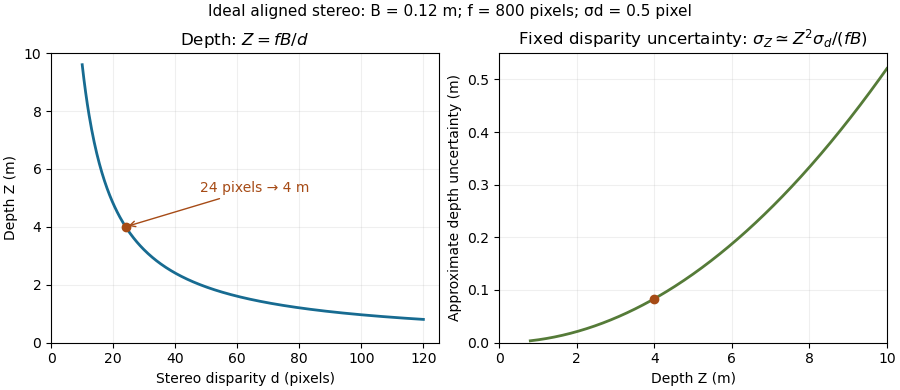
Consider ideal cameras with parallel axes, separated by a baseline . With matching forward-projection coordinates and common focal length in image-coordinate units, a point at projects toSubtracting gives the stereo disparity , hence . If and are measured in pixels, has the same length unit as .
For an original example, , pixels and pixels give . First-order propagation of uncertainty gives . Thus fixed disparity precision produces increasing depth uncertainty for more distant objects. Correctly matching the same feature is also essential; ambiguous or hidden features can defeat the reconstruction even when the geometry is known.

Historian of science Created 2026-10-18 Updated 2026-10-24
Aerospace engineering Created 2026-10-18 Updated 2026-11-05
Aerospace engineering concerns aircraft and spacecraft, linking aerodynamics, structures, propulsion, control and thermal design. Aircraft operate through forces exchanged with the atmosphere; spacecraft also require orbital dynamics and operation in vacuum. A low-mass structure can reduce propulsion requirements but may be more flexible, affecting control and vibration. Coupling these subsystems makes performance a system-level property: improving one component's isolated efficiency does not necessarily improve the complete vehicle.
Manufacturing Created 2026-10-18 Updated 2026-11-05
Manufacturing turns a design and raw materials into physical products through controlled processes such as casting, forming, machining and joining. The process changes more than shape: heat treatment and deformation can alter microstructure and residual stress. A component's tolerances, surface finish and defect population therefore depend on the production route. Reproducibility requires measuring variation across parts and relating it to the required function. Material selection and process selection are coupled because a good nominal property is of little use if the required geometry cannot be made consistently.
Lighthouse Created 2026-10-18 Updated 2026-11-05
A lighthouse produces a visible navigational light from a fixed coastal or offshore structure. Its optical system concentrates light into selected directions rather than radiating equal useful intensity everywhere. A Fresnel lens can approximate the focusing action of a thick lens through stepped sections with less material. Rotating or switched beams give characteristic flash patterns that distinguish stations. Visibility depends on intensity, atmospheric scattering and the geometric horizon, so greater source power alone does not remove every range limitation.
Mechanical engineering Created 2026-10-18 Updated 2026-11-05
Mechanical engineering studies and designs machines and physical systems using mechanics, thermodynamics, fluid flow and materials. A pump, engine or robotic joint links forces and motion to energy conversion and dissipation. Design analysis must distinguish ideal kinematics from the loads and losses required to realize it. For example, a linkage may permit a desired motion while its bearings overheat or its members deflect excessively. Measurement and testing connect such component-level predictions to actual system behaviour.
Materials science 2026-10-18
Materials science relates the preparation and internal structure of materials to their properties and uses. Crystal structure, elasticity and electrical conductivity describe different aspects of that connection.
Engineer Created 2026-10-18 Updated 2026-11-05
An engineer develops or evaluates a design against practical requirements using engineering methods. The reasoning includes the intended function, the conditions under which it must work, the approximations in its model and the evidence supplied by tests or measurements. For a small actuator, force capacity, response time, heating and manufacturing tolerances can all matter. Different specializations select different tools, but the common task is to justify how a constructed system will meet its specified function.
Civil engineering Created 2026-10-18 Updated 2026-11-05
Civil engineering concerns designed infrastructure such as buildings, bridges, transport networks and water systems. Its analyses connect mechanics, materials, fluid flow and ground behaviour to service requirements. For a beam, checking that stress stays below an allowable value is only one requirement; deflection, vibration, fatigue and foundation movement can also control a design. Physical scale models, field measurements and construction inspection test assumptions that an ideal structural model cannot establish by itself.
Telecommunication 2026-10-18
Telecommunication conveys information between separated places by physical signals. Radio communication uses radio waves; telegraphy communicates discrete written symbols. The engineering problem includes choosing a source, a channel and a readable output, then distinguishing that output from noise.
Slotted line 2026-10-18
A slotted line samples an electromagnetic field along a guide with a movable probe introduced through a longitudinal slot. Positions of standing wave minima determine the guided wavelength; a detector response need not be a calibrated field amplitude.
Optoelectronics Created 2026-10-18 Updated 2026-11-05
Optoelectronics combines electronic devices with generation, detection or control of light. A light-emitting diode converts carrier recombination into photons, while a photodiode converts absorbed photons into an electrical response. Semiconductor band structure determines which photon energies interact efficiently, but device geometry, recombination and transport also control speed and efficiency. Optical communication links, image sensors and photovoltaic devices use different parts of this interaction. Measuring an optical signal therefore often requires understanding both the light field and the electronic readout.
Chart recorder 2026-10-18
There are unlisted articles, also show them or only show them.