
In the gravitational potential , a regular noncircular bound orbit requires and has with . Each radial period advances the angle by . The full position and velocity return after finitely many radial periods precisely when is rational. Irrational gives a dense rosette on the two-frequency invariant torus. Rationality permits a fifth orbit label fixing the apsidal phase on that resonant angular momentum family, but does not give global superintegrability for all nearby angular momenta. When , every regular bound Kepler orbit is closed and the Laplace-Runge-Lenz vector supplies the globally defined additional integral.
For with and , the positive-radius scattering branch has . Thus the principal complex argument in the displayed expression is continuous throughout that branch, unlike at an apocentre of a bound orbit. Its derivative is , so the angle modulo , or the associated unit apsidal vector in the orbital plane, is a stationary integral of motion fixing the periapsis direction. Together with energy and three components of specific angular momentum, it gives five regular scattering labels even for irrational . Periodicity is therefore necessary for five orbit labels in recurrent bound motion, not in general for escaping trajectories.
Complement of an affine toric face chart 2026-10-14
If , choose with . Then . Its complement is the union of orbit closures indexed by faces of that are not faces of .
// Target: geometry-and-topology.bigb
Monomial support face of a toric point Created 2026-10-14 Updated 2026-11-05
Work with closed points over an algebraically closed field . For , the exponents for which form a semigroup face: a product is nonzero exactly when both factors are nonzero. In a saturated polyhedral monoid these exponents are precisely the toric lattice points of one face of .
The nonzero values define a homomorphism from the group generated by that face to . Extending it to the full toric lattice shows that points with the same support face differ by the action of the dense algebraic torus. They therefore form a single orbit.
For , the possibilities are both coordinates nonzero, one specified coordinate nonzero and the other zero, or both zero. These are the dense algebraic torus, the two punctured axes and the origin. The closed-point/field convention avoids confusing these geometric orbits with arbitrary scheme points or rational-point descent.[ref]
Toric Varieties by David A. Cox and others. chapter3, distinguished points and the orbit-cone correspondence
// Target: mathematical-optimization.bigb
An adapted process with integrable coordinates is a martingale exactly when the displayed equality holds for every bounded stopping time. For the forward implication, expand and condition each term on . Conversely, for choose on and elsewhere. Subtract the equality for the constant stopping time to obtain , which is the defining conditional expectation identity.
For an integrable supermartingale with the displayed increment bound, . Thus the stopped values are dominated by one integrable random variable, including . Apply optional stopping at the bounded times and then the dominated convergence theorem. For a martingale the same proof gives equality.
Approximate experimental design Created 2026-10-14 Updated 2026-11-05
An approximate design is a probability measure on the design region, with weight specifying a proportion of observations at . For independent observations and common error variance , a linear regression with vector has normalized information matrix of an experimental design ; its least-squares estimator has covariance when the allocations realize these proportions. Exact designs restrict to integers.
D-optimal design Created 2026-10-14 Updated 2026-11-05
A D-optimal design maximizes the determinant of the information matrix of an experimental design, equivalently minimizing the determinant of the covariance matrix of a fixed-size least-squares estimator. It minimizes the volume of a fixed-level confidence ellipsoid for the model coefficients under the usual Gaussian model.
G-optimal design Created 2026-10-14 Updated 2026-11-05
A G-optimal design minimizes the maximum design sensitivity function over the full design region. Thus it minimizes the worst variance of a fitted regression mean, excluding the separate noise variance of a new observation. The sensitivity average is , so its supremum is at least .
For continuous regressors spanning a -dimensional space on a compact design region, and approximate designs with nonsingular information matrix of an experimental design, the following are equivalent: D-optimal design, G-optimal design, and . A D-optimal design has nonpositive directional derivatives . Conversely, if every such derivative is nonpositive, concavity of bounds every competing information matrix by the tangent at , proving D-optimality. The sensitivity average is , and a D-optimal design exists by compactness of the information-matrix set and the spanning assumption; hence the optimal G-value is . Sensitivity equals at every support point of an optimal design. The equivalence concerns approximate allocations; integer restrictions can change exact-design optima.
Dioptre 2026-10-14
A dioptre, also spelled diopter, is the unit of optical power equal to one reciprocal metre. In , convert focal length to metres before taking the reciprocal: gives , not . A dioptre measures focusing strength, distinct from the transverse magnification of an image.
Orthogonal opposite edges of a tetrahedron Created 2026-10-14 Updated 2026-10-20
Place one vertex of a tetrahedron at the origin and denote the other vertex vectors by . Orthogonality of two pairs of opposite edges of a tetrahedron forces . It follows that the third pair is orthogonal too. The three sums of squared lengths of opposite edges all equal . This gives a dot product test for the special geometry without solving for the face planes.
Time reversal of an open migration process 2026-10-14
For a stationary open migration process with local total departure rate and traffic rates , adjacent product-weight ratios give the displayed reversed parameters. The traffic equations of an open migration process make each reversed routing row sum to one, while total external arrival rates agree in the two directions. Thus the reversed process has the same local departure functions and is again an open migration process.
Positive open of a locale 2026-10-14
An open is positive when its positivity truth value holds. Positivity gives a constructive witness of inhabitedness and must not be replaced by double-negated nonemptiness.
Totally connected locale 2026-10-14
A positive open locale is totally connected when every positive open of a locale is connected. Under classical logic its positive opens form a completely prime filter, hence specify a dense point. Positivity of the whole locale is essential: the empty locale satisfies the condition on positive opens vacuously but has no point.
For , the dense monomorphism classifier consists of the truth values above , so has least element . Conversely, if it has least element , density of a monomorphism is exactly containment of the pulled-back subterminal . For a subobject , the mono is dense, so and . Since , applying to gives . Hence equality holds.
General-position hemisphere count 2026-10-14
Choose points of such that every of their position vectors are linearly independent. Any equatorial hyperplane then contains at most points. If , at least one of each opposite pair of open hemispheres contains points. Such configurations exist: take distinct real parameters and normalize ; the Vandermonde determinant proves the required independence. This weaker one-of-two guarantee already suffices for the topological lower bound in Lovász theorem on Kneser graphs.
Planar rotation as a one-parameter subgroup 2026-10-14
Differentiate the planar rotation matrix at angle zero:The even and odd powers in the matrix exponential therefore giveThis exact formula gives the whole one-parameter subgroup. Taking means unit angular velocity: at , sends to , a counterclockwise quarter-turn. At , it equals ; at , it returns to . Choosing reaches the quarter-turn at . Changing the generator changes the speed, while preserving the circular path.
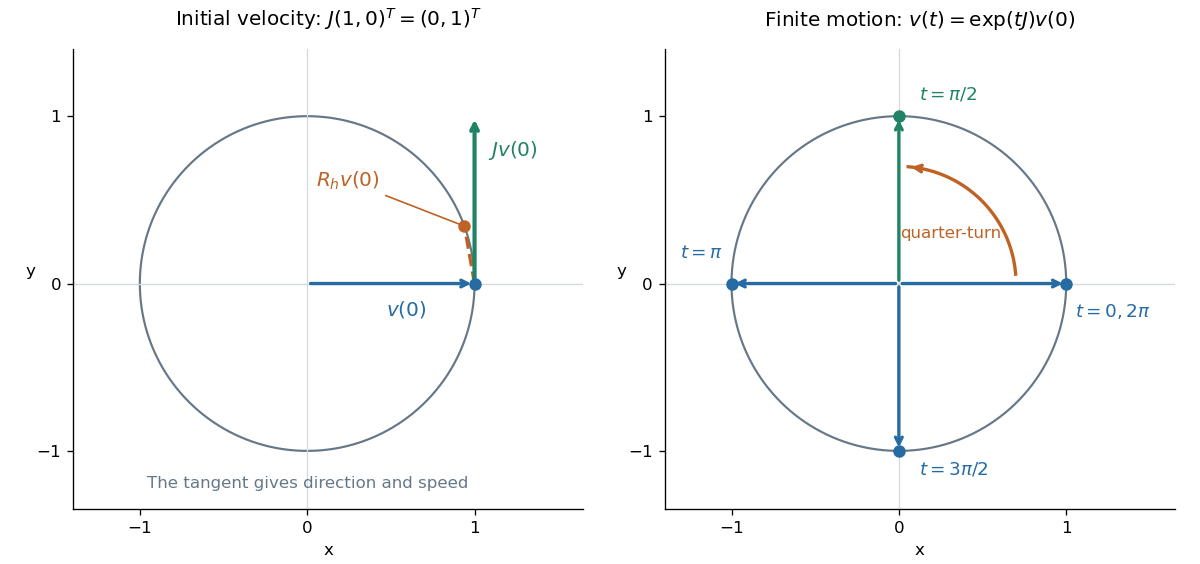

For a moving vector , the ordinary differential equation says its velocity is perpendicular to its position. The beautiful compression is that one constant matrix specifies every angle of this endless family of rotations.
Mean measure of Poisson-Dirichlet components Created 2026-10-14 Updated 2026-11-05
For , whenever the absolute integral is finite. Apply the Mecke formula for a Poisson random measure to a selected jump and the remaining total , whose density is . Changing variables to and factors out a Gamma function and gives the displayed measure. Weighting it by gives a probability density , the Beta distribution of a size-biased component.
Factorial moment densities of Poisson-Dirichlet components Created 2026-10-14 Updated 2026-11-05
This density is supported where all and , and gives the expected sum over ordered distinct components of . Apply the iterated Mecke formula for a Poisson random measure to selected jumps and the remaining gamma total . With and , the Jacobian is and the integral in is , giving the density. It describes joint counts of large components, beyond the first-moment measure.
There are unlisted articles, also show them or only show them.