
Nonexact angular one-form 2026-10-14
On the punctured plane, this one-form is closed and locally the differential of the polar angle. Its line integral around a closed curve is times the winding number. A once-winding circle therefore has nonzero integral, proving that no global single-valued angle potential exists and the form is not an exact differential form.
For a counterclockwise circle of radius , substitute , . The pullback of a differential form isThe radius cancels. In coordinates, and satisfy away from the origin, so there. The nonzero integral is a global obstruction to being an exact differential form, not a nonzero local exterior derivative.
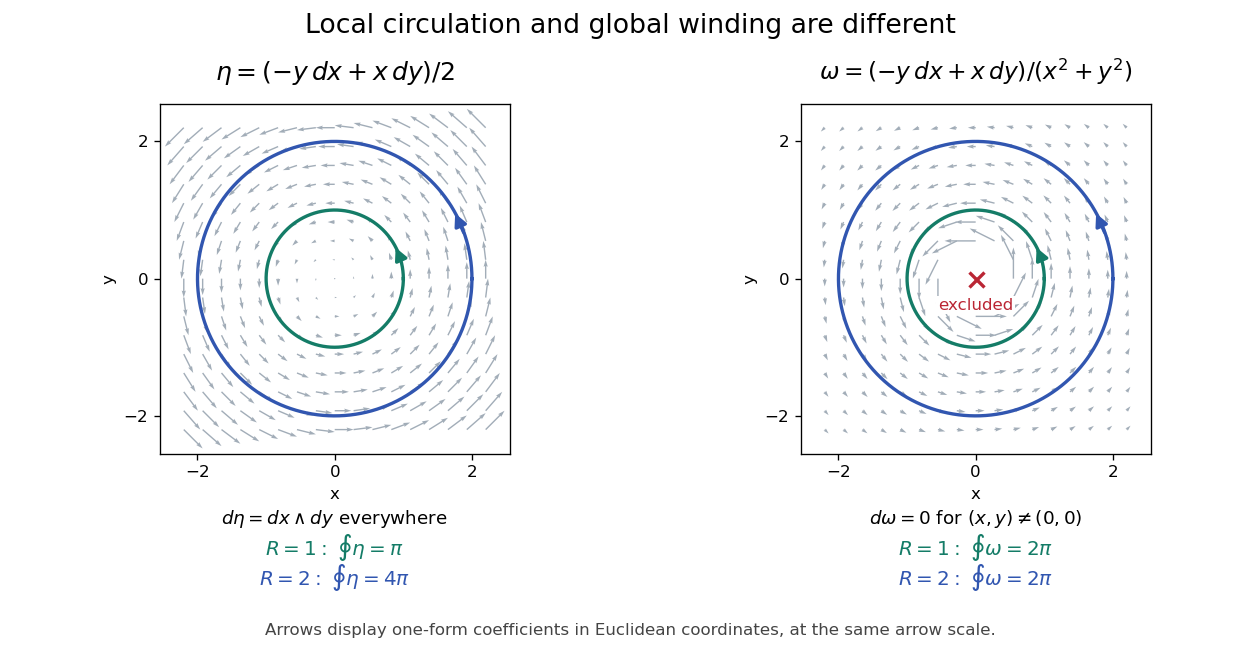
Smooth local circulation scales with enclosed area, whereas a closed angular form detects winding around an excluded point
. Details. 
Compare this with the smooth one-form on the whole plane. Here , and its integral around a radius- circle is , the enclosed area. The Generalized Stokes theorem applies to the full disc for . For , that disc crosses the excluded origin, where the one-form is undefined. On an annulus the theorem applies, but its induced inner boundary is clockwise: the two integrals and cancel. This explains exactly why closedness and nonzero circulation can coexist.
Uniform utility convergence need not preserve closed preference convergence Created 2026-10-14 Updated 2026-11-05
On the utility functions converge uniformly on the whole domain to . Their preference relations remain the usual order, while the limiting utility function makes all pairs indifferent. The weak comparison in the limit cannot be approximated by comparisons from the varying graphs. Uniform convergence does guarantee the upper graph-limit condition, because convergent pairs remain in a fixed bounded set.
Exponential closed-box gas consumption Created 2026-10-14 Updated 2026-11-05
With gross star formation rate , constant returned mass fraction , and the instantaneous recycling approximation, the net locked mass rate is . Mass conservation gives . For constant stellar yield per unit locked mass and initially pristine gas, metal conservation gives , so gas-phase metallicity grows as . Gross star formation and permanent locking have different normalizations.
Closed-box metallicity distribution Created 2026-10-14 Updated 2026-11-05
For a pristine closed-box model of galactic chemical evolution, and imply independently of the star formation rate. The resulting metallicity distribution function is exponential on . Its normalized density is . A fixed initial mass function and survival selection are needed to turn locked stellar mass into a stellar number distribution. Logarithmic abundance intervals have the additional factor .
Saturating closed-box enrichment law Created 2026-10-14 Updated 2026-11-05
A finite-metal-fraction variant of the closed-box model of galactic chemical evolution uses effective stellar yield , rather than constant yield. With pristine initial gas and , metal accounting gives and hence . The mass-weighted mean stellar metallicity is . At final gas fraction , the metallicity distribution function is on . For trace abundances, and the usual closed-box metallicity distribution is recovered to leading order.
Tensor contractions in the SU2 Clebsch-Gordan decomposition Created 2026-10-14 Updated 2026-11-05
Realize . Contract pairs of indices, one from each symmetric tensor, with the alternating invariant tensor , and symmetrize the remaining indices. This is a nonzero intertwining operator into . In the bihomogeneous polynomial realization, is a highest-weight vector of weight . Its lowering string has length . These inequivalent irreducible summands exhaust the tensor product, since their dimensions sum to .
Classifying topos of partial orders 2026-10-14
Let contain finite partially ordered sets and all order-preserving functions, including the empty object. The covariant functor category classifies weak partial orders. Finite positive presentations reduce to finite preorders with mutually comparable cycles identified. An internal model gives a flat functor on ; conversely the corresponding filtered presentation by finite models recovers its carrier and order relation.
Classifying topos of strict partial orders 2026-10-14
Let contain finite strict partial orders and strict order-preserving functions. Its covariant set-valued functor category classifies the strict theory. A finite presentation with a strict cycle is contradictory; every other finite diagram gives a finite strict partial order. Equalizing finitely many element identifications either gives such an order or forces a forbidden cycle, so the internal model-to-flat-functor construction remains valid. The reflexification of a strict partial order induces a surjective geometric morphism to the weak-order classifier, but not a geometric embedding because strict maps exclude collapse of comparable elements.
Classifying topos of linear orders 2026-10-14
With empty objects allowed, finite totally ordered sets and all weak order-preserving functions give a presheaf classifier for weak total orders. Finite tuples in a model can locally be merged into a sorted tuple using finitely many totality disjunctions. Equalizing two maps between finite chains amounts to collapsing the convex intervals forced equal. These two constructions give the flatness conditions without assuming decidable equality.
Classifying topos of strict linear orders 2026-10-14
Finite strict total orders and increasing injections, including the empty order, give a presheaf classifier for strict total orders. Trichotomy locally merges two finite sorted tuples, identifying equal entries. A strict map from a chain is injective, so parallel maps admitting the same realization are already equal. Reflexification gives a geometric morphism to the classifying topos of linear orders; pulling back weak totality gives exactly strict trichotomy.
Generic local ring 2026-10-14
In the sheaf topos for the Zariski coverage on finitely presented rings, the universal local ring is represented by the polynomial ring . At the stage of a finitely presented ring , its section set is , and restriction along is that ring map. It is internally local because the localizations at and cover each stage. Its square-zero infinitesimals are represented by . Stage rings need not themselves be local or reduced; their variation supplies the internal local and infinitesimal semantics.
The stabilizer of a line in is , giving the homogeneous space . Its classifying-space Serre fibration has rationally acyclic fiber for odd , so its cohomological Serre spectral sequence has only its degree-zero row and gives the displayed restriction isomorphism. The factor is itself rationally acyclic. For even , the fiber has a top rational class, with determinant-sign monodromy, so the one-row argument fails. The top universal Pontryagin class is nonzero on but vanishes on restriction to , witnessing genuine failure of stabilization.
Classification tree 2026-10-14
A classification tree partitions predictor space recursively and attaches a class probability vector to each terminal region. For a categorical response, a fitted leaf commonly uses its observed class proportions and predicts their largest entry. Binary numerical splits compare one coordinate with a threshold. Growing a tree greedily by reducing classification-tree deviance gives an interpretable rule but does not globally optimize the tree. Cost-complexity tree pruning and cross-validation control complexity and assess prediction error.
Misclassification rate Created 2026-10-14 Updated 2026-10-20
The misclassification rate is the expected zero-one loss of a classification in statistical learning rule. Its empirical version is the fraction of incorrectly labeled observations. Evaluation on the fitting sample gives a training error; evaluation on an independent test set estimates prediction error. For a majority-class leaf of a classification tree, the training error count is , unlike classification-tree deviance, which also uses the fitted class probabilities.
Let be a domain satisfying both Ore conditions, with quotient division ring . A matrix over is regular exactly when it is invertible over : a kernel vector of a singular matrix can have its denominators cleared to give a nonzero annihilator over . An upper triangular matrix is regular exactly when all diagonal entries are nonzero. Each finite list of entries of a matrix over has a common left denominator . Thus it is a fraction with denominator , proving the displayed classical localizations. The triangular localization retains its strictly upper triangular nilpotent ideal; it is not a semisimple matrix ring.
Class DL process Created 2026-10-14 Updated 2026-11-05
An adapted process is of class DL when, for every finite , the family is uniformly integrable. A local martingale is a true Martingale exactly when it has this property. This is a local-in-time condition, not Uniform integrability over the whole half-line.
// Target: probability-and-statistics.bigb
One-period quadratic hedge 2026-10-14
A one-period quadratic hedge minimizes over deterministic holdings, where is the riskless gross return, , and the covariance matrix is invertible. For a square-integrable claim, the unique solution is and . Centering separates the squared bias from the quadratic error. Completing the square gives the excess error as after the bias is minimized. Unlike claim replication, the residual need not vanish.
Closed-streamline threshold for a circular topographic anticyclone Created 2026-10-14 Updated 2026-11-05
For the circular topographic anticyclone in a positive uniform current , the opposing disturbance speed is at most . Below the displayed threshold remains positive everywhere, so no streamline can close. Above it an interior stagnation point at is a center, while the exterior point is a saddle. At equality the two meet at the rim. This is the onset criterion; once closed contours form, the potential vorticity of trapped fluid is not determined solely by its present upstream conditions.
Rich-bisector deletion bound 2026-10-14
Every supporting centre of an arc between fixed endpoints lies on their perpendicular bisector. Multiplicity at least therefore makes that line contain at least of the original points. For each such line containing points, its centres each support at most circles; on one circle at most two consecutive-point arcs have that symmetry axis. The rich line bound summed over dyadic occupancies gives the displayed bound.
Put and , where . The circle component of is . Since , its integral equals three copies of up to a boundary term. The coefficient therefore becomes after circle integration. Boundary terms and global potential patching must be retained when the spacetime has boundary or nontrivial flux topology.
There are unlisted articles, also show them or only show them.