
A map from the -sphere to a CW complex can be homotoped into its -skeleton. By compact subsets of CW complexes lie in finite subcomplexes, its image lies in a finite subcomplex. For a top-dimensional cell of dimension , use smooth approximation of maps into Euclidean space in its interior, with a cutoff supported away from the cell boundary. The Sard theorem supplies a point in a smaller interior ball omitted by the smoothed map; the cutoff is chosen so the transition region also avoids that point. Radial retraction from the omitted point pushes the image into the cell boundary and fixes all other cells. Repeating over the finitely many higher-dimensional cells proves the assertion, without assuming the initial continuous image has measure zero.
Finite spectrum 2026-10-14
A finite spectrum is a topological spectrum equivalent to a cell spectrum with finitely many cells. Such an object is compact in the stable homotopy category and has a Spanier-Whitehead dual. Compactness means maps out of it commute with filtered homotopy colimits of spectra.
Ceiling count for fixed-size batches 2026-10-14
Suppose is a nonnegative integer count of items and each batch holds at most items, where is a positive integer. The smallest sufficient number of batches isIndeed, exactly when the integer is at least . If , no batches are needed. If is a multiple of , no partly filled batch is needed.
For items with capacity per batch, . Five batches can be full and the sixth holds two items, leaving unused places. This is a different question from the five complete groups counted by .
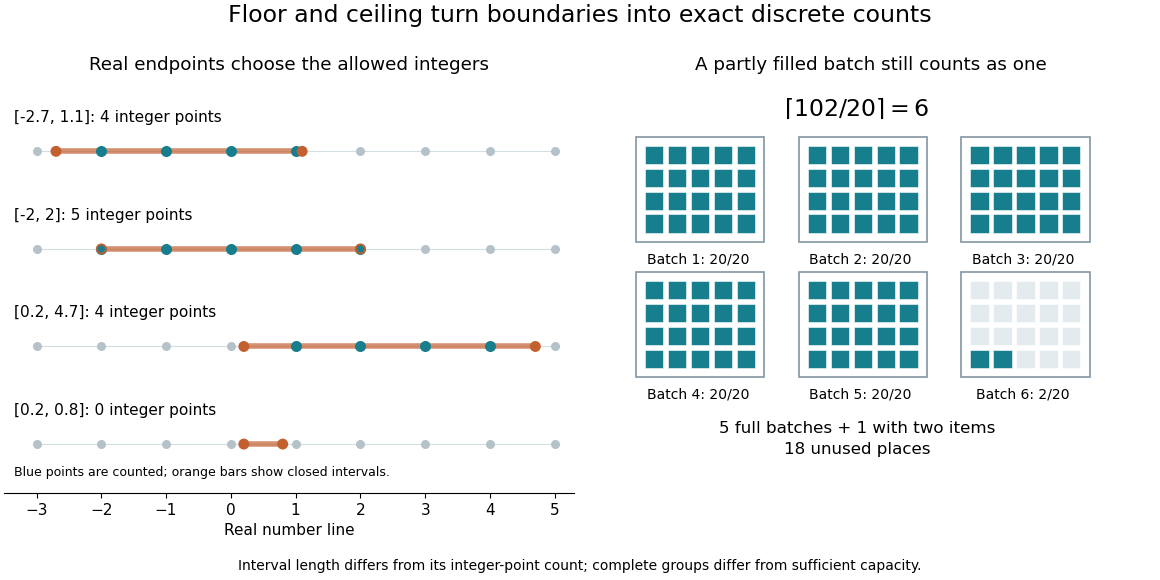

Writing the Euclidean division , , gives the equivalent rule when , and when . This explains the ceiling function's jump: one extra item beyond a complete multiple demands a whole additional batch. For exact integer arithmetic, the identity avoids a fractional intermediate value; an implementation still needs an integer representation large enough to hold .
Myt1 2026-10-14
Myt1 is a protein kinase distinct from Wee1. The cloned Xenopus laevis Myt1 phosphorylated Cdc2 at both inhibitory sites Thr14 and Tyr15; depletion experiments implicated it as the predominant Thr14-directed activity in Xenopus laevis egg extracts.[ref]
Myt1: a membrane-associated inhibitory kinase that phosphorylates Cdc2 on both threonine-14 and tyrosine-15 by P. R. Mueller and others. Mueller, Coleman, Kumagai and Dunphy (1995), abstract: Xenopus clone, both inhibitory sites and immunodepletion result
CDK-activating kinase 2026-10-14
A CDK-activating kinase is a protein kinase supplying activating phosphorylation to a cyclin-dependent kinase 1 preparation. The Xenopus laevis experiment above distinguished this activity from the catalytic activity of Cdc2 itself. CAK names that function here, without asserting that every species uses the same protein assembly.
Write . Pairing and after differentiating twice givesThe power series of has strictly positive even coefficients, and the other factor has nonnegative even coefficients. Thus every even coefficient of is negative. Since is even with , the displayed sign pattern follows. This supplies a short positivity argument for the first Dahlquist barrier.
Hydrostatic response to a localized horizontal force Created 2026-10-14 Updated 2026-11-05
For a weak horizontal forcing proportional to in an ideal uniformly stratified nonrotating fluid, the low-frequency hydrostatic approximation gives the displayed one-dimensional wave equation for the streamfunction amplitude. Two oppositely propagating characteristic integrals determine the response. A source confined to and switched on at time zero produces no response beyond in this reduced equation. The bound on mixed forcing derivative controls the neglected vertical acceleration in characteristic magnitude.
Null current of a commuting Majorana spinor Created 2026-10-14 Updated 2026-11-05
In four dimensions a single commuting Majorana spinor is specified by a two-component complex spinor . Its future Dirac current is proportional to , and the Pauli matrix multiplication law implies . Thus it is null. A Dirac spinor or a sum of independent Majorana currents can be timelike. This distinction matters when applying a timelike-current classification to minimal real supersymmetry.
Self-similarity of a Cauchy process 2026-10-14
For a standard Cauchy process, the increment characteristic function is . Scaling space by and time by leaves this expression unchanged and preserves independent increments, proving equality of all finite-dimensional distributions. Equivalently, has the original process law. Scaling both space and time by instead changes the exponent by and is not an invariance unless .
A complete Cauchy hypersurface in Minkowski spacetime, such as , has full domain of dependence and empty Cauchy horizons. This does not forbid horizons for a non-Cauchy initial surface in the same spacetime. The smooth edgeless spacelike hyperboloid , , has domain of dependence and a past Cauchy horizon on the future light cone of the origin. Every causal curve starting inside that cone crosses the hyperboloid in the direction needed for dependence: passes through , while a null generator of the cone never meets it. The time-reversed hyperboloid gives the analogous future horizon.
Idempotent ideal in a finite category 2026-10-14
A collection of arrows is a two-sided ideal when arbitrary precomposition and postcomposition preserve it. If a finite category has split idempotent morphisms, every ideal satisfying is generated by identities belonging to . Factor an arrow repeatedly as a longer product of arrows of . Two prefixes coincide, since there are only finitely many arrows. The intervening endomorphism fixes that prefix; an idempotent power of still fixes it. Write , . Then , and factors through . Applied to the least covering sieves of a finite site, this proves rigid coverage.
Total functional relations define morphisms 2026-10-14
In a regular category, a relation is total if its projection to is a regular epimorphism, and single-valued if two pairs with the same first component have the same second component. The latter makes that projection a monomorphism. A regular epimorphism that is monic is invertible, so has graph exactly . No axiom of choice or set-based element selection is used.
Category of relations (sets) 2026-10-14
The category of relations on sets has sets as objects and binary relations as morphisms. Relational composition declares when some intermediate satisfies both component relations; the identity is the diagonal relation.
Covariant density presentation 2026-10-14
For a set-valued covariant functor on a small category, the Yoneda lemma sends the element to the transformation . These transformations form a cocone indexed by the opposite category of elements. At , send the representative to . It is surjective using ; two representatives of are identified through that same object of the category of elements. This proves the displayed presentation pointwise.
Generating function of the Catalan numbers 2026-10-14
The ordinary generating function packages the Catalan recurrence. Its Cauchy product gives the formal power series identityThe constant term is . Solving the quadratic equation chooseswith the formal power series square root having constant term one. The apparent quotient at has constant term one after cancellation; the other quadratic solution has a pole and cannot be this ordinary generating function. The equation records the empty object or an outer unit with two ordered smaller objects.
Oriented-axis invariant Cartesian tensor Created 2026-10-14 Updated 2026-11-05
A Cartesian second-rank tensor invariant under all rotations about an oriented unit axis has the displayed form. A half-turn about the axis eliminates the mixed axial-transverse entries, and a quarter-turn makes the transverse block a scalar matrix plus an antisymmetric planar rotation generator. Conversely both transverse terms commute with every rotation about the axis. The antisymmetric term is allowed unless symmetry or an additional axis-reversing rotation is imposed. This differs from an axially invariant second-rank tensor for an unoriented axis.
Divergence of a Cartesian second-rank tensor 2026-10-14
For a constant orthogonal Cartesian coordinate change , a Cartesian second-rank tensor obeys . The chain rule gives . Consequently , the transformation rule for a vector. Under non-Cartesian position-dependent coordinate changes, partial derivatives must be replaced by the appropriate covariant derivative.
Every three-dimensional Cartesian second-rank tensor splits into scalar, symmetric-traceless, and antisymmetric parts. Their coefficients are , , and . The epsilon contraction identity reconstructs the antisymmetric part and proves uniqueness. Under proper rotations behaves as a vector, but under reflections it is an axial vector.
Cubically invariant second-rank tensor Created 2026-10-14 Updated 2026-10-18
A Cartesian second-rank tensor in three dimensions invariant under quarter-turn rotations about all three coordinate axes is a scalar multiple of the identity matrix. Squaring the quarter-turns gives coordinate half-turns; invariance under these forces every off-diagonal component to vanish. The quarter-turns then equate the three diagonal components. This conclusion does not require the original tensor to be symmetric.
Extensional reflexive object 2026-10-14
An object isomorphic to its own exponential supplies mutually inverse folding and unfolding maps. Evaluation defines application, and folding after currying defines abstraction. The exponential universal property gives the beta rule, while the full isomorphism gives eta conversion. A mere retraction of the function object generally suffices for beta but not automatically eta.
There are unlisted articles, also show them or only show them.