
Source counts on an FLRW past light cone Created 2026-10-14 Updated 2026-10-20
For proper number density in an FLRW metric , a radial shell has proper volume . A radial null geodesic obeys . Multiplication gives the displayed shell count on a local radial branch of the past light cone. Spatially uniform number density need not be time independent or have conserved comoving number density.
Double commutant theorem for star-algebras 2026-10-14
A unital subalgebra closed under the adjoint operator, on a finite-dimensional real or complex inner product space, equals its double commutant of an operator algebra. Here is a proof that does not require a classification of algebras. For , choose a basis and let . The diagonal action of preserves and , so the orthogonal projection onto commutes with that action. Each matrix entry of this projection belongs to . Hence the diagonal action of commutes with the projection and preserves . Since , the tuple belongs to , and therefore for one . This implies . Without the unital hypothesis the conclusion is .
Von Neumann double commutant theorem Created 2026-10-14 Updated 2026-11-05
For a unital star-subalgebra of the bounded operators on a complex Hilbert space, its strong operator topology and weak operator topology closures equal its double commutant of an operator algebra. To approximate on finitely many vectors, take their tuple in . The projection onto its diagonal- cyclic subspace has matrix entries in , so it commutes with the diagonal action of . Therefore the image tuple under lies in that cyclic subspace and can be approximated by a single .
Accessible state of a Markov chain 2026-10-14
For a finite, time-homogeneous Discrete-time Markov chain, state is accessible from when some finite path of positive transition probabilities leads from to . Equivalently, for some , allowing a zero-step path when . Accessibility is reflexive and transitive; communicating states require accessibility in both directions. See Ward Whitt's lecture notes of September 24, 2013, classification of states. In the closed-cycle example in communicating class, despite , because ; fails at every step count.
Combinatory logic term 2026-10-14
A finite applicative expression over free variables and the combinator constants , with application associating to the left. One may instead take as the abbreviation . There is no variable binder in this syntax.
Bracket abstraction 2026-10-14
Bracket abstraction removes a free variable from a combinatory logic term. The displayed clauses are applied in that order, giving and . Under the standard lambda expansions of , the result is beta-equivalent to . The recursive translation of lambda terms therefore preserves variables and application and reflects weak equivalence, but need not preserve all beta equivalences.
Off-axis pinhole test for coma 2026-10-14
The institution-issued AY 105 Lab Experiment 3: Optical aberrations by California Institute of Technology (Spring 2011 offering, Part A, pp. 2–3, 7–8) specifies a concrete optical bench: a lamp, opal diffuser and condensing optical lens illuminate a or optical pinhole; a photographic telephoto optical lens acts as a collimator, producing an approximately beam. A test optical lens sits on a rotation stage, followed by an adjustable optical microscope. The procedure establishes the on-axis image, then rotates the test optical lens a few degrees and examines the off-axis image through optical focus. It compares this readout with through-focus ray tracing at the corresponding field angles and offers a Ronchi ruling to calibrate the measuring eyepiece.
Part B (pp. 9–10) substitutes a spherical mirror of radius of curvature, with the optical microscope beside the incoming beam so the image is necessarily off-axis. It calls for measuring the field angle, calibrating the eyepiece and recording the image's length and width at minimum size. These are specified apparatus dimensions and instructions, not supplied measurement results or dimensions of the normalized figures.
A controlled extension would record images at zero and equal positive and negative field angles, repeat zero afterwards, and scan through optical focus at every setting. Keep the illuminated optical pupil and illumination fixed, recenter the optical microscope without clipping the bundle, and use its calibrated scale to separate a mere image displacement from a change in blur shape. The pure Seidel coma pupil mapping predicts reversal and linear growth; a stationary asymmetric central image instead calls for checking alignment. A focus-dependent change between perpendicular elongations suggests an astigmatism contribution. These comparisons test the model rather than assuming every off-axis flare is pure coma.
The optical pinhole has finite angular size, approximately its diameter divided by the collimator's focal length; the collimator and observing optical microscope also contribute their own optical aberrations. A broadband lamp can mix chromatic aberration with the geometric blur, and diffraction limits the smallest visible structure. A narrow spectral band, repeated field settings and a reference image help separate these effects. Consequently a measured length and width are useful checks on off-axis image formation, but they cannot by themselves determine a unique coma coefficient or recover the full point spread function.
Seidel coma pupil mapping 2026-10-14
Consider an original, explicitly normalized model of primary coma, rather than a prescription for a particular optical lens. Let be Cartesian coordinates in a circular optical pupil divided by its radius , with . Let be a signed small field angle divided by an arbitrary positive reference angle. With polar coordinates , , prescribe the wavefront errorHere is an arbitrary positive optical path difference scale, not a measured error. The cubic optical pupil dependence and linear field dependence are the classical Seidel form.[ref]
Coma aberration. Amateur Telescope Optics, §4.2, classical coma formula after equation 15 and equation 13: pupil-cubic and field-linear dependence
In the paraxial approximation, light ray direction errors follow the transverse gradient of wavefront error. For a reference sphere a distance from the exit optical pupil in a uniform image medium of refractive index , the corresponding image-error scale is . Choose image-error coordinate signs so the normalized displacement is ; reversing the convention reverses the plotted orientation. Image coordinates below are errors relative to the ideal image of this particular object point, rather than positions of different objects:The partial derivatives explain the asymmetry: opposite optical pupil points and land together, rather than on opposite sides of the ideal image. For , every is nonnegative, while can have either sign. The figures stipulate this single wavefront error, omit other optical aberrations and diffraction, and assign no instrument dimensions.
For a ring of fixed optical pupil radius , the double-angle formulas for trigonometric functions giveThus each ring maps into a circle of radius whose centre is displaced by . Doubling quadruples both sizes; for , the edge ring has centre and radius , while the half-radius ring has centre and radius . Superposing these displaced circles produces the comet-like envelope.
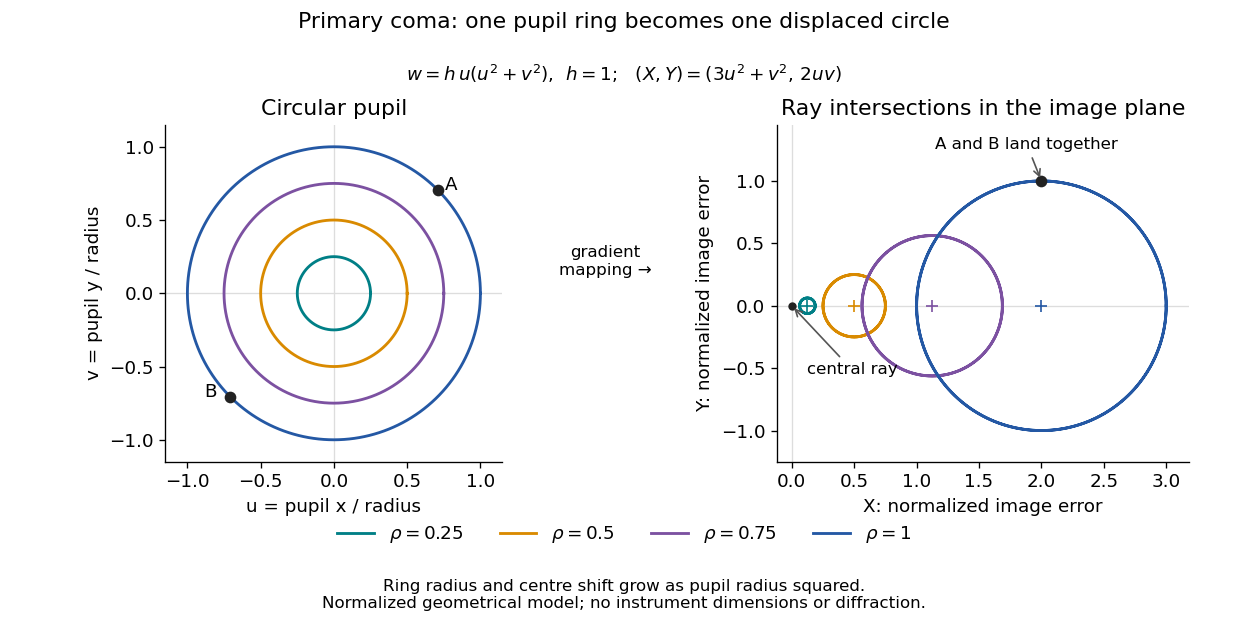

For uniform irradiance over the circular optical pupil, equal area samples give an equal-weight geometrical image. Its centroid is because and . Moving the coordinate origin to that centroid translates the image; it does not remove its asymmetric shape. Adding a linear term to likewise translates all light rays equally. These origin choices must be distinguished from changing the optical aberration itself.
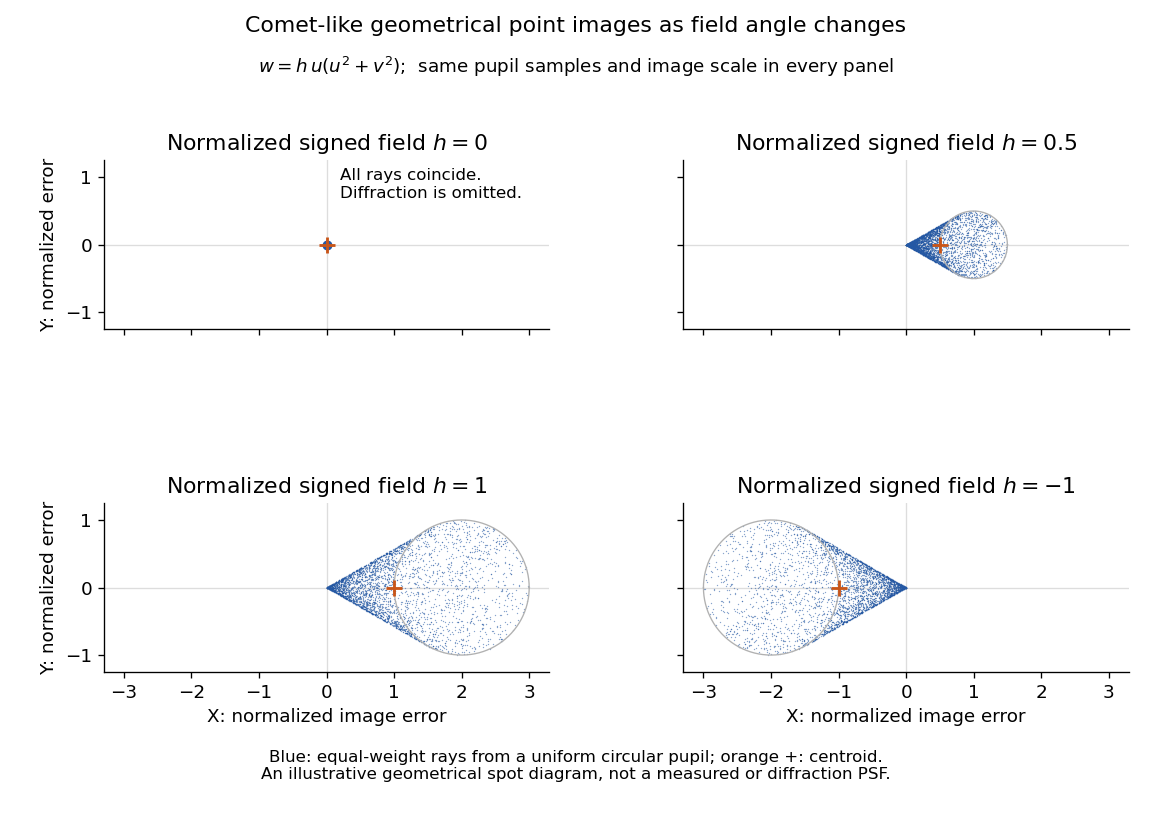

The model's full transverse extent is along and along . Halving the field angle halves the blur, and reversing it reverses the pattern about the ideal image. This isolates why coma matters for an optical camera's usable field of view: collecting more light does not ensure that off-axis points remain compact. Near diffraction-limited resolution, a physical optics calculation of the point spread function is needed instead of interpreting the geometrical tip as an infinitely sharp image.[ref]
Coma aberration. Amateur Telescope Optics, §4.2, Figure 41: geometrical spots versus diffraction images
Gauss-Legendre method 2026-10-14
The -stage Gauss--Legendre Runge--Kutta method collocates at the Gauss--Legendre quadrature nodes on . It is symmetric, A-stable, and has order .
Collocation tableau row-sum identity 2026-10-14
For a collocation Runge-Kutta method, , where the Lagrange interpolation basis obeys . Hence each row sum is its collocation node. Failure of this identity disproves a claimed collocation tableau with those nodes. The identity alone is necessary rather than sufficient: the individual integrated basis coefficients must also agree.
Collocation order theorem 2026-10-14
For distinct collocation nodes, let . If for , and the next moment is nonzero, the associated interpolatory quadrature has order , and the collocation Runge-Kutta method has the same classical order for sufficiently smooth differential equations. Here . Equivalently, if the quadrature is exact through degree but not degree , the method has order . The generic order is at least , Gauss collocation methods reach , and Radau IIA methods reach .
Two-node collocation A-stability criterion 2026-10-14
For distinct nodes , the two-stage collocation Runge-Kutta method has stability functionThe denominator has no zeros in the closed left half-plane. On the imaginary axis the denominator's squared modulus minus the numerator's is . Thus , equivalently , is necessary and sufficient for A-stability, using the maximum modulus principle and the bound at infinity.
Narrow phase 2026-10-14
The narrow phase checks the actual objects for candidates retained by the broad phase. Its numerical guarantees depend on the chosen shape test.
// Target: analysis.bigb
Broad phase 2026-10-14
The broad phase generates candidate pairs with inexpensive conservative enclosure tests. An accepted pair still needs the narrow phase.
Finite-exponential Cole-Hopf solution 2026-10-14
For the negative-flux viscous Burgers equation , set . A sum of exponentials in the initial heat data evolves into , giving the displayed softmax function average. Two terms produce a traveling tanh shock from the lower to the higher state, with speed minus their mean.
Sinusoidal Cole-Hopf solution for negative-flux Burgers flow Created 2026-10-14 Updated 2026-10-18
For and initial data , the Cole-Hopf transformation gives . The Fourier series of this exponential and the heat equation give the displayed exact positive diffusion solution. Its first harmonic gives . The large-argument asymptotic expansion of a modified Bessel function makes the ratio tend to one as .
For , these sheaf cohomology dimensions follow from the vanishing for and the hyperplane exact sequence for twisting sheaves. Induct on dimension and then on in . The long exact sequence in sheaf cohomology gives higher-degree vanishing and the recurrence . Starting with yields the formula; the corresponding homogeneous monomials form a basis of global sections.
There is no fiber bundle when and is odd. A local trivialization makes a retract of an open subset of , so for ; the long exact sequence of homotopy groups of a fibration makes connected. In the multiplicative rational Serre spectral sequence, only base columns zero and occur. Since , a fibre class must satisfy , the base generator. Its degree is even. If is its first vanishing power, the derivation law gives on the page, a contradiction. Bounded fibre cohomology ensures such a vanishing power exists. In particular cannot be the total space of a bundle over .
Coherent theory of local rings 2026-10-14
Use the signature of unital commutative rings, its equational axioms, and the coherent sequents and , where abbreviates . In a set-based model the nonunits form its unique maximal ideal; this is the usual nonzero local ring. In a topos the disjunction expresses local existence of a unit witness. Its classifying topos is defined by the Zariski coverage on finitely presented rings.
Suppose the first ancilla records parity , then a fault of value flips , and the second ancilla records parity . For incoming bit-error pattern , the observed error syndrome is the displayed pair, while the final data error before recovery is . When , the observed syndrome differs from the actual data syndrome by . Applying the usual minimum-weight recovery leaves a nonzero syndrome, so the state is outside the code space even when the channel itself made no error. This is a timing-dependent failure of this simple extraction circuit, not a general obstruction to fault-tolerant quantum error correction.
There are unlisted articles, also show them or only show them.