
Log-radius slope of the circle log-mean 2026-10-14
Fix a holomorphic function on a neighbourhood of a closed disk, with . On an interval of positive radii whose circles contain no zeros of a function, differentiating Jensen's formula with respect to givesEach interior zero of a function contributes slope one for each unit of its multiplicity of a zero. Between consecutive zero moduli, is an affine function; passing the modulus of a zero of multiplicity of a zero increases the adjacent slopes by . The finite sum defines a continuous convex function of whose values agree with the circle log-mean of a holomorphic function at every boundary-zero-free radius. This describes the adjacent line segments without asserting a boundary-singularity extension of the integral.
Polynomial circle log-mean 2026-10-14
For a polynomial with , no polynomial root at zero, and different from every , Jensen's formula gives the displayed expression. The polynomial roots are repeated according to their multiplicity of a zero: an exterior root contributes , whereas an interior root contributes .
For an explicit example, take the polynomialIts two simple zeros are and . The circle log-mean of a holomorphic function is thereforeAt the open disc contains no zeros of a function, at it contains only, and at it contains both. These three circles avoid the polynomial roots; the radii and are excluded from the displayed version.
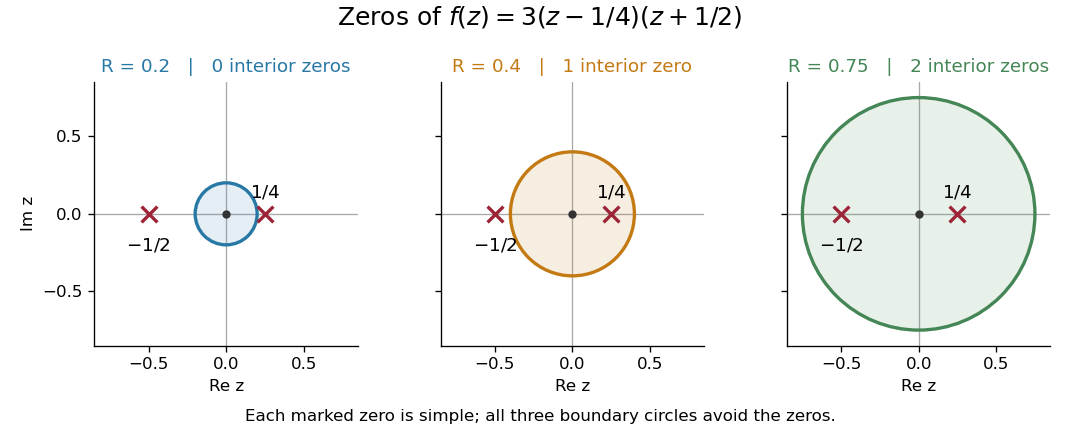
The zeros of inside three concentric disks
. The three boundary circles enclose respectively zero, one and two simple zeros. Each zero contributes to Jensen's formula only after the radius exceeds its complex modulus. Details.
The corresponding values of the circle log-mean of a holomorphic function and the circle geometric mean of a holomorphic function areFor example, at the contribution of the sole interior zero of a function is ; adding it to gives . The second polynomial root still affects , but contributes no additional interior-zero term at this radius.
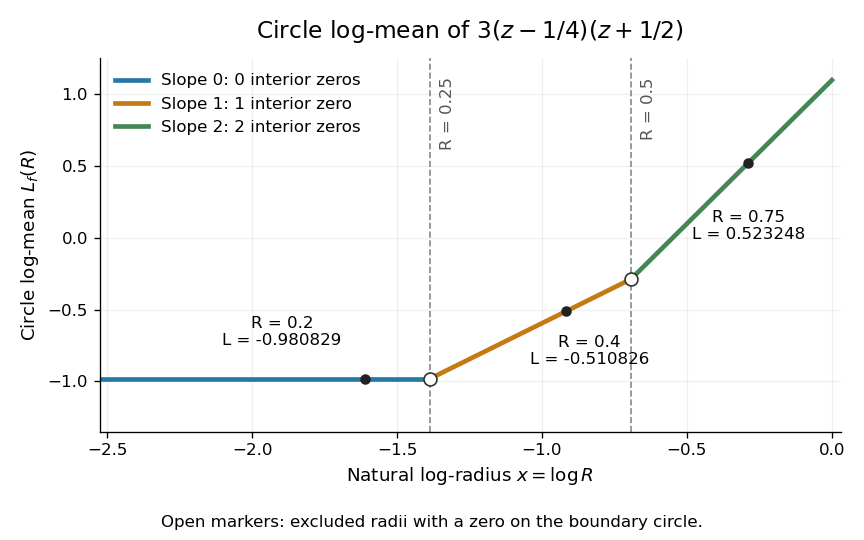

The continuous angular geometric mean of the positive boundary complex modulus isHere the empty product is one. This differs from the angular arithmetic mean . In general by the concavity of the logarithm; equality requires constant boundary complex modulus. For a holomorphic function with no zeros of a function in the closed disk, Jensen's formula gives , even when the boundary complex modulus varies with angle. Thus replacing the mean of a logarithm by the logarithm of an arithmetic mean loses the exact zero identity.
Chromatic index bounds 2026-10-14
For every finite simple graph, Vizing's theorem givesHere is the maximum degree of a graph, taken as zero when there are no vertices. A bipartite graph has the stronger equality . The six-job complete bipartite graph above attains this lower bound, while the triangle in a graph attains the extra-colour alternative. The simple-graph restriction in the upper bound matters.[ref]
The bipartite graph equality still holds for finite loopless multigraphs, with parallel edges counted separately in each vertex degree. For instance, parallel jobs between two resources need exactly slots: every pair conflicts, and . For a general finite loopless multigraph, however, the simple graph upper bound can fail. Put two parallel edges on each side of a triangle in a graph. All six edges pairwise share a vertex, so each needs its own colour; every vertex has degree of a vertex four. Consequently . A multiplicity-aware bound is , where is the largest number of parallel edges between a pair of vertices. The doubled triangle in a graph has and attains that bound. These statements exclude self-loops; the two-distinct-resource scheduling model excludes them too.[ref]
Line graphs and edge coloring. Line graphs and edge coloring, slide 2: bipartite multigraph equality, multiplicity bound and fat triangle
For historical orientation, Graph Theory by Reinhard Diestel (Colouring preview, §5.3, p. 132) dates the bipartite equality to 1916 and Vizing's theorem to 1964. These are textbook attributions; the original papers have not been inspected here. The results state existence of optimal or nearly optimal proper edge colourings, rather than saying that arbitrary greedy choices will find them. The list-chromatic index asks the further question of success for every sufficiently large family of allowed-colour lists.
A rational map is smooth as a map between compact round spheres, including at its poles in reciprocal coordinates. Its spherical differential norm therefore has a finite supremum . Integrating along a shortest spherical geodesic gives . Since , we obtain . In finite coordinates the differential norm is , extending continuously to the whole sphere. This uniform bound is useful for passing equicontinuity through compositions.
Spectral Kraus decomposition Created 2026-10-14 Updated 2026-11-05
Use the unnormalized Choi matrix , which has trace for a channel. A positive such matrix has a spectral decomposition with vectors . In paired bases define the Kraus operator by , so . Partial contraction with a conjugate index vector gives , hence . Rank-one projectors span the operator space, proving the Kraus representation on all inputs. Trace preservation is equivalent to . This construction needs at most nonzero Kraus operators.
Let , and . The canonical anticommutation relations imply and . The Leibniz rule for the commutator, together with and , gives the displayed transformations. These are equal-time operator relations; common nonzero quark masses remove conservation of the charges without changing their canonical action on the fields.
Quark chiral condensate 2026-10-14
A nonzero vacuum value of the scalar quark density breaks the massless nonsinglet chiral symmetry to its diagonal vector subgroup. Indeed, the nonsinglet axial charge algebra of quark densities gives , whereas invariance of the vacuum under every conserved axial charge would make these expectations vanish. The three broken generators produce three massless Goldstone bosons in the exact chiral limit. Small equal quark masses explicitly break that symmetry and turn the pions into pseudo-Goldstone bosons, with squared masses linear in the quark mass at leading order.
Uniqueness of the two-derivative two-flavour chiral action Created 2026-10-14 Updated 2026-11-05
For with , the chiral group acts transitively. A derivative-free invariant is therefore constant. At , its diagonal stabilizer acts on tangent vectors by the irreducible three-dimensional rotation representation; the only invariant symmetric metric is a multiple of . Transporting this metric gives the displayed unique Lorentz-invariant two-derivative action up to normalization and total derivatives. Equivalently, is traceless, eliminating a separate double-trace invariant. Writing and using gives canonically normalized pion kinetic terms.
Leading pion mass from a two-flavour condensate Created 2026-10-14 Updated 2026-11-05
For condensate normalization , replacing the condensate matrix by maps the real quark mass matrix to . Since , expansion gives a constant minus . Comparison with gives the displayed common leading mass. Strong isospin-breaking mass splitting enters beyond this leading action; electromagnetic effects are also excluded.
The relation uses for the tautological line on the projectivization of . It follows from the rank of the complementary bundle and Whitney multiplication. The alternating signs are ring subtraction; they do not assert that the First Chern class of a dual line is the additive negative in complex cobordism, where duality uses the formal-group inverse.
// Target: geometry-and-topology.bigb
For a smooth degree- projective hypersurface , put . The cotangent Euler sequence in homogeneous coordinates gives . The Conormal exact sequence for Kähler differentials and Whitney sum formula for Chern classes therefore yield . In codimension , its coefficient is . Higher classes vanish by rank and dimension; the formal quotient is truncated in the Chow ring.
Kaon bag parameter 2026-10-14
For relativistically normalized kaon states and , define . The dimensionless kaon bag parameter measures strong interaction corrections to the vacuum-insertion normalization. The coefficient and matrix element must be defined in the same renormalization scheme and at the same scale. Dividing by gives the corresponding two-state mixing-Hamiltonian normalization.
Charge carrier mobility Created 2026-10-14 Updated 2026-10-18
Charge carrier mobility is the magnitude of steady drift velocity per unit weak electric field in a scalar transport model. In the Drude model, and . The positive charge carrier mobility separates ease of motion from the sign of electric charge; its SI unit is .
Drift velocity Created 2026-10-14 Updated 2026-10-20
The drift velocity is a charge carrier population's mean velocity relative to its material's rest frame. It describes the net transport superposed on microscopic motion. For a single species, current density is ; for electrons, reverses the direction. It is distinct from the propagation speed of an electrical disturbance. [ref]
https://openstax.org/books/university-physics-volume-2/pages/9-2-model-of-conduction-in-metals. Ling, Sanny and Moebs, §9.2: drift and transport
. Characteristically simple group Created 2026-10-14 Updated 2026-11-05
A nontrivial group with no proper nontrivial characteristic subgroup. A minimal nontrivial normal subgroup of a finite group has this property: every characteristic subgroup of it is normal in the ambient group.
Exponential martingale of a Lévy process 2026-10-14
With the convention , this complex process is a martingale for each real . Its absolute value is the deterministic finite number . Conditioning on the past at time and using independent increments multiplies by , giving . Under the opposite exponent convention the sign of the compensating term reverses.
Gelfand representation 2026-10-14
For a unital commutative complex Banach algebra , the Gelfand transform sends to the continuous function on its character space of an algebra. It is a contractive unital algebra homomorphism into .
For a commutative complex unital Banach algebra, maximal ideals correspond bijectively to characters of an algebra by taking kernels. Give the maximal ideal space the Gelfand topology through this correspondence. It is a compact Hausdorff space, since the characters form a weak-star closed subset of the dual unit ball, which is compact by the Banach-Alaoglu theorem.
Algebraic torus character 2026-10-14
An algebraic torus character is a morphism of algebraic groups . For a split torus with character lattice , these are precisely the Laurent monomials , with .
// Target: algebra.bigb
There are unlisted articles, also show them or only show them.