
R. S. DaBell Created 2026-10-14 Updated 2026-11-05
R. S. DaBell coauthored validation of Fourier-transform microwave spectroscopy for trace gases. Comparisons of carrier conditions and a blind mixture test how reliably spectral measurements recover prepared concentrations.
The experiment distinguishes molecular identification from quantitative calibration: detecting a characteristic line does not by itself establish its concentration.[ref]
The Validation of Fourier-Transform Microwave Spectroscopy for Trace-Gas Analysis. Printed pages 25–27, Figures 2–3 and 6, Table II
Pamela M. Chu Created 2026-10-14 Updated 2026-11-05
Pamela M. Chu coauthored validation of Fourier-transform microwave spectroscopy for trace-gas analysis. The study compares an instrument response with known and blind gas mixtures.
A resolved rotational line can identify a molecule, but quantifying its abundance also requires a calibration model. Nozzle expansion and carrier-gas conditions can alter the relation between the prepared mixture and the measured signal.[ref]
The Validation of Fourier-Transform Microwave Spectroscopy for Trace-Gas Analysis. Printed pages 25–27: apparatus, calibration and blind mixture
Identity source: www.nist.gov/people/pamela-m-chu
Andrei Tokmakoff Created 2026-10-14 Updated 2026-11-05
Andrei Tokmakoff developed teaching treatments of molecular absorption lineshapes and rotational optical responses. His authored notes connect population differences and transition matrix elements with an experimentally observed spectrum.
A transition's energy determines where a line can occur, while its dipole or polarizability matrix element helps determine whether the line is observable. This separates the existence of energy levels from the strength of a spectroscopic signal.[ref]
Absorption lineshapes by Andrei Tokmakoff. Sections 6.1–6.2, population factors and optical matrix elements
Identity source: chemistry.uchicago.edu/faculty/andrei-tokmakoff

Portrait of Andrei Tokmakoff
. Photograph identified on the University of Chicago Department of Chemistry profile. William E. Moerner Created 2026-10-14 Updated 2026-11-05
William E. Moerner coauthored optical detection and spectroscopy of individual molecules in a solid. Resolving a single emitter separates its response from the average over many molecular environments.
The experiment connects spectral selectivity and optical sensitivity with molecular-level observation. A measured ensemble line can hide distinctions that become visible when individual molecules are observed.[ref]
Optical detection and spectroscopy of single molecules in a solid by W. E. Moerner and L. Kador. Primary single-molecule optical detection paper

Portrait of William E. Moerner
. Christopher P. Michel (Cmichel67), own photograph, 18 July 2024. Creative Commons Attribution-Share Alike 4.0 International., via Wikimedia Commons. Source.
Delmar S. Larsen Created 2026-10-14 Updated 2026-11-05
Delmar S. Larsen authored or curated a physical-chemistry treatment of harmonic vibrations and infrared spectroscopy. Its dipole-change criterion explains why a vibrational mode can exist without producing an ordinary infrared absorption line.
Anharmonic corrections also permit overtones absent from the simplest harmonic, linear-dipole selection rule. These distinctions connect a model's assumptions with the features actually seen in a spectrum.[ref]
14: Harmonic Oscillators and IR Spectroscopy, UCD Chem 110A by Delmar S. Larsen. Lecture 14: infrared activity and overtone discussion
Tim Harrison Created 2026-10-14 Updated 2026-11-05
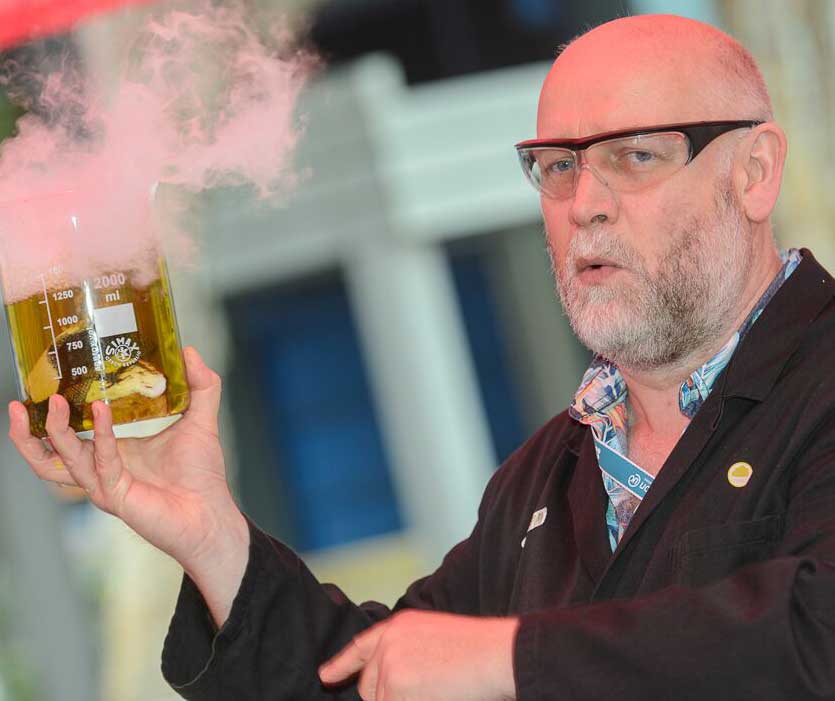
Tim Harrison co-prepared demonstrations that link visible chemical changes with equations and controls. In the zinc–copper-sulfate demonstration, a comparison with zinc sulfate helps test the interpretation of metal displacement.
The display is useful scientifically because the control and material balance connect an appearance change with a specific chemical transformation.[ref]
Chemical Demonstrations Booklet by Magdalena Wajrak and Tim Harrison. Demonstration 16, equipment, observations, and comparison
Magdalena Wajrak Created 2026-10-14 Updated 2026-11-05
Magdalena Wajrak co-prepared chemical demonstrations connecting visible observations with balanced reaction chemistry. A zinc–copper-sulfate comparison distinguishes a reacting metal-salt pair from a zinc-sulfate control.
The control helps assign the colour and deposit changes to the proposed redox transformation. An observation becomes more informative when a comparison excludes a simpler explanation.[ref]
Chemical Demonstrations Booklet by Magdalena Wajrak and Tim Harrison. Demonstration 16, pages 32–33
Her institutional profile identifies her as a chemist whose research areas include electrochemistry and theoretical chemistry.
George T. Furukawa Created 2026-10-14 Updated 2026-10-18
A chemist specializing in physical chemistry and precision thermometers.[ref]
https://cen.acs.org/articles/84/i20/Obituaries.html. Obituaries, 15 May 2006, George T. Furukawa entry: physical chemistry and precision thermometer calibration
His initials G. T. Furukawa appear on the 1997 study of triple-point cells.[ref]https://www.nist.gov/publications/effects-different-methods-preparation-ice-mantles-triple-point-water-cells-temporal. NIST publication record, Author(s): G T. Furukawa; Metrologia 34 (1997)
Gerhard Leubner-Metzger Created 2026-10-14 Updated 2026-11-05
Researcher in seed physiology. With William E. Finch-Savage, Leubner-Metzger analyzed regulation of seed dormancy and germination, distinguishing a viable seed’s capacity to grow from its immediate response to favorable conditions.[ref]
Seed dormancy and the control of germination by William E. Finch-Savage and Gerhard Leubner-Metzger. Title, author list and reported study
William E. Finch-Savage Created 2026-10-14 Updated 2026-11-05
Researcher in seed physiology. With Gerhard Leubner-Metzger, Finch-Savage analyzed seed dormancy and germination control, connecting environmental sensing with the physiological state that permits or prevents growth.[ref]
Seed dormancy and the control of germination by William E. Finch-Savage and Gerhard Leubner-Metzger. Title, author list and reported study
Vivian Kearns Toole Created 2026-10-14 Updated 2026-11-05
Researcher in seed physiology. Toole coauthored experiments on reversible light control of germination, making the timing of a developmental transition experimentally responsive to environmental signals.[ref]
A Reversible Photoreaction Controlling Seed Germination by Harry Alfred Borthwick and others. Title, author list and reported study
Eben H. Toole Created 2026-10-14 Updated 2026-11-05
Researcher in seed physiology. Toole coauthored experiments on reversible photochemical control of germination, helping connect environmental light with the decision to initiate growth.[ref]
A Reversible Photoreaction Controlling Seed Germination by Harry Alfred Borthwick and others. Title, author list and reported study
Marion W. Parker Created 2026-10-14 Updated 2026-11-05
Plant physiologist and coauthor of research on reversible light control of germination. The study connected light exposure with a physiological response that could be switched by a subsequent treatment.[ref]
A Reversible Photoreaction Controlling Seed Germination by Harry Alfred Borthwick and others. Title, author list and reported study
Harry Alfred Borthwick Created 2026-10-14 Updated 2026-11-05
Plant physiologist who coauthored experiments on reversible light control of germination. Alternating light treatments made the physiological response reversible, connecting a plant developmental decision with a photochemical switch.[ref]
A Reversible Photoreaction Controlling Seed Germination by Harry Alfred Borthwick and others. Title, author list and reported study
Greenfield Sluder Created 2026-10-14 Updated 2026-11-05
Researcher in cell division. Sluder coauthored experiments showing how unattached kinetochores generate a signal delaying anaphase, connecting individual-chromosome status with cell-wide checkpoint control.[ref]
Alexey Khodjakov Created 2026-10-14 Updated 2026-11-05
Researcher in mitosis. Khodjakov coauthored work on the inhibitory signal from unattached kinetochores, using cellular observations to connect chromosome attachment with control of anaphase.[ref]
Richard W. Cole Created 2026-10-14 Updated 2026-11-05
Researcher in microscopy and mitosis. Cole coauthored experiments on signaling by unattached kinetochores, connecting observations of chromosome behavior with a mechanism that prevents premature anaphase.[ref]
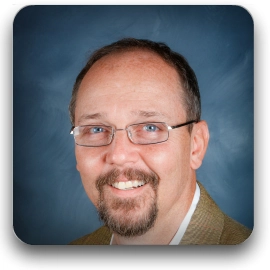
Portrait of Richard W. Cole
. Portrait linked on the QUAREP profile of Richard Cole, which identifies his Wadsworth Center microscopy appointments. Conly L. Rieder Created 2026-10-14 Updated 2026-11-05
Researcher in mitosis. Rieder and collaborators investigated the inhibitory signal produced by unattached kinetochores, connecting chromosome attachment status with the checkpoint that delays anaphase.[ref]
William F. Dove Created 2026-10-14 Updated 2026-11-05
J. David McDonald Created 2026-10-14 Updated 2026-11-05
Geneticist and coauthor of the study identifying the mouse Clock gene through mutagenesis and mapping. The work connected an experimentally altered behavioral rhythm with a specific genetic locus.[ref]
There are unlisted articles, also show them or only show them.