
Johann Andreas von Segner Created 2026-10-14 Updated 2026-11-05
Johann Andreas von Segner trained in medicine and later worked in mathematics, physics and astronomy. His institutional biography emphasizes fluid mechanics and his development of a reaction water wheel, an early hydraulic turbine.[ref]
https://www.catalogus-professorum-halensis.de/segner-johann-andreas.html. University of Halle historical catalogue, academic appointments and fluid-mechanical work
The apparatus turns a redirected water flow into torque: the exiting fluid carries angular momentum, and its change is balanced by a reaction on the rotor. This makes the device an example of how a conservation law becomes a mechanical design principle.
Johann Andreas von Segner
. Historical portrait identified on the portrait record. Source.
Eugène Charles Catalan Created 2026-10-14 Updated 2026-11-05
Eugène Charles Catalan studied counting problems including triangulations of a polygon, leading to the sequence now called the Catalan numbers.[ref]
https://mathshistory.st-andrews.ac.uk/Biographies/Catalan/. University of St Andrews biography, summary and triangulation work
The formula counts several apparently different families: triangulations of a convex -gon, balanced parenthesizations and plane binary-tree structures. The Catalan recurrence expresses how selecting a root operation divides such an object into two smaller objects. This illustrates why a historical counting problem can become a reusable language for combinatorics.Homepage: 200.ulg.ac.be/catalan-bio.html


Igor Pak Created 2026-10-14 Updated 2026-11-05
Igor Pak works in discrete mathematics, including enumerative combinatorics, algebraic combinatorics, polyhedral geometry, and probability and computation on groups. His research page presents these as interconnected subjects and lists lectures on convex polytopes and combinatorial inequalities.[ref]
https://www.math.ucla.edu/~pak/. Research statement and selected lectures
A common theme is to explain a numerical counting identity through the structure of the objects being counted, such as a bijection, rather than relying only on algebraic manipulation. Polyhedral methods add geometric constraints to those discrete enumeration questions.Homepage: www.math.ucla.edu/~pak/

Willem Mantel Created 2026-10-14 Updated 2026-11-05
Willem Mantel posed the1907 question now associated with the triangle-free extremal bound: a triangle-free graph with vertices has at most edges. A balanced complete bipartite graph attains the bound. The historical record distinguishes the proposer from the published solver, Willem Abraham Wythoff. Mantel also taught calculus to prospective engineers in Delft.[ref]
https://www.nieuwarchief.nl/serie5/pdf/naw5-2016-17-4-275.pdf. Robbert Fokkink,2016, printed pp279–280, Mantel's1907 problem, published Wythoff proof and teaching role
The result is a model of extremal graph theory: forbidding a small configuration imposes a global limit on edge density. Pál Turán Created 2026-10-14 Updated 2026-11-05
Pál Turán worked in number theory and combinatorics. His1934 proof of the typical size of the number of prime divisors became an important precursor of probabilistic number theory: averaging a counting function can reveal the behaviour of almost all integers without computing it separately for each integer.[ref]
https://mathshistory.st-andrews.ac.uk/Biographies/Turan/. University of St Andrews biography,1934 Hardy–Ramanujan proof and doctoral thesis
In extremal graph theory, the theorem carrying his name asks how many edges force a complete subgraph. The triangle case gives the sharp threshold, attained by a balanced complete bipartite graph.
Portrait of Pál Turán
. Bundesarchiv, Bild 183-33149-0001 / CC-BY-SA 3.0; photographer unknown. CC BY-SA 3.0, via Wikimedia Commons. Source.
Robbert Fokkink Created 2026-10-14 Updated 2026-11-05
Robbert Fokkink studies game theory, dynamical systems, ergodic theory and topology. His research statement highlights search games, symbolic sequences and the topology of inverse limits and tiling spaces.[ref] A search-game model makes uncertainty strategic: the best search plan depends on where a target can be hidden and what information the searcher receives. His historical research on Willem Abraham Wythoff also connects the provenance of early extremal graph theory with the study of mathematical games.[ref]
https://www.nieuwarchief.nl/serie5/pdf/naw5-2016-17-4-275.pdf. Authored historical article,2016, pp275–280
Homepage: diamhomes.ewi.tudelft.nl/~rfokkink/
Jan-Hendrik Evertse Created 2026-10-14 Updated 2026-11-05
Jan-Hendrik Evertse works in number theory, particularly Diophantine equations. His books study the unit equation over a number field, equations involving discriminants, and effective methods for Diophantine equations over finitely generated integral domains. The effective viewpoint asks for bounds and procedures that make solution sets accessible to explicit computation, beyond an abstract existence or finiteness statement.[ref]
https://pub.math.leidenuniv.nl/~evertsejh/. Author homepage, books on unit equations, discriminant equations and effective Diophantine methods
Homepage: pub.math.leidenuniv.nl/~evertsejh/

Homepage photograph for Jan-Hendrik Evertse
. Image linked from the Leiden Mathematical Institute homepage and labelled Oberwolfach 2012. Carl Gustav Jacob Jacobi Created 2026-10-14 Updated 2026-11-05
A German mathematician who made major contributions to elliptic functions, number theory and Hamiltonian mechanics. His 1829 work on elliptic functions developed a theory using theta functions, during the same period in which Niels Henrik Abel independently advanced the subject.
He also investigated first-order partial differential equations arising in dynamics and wrote extensively on determinants. The Jacobian determinant bears his name: it measures local volume scaling for a differentiable change of variables. This connects his work to both coordinate transformations in multivariable calculus and the study of dynamical equations. His Königsberg teaching helped establish research seminars as a way to train mathematicians. [ref]
https://mathshistory.st-andrews.ac.uk/Biographies/Jacobi/. University of St Andrews historical biography, mathematical work and career

Portrait of Carl Gustav Jacob Jacobi
. August Kaselowsky; heliogravure by Giesecke & Devrient. Public domain (as designated on Commons). Source and usage information on the linked Wikimedia file page. Source.
André Jürgen Massing Created 2026-10-14 Updated 2026-11-05
André Jürgen Massing works on numerical methods for partial differential equations, including finite element methods for fluid mechanics and problems with moving boundaries. His publications study both computational formulations and error estimates, connecting approximation on a mesh with the reliability of the simulated physical model.[ref]
https://www.ntnu.edu/employees/andre.massing. NTNU profile, publications on cut finite elements, moving-boundary multiphysics and Stokes time stepping
Homepage: www.ntnu.no/ansatte/andre.massing
John C. Butcher Created 2026-10-14 Updated 2026-11-05
John C. Butcher works on numerical methods for ordinary differential equations, particularly Runge-Kutta methods and general linear methods. His research connects the algebraic structure of a numerical method with its approximation and numerical stability properties. The Butcher tableau records the stages and weights of a Runge-Kutta method compactly.[ref]
https://www.math.auckland.ac.nz/~butcher/biography.html. University of Auckland biography, Research Interests and 1991 mathematical-research award citation
Karl Heun Created 2026-10-14 Updated 2026-11-05
A German mathematician who studied linear differential equations and later held a chair in technical mechanics at Karlsruhe. His work on second-order equations with four singular points led to the Heun equation, extending the family associated with the hypergeometric differential equation.
His name is also attached to Heun's method, a predictor-corrector Runge-Kutta method for numerical integration. The predictor estimates an endpoint slope and the correction averages it with the initial slope. The special-function equation and the numerical method are distinct contributions linked by the study of differential equations, rather than two names for the same construction. [ref]
https://mathshistory.st-andrews.ac.uk/Biographies/Heun/. University of St Andrews historical biography, mathematical work and career

Portrait of Karl Heun
. Historical portrait hosted by Wikimedia Commons; attribution and licensing are recorded on the source page. Source.
Carl Runge Created 2026-10-14 Updated 2026-11-05
A German mathematician whose work combined numerical analysis with spectroscopy. He studied numerical solution of equations and the measured wavelengths of elemental spectral lines, rather than treating mathematical computation as separate from experimental questions.
His name is attached to the Runge-Kutta method for approximating ordinary differential equations, alongside Martin Kutta. Such methods replace a continuous evolution by a succession of computed time steps. His work on spectral regularities similarly sought structure in numerical measurements. These two interests make him an example of the exchange between practical calculation and mathematical models of physical observations. [ref]
https://mathshistory.st-andrews.ac.uk/Biographies/Runge/. University of St Andrews historical biography, mathematical work and career

Portrait of Carl Runge
. Unknown photographer; reproduced in Constance Reid, Hilbert (1970), p. 234. Commons public-domain claim for life-plus-70 jurisdictions; US basis not supplied, via Wikimedia Commons. Source.
Rodolfo Ruben Rosales Created 2026-10-14 Updated 2026-11-05
Rodolfo Ruben Rosales works in applied mathematics, including nonlinear waves, fluid mechanics, materials science and numerical partial differential equations. His research connects differential equations with physical wave propagation and the numerical methods for approximating those dynamics.[ref]

Portrait of Rodolfo Ruben Rosales
. Photograph identified on the university profile. Steven G. Krantz Created 2026-10-14 Updated 2026-11-05
Steven G. Krantz works in complex analysis, including several complex variables and their connections to harmonic analysis. His research includes boundary behavior and estimates for holomorphic functions, integral operators and the geometry of complex domains. His books develop these analytic and geometric viewpoints as well as introductory real analysis.[ref]
https://www.math.wustl.edu/~sk/vita.pdf. Author CV, research papers including Boundary values and estimates for holomorphic functions of several complex variables, and Books
Homepage: www.math.wustl.edu/~sk/

Portrait of Steven G. Krantz
. Photograph identified on the university profile. Daniel Dadush Created 2026-10-14 Updated 2026-11-05
Daniel Dadush studies mathematical optimization, including linear programming, integer programming, geometry of numbers and discrepancy theory. His work connects the geometry of high-dimensional convex sets with algorithms for mathematical optimization.[ref]
Homepage: homepages.cwi.nl/~dadush/
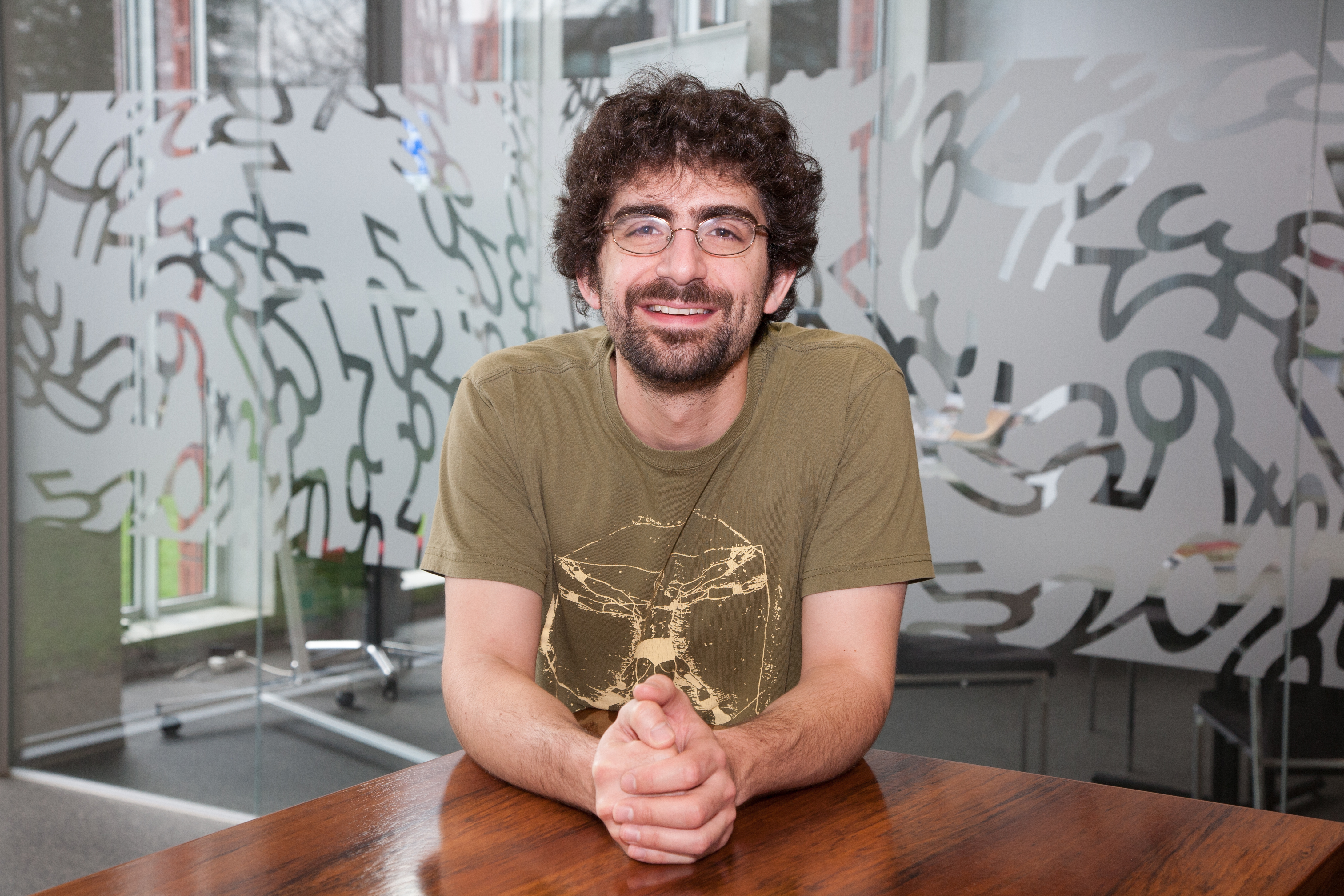
Portrait of Daniel Dadush
. Photograph linked on the CWI personal homepage. Albert W. Tucker Created 2026-10-14 Updated 2026-11-05
Albert W. Tucker worked in topology, game theory and nonlinear optimization. With Harold W. Kuhn he helped formulate the conditions now called the Karush-Kuhn-Tucker conditions, which extend the use of Lagrange multipliers to inequality constraints. He also supplied the familiar name and narrative for the prisoner's dilemma.[ref]
https://mathshistory.st-andrews.ac.uk/Biographies/Tucker_Albert/. University of St Andrews biography, nonlinear programming and the prisoner's-dilemma interpretation
That example makes a mathematical distinction memorable: individually advantageous choices can lead to an outcome both players prefer less than a coordinated alternative. The payoff inequalities, rather than the story alone, define the strategic conflict.Portrait of Albert W. Tucker
. Unknown photographer; First International Topology Conference, Moscow, 1935; ETH Library source; extraction by Jochen Burghardt. Public domain asserted by Commons in origin and life-plus-70 jurisdictions. Source usage terms, via Wikimedia Commons. Source. Harold W. Kuhn Created 2026-10-14 Updated 2026-11-05
Harold W. Kuhn connected game theory with continuous and discrete optimization. His work with Albert W. Tucker supplied the1951 nonlinear-programming formulation behind the Karush-Kuhn-Tucker conditions, while his1955 Hungarian algorithm addressed the assignment problem. He also developed extensive-form games and the relation between mixed strategies and behavioral strategies.[ref]
https://www.princeton.edu/news/2014/07/05/harold-kuhn-princeton-mathematician-who-advanced-game-theory-dies-88. Princeton University obituary, research on nonlinear programming, extensive games and the1955 assignment paper
These contributions distinguish three mathematical questions: local constrained optimality, a discrete cost-minimizing assignment, and which randomized decisions can represent a player's information-dependent plan.Biography: www.princeton.edu/news/2014/07/05/harold-kuhn-princeton-mathematician-who-advanced-game-theory-dies-88

Portrait of Harold W. Kuhn
. Portrait identified on the Princeton University obituary. Image credit: Princeton University Office of Communications. William Karush Created 2026-10-14 Updated 2026-11-05
William Karush obtained necessary conditions for inequality-constrained optimization in his1939 master's thesis. The result was independently rediscovered and published by Harold W. Kuhn and Albert W. Tucker, producing the name Karush-Kuhn-Tucker conditions.[ref]
https://www.math.u-szeged.hu/~hajnal/courses/MSc_Optimalizalas/2014/Cottle%20-%20William%20Karush%20and%20the%20KKT%20theorem.pdf. Richard W. Cottle, William Karush and the KKT Theorem, Documenta Mathematica extra volume2012, printed pp255–257
Their distinguishing idea is that an inequality constraint can be active or inactive: a nonnegative Lagrange multiplier pairs with its constraint through complementary slackness. A constraint qualification is needed for the usual necessary-condition theorem; a stationary Lagrangian equation alone is insufficient. Gaston Floquet Created 2026-10-14 Updated 2026-11-05
A French mathematician who studied linear differential equations, particularly equations with periodic coefficients. His 1883 memoir developed the structure now called Floquet theory: periodic changes can be separated from exponential evolution in a fundamental solution matrix. This reduces a periodically driven linear problem to information accumulated over one period.[ref]
Sur les équations différentielles linéaires à coefficients périodiques by Gaston Floquet (1883). original memoir, Annales scientifiques de l'École Normale Supérieure12, pp47–88
The Floquet multipliers then determine whether repeated periods amplify or suppress perturbations. The idea is useful in the stability analysis of periodic motions, where a coefficient matrix need not be constant for its long-term growth to be tractable. Floquet's teaching and research career was closely associated with Nancy. [ref]
https://mathshistory.st-andrews.ac.uk/Biographies/Floquet/. University of St Andrews historical biography, mathematical work and career

Portrait of Gaston Floquet
. Portrait identified on the MacTutor portrait page. Marco Gualtieri Created 2026-10-14 Updated 2026-11-05
Marco Gualtieri works in differential geometry and mathematical physics, with a focus on generalized geometry. His own research page identifies that focus rather than presenting him only as an instructor.[ref]
https://www.math.toronto.edu/mgualt/. Research statement
The geometric viewpoint concerns structures carried by a smooth manifold, where tangent directions and covectors can be studied together. It connects the study of complex geometry and symplectic geometry with mathematical descriptions of physical fields.Homepage: www.math.toronto.edu/mgualt/
Instructor for the 2012 Topology I: smooth manifolds (MAT1300HF) course; the course information explicitly identifies his role as instructor.
There are unlisted articles, also show them or only show them.