
Entrainment of circadian rhythm Created 2026-10-14 Updated 2026-11-05
Entrainment of circadian rhythm synchronizes a circadian clock to a repeating cue, a zeitgeber. One-to-one entrainment of circadian rhythm gives one cycle per environmental cycle with a stable relative circadian phase.[ref]
Overview of Circadian Rhythms by Martha Hotz Vitaterna and others. pp. 86–87, synchronization to external cues; p. 92, Entrainment and Zeitgeber
The stable relation need not put an activity onset exactly at lights-off: a constant offset also expresses phase locking.For an original local model, let be the activity-onset offset from lights-off on environmental cycle , with a negative value meaning an earlier onset. Choose an intrinsic period and environmental period . Let be a stipulated daily delay, measured in hours; positive moves the next onset later. The recurrence relation isA fixed phase relationship requires : here a half-hour delay balances the half-hour intrinsic advance each cycle. This equality alone describes balance; restoration after a small disturbance also requires fixed point stability for an iteration.
Choose the illustrative local law . Thenfor the chosen starting offset . The error shrinks by a factor of each cycle, proving fixed point stability for an iteration in this model. After five cycles , about fourteen minutes early. At the fixed point, the imposed delay is and the corrected onset interval is , although the uncoupled period remains .
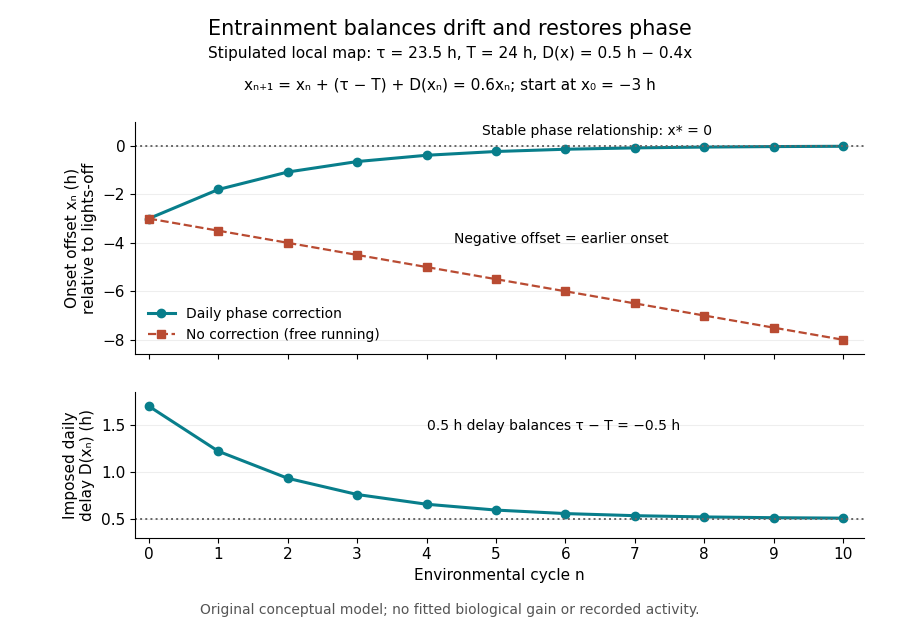
Daily phase correction restores a stable relation in an idealized entrainment of circadian rhythm model
. Original conceptual circadian phase traces from the stated recurrence relation. With the stipulated delay law, the offset approaches zero and the delay approaches half an hour. With no correction, the offset drifts earlier. The coefficient and starting offset are selected for explanation, not measured biological parameters. Lines join discrete cycle values. Details.
The uncorrected comparison has and , so after five cycles it is hours early. The two traces separate ongoing timekeeping from adjustment to a zeitgeber. The chosen linear delay law is only a local teaching construction: it is not a measured response to light, does not account for wrapping of circadian phase, and does not predict an organism's entrainment range. Nor does it include masking of circadian rhythm. In a real study, tracking several cycles after removal of the cue or after a timed perturbation supplies information that a single activity value under illumination cannot provide.
Free-running circadian rhythm Created 2026-10-14 Updated 2026-11-05
A free-running circadian rhythm persists without an entraining cycle. Its period separates corresponding circadian phases, such as successive activity onsets, under specified constant conditions.[ref]
Overview of Circadian Rhythms by Martha Hotz Vitaterna and others. pp. 86–87, Figure 1A; p. 92, Free running
A circadian phase tells where the system is within its cycle; a period tells how long one cycle takes. Choosing onset rather than peak as the reference changes the phase label, not the period of an ideal repeating signal.Consider an original, deliberately idealized model with . For seven days prescribe a 12:12 LD cycle with activity starting at hour 12 of each 24-hour day. Then omit the next scheduled dawn and keep the environment dark. Stipulate that the first DD onset retains hour 12, and that every later onset is exactly after the previous one. Activity lasts eight hours after each onset. These are chosen model values, not recorded mouse or human data, and the fixed activity window represents an output of the model rather than the molecular mechanism of a circadian clock.
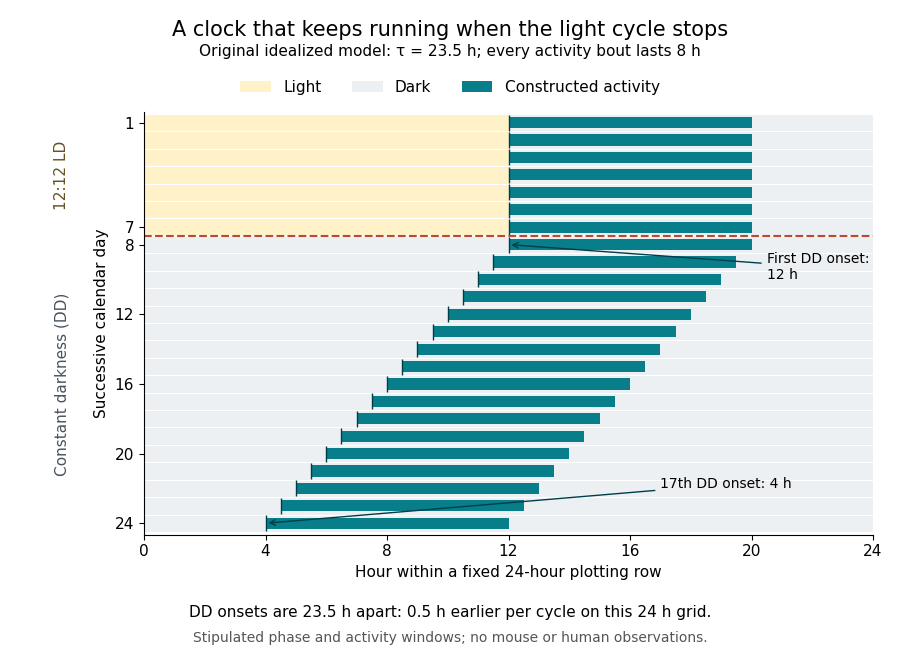
An idealized circadian rhythm under 12:12 LD followed by constant darkness
. Original stipulated actogram: each row is a fixed 24-hour calendar day, with successive days running downwards. Yellow denotes light, pale gray denotes darkness, and teal denotes the chosen activity window. The DD period is , so successive activity onsets move earlier on the plotting grid. No biological measurements are plotted. Details.
An actogram displays activity against time in successive rows. Here each row spans , regardless of the circadian rhythm's period. If is the first DD onset and counts completed free-running cycles, thenThe unwrapped onset displacement is therefore . After eight cycles the onset is four hours earlier than a 24-hour continuation would predict; after sixteen cycles it is eight hours earlier. Because these onsets remain within successive calendar rows in the displayed interval, their row positions are hours. The visual slant comes from comparing two different periods, not from cessation of the oscillation.
An alternative phase oscillator description makes the same distinction explicit. Set the circadian phase to zero at and defineThe angular frequency is constant in this model. Onset occurs whenever the unwrapped circadian phase completes another turn. A period longer than would instead produce later onsets; equality would produce aligned rows even without entrainment of circadian rhythm. Thus aligned rows by themselves do not identify the cause of a daily pattern. Real activity can be noisy, and a free-running circadian rhythm's period can vary with conditions or with time after release; the stipulated straight line assumes a stationary period.
Centromere Created 2026-10-14 Updated 2026-10-18
A centromere is the chromosome region where a kinetochore assembles.[ref]
The Process of Meiosis. Biology 2e by Mary Ann Clark and others; §11.1, Prometaphase I, kinetochore proteins at centromeres
Following DNA replication, both sister chromatids have their own copied centromere regions; the counting convention groups the attached sisters as one replicated chromosome. Cohesin maintains sister association: a centromere is not an extra DNA bridge joining two separate DNA molecules.[ref]Cell Division. Biology 2e by Mary Ann Clark and others; §10.1, Eukaryotic Chromosomal Structure and Compaction, final paragraph, centromeric region and cohesin
Chromosome segregation Created 2026-10-14 Updated 2026-10-20
Chromosome segregation allocates chromosomes to the products of division. Mitosis separates sister chromatids, preserving ploidy in completed daughter cell nuclei. Meiosis I separates homologous chromosomes with their sister chromatids still associated, reducing diploid to haploid ploidy; meiosis II separates the sister chromatids. Only the first of the two divisions reduces the number of complete sets.[ref]
The Process of Meiosis. Biology 2e by Mary Ann Clark and others; §11.1, introduction comparing mitosis and meiosis; Telophase I and Cytokinesis; Meiosis II
For example, correct chromosome segregation of the stipulated three homologous chromosome pairs gives each meiosis I product one , one and one , each replicated. Giving one product both members and the other none would preserve the total DNA across products while failing to give each a complete set. Conservation of material alone does not prove correct chromosome segregation.
Optical activity Created 2026-10-14 Updated 2026-10-18
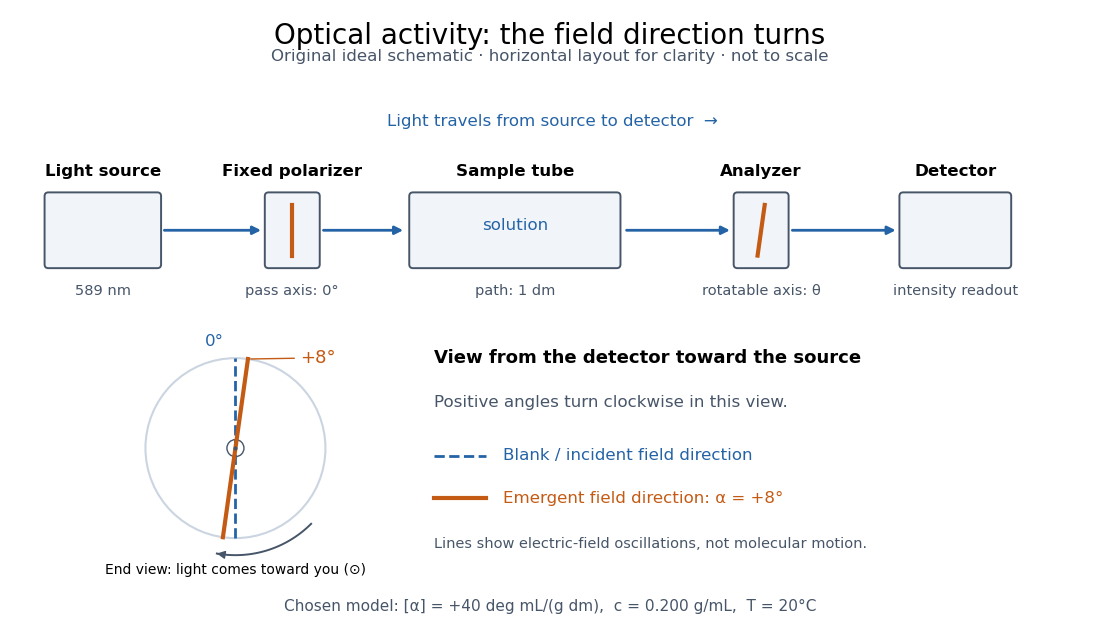
Optical activity is the ability to rotate the direction of linear polarization of transmitted light. In an achiral solvent, the two members of an enantiomer pair have equal and opposite optical rotations at the same wavelength, temperature and concentration. The measured angle concerns a bulk sample; it is not a geometric rotation of the molecules.[ref]
The rotating object in this description is the direction along which the electric field oscillates. At each position the transmitted light can still have linear polarization: its electric field moves back and forth along a line, while the orientation of that line changes along the sample. Nothing requires the molecules to turn bodily through the observed angle. This makes polarimetry a bridge from molecular chirality to a visible bulk measurement, and, with a suitable calibration, a way to follow concentration or the balance of enantiomers.
In a transparent, isotropic chemical solution, natural optical rotation can be understood as circular birefringence: the two opposite circular polarizations accumulate different wave phases, and their equal-amplitude sum remains linearly polarized along a rotated direction. Circular dichroism instead means unequal absorption of those components and can produce elliptical polarization. These are related responses, not interchangeable measurements. General birefringence need not produce this simple rotation of linear polarization.[ref]
Optical Activity and Molecular Dissymmetry in Coordination Chemistry by Stephen F. Mason. Optical Activity and Molecular Dissymmetry in Coordination Chemistry, introduction, printed pp. 335–336: refractive-index difference and absorption counterpart

Axial chirality 2026-10-14
An allene has a unit whose terminal substituents lie in perpendicular planes. In , with and , the two terminal pairs can define enantiomers without any tetrahedral carbon stereocenter. The groups need be different within each end pair, not all four mutually different. This is axial chirality.[ref]
Axial Chirality. Basic Terminology of Stereochemistry, entry Axial Chirality: nonplanar pairs about an axis, including allenes
Meso compound 2026-10-14
A meso compound is an achiral molecule despite having stereocenters. Tartaric acid, , has two tetrahedral carbon stereocenters. Its and forms are enantiomers, but and name the same meso form after equivalent ends are identified. A symmetric spatial arrangement has a mirror plane exchanging its two halves. Thus there are three stereoisomers, not four.[ref]
5.7 Meso Compounds. McMurry, Organic Chemistry, §5.7, Figure 5.12: meso-tartaric acid and its symmetry plane
Opposite R and S configurations alone do not guarantee a meso compound: the rest of the molecule must permit mirror superposition. Likewise, a meso compound is one achiral chemical compound, whereas a racemate is a mixture of two chiral molecule populations. Both can give zero optical rotation for different reasons.
Tetrahedral mirror-image test 2026-10-14
Take a central chemical atom at the origin and four substituents at the vertices of an ideal regular tetrahedron:These dimensionless coordinates describe shape, not measured bond lengths. For distinct labels A, B, C and D, define a signed determinantIt is six times the oriented volume of the labelled tetrahedron. A translation cancels from the differences. A rotation has and preserves , whereas the mirror matrix has and changes it to . Consequently no rotation can place every distinct label on its mirror partner. This argument uses three-dimensional coordinates, not clockwise order on a page.
Now let C and D both be the same substituent H. Swapping these identical groups is allowed. For this model the half-turnabout the axis maps the reflected A and B to their original positions and exchanges the two H positions. The models superpose. With distinct C and D, the same half-turn fails precisely at those two labels; the determinant argument rules out every other rotation as well. This is the local reason two identical hydrogen chemical atoms prevent glycine's amino acid alpha carbon from being a tetrahedral stereocenter.
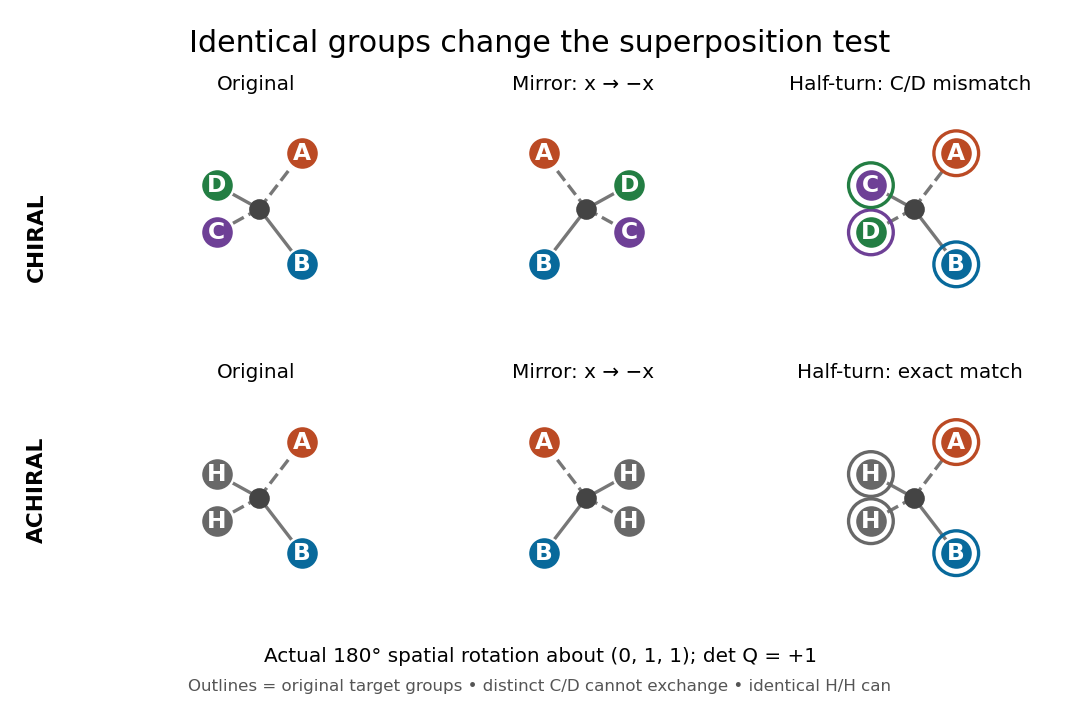
The same spatial half-turn succeeds only when the exchanged groups are identical
. Original model, mirror model and rotated mirror model. Top: the distinct C and D remain mismatched, so the A/B/C/D model is chiral. Bottom: the identical H groups may exchange, so the A/B/H/H model is achiral. The operation is an actual three-dimensional rotation about , with determinant . Details.
For a flexible molecule, also distinguish conformational isomerism from a persistent enantiomer pair. A particular frozen shape may be chiral while ordinary internal motions interconvert mirror shapes. Turning the entire model is always allowed in a spatial comparison; an internal motion must be considered with its actual accessibility and timescale.
Achirality 2026-10-14
Achirality means that a molecule is superposable on its mirror image. A reflection plane that leaves the complete labelled spatial structure unchanged establishes achirality. Absence of such a plane alone is not a complete test: other orientation-reversing spatial symmetries can also make a rigid structure achiral.
Chiral molecule 2026-10-14
LabQuest Experiment 6 from Chemistry with Vernier, issued by Vernier Software & Technology as identified in its printed footer. No individual author or editor and no document date verified; the URL does not establish a publication year.
Online text: openstax.org/books/chemistry-2e/pages/3-3-molarity
Section of Chemistry 2e by Paul Flowers, Klaus Theopold, Richard Langley and William R. Robinson. These are whole-book authors, with no separately credited chapter author. The book citation gives publication on 14 February 2019; no section revision date is inferred.
Section of Chemistry 2e by Paul Flowers, Klaus Theopold, Richard Langley and William R. Robinson. These are whole-book authors, with no separately credited chapter author. The book citation gives publication on 14 February 2019; no section revision date is inferred.
Section of Chemistry 2e by Paul Flowers and others. The 2019 date and author credits belong to the book; no separate section date or author is established.
Cited passages: §15.1, The Solubility Product: saturated solutions and silver chloride dissolution; Predicting Precipitation: comparison of the reaction quotient with the solubility product and mixing volumes.
List of chemical engineers 2026-10-14
Rubidium Created 2026-10-14 Updated 2026-11-05
Rubidium is the chemical element with atomic number 37 and symbol . It is a alkali metal. It commonly forms a singly charged positive ion. Its optical transitions are useful in atomic spectroscopy and laser-cooling experiments, while rubidium-87 adds an experimentally useful isotope-specific nuclear-spin structure.[ref]
Nicotinamide adenine dinucleotide Created 2026-10-14 Updated 2026-11-05
Nicotinamide adenine dinucleotide is a coenzyme with two nucleotide units, one containing nicotinamide and the other adenine. Its oxidized and reduced forms are NAD+ and NADH.
Allene 2026-10-14
An allene contains the unit with two consecutive carbon–carbon covalent bonds of order two. Suitable terminal substituents give axial chirality.
Potassium hydroxide Created 2026-10-14 Updated 2026-11-05
Potassium hydroxide is , an ionic solid that provides potassium and hydroxide ions on dissolution. The hydroxide acts as a strong base in water.
Its stoichiometry is one hydroxide per potassium ion. Comparing it with potassium carbonate shows that sharing a cation does not give two salts the same acid-base behavior.
Silicon dioxide Created 2026-10-14 Updated 2026-11-05
There are unlisted articles, also show them or only show them.