
Online text: sites.math.washington.edu/~lee/Books/ITM/c01.pdf
Author-hosted sample of Chapter 1, Introduction. The second-edition book is credited to John M. Lee, published by Springer in Graduate Texts in Mathematics 202, and carries copyright 2011. Its Chapter 1 definition is explicitly provisional; formal manifold hypotheses in this wiki are supported by the separately cited Toronto notes.
Cited passages: Introduction to Topological Manifolds by John M. Lee, second edition, Chapter 1, pages 1–3 on local models and pages 5–6 on topological invariants.
Online text: introcs.cs.princeton.edu/java/44st/
Cited passages: Introduction to Programming in Java, section 4.4, Binary search trees: recursive definition and node representation.
By Daniel Dadush.
Lecture 1 notes credit Daniel Dadush as scribe, with Daniel Dadush and Léo Ducas listed as lecturers. Mastermath Spring 2018 identifies the course offering; no publication year or whole-course authorship is inferred.
Cited passages: §7, Definition 11 and Lemma 12, printed p. 9: determinant and integer-inverse characterization; §7, Lemma 13, printed p. 9: equivalent lattice bases.
Interpreter arithmetic trace Created 2026-10-14 Updated 2026-10-31
Use the compilation arithmetic example with input . An abstract syntax tree interpreter first reads
x, obtains , forms , and finally computes . Interpreting the folded abstract syntax tree skips the addition but gives the same result. The compiled stack machine instructions instead produce the following trace; the top of the stack is written on the right:instruction stack after instruction
initial []
LOAD x [7]
PUSH 5 [7, 5]
MUL [35]
PUSH 4 [35, 4]
SUB [31]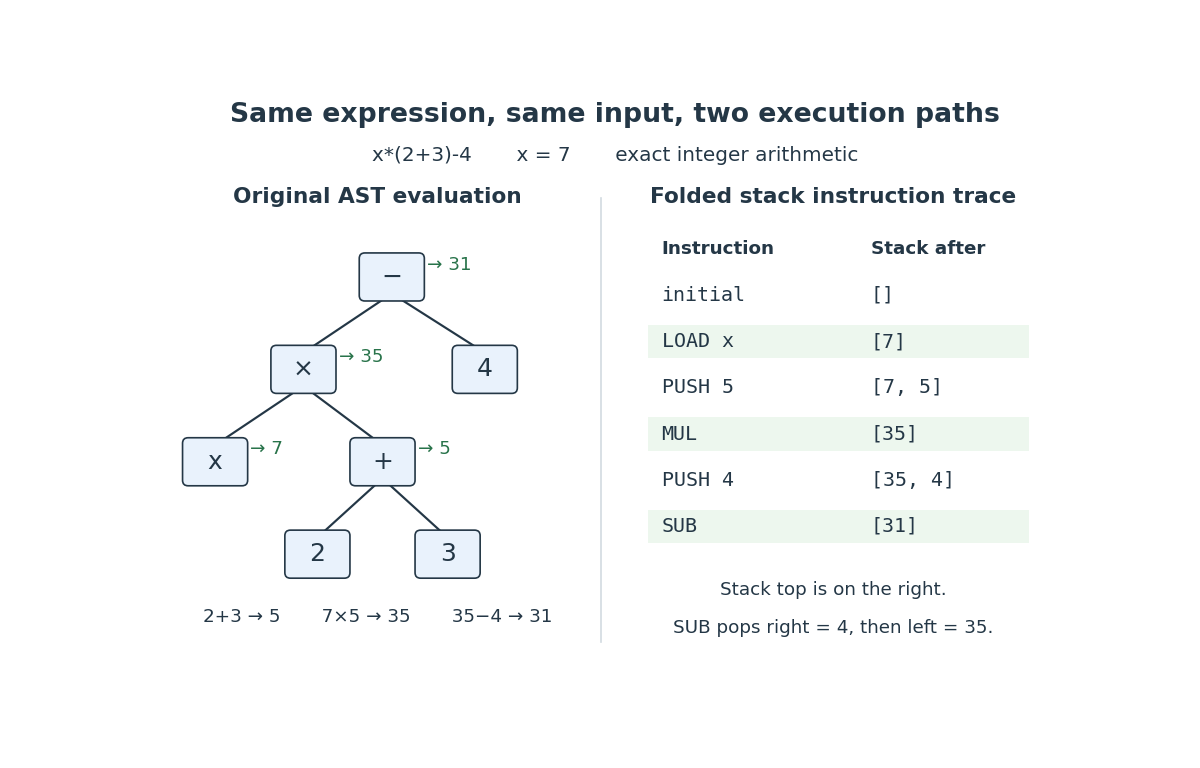
Execution of
. Details. x*(2+3)-4 at : the original abstract syntax tree and the folded stack machine instructions both give 
The order in
SUB is essential: reversing its two popped operands would give . The same stored instruction sequence works for input , yielding , without repeating parsing or constant folding. An abstract syntax tree interpreter can likewise reuse its already-parsed tree. Reusing a representation is therefore useful to both approaches; it does not itself distinguish compilation from interpretation.The pleasing part is that a nested rooted tree and a flat instruction sequence express the same computation. The structural induction in the compilation arithmetic example connects them by a precise stack property. This tiny language always terminates and has no side effects; richer programming language semantics require a correctness argument that also accounts for failures, externally visible actions, and possible nontermination.
Work by I. A. Waitz 2026-10-14
List of historians of mathematics 2026-10-14
Work by Harry Buhrman 2026-10-14
Work by GE Healthcare 2026-10-14
Work by G. P. Moss 2026-10-14
Fundamentals of Numerical Computation by Tobin A. Driscoll and others 5.7 Adaptive integration 2026-10-14
Online text: fncbook.com/adaptive/
§5.7 of the authors’ online textbook. Its difference-based error estimation is distinguished from a universal accuracy guarantee; no online-edition date is inferred.
Fundamentals of Numerical Computation by Tobin A. Driscoll and others 6.4 Runge-Kutta methods 2026-10-14
Online text: fncbook.com/rk/
Hertz Created 2026-10-14 Updated 2026-11-05
The hertz, symbol , is the SI unit of frequency: for a periodic phenomenon. A oscillation completes fifty cycles per second and has period of an oscillation . The unit name is written in lower case in ordinary prose, while the symbol retains its capital H.
Angular frequency is instead expressed in radians per second. A frequency of corresponds to angular frequency , not . The SI uses separate unit names to keep these physically different quantities distinguishable even though both involve inverse time.[ref]
The International System of Units (SI), ninth edition, SI Brochure. §2.3.4, Table 4 and note (d), printed pp. 132–133; discussion of frequency and angular frequency, printed p. 135 in version 4.01
Euclid's Elements by Euclid Book IX, Proposition 36 Created 2026-10-14 Updated 2026-10-18
Cited passages: Book IX, Proposition 36: statement and concluding proof; Euclid, Elements IX.36, translated text and commentary by David Joyce.
Substrate-level phosphorylation Created 2026-10-14 Updated 2026-10-18
Substrate-level phosphorylation forms ATP by enzyme-catalyzed transfer of a phosphate group from a phosphorylated substrate to ADP. In canonical glycolysis, two such transfers occur for each three-carbon route, giving four gross ATP per glucose. Unlike oxidative phosphorylation, these transfers do not require an electron transport chain.[ref]
Biology 2e by Mary Ann Clark and others. §7.2, steps 7 and 10: phosphate transfer to ADP; §7.5, opening comparison of fermentation with respiration
The pyruvate kinase example under Coupled-enzyme readout of glycolytic ATP formation separates the material transfer from its detection. A favourable coupled chemical reaction supplies the driving change in Gibbs free energy; the enzyme supplies a catalytic route. Counting ATP-forming transfers gives a gross yield, while subtracting upstream ATP use gives the net yield.
Oxidative phosphorylation Created 2026-10-14 Updated 2026-10-20
Oxidative phosphorylation couples respiratory redox conversion to ATP formation through chemiosmosis. ATP synthase uses inward proton flow to join ADP and inorganic phosphate.[ref]
Molecular Biology of the Cell, 4th edition by Bruce Alberts and others. Chapter 14, Electron-Transport Chains and Their Proton Pumps, Summary: ATP synthase and chemiosmotic coupling
The intermediate electrochemical gradient explains why respiratory uncoupling can preserve oxygen consumption while reducing ATP formation. An electron ledger alone cannot determine the recovery of useful free energy.
Electron transport chain Created 2026-10-14 Updated 2026-10-20
An electron transport chain transfers electrons from an electron donor through electron carriers to a terminal electron acceptor. In the mitochondrial respiratory chain, some transfers drive protons across the inner mitochondrial membrane; their return through ATP synthase can drive ATP formation.[ref]
Molecular Biology of the Cell, 4th edition by Bruce Alberts and others. Chapter 14, Electron-Transport Chains and Their Proton Pumps, Summary: carrier sequence, outward proton transport and ATP synthase
The useful separation is between an electron route and a proton route. The former ends in a redox chemical reaction; the latter changes an electrochemical gradient across a membrane. Energy coupling connects them without making electrons and protons interchangeable. An oxygen readout consequently need not be an ATP readout.
This article focuses on the mitochondrial respiratory chain. Bacteria can use other terminal electron acceptors in anaerobic respiration. In chloroplast light-dependent reactions, light supplies energy and linear electron transport connects water oxidation to NADP+ reduction, releasing oxygen. Thus neither oxygen consumption nor the mitochondrial arrangement defines every electron transport chain.[ref]
Biology 2e by Mary Ann Clark and others. §7.5, Anaerobic Cellular Respiration; §8.2, Generating an Energy Carrier: linear transport from water to NADP+
Work by E. M. Greitzer 2026-10-14
Work by Dona Mapston 2026-10-14
There are unlisted articles, also show them or only show them.