
William G. Dunphy Created 2026-10-14 Updated 2026-11-05
Researcher in cell cycle control. Dunphy coauthored work on Myt1 and inhibitory Cdc2 phosphorylation, helping connect mitotic regulation with the activities of distinct inhibitory kinases.[ref]

Portrait of William G. Dunphy
. Portrait linked on the Caltech profile of William G. Dunphy. Akiko Kumagai Created 2026-10-14 Updated 2026-11-05
Researcher in cell cycle biochemistry. Kumagai coauthored work on Myt1, connecting inhibitory phosphorylation of Cdc2 at two regulatory sites with a membrane-associated control mechanism.[ref]
T. R. Coleman Created 2026-10-14 Updated 2026-11-05
Coauthor of research on Myt1 and inhibitory Cdc2 phosphorylation. The experiments connected a membrane-associated protein kinase with control of entry into mitosis; initials are retained without an unverified full-name expansion.[ref]
P. R. Mueller Created 2026-10-14 Updated 2026-11-05
Paul Russell Created 2026-10-14 Updated 2026-11-05
Researcher in cell cycle control. Russell coauthored experiments showing inhibitory phosphorylation of Cdc2 by human Wee1, connecting kinase action with regulation of cell division.[ref]
Clare McGowan Created 2026-10-14 Updated 2026-11-05
Researcher in cell cycle control. McGowan and collaborators investigated inhibition of division by Wee1 phosphorylation of Cdc2 at Tyr15, linking a particular chemical modification with suppression of mitotic entry.[ref]
Richard W. Deibler Created 2026-10-14 Updated 2026-11-05
Researcher in cell cycle biochemistry. Deibler and collaborators quantitatively reconstructed activation of mitotic CDK1 in cell extracts, connecting regulatory interactions with the timing of a switch into mitosis.[ref]
Carl Theodor Anger Created 2026-10-14 Updated 2026-11-05
Carl Theodor Anger worked in astronomy and mathematics; the Anger function is associated with his name. This special function provides an example of how oscillatory integrals become reusable mathematical objects.
In modern notation it is defined by . Setting gives , with limiting value one at . The example follows directly by integrating a cosine and illustrates how a general special-function representation yields elementary limiting cases.[ref]
NIST Digital Library of Mathematical Functions. Section 11.10(i), equation 11.10.1: definition of the Anger function
Institutional biographical record: www.deutsche-biographie.de/116311282.html
Diacylglycerol Created 2026-10-14 Updated 2026-11-05
A diacylglycerol is a glycerol derivative with two fatty-acid ester groups and one free hydroxyl group. Both chain identity and the positions of the ester groups specify an individual diacylglycerol.
Certain membrane-associated diacylglycerols act as second messengers. Cleavage of phosphatidylinositol 4,5-bisphosphate can produce a diacylglycerol that stays in the cell membrane together with soluble inositol trisphosphate, allowing one chemical event to generate signals in two cellular locations.
Linear search correctness 2026-10-14
The loop invariant just before inspecting index is: , and no entry at an index matches . Initially , so there are no earlier entries. A failed equality test extends the excluded region by one position and preserves the loop invariant. A successful equality test at index establishes a match; the loop invariant establishes that it is the first one. At exhaustion, and every entry has failed, so the absent result is correct. The number of remaining entries decreases after each failed equality test, proving termination for a finite sequence. Together these establish algorithm correctness under the assumptions that the input is stable and each equality test terminates. No step of the argument compares the relative order of values.
Linear search comparison count 2026-10-14
Count just the equality tests between the target and an entry, excluding loop conditions and index updates. If the first match is at index , linear search uses exactly equality tests. If the target is absent, it uses exactly . Thus for the best successful case costs one equality test, and the worst case costs , attained by absence or a first match at the last index. For , the sole outcome is absence with .
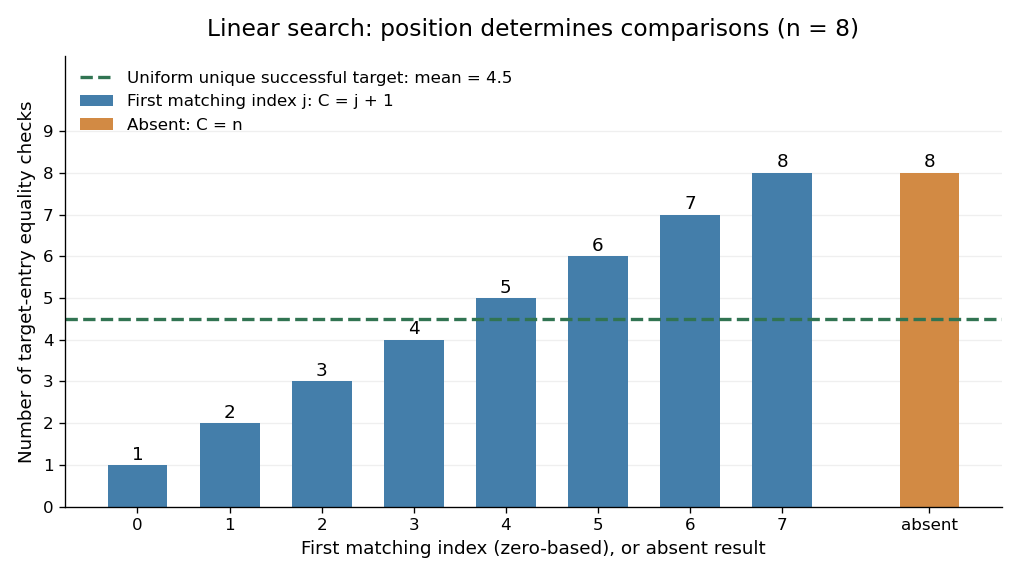

An expected value needs a specified probability distribution. For , condition on success, assume the target occurs exactly once, and assume its position has a uniform distribution on a finite set of indices . Then the expected value of the linear search comparison count isThis is the average of the costs under those assumptions, with no assumption that the array is sorted. It is not a universal average for arbitrary queries. For example, with , a unique successful target at index with probability and at index with probability has expected value , rather than .
Duplicates also require care about what is sampled. Choose a position uniformly in , then search for its value. All queries succeed, but the five possible sampled positions give costs : both positions holding cause an immediate match at index . The expected value is , not . Uniformly choosing an occurrence does not uniformly locate the first match.
More generally, let the success probability be and let be the conditional probability that the first matching index is , allowing duplicates. Since , the expected value isUnder the unique, uniformly located successful-target assumptions this becomes . If every query is absent, and without needing conditional probabilities. When , success is impossible and ; the successful-search conditional formula is undefined.
Converting the linear search comparison count to execution time needs a cost model. Under constant-cost equality tests, next-entry access, and loop bookkeeping, worst-case time complexity is in Big O notation for , with constant overhead even for the empty sequence. Variable-length entries can make an equality test expensive. On a linked list, advance along its links; repeatedly restarting at the head to obtain the next numeric index adds work that the comparison count does not capture. These are exact operation counts and conditional mathematical averages, not runtime measurements.
Low-pass filter Created 2026-10-14 Updated 2026-10-18
A low-pass filter preferentially transmits low frequencies and attenuates higher frequencies. It can smooth rapid noise in a slowly varying signal, but it also suppresses wanted variations outside the useful signal bandwidth. An RC low-pass filter gives a concrete continuous-time example; a moving average implements related smoothing on a discrete-time signal.
The useful question is how much change the measurement can tolerate. Preserving the low frequencies of a temperature record while reducing a fast unwanted oscillation can improve readability. Preserving the sharp onset of a pulse requires higher frequencies, so excessive smoothing changes its timing and shape. The RC low-pass frequency response and RC low-pass step response make this signal bandwidth versus settling time tradeoff quantitative.
Laboratory Manual Physics, Class XII Experiment 6: Resistance and figure of merit of a galvanometer 2026-10-14
Work by Karl Weierstrass 2026-10-14
Work by James M. Fiore 2026-10-14
Online text: goldbook.iupac.org/terms/view/15225
Gold Book entry 15225, in the fifth-edition online version 5.0.0 (2025), issued by IUPAC. The entry cites 2009 recommendations, p. 994; no individual editors or recommendation authors are inferred here.
Cited passages: IUPAC Compendium of Chemical Terminology, fifth edition, entry “polymorph” (15225), definition and Note 2.
Online text: goldbook.iupac.org/terms/view/M03988
Cited passages: Gold Book, fifth edition, molecular ion in mass spectrometry: formation by electron removal or addition without fragmentation.
Online text: goldbook.iupac.org/terms/view/M04002
Cited passages: Gold Book, fifth edition, molecule: neutral entity with more than one atom; bound-state qualification.
Online text: goldbook.iupac.org/terms/view/O04344
Cited passages: Gold Book, osmotic pressure: definition of the solvent-only membrane; Gold Book, osmotic pressure: equilibrium definition, solvent activity formula and dilute ideal limit.
Work by Isaac Newton 2026-10-14
There are unlisted articles, also show them or only show them.