
Discrete Mathematics: An Open Introduction (3rd edition) by Oscar Levin 3.1 Propositional Logic 2026-10-14
Cited passages: Discrete Mathematics: An Open Introduction, 3rd edition, §3.1 Truth Tables: conjunction, disjunction and negation tables; §3.1 Logical Equivalence: definition and comparison of truth-table columns; §3.1 Example 3.1.3 and De Morgan’s Laws box; Front Matter: title, whole-book author, edition, displayed date August 12, 2025; Institutional Oscar Levin profile, Publications entry: third edition (2018).
The manufacturer-issued Protein Preparation Handbook reports a paired dialysis comparison: of bovine serum albumin, in sodium chloride, was held behind a MWCO membrane against of water in a conical tube, shaken at room temperature. The bath was replaced after two hours. A conventional stirred-beaker treatment against of water supplied the comparison control. Residual salt was followed by sample electrical conductivity; results averaged two samples. This readout tests small-ion removal, not protein retention.[ref]
Protein Preparation Handbook, Thermo Fisher Scientific. Protein Preparation Handbook, printed p. 11, Figure 9A and caption: sample preparation, 10K membrane, baths, conductivity and conventional-dialysis reference
Its separate retention experiment used individual proteins at in saline or carbonate-bicarbonate buffer solution, pH , with membranes rated , , , and . After seventeen hours at , retained protein was estimated by a bicinchoninic acid assay. The size series and membrane series compare retention; they do not isolate shape independently of mass. The figure caption supplies neither a no-membrane recovery control nor a complete uncertainty analysis. These are manufacturer comparisons, not proof of universal recovery or unchanged enzyme function.[ref]
Protein Preparation Handbook, Thermo Fisher Scientific. Protein Preparation Handbook, printed p. 11, Figure 8 and caption: membrane series, preparation, duration, temperature and protein assay; the separately plotted vitamin B12 uses a different optical readout
The two experiments answer complementary questions: did the small solute leave, and did the desired macromolecule remain? In a new experiment, a bath blank and a starting salt standard would help interpret electrical conductivity, while a matched undialyzed protein aliquot and recovered volume would help distinguish handling loss from dilution. Those are proposed additional controls, not controls claimed for the published figures. Other ions also contribute to electrical conductivity, so the readout cannot generally identify sodium chloride alone in an unfamiliar buffer solution.
Repeated-bath dialysis model 2026-10-14
Consider an original ideal model with sample volume , bath volume , and initial sample solute concentration . Assume each volume is fixed, a freely permeant, nonbinding solute, no chemical reactions, complete mixing on each side, and equal concentrations at equilibrium. Each fresh bath initially contains none of this solute. The protein is perfectly retained in this model.
The first equilibration redistributes the initial amount of substance through both compartments. Conservation givesThis denominator includes the sample itself. For the chosen and , , rather than . Nine-tenths of the initial solute is in the bath and one-tenth remains in the sample; nothing has vanished during equilibration.
Discarding the equilibrated bath removes its solute. A second fresh bath starts with only of solute in the entire system, so the same argument applies again. Induction gives the geometric progressionHere counts completed equilibrations with fresh baths: is the first bath, follows one replacement, and follows two replacements. The normalized sample concentrations are respectively , and . Leaving the first bath in place for longer cannot lower the ideal equilibrium value below .
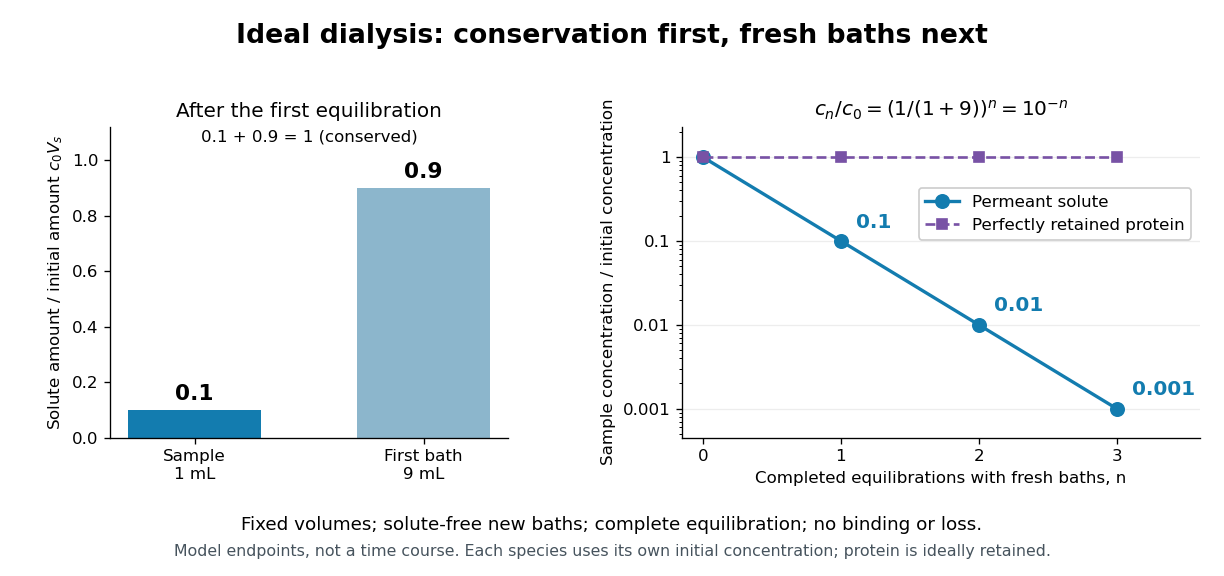
Repeated fresh baths reduce normalized solute concentration geometrically
. Original fixed-volume model, not experimental data. The left panel normalizes the first bath's conserved amount of substance by , distinguishing the sample's share from the bath's share. The right panel plots sample solute concentration divided by after each completed fresh-bath equilibration on a logarithmic vertical axis. The protein curve is normalized independently by its own initial concentration. The perfectly retained protein stays at normalized concentration one only because its amount of substance and the sample volume are fixed. Details.
The same conservation argument handles a fresh bath already containing a permeant solute at fixed concentration :Thus the sample approaches , not necessarily zero. For example, if a hypothetical new buffer component starts at zero in the sample and at in every bath, its sample concentration reaches , and in the three equilibrations. Outward removal and inward replacement follow the same mathematics.
Equilibrium fractions do not specify elapsed time. An illustrative well-mixed linear ordinary differential equation model within one bath isHere is an effective transfer coefficient with units of volume per time. Adding the two equations conserves ; subtracting their normalized forms givesThe difference undergoes exponential decay. A bath replacement resets , renewing the driving difference without making jump instantly. The plotted points are equilibrium endpoints, not a measured time course or a timetable for an arbitrary protein.
Real sample volume can change through osmosis; proteins can be lost through leakage or adsorption to the semipermeable membrane. Consequently, a measured decrease in protein concentration alone cannot distinguish dilution from loss of protein. Measuring recovered volume as well as protein concentration permits an estimate of recovered protein mass.[ref]
Dialysis: an overview, Pierce Biotechnology technical note. Tech Tip 20, p. 2, Other Factors in Dialysis: water transport, volume change and nonspecific membrane binding
Buffer exchange 2026-10-14
Buffer exchange changes the small components surrounding a retained macromolecule toward those of a desired buffer solution. Components absent from fresh dialysate tend to leave; supplied components can enter. Each permeant solute has its own exchange problem.[ref]
Dialysis: an overview, Pierce Biotechnology technical note. Tech Tip 20, pp. 1-2, renewed gradients and Other Factors in Dialysis
For a dilute, nonbinding permeant solute, an ideal equilibrium calculation approaches the bath's specified concentration. That approximation need not describe a solute bound to a protein or a charged mixture with additional electrical constraints. Retaining a protein also does not by itself establish that its protein structure or catalytic function survives the change of buffer solution.
Molecular weight cut-off 2026-10-14
The molecular weight cut-off rates retention of reference molecules. One manufacturer's definition uses the mass at which approximately remains after seventeen-hour dialysis, tested with globular proteins. A rating uses dalton units: a mass, not a length or an absolute passage threshold.[ref]
Dialysis: an overview, Pierce Biotechnology technical note. Tech Tip 20, p. 1, Factors Affecting Dialysis Rate: MWCO definition and globular reference molecules
A semipermeable membrane has a distribution of passage sizes, and a molecule's shape affects passage as well as its mass. Near the nominal MWCO, slow passage can make substantial retention compatible with eventual leakage. The protein-retention experiment below makes retention an observable quantity rather than a universal yes-or-no property inferred from the label.
Dialysate 2026-10-14
The external chemical solution on the other side of a dialysis semipermeable membrane. Its composition supplies the boundary condition for exchange: it can receive unwanted small solutes or supply desired small solutes. A bath replacement discards the old dialysate and introduces a new reservoir with a specified composition.
Work by David R. MacIver 2026-10-14
The inspected online edition is undated. The displayed 2016–2026 range has no stated date role and is not taken as a publication year.
Cited passages: Data Structures and Algorithms, section 9.1.1: complete shape and binary heap example; Data Structures and Algorithms, section 9.1.1: full shape and Huffman coding tree example; Data Structures and Algorithms, section 9.1.1: perfect shape, equal leaf levels, and Figure 9.4; Data Structures and Algorithms, section 9.1.2, height pseudocode: null returns -1.
Work by Cosma Rohilla Shalizi 2026-10-14
LLVM Created 2026-10-14 Updated 2026-11-05
LLVM is a collection of reusable compiler infrastructure built around a typed intermediate representation. Its static single-assignment form gives each register-like value one definition, making data dependencies explicit for compiler optimization. The same intermediate representation has an in-memory form, a compact bitcode form and a readable textual form.[ref]
LLVM Language Reference Manual. Abstract, Introduction and Well-Formedness
A compiler front end translates a source programming language into the intermediate representation; optimization passes transform it while preserving the required semantics; a compiler back end produces code for a target computer architecture. Sharing the middle stages lets several source programming languages reuse the same analyses and target support. For a small textual example,
%y = add i32 %x, 1 defines a new 32-bit integer value from an earlier one. The value %y is defined once even if the source program repeatedly assigns to a source variable. Intermediate representation 2026-10-14
A program representation used between input and final output, convenient for analysis, transformation or execution. An abstract syntax tree and bytecode can each serve this role.
Addition principle 2026-10-14
The rule of sum counts alternatives in disjoint finite sets by adding their sizes. For a disjoint union , each element belongs to exactly one alternative, so . Overlapping alternatives require accounting for repeated elements, as in the inclusion-exclusion principle. The groups indexed by first-return position in the Catalan recurrence are disjoint alternatives.
Inclined plane Created 2026-10-14 Updated 2026-10-18
An inclined plane is a flat surface tilted through an angle above horizontal. A ramp exchanges a smaller lifting force for a longer travel distance; for a released body, it reduces the downhill component of gravitational weight and makes the resulting acceleration easier to measure. Its simplest dynamical model is a nonrotating block on a stationary, rigid surface, with constant mass , uniform gravitational acceleration of magnitude , and . Assume continued contact, negligible drag force, no tipping, and no applied pull. The only forces are gravitational weight, the normal force, and any tangential friction.
The central distinction is between a block resting on the inclined plane and one already sliding. Static friction supplies the force needed to maintain rest, up to its bound; kinetic friction has a prescribed magnitude in the ideal constant-coefficient model. These laws are empirical approximations whose range depends on the contacting surfaces.[ref]
6.2 Friction. University Physics Volume 1 by William Moebs and others; “Magnitude of Static Friction” and “Magnitude of Kinetic Friction”, equations 6.1–6.2; empirical-law limitations before Example 6.10
Trajectory Created 2026-10-14 Updated 2026-11-05
A trajectory describes a body's position as it evolves with time, such as for a point mass. Its first time derivative is velocity and its second is acceleration. A geometrical path records which positions are visited; the time-parametrized trajectory additionally records how fast and in which direction the body moves along that path.
For a projectile in a uniform gravitational field without air resistance, horizontal uniform motion and vertical constant acceleration combine into a parabolic path. Changing the initial velocity selects a different trajectory even under the same force law. A phase-space trajectory retains momentum as well as position, so a particle passing through the same spatial point with different velocities occupies different phase-space states. Returning to one position alone therefore does not establish that the full motion is periodic.
Classical Dynamics by David Tong 3. The Motion of Rigid Bodies Created 2026-10-14 Updated 2026-10-20
Online text: www.damtp.cam.ac.uk/user/tong/dynamics/three.pdf
Cited passages: Classical Dynamics by David Tong, §3.4.3, The Asymmetric Top: Stability, printed pp. 57–58, equations (3.40)–(3.45); Classical Dynamics by David Tong, §3.4.3, equations (3.41)–(3.45), and §3.4.4, invariants (3.46)–(3.47); the invariant-bound argument here is an original short derivation.
Actogram 2026-10-14
Masking of circadian rhythm 2026-10-14
In masking of circadian rhythm, an external condition changes the observed output without necessarily changing the underlying circadian clock.
Circadian phase 2026-10-14
A circadian phase specifies position within a circadian rhythm's cycle relative to a chosen reference event.
Circadian clock 2026-10-14
There are unlisted articles, also show them or only show them.