
Lowest-price auction 2026-10-14
The highest bidder wins a single item but pays the lowest submitted bid, while losers pay nothing. This differs from a lowest unique bid auction. With at least two bidders using increasing strategies, the winning bidder pays the smallest opponent bid.
// Target: mathematical-optimization.bigb
Vickrey auction 2026-10-14
A single-item auction in which the highest bidder wins and pays the highest competing bid. Under private values and quasilinear utility, bidding one's valuation is a dominant strategy: if the competing maximum is below one's value, winning at that price is best; if it is above one's value, losing is best; equality gives zero utility either way. Thus truthful bidding is an ex post Nash equilibrium.
Superattracting periodic point Created 2026-10-14 Updated 2026-11-05
A holomorphic periodic point is superattracting if its return multiplier is zero. The return map then has local expansion with . This implies a strict contraction on a sufficiently small disc and rapid convergence of returns. Infinity is superattracting for every polynomial of degree at least two: the reciprocal-coordinate return has a zero of order equal to the polynomial degree.
Atomic read-modify-write 2026-10-14
An atomic operation that reads a shared object's value and changes it as one indivisible action. For an increment from , the two operations under mutual exclusion produce then in either software thread order. A test-and-set is another example. The operation's ordering guarantees for other data still depend on the memory model and its selected acquire-release synchronization semantics.
Countable atomic model without a countable saturated model Created 2026-10-14 Updated 2026-10-31
Take a countable structure with countably many independent unary predicates, every finite predicate pattern realized infinitely often, and a constant naming every element. Its complete theory has an atomic model: tuples of named elements have types isolated by equations to their names. But every infinite binary predicate pattern, together with inequalities to every named element, is consistent. There are uncountably many such one-types, so no countable omega-saturated model exists. Thus existence of a countable atomic model does not imply existence of a countable saturated one.
Hydrodynamic escape Created 2026-10-14 Updated 2026-11-05
Hydrodynamic escape is atmospheric loss in which collisions couple the gas into a bulk outward flow. Heating raises the gas pressure and can drive expansion against gravity; an escaping solution often accelerates through a sonic point. The temperature and velocity profiles must satisfy energy and momentum balances, rather than being fixed by a collisionless high-speed tail alone.
The flow can carry heavier species along with the dominant light gas, provided coupling is strong enough. Energy-limited atmospheric escape estimates a mass-loss rate by assigning a fraction of absorbed stellar power to gravitational work. That estimate can fail when radiative cooling, limited heating supply or other parts of the flow's energy budget dominate. A small Jeans escape parameter is suggestive of strong escape, but does not by itself specify a unique outflow.
For two-qubit pure states with smaller squared Schmidt coefficients , optimal stochastic conversion of a two-qubit pure state succeeds independently with probability . The asymptotic pure-state entanglement conversion rate of collective LOCC is instead , where is binary entropy. The difference is strict: differentiating gives . Hence . Independent filtering loses entanglement in its product-state failure branches, whereas collective concentration and dilution preserve entanglement asymptotically.
Hot-bottom burning Created 2026-10-14 Updated 2026-11-05
When the bottom of an Asymptotic giant branch star's convective envelope becomes hot enough for hydrogen burning, the CNO cycle can convert newly dredged-up carbon into nitrogen. Its onset and strength depend on mass, composition and envelope structure; it is not a universal property of all stars at one initial mass.
AGB envelope-loss and core-growth timescales 2026-10-14
The fate of an Asymptotic giant branch star depends on whether its envelope is removed before its core reaches the next ignition or instability threshold. The approximate envelope-loss time is , while the time to add a required core mass is . Shell stellar nuclear fusion grows the core; third dredge-up can reduce the net growth. If , shell fuel disappears first and a white dwarf remnant is favored. The opposite ordering permits further core growth but does not by itself specify whether carbon burning is stable, explosive, or followed by further evolution. Both rates change with time, so the estimates guide rather than replace a stellar model.
Small-core SIS endemic expansion 2026-10-14
For fixed , let . The rare high-risk group's SIS model has , whereas low-risk infection is . Substitution into both equilibrium equations proves these coefficients. The leading basic reproduction number is with correction , while global susceptibility tends to one. These expressions explain why an endemic core can coexist with a large susceptible majority; they are nonuniform when a group is near its own threshold.
Nonlinear ODE bounds from interior extrema 2026-10-14
If a thrice differentiable solution has both endpoint values and both endpoint first derivatives bounded in modulus by , it obeys and throughout the interval. A positive interior maximum of would give , and a negative interior minimum would give , both impossible. For , differentiation gives , so the same argument applies at an extremum of . The resulting uniform bound and Lipschitz constant imply total boundedness of the solution family by the Arzelà-Ascoli theorem.
Artinian modules in a short exact sequence Created 2026-10-14 Updated 2026-11-05
For a short exact sequence , the middle module is Artinian exactly when both outer modules are Artinian. Submodules and quotients inherit the descending chain condition. Conversely, for a descending chain , both and its image in eventually stabilize. If , choose with the same image in ; then , giving . Induction shows that finite direct sums of Artinian modules are Artinian.
Artinian modules are co-Hopfian 2026-10-14
For an injective module endomorphism of an Artinian module, the chain stabilizes. If , then every satisfies . Injectivity of gives , proving surjectivity. No finite-length or Noetherian hypothesis is needed.
Artin L-function order at one 2026-10-14
Assume that every nontrivial one-dimensional Artin L-function over the intermediate fields is holomorphic and nonzero at one, while the trivial one is the base Dedekind zeta function with a simple pole. By Brauer induction, with integers and linear characters . Compatibility of Artin L-functions with induced representations expresses as the corresponding product of . Its order at one is . Frobenius reciprocity turns this sum into . Hence every nontrivial irreducible character gives order zero and a holomorphic nonzero function near one. This local conclusion does not assert global Artin holomorphy.
Local factor of an Artin L-function 2026-10-14
Only the inertia group invariants enter an Artin L-function local factor. A Frobenius automorphism lift acts unambiguously on this subspace, since other lifts differ by inertia. For an unramified one-dimensional group representation, the factor is ; for a ramified one-dimensional group representation, the invariant subspace is zero and the factor is one. This explains the zero values used at conductor primes by quadratic Dirichlet characters.
ARMA(1,1) causal and inverse coefficients 2026-10-14
For and , the autoregressive moving-average model has and the displayed coefficients for . These follow by multiplying the two geometric power series. If , all later coefficients vanish and the filtered process is white noise. Thus root restrictions on an uncancelled nonminimal representation are sufficient but need not be necessary for the process after common factor cancellation in an ARMA model.
Binary quadratic refinement 2026-10-14
A binary quadratic refinement of a fixed nonsingular alternating bilinear form has polar form . The difference of two refinements is linear, so nondegeneracy gives the displayed unique parametrization by . For , refinements of plus and minus Arf invariant of a quadratic form have respectively and elements. Completing the square in the binary character sum gives .
Torque criterion for constant areal velocity 2026-10-14
Assume a constant positive mass , a twice differentiable trajectory in the fixed plane, a fixed origin in an inertial frame, and Newton's second law for the net force. The product rule gives the short proofThe term vanishes. This is the planar angular momentum balance written in area language.[ref]
University Physics Volume 1. Section 11.2, equations 11.5-11.6: particle angular momentum and its torque balance
On a connected time interval, areal velocity is constant if and only if throughout. Since both position and acceleration lie in the fixed plane, the net torque has only that normal component. For , zero net torque is therefore equivalent to net force parallel to : its instantaneous direction is central, possibly inward, outward or zero. This diagnoses the net force along this motion, not its dependence on position or time elsewhere. Opposing transverse forces may cancel.
A central force about a fixed origin gives conservation of angular momentum, irrespective of its radial dependence: an inverse-square law is sufficient but unnecessary. With nonzero conserved angular momentum, fixes the orbital plane. Zero angular momentum gives radial motion and zero areal velocity; it does not select a unique orbital plane. The converse needs the fixed-plane assumption: a constant projected areal velocity in three dimensions only constrains one torque component. Also, makes the instantaneous torque vanish regardless of force and makes plane polar coordinates singular. A moving origin or changing plane requires additional terms.
Orbital observations behind the area law 2026-10-14
Why infer an area law from astronomy? In the authored account The great Martian catastrophe and how Kepler fixed it by Owen Gingerich, a 13 August 1593 Mars observation has ecliptic longitude , against predicted and . These are Earth-based directions with a date, not measured Sun-based areas. The observer's armillary sphere used graduated circles and sighting arms to read declination; reversing it allowed a second reading. Comparing stars at different altitudes exposed refraction, and a planet-based check revealed an erroneous solar correction table. The apparent Mars distance signal had been contaminated by that correction. Johannes Kepler subsequently corrected the observer's Earth orbit, then tested Mars trajectories. The account describes typical angular errors of or less ( arcseconds): small residuals needed care.[ref]
The great Martian catastrophe and how Kepler fixed it by Owen Gingerich. pp. 51-53: Fig. 2, refraction checks, 13 August log table, Earth-orbit correction and angular errors
The Tufts class notes Kepler's Astronomia Nova and the Orbit of Mars explain the key limitation: an area requires a trajectory and distances, so Kepler's second law cannot be directly tested from angular observations alone. They describe checking the combined ellipse and area law against 28 dated observations around seven oppositions during 1583-1595, using an Earth model to predict Earth-based directions; agreement improved greatly but some discrepancies remained.[ref]
Kepler's Astronomia Nova and the Orbit of Mars. p. 20, items 3-5, and pp. 26-27, section IV.D: predictions, residuals and dependence of the area test on a trajectory
The inferential chain is useful today too: recover relative positions and times, compare swept areas, and ask what forces are compatible with their evolution. Agreement with equal areas supports zero torque about the chosen origin under the assumptions below; it alone does not identify an inverse-square law. Recovering the radial force also needs the trajectory and its timing, as in inferring an inverse-square force from Kepler laws. The two diagrams here are calculated examples, not the historical measurements.
Equal-time sectors of a Kepler ellipse 2026-10-14
Take an illustrative elliptic Kepler orbit with semi-major axis , orbital eccentricity and gravitational parameter , in consistent dimensionless units. Its semi-minor axis is , mean motion is , and specific angular momentum magnitude is . About the attracting focus,The two sectors below each span , giving . Near periapsis the short radius sweeps a wide angle; near apoapsis the long radius sweeps a narrow angle. Constant areal velocity therefore does not require constant angular velocity or constant speed.
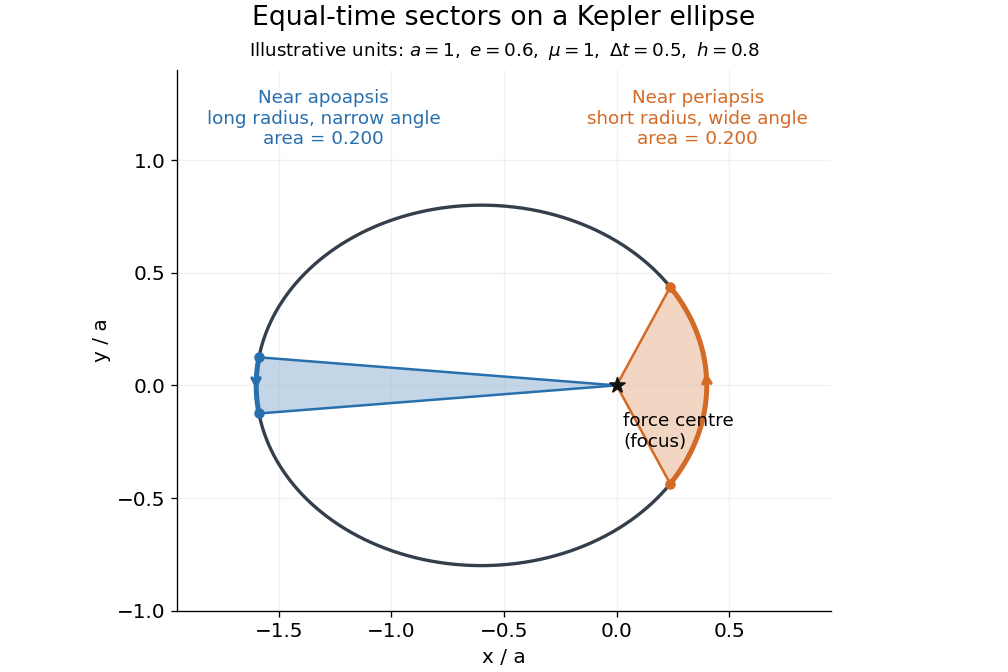

To compute the sectors without mistaking equal angles for equal times, parametrize the ellipse by eccentric anomaly :This follows by integrating . Kepler's equation gives , with mean anomaly measured from periapsis time . Consequently . The displayed sectors use mean anomaly intervals and , rather than equal eccentric anomaly increments.
There are unlisted articles, also show them or only show them.