
Black-hole evaporation Created 2026-10-06 Updated 2026-10-14
Black-hole evaporation is mass loss through Hawking radiation. For a large isolated Schwarzschild black hole, the leading mass dependence is and the evaporation timescale is proportional to . This semiclassical scaling cannot determine the endpoint when the curvature reaches quantum-gravitational scales.
The first integral singular homology of the Hawaiian earring has a direct summand isomorphic to . This consequence of its structural homology theorem suffices, through the universal coefficient theorem for cohomology and nonzero Ext of the rationals with integer coefficients, to show that its integral is nonzero. The precise structural theorem is Theorem 3.1 of www.sas.rochester.edu/mth/sites/doug-ravenel/otherpapers/eda-kawamura2.pdf.
Fitted-residual orthogonality 2026-10-06
For a full-rank ordinary least squares design matrix, the hat matrix and residual projection satisfy . Hence fitted values and regression residuals are perpendicular as observed vectors. Under isotropic errors their cross-covariance matrix is zero, and under a normal linear model the two vectors are independent.
Hartmann number 2026-10-06
The Hartmann number measures the strength of magnetic coupling relative to viscous and resistive effects in a channel:Here is the channel half-width, the kinematic viscosity, the magnetic diffusivity and the electrical conductivity. In Hartmann flow, large produces thin magnetic-viscous wall layers and a flatter, slower core for fixed pressure gradient.
Hartmann layer 2026-10-06
A Hartmann layer is the thin viscous-magnetic boundary layer next to a wall crossed by the applied magnetic field. For channel half-width and large Hartmann number , its thickness is . It restores the no-slip boundary condition and the specified magnetic wall condition outside the nearly uniform Hartmann flow core.
Hartmann flow rate with normal-field walls 2026-10-06
For a streamwise pressure gradient and walls at with zero tangential magnetic field, the volumetric flow rate per unit span isIts zero-field value is ; it decreases strictly for and is asymptotic to . The partial-fraction expansion of the hyperbolic cotangent proves monotonicity directly.
Attaching sphere 2026-10-06
The attaching sphere of an index- handle is in the previous boundary. Its framing of an embedded sphere identifies a neighbourhood with and specifies the handle attachment.
Belt sphere 2026-10-06
The belt sphere of an index- handle is in the boundary after attachment. It is the attaching sphere of the dual index- handle. Its intersections with the attaching spheres of later handles detect passages through this handle.
Handle slide Created 2026-10-06 Updated 2026-10-14
A handle slide replaces the framed attaching sphere of one handle by a band sum with a parallel copy of another handle of the same index. It changes the attaching data while preserving the diffeomorphism type of the resulting manifold. On the handle incidence matrix it performs an elementary row operation, or a column operation when applied to the dual decomposition.
Sign rounding bound for a unit eigenvector 2026-10-06
Suppose encodes the true partition and is a unit estimated eigenvector. Every coordinate of the wrong sign contributes at least to . Since this is at most , which is the squared Frobenius distance between the rank-one orthogonal projection matrices, the bound follows. Coordinates estimated as zero may be assigned consistently to either group.
Exponential packing of a Hamming cube 2026-10-06
An inclusion-maximal separated set of separation covers the Hamming cube by strict-radius balls. The Hoeffding lower-tail bound for Hamming balls then gives at least selected vertices. At this yields vertices, all separated by at least .
Entropy bound for a Hamming ball 2026-10-06
For , the number of binary words within Hamming distance of a fixed word is at most , with the binary entropy function in natural logarithms. In , each summand weight for is at least . Also , so . These two bounds give the approximate-recovery denominator in the list-decoding Fano inequality.
Hoeffding lower-tail bound for Hamming balls Created 2026-10-06 Updated 2026-10-14
For a uniform vertex of the Hamming cube, distance from a fixed vertex is the sum of independent Bernoulli random variables with parameter . The lower-tail Hoeffding inequality implies that the fraction of vertices at distance at most , , is at most . Strict-radius balls satisfy the same upper bound.
Surrogate Hamiltonian Monte Carlo 2026-10-06
Surrogate Hamiltonian Monte Carlo uses an auxiliary smooth probability density function to generate trajectories but applies a Metropolis–Hastings acceptance probability using the intended target . For Gaussian momenta and an involutive Metropolis proposal generated by flipped leapfrog integration, the acceptance probability is . Only the surrogate gradient is required during the trajectory; target density evaluations are still required at the endpoints.
Haar scaling function Created 2026-10-06 Updated 2026-10-14
At level , a Haar scaling function is the normalized indicator function of the dyadic interval . Its L2 norm is one because its squared height is and its support length is .
For a real square-integrable function , its coefficient isMultiplying the coefficient by the Haar scaling function restores the cell average on that interval. The disjoint supports make the functions at one level an orthonormal basis of the cellwise-constant subspace. This normalization is also what turns coefficient variances in the Gaussian white noise model into and cellwise variances into in the Haar projection estimator in Gaussian white noise.
Haar projection Created 2026-10-06 Updated 2026-10-14
The Haar projection at level is the orthogonal projection onto the functions constant on level- dyadic intervals. On each cell it replaces by its cell average. This is the closest cellwise-constant approximation in the L2 norm, because choosing a constant on a cell minimizes at its cell average.
On , take the step function with values on successive quarter-intervals. At level zero, its Haar projection is the constant . At level one, it has values and on the two halves. At level two, it recovers the four original values exactly. With normalized Haar wavelets, these approximations areThe coefficients are L2 inner products, so they differ from the discrete vector coefficients by the factor . Their squared sum also has a direct meaning:The approximation errors in squared L2 norm of are respectively : each added detail removes exactly its own squared coefficient from the error.
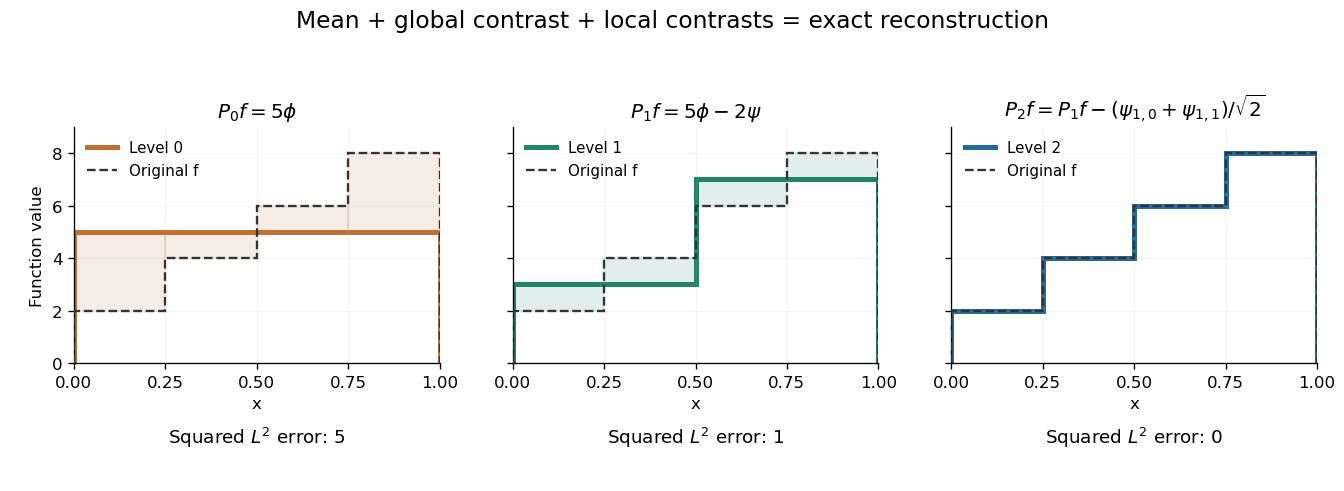
Coarse mean, half-interval contrasts and quarter-interval details reconstruct the same four-step function
. Details. 
The Haar projection can be expressed using level- Haar scaling functions, or through a coarse scaling family and the Haar wavelets at intermediate levels. On with lowest level zero, that coarse family is the single constant function . On the whole real line, use the integer translates of a coarse Haar scaling function instead; one global constant is not square-integrable. Refinement improves the representation while retaining the earlier coefficients.
GRW collapse-centre event probabilities 2026-10-06
For equal particle rates in the GRW model, the next centre falls in with probability . With zero Hamiltonian operator, two successive centres in have joint probability . Dividing by the first-event probability gives the conditional second event, including repeated particle labels. Spatial probabilities depend on actual packet mass, not solely the nominal packet centres.
A first localization near one macroscopically separated branch suppresses the other branch through the Gaussian GRW localization operator. This selects a correlated pointer alternative. However, if a region contains only packet centres and excludes substantial packet mass, the next centre need not lie in that region's small enlargement. Probabilities for the first event and approximately one for the next require regions containing essentially all corresponding branch mass. The general GRW collapse-centre event probabilities retain the geometry exactly.
Pumping of a group multiplier automaton 2026-10-06
In an accepted padded convolution of words, a loop after one tape ends can be deleted or repeated while keeping that entire tape fixed. The altered other tape still represents the same required neighbouring group element. A shortest representative has a suffix no longer than the fixed number of automaton states; an accepted longer suffix gives infinitely many representatives of the same element.
Linear-time multiplication in an automatic structure Created 2026-10-06 Updated 2026-10-14
Fix the first tape of a group multiplier automaton and use dynamic programming over automaton states and output-padding status, retaining predecessor pointers. The pumping of a group multiplier automaton bounds the search by layers, each of fixed size. This constructs a representative of in time without assuming uniqueness of representatives.
There are unlisted articles, also show them or only show them.