
Past exam of the mathematics course of the University of Cambridge 2005 iii Paper 27 12 Solution Created 2026-10-03 Updated 2026-10-14
The Fodor lemma, also called Fodor's theorem, states: if is a regular uncountable cardinal, is stationary and is regressive, meaning for every nonzero , then some fibre is stationary.
Delete zero from , which preserves stationarity. Suppose no fibre is stationary. For each , choose a club set avoiding that fibre. The diagonal intersectionis a club. To prove unboundedness, start above an arbitrary bound and choose a strictly increasing sequence with in every for . The intersection of these fewer-than- clubs is club by club filter completeness. Put . For any , every sufficiently late lies in , so its closure gives . Thus . For closure of , let be a limit point of ; for each , the members of above witnessing that limit lie in , and closure gives .
Stationarity supplies . Since , we have , but that club was chosen to avoid the fibre containing . This contradiction proves the theorem. For completeness, club filter completeness follows by a similar diagonal sequence: cycle through fewer than clubs over rounds, each time choosing a larger member of the next club. Regularity keeps the supremum below , and every club is visited cofinally often in the construction, so its closure contains the supremum. Their intersection is also closed.
Past exam of the mathematics course of the University of Cambridge 2005 iii Paper 27 11 Solution Created 2026-10-03 Updated 2026-10-14
Interpret the assertion in the usual well-founded, class-theoretic version of Zermelo set theory, including foundation, class comprehension and separation with class parameters. Classes are not extra sets. The axiom of limitation of size, in the form used here, says that every proper class is in bijection with the universe .
First derive replacement. Let a functional class relation map a set onto its image class . If were proper, the limitation axiom would give a bijection . Its composite with the original map would be a surjection . Class-parameter separation formsSurjectivity gives with , whence iff , a contradiction. Thus is a set, proving each instance of replacement. The argument also gives class replacement when the functional class is a parameter.
The class of ordinals is proper: were it a set, its union and successor would be ordinals larger than every ordinal in it. Limitation gives a bijection . Ordering by the ordinal indices of gives a global well-order; each nonempty set has a member with least index. Choosing that member defines global choice.
Conversely assume replacement and global choice. Ordinary choice well-orders each rank segment, and global choice selects such a well-order uniformly, since the collection of well-orders of each fixed rank segment is a nonempty set. Order all sets first by their rank of a set and then by the selected order within that rank. The resulting global order is set-like: the predecessors of any element are contained in a rank segment and form a set. Restrict it to a proper class . By transfinite recursion, enumerate in this order. It cannot be exhausted at a set ordinal, since replacement would then make a set. Every member appears, because its predecessors form a set, whose well-order has an ordinal order type. Hence has order type . The same applies to , and composing the two enumerations gives a bijection . Thus limitation of size is equivalent to replacement plus global choice in this class-theoretic setting.
Past exam of the mathematics course of the University of Cambridge 2005 iii Paper 27 10 a Created 2026-10-03 Updated 2026-10-14
Past exam of the mathematics course of the University of Cambridge 2005 iii Paper 27 1 Solution Created 2026-10-03 Updated 2026-10-14
Let be the finite approximation to the halting problem obtained by running the first programs for steps, so and is not computable. For , define the recursive triple colouring with no computable infinite homogeneous set byThis is a total computable function. Here homogeneous sets are required to be infinite: finite homogeneous sets certainly exist. An infinite homogeneous cannot have colour one. Fix ; the finite approximation below eventually stabilizes, so two sufficiently large in give colour zero. If has colour zero, choose in with . For arbitrarily large , homogeneity gives , and hence . Thus computes membership of in . A computable infinite would make the halting problem computable, a contradiction.
For the uncountable partition relation, the Erdős-Rado theorem for finite arities states that for every infinite cardinal and integer ,The case is the pigeonhole principle: a union of sets of size at most cannot have size . Suppose the assertion holds for . Put and , and let . We give the closed elementary-submodel construction of an end-homogeneous sequence, which avoids intersecting a decreasing family of reservoirs at a limit stage.
Take a sufficiently large regular and an elementary substructure with , containing and all ordinals below , and closed under sequences of length at most . Such an is obtained by successive Skolem hull closures: , and the regularity of puts any at-most--long sequence from the union inside one stage. Put . The set has no greatest element, since taking an ordinal successor is definable in , so .
Recursively choose an increasing sequence in . At stage , its earlier set has size at most , and the colour table on has size at most . Both and this table belong to by its closure. The setbelongs to and is nonempty because it contains . Elementarity supplies . Consequently the colour of each -tuple from the resulting sequence depends only on its first entries. The induction hypothesis applied to these entries gives a homogeneous subsequence of size , proving the result.
Infinite exponents behave differently with the axiom of choice. On the countably infinite subsets of any infinite cardinal , choose a representative of each equivalence class modulo finite symmetric difference. Colour a set by the parity of . Removing one point flips its colour. Every infinite proposed homogeneous set contains an increasing sequence of order type , and that sequence and its tail have opposite colours. Thus the finite-symmetric-difference colouring of infinite subsets gives , whether the domain consists of all countably infinite subsets or only those of order type . There is no unrestricted infinite-arity counterpart to the displayed finite-arity theorem in ZFC.
Past exam of the mathematics course of the University of Cambridge 2005 iii Paper 26 6 Solution Created 2026-10-03 Updated 2026-10-14
A preadditive category has an abelian group of morphisms between each pair of objects, and composition is additive in both variables. An additive category is a preadditive category with a zero object and finite products in a category; equivalently one may require finite coproducts. The equivalence, and the stronger assertion that these constructions agree canonically, follow from the argument below. An abelian category is an additive category with kernels in a category and cokernels in a category, in which every monomorphism is a categorical kernel and every epimorphism is a categorical cokernel. A monomorphism with the first property is a normal monomorphism; an epimorphism with the second is a conormal epimorphism.
Let , with projections . There is a unique with , interpreting the other components as zero. Since every sends to , the product's universal property givesGiven arrows , put . Then . Conversely any arrow with these restrictions equals , so it is uniquely this sum. Thus is a coproduct in a category. The empty product is the zero object and also the empty coproduct. The dual argument starts from coproducts and constructs projections; it proves the equivalent definition. Hence finite products and coproducts are the same biproducts, with the displayed identities giving the canonical identification.
For the image factorization in an abelian category, let , let be its cokernel, and let be the kernel of . Since , write . We prove that is epic. Suppose satisfies and let be its categorical kernel. Then for some . The composite is monic and hence is a normal monomorphism, say for . Since , the categorical cokernel property makes factor through , and therefore . The categorical kernel property of gives with . Cancellation of yields ; since is monic this also gives . Thus is invertible and . In a preadditive category, now implies , hence . This proves is an epimorphism and supplies the required factorization.
For uniqueness, an epimorphism that is a categorical cokernel is the categorical cokernel of its own categorical kernel. Indeed, if and , then factors through ; an arrow killing therefore kills and factors uniquely through . Dually, a normal monomorphism is the categorical kernel of its own categorical cokernel. If is any epi–mono factorization, monicity of gives . Both and are consequently categorical cokernels of this same categorical kernel. Their universal properties give a unique isomorphism between the intermediate objects with , and cancellation of gives . Therefore the epi–mono factorization is unique up to the unique compatible isomorphism.
Here is an additive category with truncated primary torsion, with the prime fixed as . Its objects are finitely generated abelian groups having no element of order , and its morphisms are all group homomorphisms. Equivalently their -primary torsion subgroup has exponent at most . It is a full subcategory of abelian groups, closed under finite direct sums and subgroups. Its hom groups and bilinear composition are inherited, and the zero group and finite direct sums belong to it, so it is additive. Categorical kernels are ordinary subgroup categorical kernels, which are still finitely generated and have no element of order .
To construct categorical cokernels, for an arbitrary finitely generated abelian group let be its -primary torsion subgroup, and defineThe Fundamental theorem of finitely generated abelian groups shows that this quotient lies in the subcategory: it leaves the free and odd-primary parts unchanged and replaces each cyclic -primary summand by either or . Every homomorphism to an allowed group kills , because it sends -primary torsion into a subgroup killed by . Thus has the universal property of a reflection. For , its categorical cokernel in the subcategory isThis has exactly the categorical cokernel universal property by the preceding factorization. Finite categorical limits exist because equalizers are categorical kernels of differences and finite products exist. Finite colimits exist dually because coequalizers are categorical cokernels of differences and finite coproducts exist.
The epimorphisms in this example are precisely the surjective homomorphisms. A surjection is epic already in abelian groups. Conversely, if is epic in the subcategory, its categorical cokernel is zero, so . A nonzero finitely generated abelian group has nonzero reflection: a nonzero free or odd-primary summand survives, and a nonzero finite -primary summand has a nonzero quotient modulo twice itself. Hence and is surjective. Its ordinary categorical kernel belongs to the subcategory, and its quotient by that categorical kernel is its codomain, which also belongs to the subcategory. It is therefore the categorical cokernel of its categorical kernel. This proves that every epimorphism is conormal.
The monomorphismis not normal. Its categorical cokernel in this category is reduction modulo , since . The categorical kernel of that categorical cokernel is the inclusion , whereas the image of is . A normal monomorphism is the categorical kernel of its own categorical cokernel, as proved above, so cannot be normal. In fact multiplication by is itself the categorical kernel of reduction modulo , up to the identification . Its composite with itself is multiplication by . Thus this example already exhibits two normal monomorphisms whose composite is not normal.
For the general assertion, let be a nonnormal monomorphism in any additive category of the specified kind. Put and be its categorical kernel, and factor . Both and are monic, so is monic. Set and be its categorical kernel. Then are normal, and for some .
Suppose their composite were normal, say . Since , factors through , whence . The categorical kernel property of supplies with ; cancellation shows , and monicity makes an isomorphism. Because , this forces . In a preadditive category, vanishing of the categorical cokernel of implies that is epic: any with have factor through the zero categorical cokernel. By hypothesis is therefore a categorical cokernel, and it is also monic. If , monicity and force ; a categorical cokernel of a zero arrow is an isomorphism. Thus is invertible, making normal, a contradiction. Consequently normal monomorphisms cannot be closed under composition in any such category; the explicit pair witnesses the failure.
Past exam of the mathematics course of the University of Cambridge 2005 iii Paper 26 5 Solution Created 2026-10-03 Updated 2026-10-14
A filtered category is nonempty, any two objects have arrows to a common object, and any parallel pair is equalized by some arrow . Equivalently, every finite diagram has a cocone: first choose a common target for its finitely many objects, then successively equalize the finitely many discrepancies along its arrows. A weakly filtered category requires a cocone only for finite nonempty connected diagrams. Equivalently, each connected component of a category is filtered. To see this, two objects in one component are joined by a finite zigzag; a cocone on that zigzag gives a common target, and a parallel-pair diagram gives the equalization condition. Conversely a connected diagram lies in one filtered component. An empty category is weakly filtered, since it has no such diagrams.
The unique outgoing-arrow lifting property is precisely that of a discrete opfibration. Let have this property, with weakly filtered. Take a diagram with finite, nonempty and connected, and choose a cocone in . Lift each uniquely from , obtaining . For an arrow , the arrow and the lift have the same source and the same image . Unique lifting gives equality of the arrows and, importantly, . Connectedness of makes all targets a single object . The lifts are a cocone in , so the domain of a discrete opfibration over a weakly filtered category is weakly filtered.
Consider discrete opfibrations and and their pullback in a category . The assumed creation of pullbacks describes its objects as pairs with , and its arrows as pairs with . There is a canonical mapwhere denotes connected components of a category. Assume the vertices are weakly filtered categories.
For surjectivity, choose components and whose images belong to the same component of . That component is filtered, so there are arrows and . Lifting them from and gives and with . Thus maps to the chosen component pair.
For injectivity, suppose and have the same images under . Filteredness of the relevant components upstairs gives arrowsWrite and . In the four arrows make a finite connected diagram with objects . It has a cocone, so there are and withLift from and from , obtaining arrows to with . Their composites with form an arrow of , and their composites with form an arrow . Hence the two representatives lie in the same component. This proves the connected components of discrete-opfibration pullbacks formulaThe map is the canonical comparison, so this is preservation of the pullback, not just an accidental bijection of its objects.
Now fix a small filtered category . Every object of has weakly filtered domain by the lifting argument, and every arrow of this slice is a discrete opfibration. Pullbacks in the slice are the created pullbacks above; their resulting domains are weakly filtered as well, since a pullback projection is a discrete opfibration onto a weakly filtered domain. The terminal slice object is . Because is nonempty and filtered, it is connected, so is a singleton. Thus the component functor preserves the terminal object and pullbacks. These construct every finite categorical limit: binary products are pullbacks over the terminal object, and equalizers are pullbacks along a diagonal into a binary product. Therefore the functor from this slice to sets preserves all finite limits.
Past exam of the mathematics course of the University of Cambridge 2005 iii Paper 26 4 Solution Created 2026-10-03 Updated 2026-10-14
For an adjunction , write its adjunction unit as and its adjunction counit as . It is an idempotent adjunction when the induced monad has invertible multiplication . The dual condition is invertibility of the induced comonad comultiplication .
To prove equivalence of these conditions, suppose is invertible. The two unit identities imply , where . For any algebra for a monad , naturality giveswhile . Thus is invertible. For each , the arrow is a monad algebra action, so is invertible. Applying proves invertible. Apply this implication to the opposite adjunction, interchanging the roles of the monad and comonad, to obtain the converse. Therefore idempotence is self-dual.
The open-set frame is ordered by inclusion. Its arbitrary joins are unions; arbitrary meets are interiors of intersections. Finite intersections are already open, so finite meets are ordinary intersections, including the empty meet . Distributivity of intersection over arbitrary unions proves the frame law. If is a continuous map, inverse imagepreserves arbitrary unions and finite intersections, including and the entire space. It is therefore a frame homomorphism. Since and , this defines .
Let and let be the set of points of a frame , namely frame homomorphisms . For , put . Preservation of joins and finite meets givesIn the last equality, a join in is precisely when at least one summand is , also covering the empty family. Thus the sets are all the opens of a topology, rather than merely a proposed basis.
For a frame homomorphism , define by . Since , it is continuous. Composition and identities follow from composition of functions, giving .
The frame-point adjunction is the natural bijectionA continuous map determines ; the displayed identities for show that is a frame homomorphism. Conversely a frame homomorphism determines exactly when . Membership in unions and finite intersections proves that is a frame homomorphism to , and proves continuity. These constructions are inverse. Precomposing in becomes inverse image of open sets; precomposing a frame homomorphism becomes composition of frame points. Hence the bijection is natural in both arguments and proves .
The adjunction unit isThe adjunction counit at , regarded as an arrow of , is represented by the frame homomorphism , . It is surjective because every open of is of this form. We can compute explicitly: it sends to . For every open of ,Thus . Conversely, evaluation at sends to , so . Both maps are continuous by their definitions. Therefore is a homeomorphism. The multiplication of the induced monad at is , which is invertible by this calculation. Consequently the frame-point adjunction is idempotent. This does not assert that every is a homeomorphism: it says that applying the point-space construction a second time makes no further change.
Past exam of the mathematics course of the University of Cambridge 2005 iii Paper 26 3 Solution Created 2026-10-03 Updated 2026-10-14
For a locally small category , an object , and a functor , the covariant form of the Yoneda lemma is the natural bijectionFor define , where . For , functoriality gives , so this is a natural transformation. Conversely, naturality of at gives . The two constructions are inverse. They are natural in , because a natural transformation commutes with evaluation. They are also natural in : an arrow induces by precomposition, and the resulting map corresponds to . Applying the result to the opposite category gives for .
Now let be a small category, and let . Finite products in a category in exist pointwise; the terminal functor is the constant singleton functor. Define the exponential of covariant set-valued functors bySmallness ensures that these natural transformations form a set. For , define at byPrecomposition respects identities and composition, so this defines a functor. Its evaluation map of an exponential object isTo check naturality, for both sides give : one side uses naturality of , and the other uses the defining action of .
Here is the full universal property. Given , define byFor , naturality of makes this commute with , so is a natural transformation. Replacing by is the same as precomposing by , proving naturality in . Conversely, gives . Starting with recovers it immediately. Starting with , its naturality at yieldsso it too is recovered. The formulas are natural in and , giving the required adjunction . Therefore the covariant functor category is cartesian closed. This proof supplies the actual exponential and does not need a colimit presentation of its arguments.
Finally suppose itself is a small category which is a Cartesian closed category. In its presheaf category, the same construction, applied to , givesThe first isomorphism uses the product's universal property: a map into is precisely a pair of maps into and . The next is the Yoneda lemma, and the last is the exponential adjunction in . Each step is natural in , , and . Under these identifications, evaluation corresponds to of the evaluation . Hence the Yoneda embedding preserves exponentials, with the natural identification .
Past exam of the mathematics course of the University of Cambridge 2005 iii Paper 26 2 Solution Created 2026-10-03 Updated 2026-10-14
An essay arguing against the claim. A good definition can change which mathematical questions are visible. Nevertheless, I would argue that category theory derives its explanatory force from the interaction between definitions and theorems; there is no sound general ordering in which definitions contribute more than theorems.
The strongest case for the contrary view comes from universal properties. A product in a category is characterized by maps into it, rather than by a particular construction of ordered pairs. The same definition applies to sets, groups, and topological spaces. An adjunction goes further: its natural correspondence of arrows puts free constructions, quotient constructions, and several kinds of completion into a common language. Such definitions remove irrelevant choices and expose relationships that would be difficult to recognize from separate constructions.
But a universal-property definition does not supply an object. The definition of a product in a category says what a product would accomplish; an existence theorem says whether the category actually has one. Even uniqueness up to unique isomorphism is a short proof, not an extra clause to be silently supplied by the word “universal”. Given two products, their universal properties produce maps in both directions, and uniqueness forces the two composites to be identities. This elementary theorem makes the definition usable independently of a chosen construction.
The Yoneda lemma illustrates the distinction especially clearly. A representable functor is a definition, but the lemma proves that its natural transformations into any set-valued functor are determined by one element. Its proof evaluates at the identity and reconstructs the whole transformation by functoriality. Consequently the Yoneda embedding is full and faithful: an object's pattern of incoming arrows recovers its morphisms without loss. That is a substantive explanation of why the chosen definition is powerful. Merely calling a functor representable would not establish it.
Similarly, defining a monadic adjunction gives a precise meaning to recovering structured objects as algebras for a monad. It does not decide whether a given forgetful functor is monadic. The precise monadicity theorem translates that difficult classification into a usable test involving adjoint functors, reflected isomorphisms, and specific coequalizers. For compact Hausdorff spaces, the crucial step is proving that a set-split relation is closed. The definition of a monad alone does not contain this topological argument. The theorem connects the algebraic language to an independently meaningful class of spaces.
There is also a danger in praising definitions without hypotheses. A Cartesian closed category has exponential objects, but a category of structured objects need not be cartesian closed merely because underlying sets have function sets. The correct exponential in a functor category generally involves natural transformations out of representable functors, not pointwise function sets. Its existence and universal property require an argument. Theorems also reveal when tempting definitions cannot support the intended construction.
Definitions provide the vocabulary and select the structures worth studying; proofs establish existence, consequences, and limitations. Category theory makes this partnership unusually explicit because its definitions are often expressed through universal properties. Its distinctive achievement is to turn well-chosen definitions into reusable theorems, rather than to make theorems secondary.
An alternative essay arguing for the claim. In category theory, theorems are indispensable, but a carefully chosen definition often performs the greater act of organization. It identifies what many apparently unrelated constructions have in common and makes whole families of proofs possible. In that explanatory sense, definitions can be the subject's most influential contributions.
Consider a universal property. Describing a product in a category as an object representing pairs of incoming arrows replaces several different concrete constructions by one invariant pattern. The corresponding uniqueness proof is important but short; the lasting insight is that the same pattern is the right question in every category. Once the definition is available, it becomes meaningful to ask which functors preserve products, whether the products exist in a new category, and how they interact with other universal constructions.
An adjunction is an even more striking example. The existence of free groups, free modules, and a Stone-Čech compactification can be proved separately. The definition of an adjunction recognizes their common relation to forgetful functors and explains why arrows out of a free object are determined by arrows out of its generators. It also packages the relation as a monad. A large collection of isolated existence results becomes an instance of a shared structure, with reusable consequences about composition and categorical limits.
A valuable definition also has to distinguish structures rather than merely rename them. An abelian category is not just an additive category with categorical kernels and categorical cokernels: normality of monomorphisms and epimorphisms matters. The additive example with truncated primary torsion shows why those clauses belong in the definition. The definition therefore preserves exactly the structure on which theorems about images and exact sequences depend.
This view does not make proofs dispensable. The Yoneda lemma justifies the use of representable functors, and the precise monadicity theorem tests when a proposed algebraic description is valid. Rather, it argues that the best categorical definitions have unusually broad explanatory reach: they select the invariant structures to which those proofs apply. If “matter more” means providing the reusable framework in which many theorems become instances of one idea, category-theoretic definitions have a strong claim to that role.
Past exam of the mathematics course of the University of Cambridge 2005 iii Paper 26 1 Solution Created 2026-10-03 Updated 2026-10-14
A monad on a category consists of an endofunctor , a unit natural transformation , and a multiplication , satisfyingAn algebra for a monad is with and . A morphism of algebras for a monad satisfies . These objects and arrows form the Eilenberg-Moore category .
For an adjunction with , the monad induced by an adjunction is , with . The Eilenberg-Moore comparison functor is and . The functor is monadic when this comparison is an equivalence of categories; this is a monadic adjunction.
The precise monadicity theorem says that is monadic exactly when it has a left adjoint, reflects isomorphisms, and satisfies the following condition: whenever the image of a parallel pair in admits a split coequalizer in , the pair has a coequalizer in and preserves that coequalizer. Equivalently, these coequalizers are created up to the canonical isomorphism identifying their underlying coequalizer objects. Here a split coequalizer of consists of , , and withThese equations prove its universal property: if , then , and is the unique factor through . Every functor preserves these equations, so every functor preserves split coequalizers.
First consider the forgetful functor . It has the free algebra functor as a left adjoint: the inverse transposition formulas are and . An monad algebra morphism whose underlying arrow is invertible has an algebra-morphism inverse, by rearranging its structure equation. Thus reflects isomorphisms.
Suppose have an underlying split coequalizer . Applying gives a coequalizer of . The equation therefore gives a unique with . The monad algebra laws follow by cancellation: composing with the epimorphism reduces it to , and composing with reduces it to . Both and are epimorphisms because they remain split coequalizers. Thus is an algebra for a monad and is an monad algebra morphism. If an algebra map equalizes , its underlying factor obeys , since this equation becomes after composition with . This proves that creates the required coequalizers. An equivalence of categories transfers these properties to any monadic , proving necessity.
Conversely assume the three conditions and write . Given , take the pairIts image is , with split coequalizer : the splittings are and , becauseLet be its coequalizer in . Preservation gives a canonical isomorphism under which . Transporting the algebra action of along this isomorphism gives . Naturality of the adjunction counit says that is an monad algebra morphism, hence . But too, and is a split epimorphism, with section . Therefore . Every algebra is consequently isomorphic to some .
It remains to establish full faithfulness, rather than merely construct objects. For , put . The adjunction counit coequalizes . The coequalizer supplied by the hypothesis has underlying coequalizer . The induced arrow from that coequalizer object to is therefore sent by to an isomorphism; reflection of isomorphisms makes it invertible. Thus itself is this coequalizer.
Now let be an monad algebra morphism, and put . The arrow coequalizes the two arrows in the preceding presentation. To check this directly, use transposition along : the transposes of and are respectively and , which agree by the algebra-morphism equation. Hence a unique satisfies . Applying gives ; cancellation of the split epimorphism yields . Finally, any arrow satisfies by naturality, so two arrows with equal image under are equal by the coequalizer property. The comparison is full and faithful and essentially surjective, hence an equivalence of categories. This proves the theorem.
For the application, the free compact Hausdorff space on a set is the Stone-Čech compactification of the corresponding discrete space. Its standard extension property says that every set map , for compact Hausdorff , extends uniquely to a continuous map . This constructs the required left adjoint. Also a continuous bijection from a compact space to a Hausdorff space is a homeomorphism, so reflects isomorphisms.
Take continuous maps whose underlying functions have a split coequalizer with splittings . The splittings need not be continuous. LetThe set is compact and hence closed. Since , it is contained in . Conversely . ThusThe set of triples on the right is closed in the compact Hausdorff space , so its projection onto the first two coordinates is compact and closed. This proves that the equivalence relation is closed, without assuming continuity of either splitting.
Give the quotient topology. The allowed closed-relation criterion makes it a compact Hausdorff space. If a continuous map equalizes , the split-coequalizer property makes it constant on the fibres of ; its unique factor is continuous by the quotient topology. Hence this is a coequalizer in compact Hausdorff spaces, preserved by . Its topology is forced uniquely, since any continuous surjection from a compact space to a Hausdorff space is a quotient map. All three conditions hold, and therefore the forgetful functor from compact Hausdorff spaces to sets is monadic.
Past exam of the mathematics course of the University of Cambridge 2005 iii Paper 25 5 Solution Created 2026-10-03 Updated 2026-10-14
The smooth h-cobordism theorem states: if is a compact smooth h-cobordism, , and its connected boundary manifolds are simply connected, then there is a diffeomorphism restricting to the prescribed identification on . In particular and are diffeomorphic. Being an h-cobordism means that both inclusions are homotopy equivalences; their fundamental groups then also identify with that of .
The homotopy-equivalence condition is necessary for a trivial cobordism: each end of a cylinder is a deformation retract, by for the incoming end and for the outgoing end. Its relative homology with respect to either end is consequently zero. Compactness is also necessary for a product with a closed compact end. The dimensional bound and simple connectivity are not necessary for an individual cobordism to be a product. The cylinder is a simply connected trivial cobordism of dimension three; and, in the theorem's dimension range, is a six-dimensional trivial cobordism with fundamental group . These prove the two non-necessity assertions explicitly, while the inclusion argument proves necessity of the h-condition.
For the remaining claims, use a cobordism Morse function: its two regular boundary levels are zero and one, and all critical points are interior. An arbitrary function with unrelated boundary values would not have the relative handle-count property. The relative Morse chain complex for has one generator per critical point, in its Morse index. ThusA trivial cobordism has zero relative homology, hence zero relative Euler characteristic. Modulo two the displayed sum is the number of critical points. An odd number makes it odd, and therefore nonzero. This proves an odd-critical-point cobordism is not trivial.
With precisely two critical points of indices , a trivial cobordism requires the two-generator relative complex to be acyclic over . Equal indices leave a rank-two homology group; a gap of more than one leaves both generators with zero possible differential. Therefore is necessary. The remaining two-term complex isChoose a transverse gradient-like vector field. A nonzero differential requires the index- point to be above the index- point; otherwise no descending connecting trajectories exist. In a common regular level between them, the belt sphere has dimension , and the attaching sphere has dimension , where . Their dimensions add to , the level's dimension, so their transverse intersection consists of points. Each intersection is one descending trajectory from to , modulo time translation. Orient the attaching sphere and use an orientation of a vector space on the handle core to coorient the belt sphere; the resulting signed count is the cellular boundary coefficientThe two homology groups are the kernel and cokernel of multiplication by . They vanish precisely when is a unit of . Consequentlyare necessary. This proves the two-critical-point obstruction to a trivial cobordism; it makes an algebraic incidence statement and does not assume that an algebraic count of one automatically supplies geometric handle cancellation.
For an explicit nontrivial cobordism from to itself, attach two zero-framed two-handles to the outgoing end of along the standard Hopf link. Its two components are unknots with linking number one. This realizes two successive surgeries, as suggested by the hint. The outgoing boundary is again , and this can be checked geometrically: the Hopf-link exterior is , and each component's zero-framing longitude is the other's meridian. Filling along these two slopes glues two solid tori with meridians intersecting once, the standard genus-one Heegaard decomposition of . Thus zero surgery on the Hopf link does return the three-sphere, not just an unspecified homology sphere.
The trace has only the two added index-two handles. Its relative cellular complex has and all other groups zero, soIt cannot be a product cylinder. Equivalently this trace is with two disjoint open four-balls removed: the usual handle presentation of has one zero-handle, the two zero-framed Hopf-linked two-handles, and one four-handle. Removing the bottom and top balls exposes the two three-sphere ends. The relative-homology calculation alone already proves the requested cobordism is nontrivial.
Past exam of the mathematics course of the University of Cambridge 2005 iii Paper 25 4 Solution Created 2026-10-03 Updated 2026-10-14
Choose real constants and define the smooth homogeneous quotientIt is unchanged by nonzero rescaling, so it is well defined on Real projective space. On the unit sphere its differential vanishes on the tangent space precisely when is proportional to , where . The entries are distinct, so the only critical projective lines are . In the affine chart , write for . ThenIts Hessian at zero is diagonal with entries . Exactly are negative, and none vanish. Thus this is a Morse function with one critical point of index for every .
Choose the quotient of the round metric on the unit sphere. The downward gradient flow has sphere equation and projective solutionNormalization to the unit sphere supplies the common positive factor. As , the smallest index with nonzero coordinate dominates; as , the largest dominates. ConsequentlyThese are its unstable manifolds and stable manifolds. If , the tangent directions in allow coordinates , and those in allow , modulo the common projective line. Together they span the full tangent space at every intersection. If the intersection is empty. Thus the flow is a Morse-Smale gradient flow, with no generic perturbation needed.
Orient each unstable manifold using its affine coordinates. The Morse-Smale complex has ; its differential counts oriented unparametrized connecting trajectories of index difference one. A trajectory from to has only coordinates nonzero, and there are exactly two, distinguished by the sign of . Each sign branch is a single orbit modulo time translation.
To calculate their signs rather than merely count two, use the characteristic closed disk of the unstable cell: the closed upper hemisphere of with , followed by projection onto . Its interior is , and its boundary map is the antipodal double cover . After collapsing , its degree on the -cell is the sum of the degrees of the two sheets. Comparing the sheets by the antipodal map on gives relative orientation : it is induced by on , whose determinant is . Thus the two trajectory signs add to , up to the choice of generator orientations. The projective quadratic Morse complex is thereforeIn particular , as required for the connected one-dimensional skeleton. The signed trajectory count agrees with this attaching-map incidence calculation, so it computes integral rather than only mod-two homology.
For , taking kernels modulo images givesFor example, an odd interior-degree generator has zero outgoing differential but twice itself is the image from the next degree; an even positive-degree differential is injective. At the top there is no incoming differential, leaving a copy of exactly when is odd. For the space is one point and only remains. This recovers the cellular homology of real projective space by explicitly constructing its Morse-Smale complex and signs.
Past exam of the mathematics course of the University of Cambridge 2005 iii Paper 25 3 Solution Created 2026-10-03 Updated 2026-10-14
For a framed embedding , index- surgery on a smooth manifold removes the interior of that region and replaces it by . Their common boundary is , along which the framing specifies the gluing. This is a surgery. Its trace is an -dimensional cobordism obtained by attaching the handle to along the outgoing boundary.
In the present surface case, and . The operation removes an annulus around the embedded curve and caps its two boundary circles by closed disks. Since , the curve cannot separate the oriented torus: a separating curve is the oriented boundary of one of the complementary subsurfaces and is therefore null-homologous. Thus it is a nonseparating curve, and the cut-open surface is connected with two boundary components. Its Euler characteristic is zero, since both the removed annulus and the gluing circles have Euler characteristic zero. Capping adds two, so the resulting oriented closed connected surface has . By the allowed surface classification it is a sphere. ThereforeEquivalently the classification shows that is a cylinder. The argument is conditional on the asserted embedding existing; it does not assign a surgery manifold to a nonexistent embedded curve.
Choose an arc in this connected cylinder joining its two boundary circles and close it by an arc crossing the removed annulus. After smoothing the joints, its closed curve meets transversely exactly once. If , then their algebraic intersection number of curves on an oriented surface isThis proves that is a primitive homology class and forces .
Conversely, if , the mapis an immersion with the required homology class. If its values at coincide, then and are integers; Bézout's identity gives . It is therefore injective and, by compactness, an embedded circle. An explicit annular thickening isThe determinant of its coordinate derivatives is . If two image points coincide, solving for the difference in the normal coordinate shows that is an integer multiple of . The strict choice of forces that integer to be zero, so and then modulo one. This supplies the actual required embedding, not just a homology class. Hence
Past exam of the mathematics course of the University of Cambridge 2005 iii Paper 25 2 Solution Created 2026-10-03 Updated 2026-10-14
The usual compact closed-manifold hypothesis is needed for the first assertion, or a proper bounded-below Morse exhaustion in an appropriate noncompact version. As literally printed without any such condition, on is a Morse function with no critical points, while . We prove the intended closed-manifold statement, which applies to the surface product later in the question.
By the Morse handle-attachment theorem, crossing an index- critical point attaches an -handle, and no topological change occurs between critical levels. Retraction to the core disks of handles gives a CW complex model with cells in dimension . Its cellular chain complex has . Tensor with , which computes the ranks of integral homology. Since homology is a quotient of a vector subspace of , . This argument has not used the Morse inequalities.
The strong Morse inequalities and top-dimensional equality areTheir weak form is . To see the algebra behind the strong form, put in the Morse chain complex, with . The kernel-image dimensions give , so the alternating difference at is exactly . Conversely, given the strong inequalities, denote those alternating differences by , with . Then , proving that they imply every weak inequality.
They are not equivalent as numerical restrictions. For the Betti numbers of , the formal counts satisfy all weak inequalities and the Euler equality, but at give . They therefore cannot be the counts of a Morse function on ; the strong inequalities detect that additional obstruction.
If all the strong inequalities are equalities, all vanish and . An integer boundary matrix with rational rank zero is the zero matrix. Thus the integral complex itself has zero differential, not merely its rationalization. Consequentlyand higher homology vanishes. In particular there is no homology torsion. This is an integral consequence of a Perfect Morse function, rather than just an assertion about ranks.
For , the integral homology is free with Betti numbers . The Künneth theorem therefore has no torsion terms, and the product's Poincaré polynomial isSumming the weak inequalities yields the lower boundChoose a surface Morse function with one minimum, saddles and one maximum. It can be built from one closed disk, the standard one-handles, and a closing closed disk, using the local forms , , and at the handle centres. Regular collars interpolate between the handles without new critical points. Now set . Its critical points are the ordered pairs of those of , and its Hessian matrix is a block direct sum; the indices add. This product of Morse functions has exactly critical points and realizes every displayed Betti count. Small bumps constant near the critical pairs can separate their values without altering the Hessians or creating new critical points.
The same minimum does not apply to arbitrary smooth functions. Here is an explicit finite-critical-point counterexample, avoiding any assumption that degeneracy leaves the Morse lower bound intact. On , takeIt is well defined because shifting either coordinate by reverses two of its factors. Its derivatives are and . If either or vanishes, both derivatives vanish only at . Otherwise and must be multiples of , giving exactly and in addition to the origin. At the first point the Hessian is , positive definite; at the second it is its negative. They are a minimum and maximum. The origin is an isolated degenerate monkey saddle, with leading term . Thus this three-critical-point function on a torus has exactly three critical points.
For , perform connected-sum gluing of functions between this torus and a perfect Morse surface of genus : delete a small neighbourhood of the torus maximum and of the other surface's minimum, and join their regular boundary circles by a monotone cylinder. Collar coordinates ensure nonzero differential throughout the neck, so precisely those two critical points are lost and none are added. The result on has critical points, retaining the degenerate point. For , simply use . Calling this smooth function and the earlier perfect Morse function , the smooth product hascritical points. This explicitly proves the negative answer to the unrestricted smooth-minimum question; it does not assert that this smaller illustrative count is sharp.
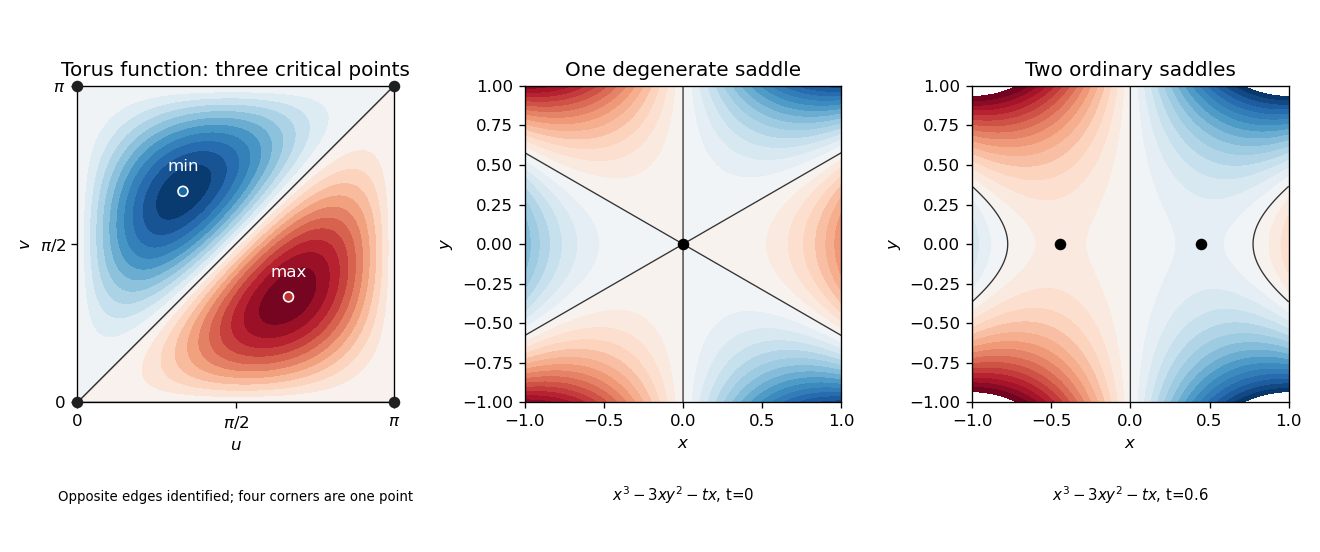
The explicit three-critical-point torus function and the local merger of two Morse saddles into one degenerate saddle
. Details. 
Past exam of the mathematics course of the University of Cambridge 2005 iii Paper 25 1 Solution Created 2026-10-03 Updated 2026-10-14
Use tangent vectors, rather than the affine tangent plane, to differentiate. Every skew-symmetric matrix gives a curve in the special orthogonal group. Its first derivative under is . The trace pairing annihilates every skew-symmetric matrix precisely when is symmetric: choosing with only entries tests each off-diagonal antisymmetric entry. Thus criticality is equivalent to being symmetric.
Since is orthogonal, , so at a critical point . Consequently commutes with . The diagonal entries are distinct, and the equation gives for . Hence and are diagonal. Orthogonality and the determinant constraint give exactlyConversely each such makes symmetric, so this list is complete.
To calculate the Hessian matrix, use local coordinates with ; the matrix exponential is a local coordinate map near zero. Its quadratic term givesbecause . There are no mixed quadratic terms. For , , so has the sign of and is never zero. Every listed critical point is therefore nondegenerate, with Morse indexThis is the trace height on the special orthogonal group calculation; the rotations in the hint select the individual coordinates .
For , the signs have indices respectively. A Morse function on a compact closed manifold has Euler characteristic equal to the alternating number of critical points, by its Morse handle-attachment theorem and resulting finite CW complex. Hence
Past exam of the mathematics course of the University of Cambridge 2005 iii Paper 24 5 Solution Created 2026-10-03 Updated 2026-10-14
It is enough to assume that is surjective for every ; an integrally surjective Hurewicz homomorphism certainly has this property. First give the minimal-model argument suggested by the hint. Let be a simply connected Sullivan minimal model, with in degrees at least two. Put . Its indecomposable quotient of an augmented algebra isMinimality makes the induced differential on zero, so projection is a chain map . The Sullivan model identification says that the induced mapis dual to rational Hurewicz homomorphism. Under the usual finite-type duality convention, the assumed surjectivity makes injective.
A product of two positive cohomology classes has a decomposable cocycle representative, so its image under is zero. Injectivity therefore givesThis deduction uses the hypothesis; zero cup products by themselves would not yet prove formality of a topological space.
Choose a homogeneous cohomology basis and cocycle representatives . Their indecomposable parts are linearly independent. Extend them to a graded basis of and replace the corresponding generators by the actual cocycles . This is a valid change of free algebra generators: each differs from its indecomposable part by products of generators of strictly smaller degree, so degree induction constructs the inverse substitution. Call these closed generators , and the remaining generators .
Define a map of graded algebrasIts target has zero differential. Every differential in is decomposable, and all products of positive target classes vanish, so is a chain map. If is any positive cocycle, its indecomposable part is in the span of the , because these form the image of . Write . Then , while injectivity of gives . Thus induces the identity on cohomology and is a quasi-isomorphism. This proves that is a formal space.
The rational wedge sum assertion has a direct topological proof, which also avoids finite-dimensional duality restrictions in the preceding model argument. Choose a homogeneous basis of . By surjectivity, each basis class is the image under the Hurewicz homomorphism of an element of . In this element is represented by an actual sphere map . Simple connectivity and ensure . The wedge sum of these maps givesand induces an isomorphism of rational homology by the choice of basis. The rational Whitehead theorem now makes it a rational homotopy equivalence, givingA wedge sum of spheres is a formal space. For each individual sphere, its augmented minimal model maps by a quasi-isomorphism to its sphere cochain algebra, and also to its cohomology algebra, by killing the extra odd generator in the even-sphere case. Take based simplicial models of the spheres. Their wedge sum is a simplicial pushout over the common basepoint, so the algebra of rational polynomial differential forms is the corresponding fibre product of augmented sphere algebras. Taking fibre products of these model maps gives a quasi-isomorphism zigzag to the square-zero cohomology algebra. This also works for infinitely many sphere summands: the positive parts are products of the individual complexes, and products of vector-space exact sequences over a field are exact. In the finite case its minimal resolution is the minimal model of a wedge of simply connected spheres. Thus the topological proof establishes both conclusions without imposing finite rank on the sphere basis. For the zero reduced-homology case the wedge sum is a point. Both the minimal-model construction and the explicit sphere map explain why the surjectivity hypothesis is decisive.
There are unlisted articles, also show them or only show them.