
Past exam of the mathematics course of the University of Cambridge 2004 iii Paper 24 7 Solution Created 2026-10-03 Updated 2026-10-14
An ultraproduct converts coordinatewise finite information into a single first-order structure. Let be nonempty structures in a common first-order language, and let be an ultrafilter on . In , setThe ultraproduct has these equivalence classes as its elements. Functions are interpreted coordinatewise; a relation holds of classes exactly when it holds on a -large set of indices. Intersecting finitely many large agreement sets shows that these interpretations are independent of representatives.
The Łoś theorem, which explains the construction's usefulness, saysHere is the proof. Induction on terms establishes the coordinatewise interpretation of atomic formulas. Finite intersections handle conjunction, and the ultrafilter property handles negation, since precisely one of a set and its complement is large. For an existential quantification, a witness class gives coordinate witnesses on a large set. Conversely, when the coordinate existential truth set is large, select a witness in each of those structures and a default element elsewhere. Its class is a witness in the ultraproduct. This uses choice. Structural induction on formulas now proves the theorem, with universal quantification obtained by negation.
Compactness. If every finite subset of a first-order theory has a model, take to be the finite subsets and choose . The cones for finite have the finite intersection property. Extend their filter to an ultrafilter by the ultrafilter lemma. For each , its cone is large, so the Łoś theorem makes the ultraproduct satisfy . This proves the compactness theorem, including theories of arbitrary set size.
Elementary extensions and nonstandard elements. An ultrapower uses a fixed structure at every coordinate. The diagonal map sending to the class of the constant function is an elementary embedding by the Łoś theorem. For a nonprincipal ultrafilter on , the class of in an ultrapower of the natural numbers exceeds every standard integer, because each corresponding tail is large. In an ultrapower of the real ordered field, the reciprocal of this element is positive and smaller than every positive standard reciprocal integer: an infinitesimal. These examples implement ordinary finite statements in a larger structure without claiming that every external subset or second-order assertion transfers.
Saturation. Such an ultraproduct over is countably saturated. To see the actual diagonal argument, list a finitely satisfiable type with parameters in the ultraproduct and fix representatives for those parameters. For each , the set of coordinates admitting a simultaneous witness to its first formulas belongs to by the Łoś theorem. Arrange that the decrease and put . The decrease, belong to , and have empty intersection. At coordinate , choose a witness to the first formulas, where is the largest with , or choose a default element if there is no such . For each fixed , on the large set . Therefore the resulting class realizes every formula. This proves countable saturation of an ultraproduct over omega; it does not assert saturation at all larger cardinalities.
Algebraic limits. Take finite fields indexed by the primes and a nonprincipal ultrafilter. Their ultraproduct is a field of characteristic zero: for every fixed positive integer , only finitely many primes divide , so on a large set. Every first-order sentence true in all finite fields holds in this infinite field, and more generally so does any sentence true for all but finitely many of the factors. This is a way to create an infinite field retaining uniform first-order information from finite fields. It does not make the field algebraically closed: the first-order sentence that every element is a square already fails in infinitely many of the factors.
Large cardinals. A countably complete ultrafilter gives a well-founded membership ultrapower of the universe. If it had an infinite descending chain represented by , each setwould be large. Countable completeness makes nonempty, giving an actual infinite membership descent at any index in the intersection, contrary to foundation. The Mostowski collapse therefore gives a transitive target and an ultrapower embedding .
For a measure on a measurable cardinal , every function with is constant on a large set: otherwise intersect the fewer than complements of all its fibres. Consequently fixes the ordinals below . The class of the identity function is below and above every constant class below , since all tails are large. Thus and its critical point is . Fine ultrafilters on that are normal ultrafilters on small subsets and kappa-complete yield the stronger embeddings witnessing supercompact cardinals.
These applications share a single principle: an ultraproduct preserves precisely the first-order information seen by its ultrafilter. Principal ultrafilters merely select a factor; nonprincipal ones can produce new sizes, elements and saturation. Existence of the needed ultrafilters and selection of coordinate witnesses are set-theoretic assumptions, and changing the ultrafilter may change the resulting model.
Past exam of the mathematics course of the University of Cambridge 2004 iii Paper 24 6 Solution Created 2026-10-03 Updated 2026-10-14
Identify the space of infinite subsets of the natural numbers with their increasing enumerations, with the ordinary topology on infinite subsets inherited from the discrete product . This is the sequence convention in the Open Ramsey theorem. For a general infinite ground set, first choose a countably infinite subset and use its enumeration. The theorem cannot mean unrestricted sequences with repetitions: the clopen partition according as the first two entries agree or differ has both colours over every infinite ground set.
For a finite finite stem and an infinite tail above , writewhere the enumeration of precedes the tail. Let be open. The tail accepts if ; it rejects if no infinite subtail accepts it. Both properties persist on infinite subtails, and any stem can be decided by thinning: choose an accepting subtail if one exists; otherwise the current tail already rejects it.
Use deciding all finite stems by fusion. At stage , choose a new element from the current tail, then thin the remaining tail to decide each of the finitely many subsets of . First decide the empty stem as well. The final selected set decides every finite stem from , because all subsequent selections lie in the tail that decided that stem. If accepts the empty stem, and we are done.
Otherwise the empty stem is rejected. If a stem is rejected, only finitely many above can have the tail accepting . Indeed, if infinitely many such formed , then every starts with one of them and has its remaining tail in . It follows that , contradicting rejection of . All other one-point extensions are rejected, since the first fusion has already decided them.
Build an infinite recursively. Maintain that every subset of the finite selected prefix is rejected. To select its next element, avoid the finite union of the finitely many accepting-extension obstructions for these rejected stems. Such an element exists, and all the new stems remain rejected. Hence every finite stem from is rejected. If some were in , openness would supply a finite initial segment of whose entire ordinary cylinder is contained in . The tail would accept , a contradiction. ThusIn particular every open payoff has an infinite homogeneous set. A finite partition into open colour classes can be handled by successive application of this two-colour assertion.
For an arbitrary partition use finite-symmetric-difference parity colouring. On the infinite subsets of the ground set, declare when is finite, and choose a representative from each equivalence class. Colour byFor any infinite , removing one member gives an infinite in the same class and reverses the parity. Thus and have opposite colours, so neither colour contains all infinite subsets of any infinite ground set. This two-colouring has no infinite homogeneous set. Representative selection uses choice; the construction is deliberately unrestricted by topological regularity.
Past exam of the mathematics course of the University of Cambridge 2004 iii Paper 24 5 Solution Created 2026-10-03 Updated 2026-10-14
Work in ZFC. The move alphabet need not be countable; choice permits the selections of moves, strategies and witnesses used below. Assume ; with the usual convention that a player unable to move loses, the empty alphabet is a trivial terminal game. We prove Borel determinacy theorem by strengthening the assertion to the existence of game coverings that unravel payoffs. Simply asserting that determined payoffs are closed under countable unions would not be a proof.
It is useful to allow a tree of legal finite plays with terminal nodes explicitly labelled as losses for either player. For an infinite branch, I wins exactly when it belongs to the payoff . Projection of a game tree is length-preserving and respects prefixes. At a projected original terminal node the outcome is inherited, but the new tree may also have artificial terminal losses.
A covering of an infinite game has such a projection and maps taking a strategy on to a strategy of the same player on . Its crucial lifting condition is this: each maximal play on following has a -compatible lift on , either projecting exactly to with its inherited terminal outcome, or projecting to a prefix of and ending in a loss for the player using . Its strategy maps must be local in depth: choices up to a given depth use only the upstairs strategy up to that depth. A -covering preserves the initial levels and choices. If is clopen, call it an unravelling of a game payoff. A winning upstairs strategy cannot have a compatible premature losing lift; hence any such covering transfers winning strategies downstairs, for the payoff pulled back by .
First, clopen determinacy with terminal losses holds on any set-sized tree. At a node where all infinite extensions have one fixed winner, the other player can win only by forcing a terminal loss for that winner. Decide that reachability game by the winning-position attractor in an infinite game: begin with the desired losing terminals, add the attacking player's positions with a successor already in the attractor and the defending player's positions with every successor in it, and take unions at limit stages. Entry ranks give a strategy reaching the target; outside the attractor the defender avoids it. If there are no infinite extensions the same reachability analysis still applies. At every remaining position there are infinite extensions in both and its complement. This remaining tree is well-founded, since an infinite branch through it would contradict clopenness at that branch. Well-founded recursion now assigns a winner upwards from the already decided nodes, choosing a winning successor when the player to move has one. These choices give an actual winning strategy.
Next we construct an announcement-and-challenge covering of a closed payoff. Let be closed, and choose an even depth . Play initially follows unchanged. At a nonterminal position of length , replace I's next move by , where is any subset of the following set of exit positions: strictly extends , is nonterminal, and is a shortest such extension along its branch satisfying . If already, the first nonterminal extension beyond counts as an exit. Distinct exits form a prefix antichain. An original terminal move always keeps its original outcome.
Player II now either accepts and makes an ordinary next move , or challenges an and makes the move prescribed by that . On acceptance, continue the original play until the first exit : it is an artificial win for I if , and an artificial loss for I otherwise. On a challenge, both players are forced to follow until it is reached, after which the original game resumes without the acceptance stopping rule. The projection forgets the announcements and challenge flags.
An infinite accepted play avoids all exits. Every sufficiently long prefix of its projection therefore has a continuation in , so closedness implies that the projection is in . Every infinite challenged play passes through an exit cylinder disjoint from . Thus among infinite plays the pulled-back payoff is decided by II's acceptance or challenge: it is clopen. This remains true when a particular branch reaches an inherited terminal position before either case produces an infinite play.
Here is the strategy-transfer proof, which also fixes the artificial terminal labels. Given an I-strategy upstairs, use its announced ordinary move downstairs and initially simulate an accepting response. If the projected play never exits, this is an exact lift. If its first exit is not in the announced , the accepting lift ends in a loss for I, as allowed. If , switch to the simulation in which II challenged this particular . The earlier ordinary prefix is unchanged: all moves through in the challenged simulation are forced and agree with the observed prefix. Beyond follow in that simulation. This gives an exact compatible lift. Original terminal outcomes are inherited throughout.
For an II-strategy upstairs, after seeing downstairs, letFor the announcement , the strategy must accept, since a challenge would have to name an element of . Use its accepting ordinary response downstairs and simulate that acceptance until an exit. If the exit belongs to , the accepting lift is an artificial loss for II, as required. If , choose an announcement for which challenges , and switch to that simulation. Its first ordinary response and all the intervening forced moves agree with the actual prefix ; after use there. This gives an exact lift. Choices of use choice. No switch uses unseen future moves, and the definition of uses only the strategy's responses at the fixed announcement level. Thus the maps are local in depth. The unchanged initial segment makes this a -covering.
We now establish the stronger assertion: every Borel payoff on every such game tree admits a -unravelling for every finite . Closed payoffs were just handled. Complements need no new construction, since the complement of a clopen pulled-back payoff is clopen.
For countable unions, suppose and the stronger assertion is known for each constituent and for its continuous pullbacks. Starting with , choose a covering that unravels the current pullback of and preserves at least the first levels and choices. Previously unravelled payoffs remain clopen under further continuous projections. There is a depth-stabilizing inverse limit of game coverings: each finite level eventually ceases to change, and these stable levels form a tree .
For completeness, the limit retains the covering property, not just the topology. Compose the projections and the depth-local strategy maps; their finite restrictions stabilize. To lift a play following the limit-projected strategy, lift it successively, coherently, from to . If all lifts are exact, the stabilized finite prefixes give a compatible play on . If a premature losing terminal lift occurs, every further lift is either exact or another losing terminal prefix, so its length cannot increase; lengths and then its finite position stabilize. This produces the permitted losing terminal lift in the limit. The choices needed to select successive lifts are available in ZFC. Projections, inherited terminal outcomes and depth-local strategy maps consequently make a genuine -covering.
On , the pullbacks of all the are clopen, so their union is open. Its complement is closed. Apply the closed-payoff construction once more to unravel this complement; it unravels the union too. Composition gives the desired covering of . This proves the induction step. Induction on a well-founded construction of a Borel set, whose operations are complementation and countable union starting from open sets, proves the assertion for every Borel payoff. Continuous preimages of a constituent have the same type of construction, so the induction hypothesis used at successive covers is justified. No countability of the move alphabet was used; all enlarged alphabets and trees remain sets.
Finally apply this result to . The unravelled clopen game has a winning strategy by the first argument. The covering lifting condition transfers it to the original game. ThereforeThis is a theorem in the usual background set theory with choice; it does not assert unrestricted determinacy for arbitrary, non-Borel payoffs.
Past exam of the mathematics course of the University of Cambridge 2004 iii Paper 24 4 Solution Created 2026-10-03 Updated 2026-10-14
Use the rooted-tree homeomorphic embedding relation: an injective map of vertices preserves lowest common ancestors, so edges may become paths and the source root may map below the target root. We prove the stronger labelled statement for labels in any well-quasi-ordering , with labels increasing under the embedding. Forgetting labels gives Kruskal's tree theorem.
First every infinite sequence in a well-quasi-ordering has an infinite nondecreasing subsequence. Colour its index pairs according as the earlier term is or is not below the later term. Ramsey's theorem gives an infinite constant-colour subsequence; the bad colour would contradict well-quasi-ordering. Applying this successively in each coordinate proves finite product closure of well-quasi-orderings.
We need Higman lemma with its proof. Order finite words over by subsequence embedding with increased letters. If there were a bad sequence, choose one minimally: at each position choose a shortest word admitting a bad continuation of the fixed prefix. No word is empty. Write , separating the last letter, and choose with . ConsiderAn earlier prefix word cannot embed in a later , since it would then embed in . Nor can embed in : adding the comparable last letters would embed in . Thus the displayed sequence is bad, contradicting minimality at , since is shorter. Finite words over a well-quasi-order are well-quasi-ordered.
Now suppose labelled rooted trees admit a bad sequence , chosen minimally in vertex count at each position. Let consist of all proper rooted subtrees of these trees, rooted at a descendant and containing all its descendants. We claim is well-quasi-ordered. Otherwise take a bad sequence from . Only finitely many subtrees come from any fixed finite prefix of the 's, and a bad sequence cannot repeat an object. Thin it so that comes from with . The sequenceis bad: would imply , since a rooted subtree embeds in its host; comparisons within the 's are excluded by their choice. But is strictly smaller than , contradicting minimality. This proves the claim.
Choose an arbitrary ordering of the children of each . Record its root label and the finite word of rooted child-subtrees:By Higman lemma and finite product closure, two records, with indices , are comparable. Map the root of to the root of , and map its selected child-subtrees into the distinct selected branches of . Within a branch the embeddings preserve lowest common ancestors; between different branches both lowest common ancestors are the roots. Labels increase everywhere. This gives , contradicting badness. Finite labelled rooted trees are well-quasi-ordered by label-monotone homeomorphic embedding. In particular, this proves the unlabelled theorem. A root-preserving variant follows by giving the root a special incomparable label unavailable at nonroot vertices; the general labelled theorem then forces root to root. Adjacency-preserving embeddings are a different, more restrictive relation and do not satisfy the same assertion.
For Friedman's finite form of Kruskal's theorem, fix and consider finite bad sequences satisfying , with indices starting at . Their prefixes form a finite bad-sequence tree. At each depth there are only finitely many possible unlabelled tree isomorphism types below the size bound, so this tree is finitely branching. If bad sequences existed at every finite length, König infinity lemma would yield an infinite branch, hence an infinite bad sequence of rooted trees, contrary to what was just proved. ThereforeThe same proof works with any fixed finite label set. The finite size bounds are what make the bad-prefix tree finitely branching; the proof does not claim a small effective numerical bound.
Past exam of the mathematics course of the University of Cambridge 2004 iii Paper 24 3 Solution Created 2026-10-03 Updated 2026-10-14
Forcing constructs new first-order models while controlling which ground-model properties survive. Fix a ground model and a partially ordered set , writing when is the stronger condition. A generic filter is upward closed, directed towards stronger conditions, and meets every ground-model dense subset of a forcing order. If is externally a countable transitive model, enumerate its dense subsets and successively choose stronger conditions in them. The resulting filter is -generic. External countability is crucial: this is not a claim that the ground model regards its own universe as countable.
A forcing name is built recursively from pairs of earlier names and conditions. For a generic filter , its evaluation of a forcing name isThe canonical forcing name evaluates to , so . Recursive evaluation also proves transitivity. Name ranks bound the ranks of their evaluations, so an ordinal in the extension is below some ground ordinal and is already a ground ordinal. Thus forcing preserves ordinals.
The central link between syntax and generic interpretation is the forcing theorem. The relation is definable in the ground model, and the forcing truth lemma saysFor an atomic membership assertion, densely many refinements must witness equality with a member-name whose associated condition is compatible with the refinement. Equality is obtained by recursive mutual inclusion of names. For negation, means no stronger condition forces ; for an existential quantification, witnesses must be obtainable densely below . Induction on name rank establishes the atomic clauses, and induction on formulas establishes definability and the truth lemma. The generic filter meets the relevant dense sets at the existential step. An arbitrary semantic assertion about one chosen generic filter is insufficient: the definable relation must work uniformly for all generic interpretations.
This explains preservation of ZFC. Extensionality and foundation follow from transitivity; canonical names supply infinity. Pair and union names give pairing and union. For separation, restrict a name's members to conditions forcing the defining formula. For replacement, the definable forcing relation lets ground axiom schema of collection bound a set of names for all possible witnesses to the unique outputs; evaluating their collected name gives the range. For power set, let name the given set and let be the set of its member-names. Every subset of has an equivalent name drawn from , by the truth lemma, so a ground set of candidate names collects all its subsets. Finally choose a ground well-order of the relevant names; its evaluated image surjects onto the desired set, and choosing the first name for each value well-orders that set. This is why ordinary forcing over a choice model preserves choice.
For a concrete example, Cohen forcing consists of finite partial functions , ordered by extension. The generic union is total because deciding each coordinate is dense. For every ground real , the set of conditions disagreeing with somewhere is dense, so . This construction changes the universe by adding a genuinely new real without changing its ordinals.
The size and compatibility of conditions determine what else changes. With the countable chain condition for forcing, an ordinal-valued name has only countably many possible values at each coordinate: take a maximal antichain deciding that value. Therefore the possible range of a name for a map with infinite ground domain of cardinality lies in a ground set of size at most . This prevents cardinal collapse and changes of uncountable regular cofinalities. Forcing by finite partial functions is ccc: the delta-system lemma thins any uncountable family of finite domains to a delta-system, and a further thinning makes their values agree on its finite root. Two remaining conditions are compatible. Distinct coordinates add distinct reals.
For example, start with GCH and take . This forcing has size and adds distinct reals. A nice name for a real uses countably many antichains, and each antichain is countable. The ground arithmetic bounds the number of such names by . Hencegiving a relative-consistency example of the failure of CH. The ground choice of GCH is available through the constructible universe; no claim that every starting model has this arithmetic is needed.
By contrast, countably closed forcing adds no new countable sequences of ground ordinals. Given a name, recursively strengthen a condition to decide each coordinate, then take a lower bound of the descending sequence. That condition decides the entire sequence. Closure and chain conditions thus control different features; neither should be silently substituted for the other.
Further applications include changing cofinalities, adding branches through trees, and constructing prescribed continuum patterns. If the aim is to violate choice, an ordinary generic extension of a choice model will not do: one restricts to a suitable symmetric collection of names, checking the axioms again. These examples also mark a limitation: forcing proves relative consistency, not absolute consistency of the background theory. The countable-transitive-model picture gives a concrete semantic construction; the definable forcing relation and Boolean-valued formulation supply the corresponding formal consistency arguments without asserting that a transitive ground model can be proved to exist.
Past exam of the mathematics course of the University of Cambridge 2004 iii Paper 24 2 Solution Created 2026-10-03 Updated 2026-10-14
The partition relation says that every colouring of the -element subsets of a set of cardinality into colours has a homogeneous set of cardinality . Define the beth numbers over an infinite cardinal by and . The Erdős-Rado theorem for finite arities gives the precise boundThus any fixed finite arity and any fixed infinite number of colours admit arbitrarily large infinite monochromatic sets once the starting cardinal is sufficiently large. For pairs, the especially useful case is . The successor in this bound matters: a binary first-difference colouring on a suitably ordered set of binary sequences supplies the familiar obstruction at . Also, a theorem for every fixed finite arity is not a theorem homogenizing all arities simultaneously.
The mechanism is to build an end-homogeneous routing tree: each new vertex is routed according to its colours to earlier vertices on its branch. A long branch is end-homogeneous, meaning the colour from a fixed earlier vertex is independent of the later vertex. There are at most routes of length , and the whole collection of short routes has size at most . Inserting vertices therefore forces a branch of length . One colour occurs at earlier vertices on that branch, giving the pair theorem. Iterating the higher-arity version of this routing construction explains the successive powers in the Erdős-Rado theorem for finite arities.
A weakly compact cardinal is an uncountable strongly inaccessible cardinal withEquivalent formulations include the tree property at the inaccessible cardinal and compactness for theories of size at most in the infinitary language : if every subtheory of size has a first-order model, so does the theory.
A measurable cardinal is an uncountable carrying a nonprincipal ultrafilter closed under intersections of fewer than members. Such an ultrafilter contains no set of size , since all singletons have complements in it and it is kappa-complete. Consequently a cofinal sequence of length would partition into too few small pieces, so is regular cardinal. If and distinct subsets of existed, choose, for each coordinate of , the bit selected by the ultrafilter. Kappa-completeness would make all those bits simultaneously constant on a large set of indices; only one distinct subset could have that bit pattern, a contradiction. Hence : is also a strong limit cardinal.
A supercompact cardinal has, for every , a fine ultrafilter that is a normal ultrafilter on small subsets and is kappa-complete onFine means is large for every . Normal means that a function with on a large set is constant on some large set. Equivalently, for every such there is an elementary embedding with critical point , , and closed under -sequences from the universe.
These notions form the implication chain supercompact measurable weakly compact. For the first implication, an embedding as above gives the measure . For the second, use a normal ultrafilter on a cardinal obtained by normalizing its measure. Indeed the ultrapower embedding gives the measure ; for a regressive , is a fixed ordinal, yielding the required constant large fibre. Given a pair-colouring, select for each the measure-one colour on the tail above . One selected colour occurs on a measure-one set of 's. Normality makes the diagonal intersection of their selected tails measure one; any two members of that intersection have the selected colour. This gives the required partition relation, and the preceding regularity and strong-limit argument gives inaccessibility.
Past exam of the mathematics course of the University of Cambridge 2004 iii Paper 24 1 Solution Created 2026-10-03 Updated 2026-10-14
Independence here is a relative consistency assertion: from a ground first-order model satisfying ZFC, construct a first-order model of each remaining theory in which the omitted axiom fails. The ground axiom of choice is a tool for constructing these countermodels, not an extra axiom imposed on the theories being tested. The constructible universe supplies the usual relative-consistency implication from ZF to ZFC, so this ground choice assumption requires no additional consistency strength. These constructions can be formalized inside an arbitrary ground model; they do not require the stronger assumption that a transitive model exists.
Union. Put and use the hereditarily locally small membership modelThe ground cardinal is a strong limit cardinal of countable cofinality. This transitive class contains the empty set and . Pairing preserves the bound, as does taking a subset, so separation holds for every formula relativized to this class. If an internally definable function has domain , ground replacement collects its range . Since and every descendant of an element of already has fewer than members, . Thus the full functional Axiom schema of replacement holds. For , every actual subset of belongs to the class andConsequently its entire power set belongs to the class. Extensionality and foundation are inherited from the ground membership relation; witnesses infinity. However belongs to , while its only possible union is , which does not. All the other ZF axioms hold, and union fails. Bounding the entire transitive closure by instead would give the wrong model: functional ranges at this singular bound need not be hereditarily small.
Power set. Use the transitive class of hereditarily countable sets. Pairing, union and separation preserve hereditary countability. A functional image of a countable domain is countable, and its members have countable transitive closures; their countable union is countable in the ground ZFC model. This proves replacement. The remaining structural axioms and infinity are inherited. Every actual subset of belongs to , but a putative internal power set of would contain all these subsets and hence be uncountable by Cantor's theorem. Power set fails in , with every other ZF axiom intact.
Replacement. Use in the cumulative hierarchy. At a limit ordinal cutoff, pairing, union, power set and every instance of separation remain below the cutoff; foundation, extensionality and infinity hold as well. With parameter , define by finite iterations of power set. The finite iteration witnesses and each value are inside , so this is an internally definable total function on . Its range has rank of a set and is absent from the model. This instance of replacement fails.
Extensionality. Build well-founded coded sets over one urelement , retaining a distinct ordinary empty set . Membership of an atom is always false, and membership of a set code is its coded extension. Thus but they have identical empty extensions. Pairing, union, separation and replacement are performed on set codes; pure witnesses infinity, and the well-founded construction gives foundation. There is a small point concerning the unmodified, untyped Axiom of power set: the atom is vacuously a subset of every object. Therefore the internal power-set object for contains all ordinary set-subsets of and the atom. It has exactly the required extension. All remaining ZF axioms hold, but extensionality fails. In the usual typed atom theory, the power-set axiom instead quantifies only over set-subsets.
Foundation. In the ground universe let exchange and and fix all other objects. On the same domain define the Rieger-Bernays permutation modelSince is a bijection, two objects with the same -members are equal, so extensionality holds. Any ground collection of desired members is represented by the object . In particular, an -pair is and the -union of isAn -subset of is an object with , so its -power-set object isTranslate every formula by replacing membership with ; ground separation and replacement collect the required extensions and the same representation supplies their internal witnesses. The -empty object is , and its -successor operation is . Ground well-founded recursion and replacement collect the iterates of from ; representing this collection gives an -inductive object. Thus infinity holds. But for , , whence and has precisely itself as its -member. Foundation fails.
Infinity. The hereditarily finite sets satisfy extensionality, foundation, pairing, union, power set and separation. Each internal domain is externally finite, so every internally definable functional image is finite and belongs to , proving replacement. No finite object can contain the empty set and all its successive Finite von Neumann ordinals. Infinity fails, and all other ZF axioms hold.
Choice with atoms. For the negative model use the Basic Fraenkel permutation model. Let be an infinite set of urelements and let every permutation of act recursively on sets. Keep precisely the hereditarily finitely supported objects: an object has a finite support if every permutation fixing pointwise fixes the object, and every object occurring in its membership ancestry must also have such a support. The class of these objects contains the pure universe and itself.
Supports for a pair are united; union preserves a support; a formula defining a subset uses the finite union of the supports of its domain and parameters. An internally definable functional range has the same support, since its values are uniquely specified, and its elements are already hereditarily supported. This proves the full separation and replacement schemas. All hereditarily supported set-subsets of a fixed set form its symmetric internal power set; this collection is invariant under the pointwise stabilizer of a support of the original set. For the untyped version add all the atoms, as above. Pure , ground well-foundedness and set-extensionality give the remaining axioms.
The family of unordered pairs of atoms is hereditarily supported. If it had a choice function , let be a finite support of . Choose distinct . The transposition exchanging fixes and , but exchanges its two possible chosen elements. Invariance of would imply is fixed by that transposition, a contradiction. Conversely, the full well-founded universe over the atoms, before restricting to finite supports, satisfies choice when the ground universe does. Both choice and its negation are relatively consistent with the stated weakening of extensionality.
Past exam of the mathematics course of the University of Cambridge 2004 iii Paper 23 6 Solution Created 2026-10-03 Updated 2026-10-14
Work in ordinary set theory with the axiom of choice. A regular category has finite limits, image factorizations as regular epimorphisms followed by monomorphisms, and pullback-stable regular epimorphisms. A regular functor preserves finite limits and regular epimorphisms.
A capital regular category is one whose well-supported objects are well-pointed objects in a category. Here well-supported means is a regular epimorphism; well-pointed means a subobject of containing every point must be the whole object. This is the convention of Definition 1.3. It permits objects of proper support with no points. Replacing this condition by global points detecting every isomorphism would change the assertion: a three-element chain is regular but cannot admit a conservative finite-limit-preserving functor to such a category.
Here is a regular-logic proof sketch of capitalization of a small regular category. Use a sort for every object of , a function symbol for every morphism, and regular theory axioms for composition, finite limiting diagrams and regular-epimorphism lifting. Its set models are precisely regular functors . Empty sorts must be allowed.
The key separation lemma is the regular-logic separation of a proper subobject. For proper, the sequentis not derivable: interpreting a derivation in would make the monomorphism a regular epimorphism, hence an isomorphism. The chase completeness for regular logic supplies a set model in which it fails. Briefly, start with a named antecedent element, adjoin witnesses for the existential axioms, and quotient by required equalities. Every consequent about the original parameter arising at a finite stage has a finite proof; thus a nonderivable consequent remains false. The filtered union is the desired model. This witness construction, rather than an assumption that every sort is inhabited, is what keeps proper supports distinguishable.
Since is small, choose a set-indexed family of regular functors, one detecting each proper monomorphism, and formIt is regular by coordinatewise finite limits and surjections. It reflects invertibility of monomorphisms. If is invertible, apply this fact to the image inclusion of and to the diagonal of its kernel pair. They are invertible, so is both a regular epimorphism and a monomorphism, hence invertible. Thus is a conservative functor.
The target is a power of sets as a capital regular category. A well-supported family has every coordinate nonempty, and choice extends any coordinate element to a global tuple. A subobject containing every tuple must consequently contain every coordinate element. Therefore it is capital, giving the required isomorphism-reflecting regular functor. This is the separation aspect of the regular representation results originating in Barr's embedding work; full faithfulness is unnecessary here.
The stronger target of a single set category has a precise restriction: admits a conservative regular functor to the Category of sets exactly when it is an almost totally supported regular category. This means every object is well-supported or a strict initial object. Here are necessity and sufficiency.
Suppose is regular and conservative. If is nonempty, its support in sets is . Since preserves images, it sends the support inclusion to an isomorphism; conservativity makes , so is well-supported.
If is empty, every projection is sent to the unique bijection between empty sets, hence is invertible. This supplies a morphism for every . The equalizer of any two such morphisms is also sent to a bijection, hence is invertible, proving uniqueness. Thus is initial. Every arrow forces to be empty and is then sent to a bijection; conservativity makes it invertible. So is strict initial.
Conversely suppose this support condition holds. Use above and takeProducts preserve finite limits and, by choice, coordinatewise surjections, so is regular. A well-supported object has all coordinates nonempty. A proper strict initial object has a subterminal image in every coordinate, with at least one empty coordinate: otherwise its arrow to would be sent by to an isomorphism, contradicting conservativity.
If is a bijection between well-supported objects, the conservativity of set products on totally supported families makes each bijective: a missing coordinate preimage or a pair of equal-image coordinate elements extends to a tuple witnessing failure of surjectivity or injectivity. Hence is invertible and so is . An arrow between strict initial objects is already invertible; an arrow from a strict initial object to a well-supported object cannot become a bijection between empty and nonempty sets. An arrow into a strict initial object is invertible by definition. These cases prove conservativity and the conservative regular representation in sets criterion.
Past exam of the mathematics course of the University of Cambridge 2004 iii Paper 23 5 i Created 2026-10-03 Updated 2026-10-14
Past exam of the mathematics course of the University of Cambridge 2004 iii Paper 23 4 Solution Created 2026-10-03 Updated 2026-10-14
An adjunction induces the monad with unit and multiplication . The Eilenberg-Moore comparison functor sends to . A monadic adjunction is one for which that comparison is an equivalence of categories. Iterating comparisons, when their left adjoints exist, gives a tower; its monadic length is the number of steps until equivalence, with length zero for an equivalence and length one for a monadic adjunction that is not already an equivalence.
The precise monadicity theorem says that a right adjoint is monadic exactly when it reflects isomorphisms and creates coequalizers of pairs whose images admit split coequalizers.
Write for one-step forgetting. For , the free extension of nested partial unary operations is the familiar set , with and unit . A map into a set with endomorphism extends uniquely by .
For , letKeep and all its old operations, and adjoin the disjoint set . On the new points define ; every old operation with is undefined there. Define the new top operation only at the old eligible points, by for .
These domains satisfy the defining rules of the nested partial unary operation category: the new points have no -fixed points, so none has any higher operation defined. Given , extend it byThe expression is defined because sends eligible points to eligible points and is total. It preserves every defined operation; preservation of at old points determines , and preservation of determines the whole chain. Thus it is the unique extension, proving .
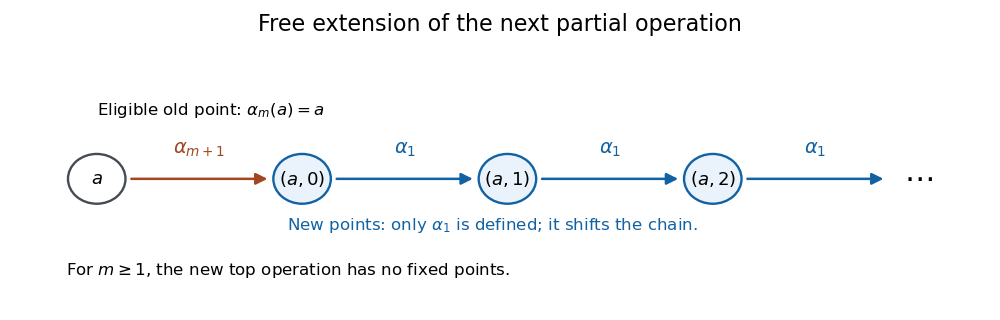
The free new operation sends each eligible point to a new value with a free chain under the first operation
. Details. 
For monadicity, reflects isomorphisms: an isomorphism of the lower structures takes bijectively to , so the inverse of a map preserving the new operation preserves it too.
Next prove the split-coequalizer lifting for a fixed-point-domain operation. Let be -morphisms and suppose their lower images have a split coequalizer , with , satisfyingEquip with on its required eligible domain. The lower-structure maps preserve eligibility. For eligible ,so preserves the top operation. If coequalizes , its lower factor satisfiesThus it is a morphism of the full structures. Uniqueness of the lifted operation follows from the eligible section and surjectivity of . This creates the specified coequalizer, so the Beck monadicity theorem proves each one-step adjunction is monadic.
Finally, every free top operation just constructed has no fixed points: for it shifts the free chain, while for it sends old eligible points to new distinct points and is undefined on the new points. Freely adjoining any further operation therefore changes nothing, since its required domain is empty. For , the monad induced on by the long free-and-forgetful adjunction is consequently the same monad, including unit and multiplication, as that for .
The first comparison category is thus equivalent to . Its algebra action evaluates the new formal value by , so the comparison from retains precisely that next operation and is the remaining forgetful functor. Iteration recovers one additional operation at each step. These remaining comparisons are not equivalences while an operation is still forgotten: take a two-element set with all retained operations equal to the identity, and choose the next operation to be the identity in one extension and the transposition in another. Higher operations can be identities in the first case and undefined in the second. The identity on the retained structure is not a morphism between these extensions, so the forgetful functor is not full. This includes .
Past exam of the mathematics course of the University of Cambridge 2004 iii Paper 23 2 Solution Created 2026-10-03 Updated 2026-10-14
Broadly in favour, if “trivial” means transparent once the correct structure has been identified. The value of category theory is often to isolate a universal property that makes a repeated argument automatic.
For example, two objects with the same universal property have unique connecting maps in each direction. Their composites and the identities satisfy the same defining conditions, so uniqueness makes those composites identities. This one argument explains the uniqueness of categorical products, categorical limits, adjoint functors and many other constructions. It also specifies which isomorphism is canonical, a point that an arbitrary objectwise choice would miss.
The Yoneda lemma makes this perspective systematic. A natural transformation out of is determined by its value at . Once that evaluation principle is recognized, questions about representable functors reduce to compositions in the original category. Similarly, the Beck monadicity theorem organizes many free-and-forgetful constructions around monad algebras, reflection of isomorphisms and specified coequalizers. The proof supplies a reusable explanation of why the algebraic structure can be reconstructed from the forgetful functor.
The substantial work lies in finding suitable definitions and verifying their hypotheses. The Freyd general adjoint functor theorem, for instance, needs completeness, local smallness and a solution set; none follows merely from calling a construction natural. The partial-operation tower below even has a monadic length that records how many distinct reconstruction steps are needed. These examples support the view that abstraction clarifies the source of an argument's simplicity. They also show why that simplicity is an achievement requiring proof.
Past exam of the mathematics course of the University of Cambridge 2004 iii Paper 23 1 Solution Created 2026-10-03 Updated 2026-10-14
Use the Freyd general adjoint functor theorem: a functor , with complete and both categories locally small, has a left adjoint precisely when it preserves small categorical limits and satisfies the solution-set condition. The latter means that every comma category has a small weakly initial set.
Here is the proof. First prove the initial-object lemma for complete categories with a weakly initial set. In a complete locally small category , take the product in a category of a small weakly initial family. It is weakly initial: project to whichever member admits a morphism into the required object. Form the simultaneous equalizer of every endomorphism of and ; local smallness makes this a small limit.
For parallel , let be their equalizer. Weak initiality supplies . Since is an endomorphism of , the defining equalities give . Cancel the monomorphism to get . Thus is a split epimorphism as well as a monomorphism, hence invertible, and . Existence of a morphism follows by composing with a map . Therefore is an initial object.
Now, if preserves small categorical limits, each has them: take the limit of the underlying -diagram and use preservation to assemble its maps out of . It is locally small and has a weakly initial solution set, so the lemma produces an initial object . Its universal property gives natural bijectionsThe universal arrows define on morphisms, proving . Conversely, a right adjoint preserves categorical limits, and its unit supplies a singleton solution set in each comma category.
Apply this to . The functor category is complete and locally small because is small; pointwise limits in a functor category show preserves all small limits. For , verify the bounded subfunctor solution set for precomposition. Choose an infinite cardinal number at least as large as the number of -morphisms and . Given , setPostcomposition makes a subfunctor, each value has cardinality at most , and factors through . After labelling its values by subsets of , only a set of possibilities for and exists. Their maps into give the required weakly initial set. Thus has a left adjoint.
It is the left Kan extension. The left Kan extension as a comma-category colimit makes it concrete:Every representative maps under to . The colimit identifications and naturality make this well-defined, giving exactly .
Past exam of the mathematics course of the University of Cambridge 2004 iii Paper 22 4 Solution Created 2026-10-03 Updated 2026-10-14
An -dimensional stratified pseudomanifold has a closed filtration with each nonempty an -dimensional manifold, dense top stratum, and . Each point of an -dimensional stratum has a stratum-preserving conical neighbourhood , where is a compact -dimensional stratified pseudomanifold. The definition is inductive, starting with zero-dimensional spaces. There are no singular codimension-one strata; connectedness of links is not required. One may work in the usual triangulable category used for Witt bordism.
A rational Witt space is such a stratified pseudomanifold for which every stratum of odd codimension has link satisfying . No extra condition is imposed at even codimension. A Witt space with collared boundary has Witt interior and Witt boundary, and a stratum-preserving collar with the product stratification. An orientation means an orientation of the regular stratum, inducing the boundary orientation on its collar.
A three-pronged graph, with its central vertex and open edges as strata, is a stratified space but not a one-dimensional pseudomanifold: the central vertex is a singular codimension-one stratum, and deleting it leaves three local branches instead of the two branches of a one-manifold. For a non-Witt pseudomanifold, take the suspension of . Its two vertices have codimension three and link , whose middle group is . It violates the Witt space condition.
The rational Witt bordism classification in dimensions divisible by four states that, for every , the middle intersection form induces an isomorphismHere is the Witt group of a field, so a nonsingular symmetric form represents zero precisely when it is metabolic, that is, when it has a half-dimensional totally isotropic subspace. The Complex projective plane gives a nonzero example: its middle group is generated by the degree-two class , with . Its form is , of signature one; a metabolic form has signature zero. Thus in .
For a closed oriented Witt space of dimension , take the closed coneAway from its vertex it is a stratified product with an interval, so all old Witt space conditions persist. At the new vertex the codimension is , which is even; hence its odd-dimensional link creates no new Witt condition. The collar is explicit, and the product orientation may be chosen to induce the given orientation on . This is a compact oriented Witt space with collared boundary, proving
Now let . Its singular strata are zero-dimensional. Their links are compact one-dimensional pseudomanifolds, which have no singular strata and are therefore nonempty finite disjoint unions of circles. A single circle is allowed, since a chosen stratum need not be intrinsically singular. The Witt condition is automatic in dimension two, because singular strata have even codimension.
Construct the normalization of a two-dimensional pseudomanifold concretely. Remove disjoint small conical neighbourhoods of the finitely many zero-stratum points. The remainder is a compact oriented surface with boundary, with one boundary circle for each local branch. Cap every such circle with a separate disk. The result is a closed compact oriented topological surface. Map each new disk homeomorphically onto its branch of the original cone, sending all the disk centres belonging to one old singular point to that point. Along the disk boundaries this agrees with the identification with the remainder, so it defines a continuous surjection . It is a homeomorphism off these finitely many centres, in particular over the prescribed open stratum. Every fibre is a point except over a zero-stratum point, where it is the finite set of its branch centres. Thus every fibre is zero-dimensional, as required.
Each component of bounds an oriented handlebody: a surface of genus is the boundary of a three-ball with one-handles attached. Let be the disjoint union of these handlebodies, oriented so that . Formgluing to . The quotient is compact and Hausdorff, and its only remaining boundary is , with an explicit product collar. Near regular points of the gluing locus, two half-ball neighbourhoods glue to a three-ball; the induced orientations match after choosing the collar orientation in the usual boundary-gluing convention.
It remains to check the singular links, rather than merely assert that this quotient is a Witt space. If an old point has circle branches, the new one-dimensional stratum has link the disjoint union of those circles. This has codimension two and imposes no Witt condition. At , each branch supplies a half-three-ball from and another from the collar. The halves glue to a full three-ball; the different branches share only the positive collar axis. Intersecting with a small link therefore gives copies of identified at one common point. This is a two-dimensional pseudomanifold with zero middle intersection homology: an allowable one-cycle avoids the common point, so decomposes into cycles in the punctured spheres, each homeomorphic to ; each such cycle bounds there. Consequently . This is exactly the Witt condition at the new codimension-three stratum. The boundary has the required product stratification. Hence is a three-dimensional Witt space with collared boundary with , proving
For the final product assertion, “product” means a nontrivial product with at least two positive-dimensional factors; a single four-dimensional factor would allow the preceding counterexample. State the standard rational intersection-homology product fact used here: products of Witt spaces are Witt, their intersection cohomology satisfies the Künneth theorem, and the complementary-degree intersection pairing on elementary tensors is the product of the factor pairings, with the sign for and . Terms whose degrees in a factor do not add to that factor's dimension pair to zero. Regrouping factors reduces total dimension four to cases or .
In the case, write . The middle intersection cohomology isEach summand is totally isotropic, because the degrees in are respectively and , neither equal to one. They pair perfectly with one another by factor Poincare duality. Thus either summand has half the total dimension and is a Lagrangian for the middle symmetric form.
For dimensions , the middle group is the direct sumThe outside summands are isotropic and pair perfectly with one another. Each factor's degree-one pairing is a nonsingular skew-symmetric form, so choose a Lagrangian subspace . Inside the central summand, is isotropic and has half its dimension. It is orthogonal to both outside summands by their degrees. Thereforeis an isotropic subspace of half the full middle dimension. In both cases the form is metabolic. The Witt bordism classification now proves the desired in . This also proves the assertion for more factors, using the regrouping just described.
Past exam of the mathematics course of the University of Cambridge 2004 iii Paper 22 3 Solution Created 2026-10-03 Updated 2026-10-14
All cohomology below has rational coefficients. First describe the incidence space geometrically. The image of is , inside . For a line , choosing a plane containing is equivalent to choosing the line in . If is the tautological line bundle on , thenThis is the projective bundle of a rank-three quotient bundle, with fibre . Local frames of the quotient bundle give local product charts. In particular is an oriented real six-dimensional manifold.
For , the intersection is exactly a line, so is a single point and the inverse map is . The intersection line varies continuously, indeed holomorphically, wherever its dimension is constant: in local Grassmannian charts it is the kernel of a matrix of constant rank, whose kernel bases can be chosen locally. Thus is an isomorphism over the open stratum. At the remaining point,Set , a derived direct image of sheaves. The proper base change for sheaves theorem identifies its derived stalks with the cohomology complexes of the fibres. Consequently is the constant rational sheaf in degree zero on , andThe cohomology sheaves are therefore finite-rank local systems on the two strata, with no other nonzero degrees. This proves that is a constructible complex of sheaves and verifies normalization. The open stratum has real dimension six, so the isolated point has codimension six. Its middle perversity is , and the intersection-complex support and cosupport axioms require stalk vanishing in degrees above two. The fibre calculation verifies the support axiom, as well as vanishing in negative degrees.
For an oriented real six-dimensional manifold, Verdier duality gives . For a proper map, Verdier duality commutes with derived direct image. Applying these statements here yieldsThe duality identity converts this intoHere is the costalk, and dualization of rational complexes reverses degrees. Thus its only nonzero groups are in degrees four and six. In particular they vanish for , which is precisely the cosupport axiom at this isolated six-dimensional singularity. The uniqueness characterization by constructibility, normalization, support and cosupport now identifies with the unshifted intersection complex of . Taking hypercohomology, and using the composition of derived global sections with , givesFinally apply the fibration result allowed in the question to . Its base is the simply connected complex projective line, its fibre is the Complex projective plane, and the projective-bundle charts above verify the fibration hypothesis. Hence, as graded rational vector spaces,The resulting Betti numbers and Poincaré polynomial areThis uses with . No assertion that an arbitrary projective fibration has the product cohomology ring is needed.
There are unlisted articles, also show them or only show them.