
Stable node Created 2026-09-24 Updated 2026-09-29
A planar equilibrium is a stable node when its two Jacobian eigenvalues are real and negative. Every nearby trajectory approaches it, tangent asymptotically to an eigendirection.
Saddle equilibrium Created 2026-09-24 Updated 2026-10-14
A planar hyperbolic equilibrium is a saddle when the Jacobian determinant is negative. It has one stable and one unstable eigendirection and corresponding one-dimensional invariant manifolds.
Attenuation bias from classical measurement error Created 2026-09-24 Updated 2026-10-07
If but the predictor is observed as , with independent centred errors, the population regression slope isMeasurement error in the predictor therefore shrinks the slope toward zero, while independent response noise changes its uncertainty but not its population value.
Interaction term Created 2026-09-24 Updated 2026-10-14
An interaction term lets the effect of one predictor depend on another. Inthe slope with respect to is .
Regression coefficient Created 2026-09-24 Updated 2026-10-14
A regression coefficient is a component of measuring the change in the linear predictor associated with its design-matrix column.
These are the parameters of a linear regression predictor, rather than the regression procedure itself.
Design matrix Created 2026-09-24 Updated 2026-09-24
The design matrix has one row for each observation and one column for each regression coefficient, so the linear predictor is .
Jump condition for an impulse Created 2026-09-24 Updated 2026-09-24
Linear system of differential equations Created 2026-09-24 Updated 2026-10-03
Resonance in a differential equation Created 2026-09-24 Updated 2026-09-24
Integrating factor Created 2026-09-24 Updated 2026-10-14
An integrating factor is a nonzero multiplier that makes a differential equation directly integrable. For a first-order linear differential equation, it gathers the unknown function and its derivative into one product rule expression. Suppose and are continuous functions on an interval containing , and consider the initial value problemDefine and . The exact solution of a differential equation throughout that interval isThe definite integral fixes , so the initial condition appears without an extra constant to determine. If the equation originally has a coefficient multiplying , first divide by that coefficient on an interval where it is nonzero; a zero of that coefficient needs separate attention. See OpenStax's first-order linear equations chapter for this normalization and the integrating factor procedure.
For a concrete balance, solve with . Here , so multiplying the entire ordinary differential equation gives . Accumulating from zero to givesThe computed values are , and . Its derivative is , which verifies exactly. Interpreting as a steady input and as proportional removal explains the shape: initially all input increases , then removal catches up. The constant particular solution balances input and removal, and the homogeneous solution is the transient response that corrects it to the initial condition. Because this autonomous differential equation has a time-independent right-hand side, is also an equilibrium point.
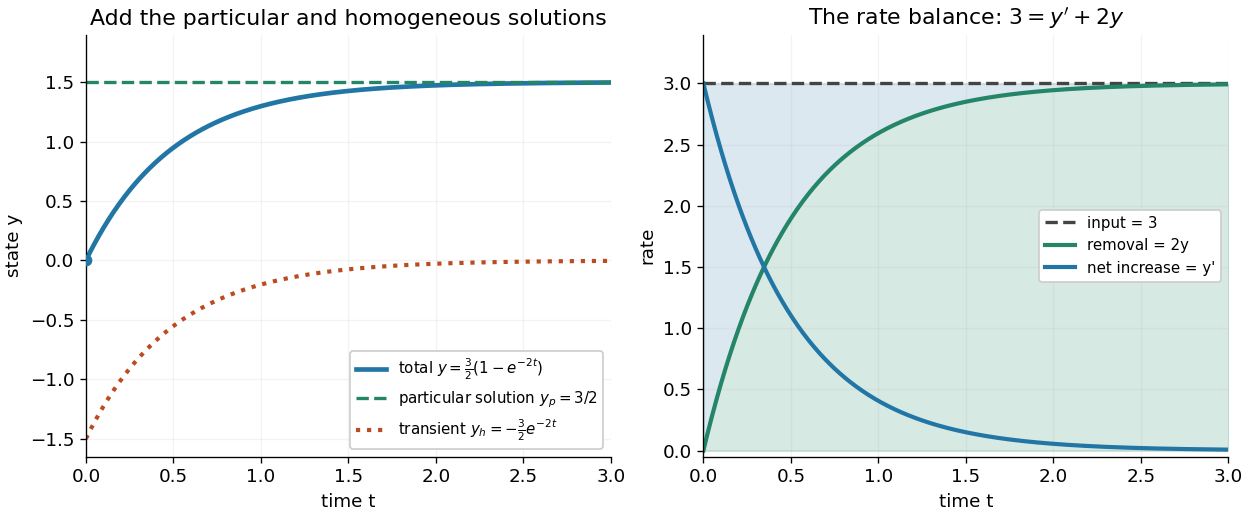

The first panel adds the particular solution and homogeneous solution; the second shows the same balance in rates, . This links the algebra to a physical accounting rule. Newton's law of cooling has this form with and , while an electrical circuit can have a varying input. In both cases the integrating factor systematically handles the input rather than requiring a guess for a particular solution.
Variable coefficients work just as directly. For , , the integrating factor is , andThus , and . The derivative verifies , including at zero, where both coefficient and input vanish. No division by is necessary. The general solution is : is a constant particular solution, and solves the associated homogeneous linear differential equation. Although this special forcing term admits a constant trajectory, this is a nonautonomous differential equation: it depends explicitly on time. Merely setting its right-hand side to zero at one instant would not establish a constant solution of a differential equation; at every state has zero slope.
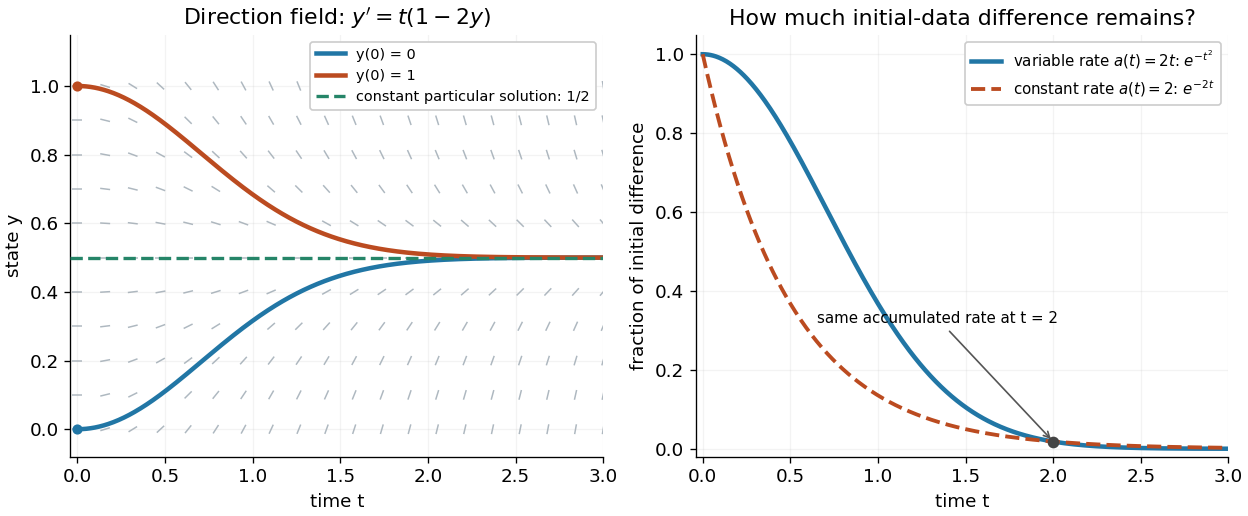
Variable-rate trajectories share a constant particular solution and forget initial data by a factor of exp minus t squared
. Details. 
The direction field shows the selected trajectory leaving its initially horizontal tangent line. For , the difference between any two solutions of a differential equation is multiplied by , rather than in the constant-rate example. This dependence on elapsed history is clearer if the exact formula is rewritten asFor , each contribution from the input at is weighted by the accumulated coefficient between and . The homogeneous solution remembers the initial condition; the particular solution given by the second term accumulates the forcing term with zero initial value. This decomposition differs from choosing a constant particular solution, but gives the same total. Initial-data memory tends to zero when ; a negative accumulated coefficient instead amplifies it. The reciprocal relation between integrating factor and homogeneous solution is developed in MIT's notes on solutions to linear first-order equations.
Why does the trick work? The fundamental theorem of calculus and chain rule give . Consequently the product rule givesIntegrating this identity and dividing by the positive exponential function produces the stated formula. Any nonzero constant multiple of works equally well; normalization is a convenience. This is the beauty of the method: a sum involving an unknown function becomes one exact derivative, leaving only an integral of known functions. See Oregon State's product-rule derivation. The related integrating factor for a differential one-form extends the idea of making an expression exact beyond this linear setting.
Second-order linear differential equation Created 2026-09-24 Updated 2026-09-24
Dominant eigenmode in a forced linear system Created 2026-09-24 Updated 2026-09-29
After diagonalising a constant-coefficient system, each eigenmode satisfies a scalar forced equation. The large-time behaviour is determined by the largest exponential rate whose coefficient does not vanish, including rates introduced by the forcing.
Particular solution Created 2026-09-24 Updated 2026-10-14
A particular solution is any one solution of a forced linear differential equation. Every solution is the sum of that particular solution and an arbitrary homogeneous solution.
Homogeneous solution Created 2026-09-24 Updated 2026-10-14
A homogeneous solution solves the associated linear equation with zero forcing. The difference of any two solutions to the same forced linear equation is homogeneous.
A homogeneous solution satisfies the associated homogeneous linear differential equation, obtained by setting the forcing term to zero. Such solutions form the kernel of the differential operator.
Matrix Created 2026-09-24 Updated 2026-09-24
Linear operator Created 2026-09-24 Updated 2026-10-03
Superposition principle Created 2026-09-24 Updated 2026-10-07
Linear function Created 2026-09-24 Updated 2026-10-14
This is a scalar-valued linear functional, so it vanishes at the origin; an affine function with a nonzero constant term is a different notion.
Linear isomorphism Created 2026-09-24 Updated 2026-10-03
There are unlisted articles, also show them or only show them.