
First isomorphism theorem for vector spaces Created 2026-09-24 Updated 2026-10-03
Lagrange resolvent eigenvector for a cyclic field automorphism Created 2026-09-24 Updated 2026-09-29
If has order and the fixed field contains a primitive th root , thensatisfies . Independence of the powers of ensures that is nonzero for some .
Linear dependence Created 2026-09-24 Updated 2026-10-14
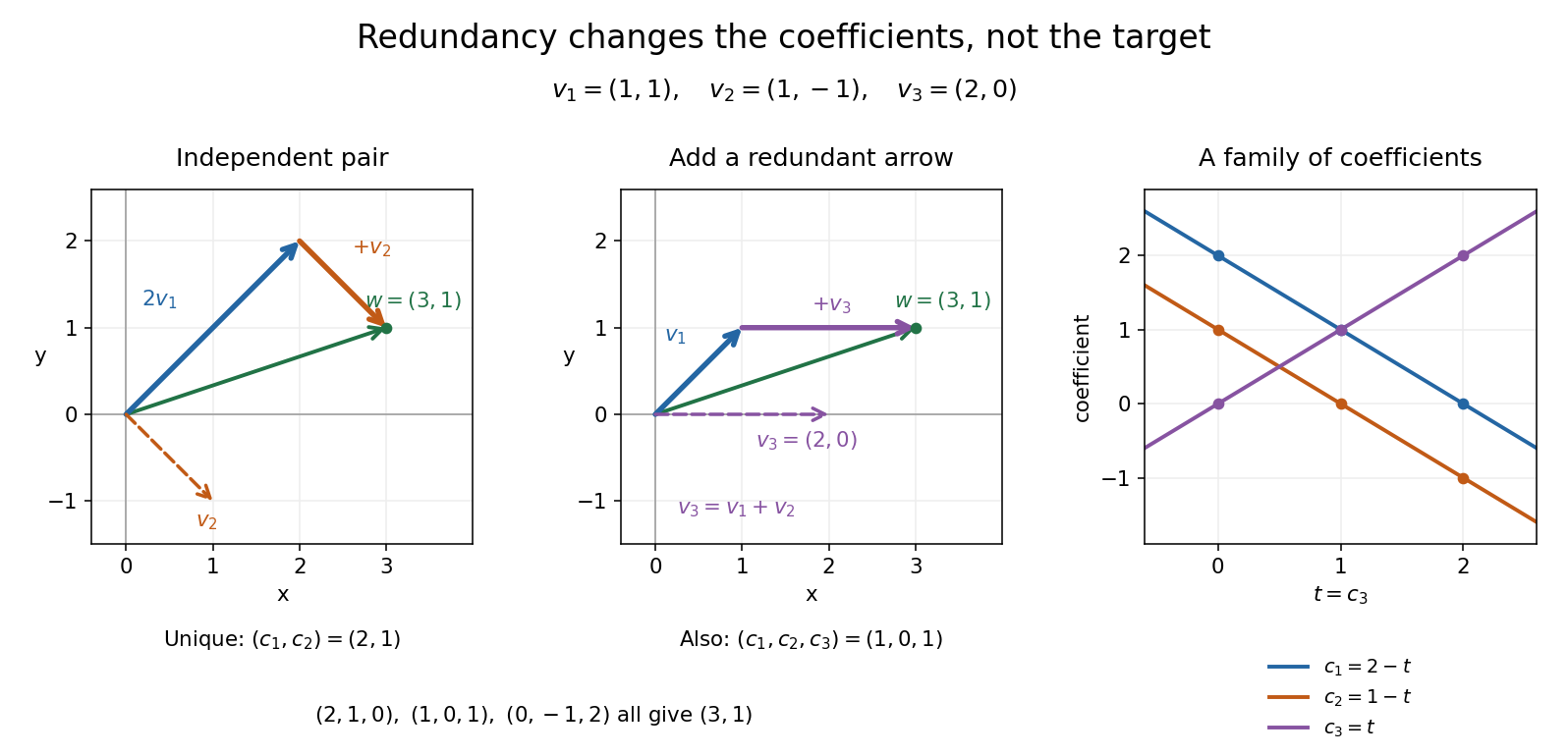
A finite family of vectors in a vector space over a specified field is linearly dependent if it has a nontrivial linear relation: with and at least one coefficient nonzero. One can then solve for a vector whose coefficient is nonzero as a linear combination of the others; removing that entry preserves the linear span. Repeated vectors in a list give linear dependence: for example has the linear relation . A list keeps both entries even though the set has only one element. Strang's notes illustrate redundant columns by expressing one as the sum of two others.[ref]
https://ocw.mit.edu/courses/18-06sc-linear-algebra-fall-2011/0bbc30e3f1d7933ea07a2d2e9ab050d9_MIT18_06SCF11_Ses1.9sum.pdf. MIT 18.06SC, Strang lecture summary 9, pp. 2–3: dependent columns
Keep and , and add . The three vectors still have linear span , but nowThe two coefficient triples and differ by the nontrivial linear relation . In fact all linear combination representations of this target areTo check both completeness and correctness, use . Linear independence of forces and , giving exactly the displayed family. Redundancy therefore preserves attainable targets while allowing their coefficients to move. For solving a linear system, these alternatives matter; for assigning unique coordinate vectors, one instead chooses a basis.

The following example shows why linear independence depends on the scalar field.
Inhomogeneous linear differential equation Created 2026-09-24 Updated 2026-10-14
An inhomogeneous linear differential equation has a nonzero forcing term. Its general solution is one particular solution plus the general solution of the associated homogeneous linear differential equation.
Squeeze theorem Created 2026-09-24 Updated 2026-09-24
Continuous function Created 2026-09-24 Updated 2026-10-14
A continuous function sends sufficiently nearby function inputs to nearby function outputs. For a real-valued function and a point that is an accumulation point of , this meansThe approached value and the assigned value must agree. Continuity on means continuity at every point of the domain of a function. At an endpoint of an interval, only approaches inside that domain of a function count. The epsilon-delta definition of continuity below also applies at an isolated point, where continuity holds automatically.[ref]
Calculus Volume 1, §2.4 Continuity. §2.4, Continuity at a Point: definition; Continuity over an Interval: one-sided endpoint conditions
For the polynomial function , approaching makes the function output approach . The continuity bounds for the square function turn this observation into an explicit guarantee: implies . This is useful whenever a small error in an function input must produce a controlled error in an function output. The required input tolerance can depend on the point and on the chosen output tolerance.
The absolute value function is also a continuous function, including at zero: . But its left and right derivatives there are and , so it is not a differentiable function at zero. Continuity controls values without requiring a tangent line. Conversely, a differentiable function is continuous wherever it is differentiable: if , the difference tends to zero with .
Several useful consequences reuse this one local idea. Addition, multiplication and function composition preserve continuity; a quotient of functions is continuous where its denominator is nonzero. On an interval, the intermediate value theorem turns continuity into a guarantee that no intermediate function output is skipped. On a compact set, the extreme value theorem guarantees attained maximum and minimum values. Those extra hypotheses matter: continuity alone on an unbounded domain of a function does not provide a global bound or an attained global maximum.
A rational function such as is continuous on its domain of a function . Zero is excluded from that domain of a function; the missing point prevents a continuous extension there, but it does not make the existing map discontinuous at one of its actual inputs. Always state the domain of a function before judging continuity.
Generalized likelihood-ratio test Created 2026-09-24 Updated 2026-10-03
A generalized likelihood-ratio test compares the likelihood maximized under the null with the likelihood maximized over the full parameter space.
Likelihood ratio Created 2026-09-24 Updated 2026-10-05
Null directions Created 2026-09-24 Updated 2026-10-14
A direction represented by a nonzero null vector has zero Minkowski norm. Such directions form the generators of the light cone.
Prolongation of a vector field Created 2026-09-24 Updated 2026-10-14
For , its prolongation to derivatives through order isIt generates a symmetry of exactly when vanishes on the equation manifold.
Prolongation lifts a vector field to the jet bundle of maps so that its flow acts on derivatives of the dependent variables as well as on their values.
Cayley transform (Lie theory) Created 2026-09-24 Updated 2026-09-24
The Cayley transform is a rational local parametrization of a matrix Lie group from its Lie algebra wherever is invertible. Unlike the exponential map, its image can meet nonidentity components.
Exponential map of a Lie group Created 2026-09-24 Updated 2026-10-14
For any Lie group, the Exponential map of a Lie group is defined by , where is the one-parameter subgroup with initial tangent vector . For a Matrix Lie group, it is the matrix exponential . Its differential at zero is the identity, so the inverse function theorem supplies a local exponential chart. A small transformation can therefore be encoded by a vector in the Lie algebra. See MIT 18.745, Lecture 7, Definition 7.2 and Theorem 7.5.
Local invertibility makes no promise about a global inverse. In the planar rotation example, for every integer , so the Exponential map of a Lie group is surjective onto but not injective. Restricting to gives unique angles for every rotation except . The omitted half-turn exposes the cut needed for this single angle chart.
Surjectivity can also fail, even in a connected Lie group. The matrix lies in the special linear group but has no real matrix logarithm: any logarithm must commute with , hence preserve each of its distinct real eigenvectors, where exponentiating a real scalar gives a positive number. See the exponential-surjectivity obstruction from distinct negative eigenvalues. These two examples distinguish two different global obstacles: repeated parameters and unreachable elements. The Exponential map of a Lie group remains locally effective in both settings.
Left-invariant metric Created 2026-09-24 Updated 2026-10-07
A left-invariant Riemannian metric is preserved by every left translation. Its Killing fields generated by left translations are right-invariant vector fields.
Maurer-Cartan form Created 2026-09-24 Updated 2026-09-24
For a matrix Lie group, the left-invariant Maurer-Cartan form is . It identifies each tangent space with the Lie algebra and obeys .
Semisimple Lie algebra Created 2026-09-24 Updated 2026-10-05
Universal enveloping algebra Created 2026-09-24 Updated 2026-09-24
The universal enveloping algebra is the associative algebra generated by subject to . Its modules are the same as Lie algebra representations.
Heisenberg Lie algebra Created 2026-09-24 Updated 2026-10-07
The three-dimensional Heisenberg Lie algebra has a basis with and central. It is a two-step nilpotent Lie algebra.
Lie algebra homomorphism Created 2026-09-24 Updated 2026-10-03
Lower central series of a Lie algebra Created 2026-09-24 Updated 2026-10-07
Center of a Lie algebra Created 2026-09-24 Updated 2026-10-14
Like the center of a group, the Lie-algebra center consists of elements commuting with every element; here commutation means vanishing of the Lie bracket.
The center is .
There are unlisted articles, also show them or only show them.