
Use the dimensionally correct flat Friedmann-Lemaître-Robertson-Walker metricThe source's is missing a factor , and its angular term must mean the unit-sphere line element , not the solid angle element . For example, has dimensions length times time, while has dimensions length squared. The corrected convention above removes both ambiguities.
A radial light ray has and . ThusA proper shell volume at emission is . Multiplying by cancels the expansion factors, equivalently using the comoving volume element directly. HenceThis counts every galaxy in the shell per solid angle, rather than intersections weighted by individual galaxy areas. Near it reduces to , as expected for a Euclidean volume shell.
Conservation of the comoving galaxy population gives . Holding the proper galaxy radius fixed, integrate a:With , , and , set . ConsequentlyFor random uncorrelated intersections, the zero-intersection probability is from the Poisson distribution, so the fraction of the sky covered by foreground galaxies out to isIgnoring overlaps gives . A literal shell of zero thickness exactly at has zero coverage; the integrated foreground interpretation is needed. Clustering changes the exact overlap probability, although the mean optical depth above still follows from the mean number density.
Finally,At this optical depth, the Poisson sky coverage is , not . The large inferred cosmological redshift extrapolates conserved galaxy counts and fixed radii far beyond their plausible physical range; it is the answer within the prescribed toy model.
The Einstein-de Sitter universe has and . Normalizing therefore gives . Differentiating givesIn the local comoving rest frame, a photon crosses proper path length . Galaxies with proper number density and geometric cross section contribute the mean number of intersections . The infinitesimal probability of an intersection is the same to first order, givingThe radius is a physical radius, and is a proper number density evaluated at epoch , rather than a density already multiplied by . For a finite path with overlaps, the integrated mean count need not itself be the probability of at least one intersection.
Apply the same symmetric-ejection and causality argument to the launch proper motions, when the proposed ejecta are fastest. One obtainsandThe fitted angular decelerations describe subsequent evolution; they do not relax the bound already imposed at launch. They are observer-time phenomenological coefficients, not directly identical physical decelerations in the source frame.
The stellar parallax distance is compatible with the constant-velocity bound , but its central value exceeds the decelerating-launch bound by , or about quoted standard deviations if the uncertainty is treated as symmetric Gaussian. Even its one-standard-deviation lower endpoint, , exceeds . At the respective inferred intrinsic speeds are and . The latter is a concrete violation of causality under the symmetric model assumptions.
Thus the supplied distance favours the constant-velocity fit. This is a consistency comparison, not a full statistical model selection: uncertainties in the fitted proper motions, their correlations, intrinsic asymmetry and the distance likelihood would be required for that.
The Doppler factors for the two discrete blobs are . Their ratio is . Lorentz-invariant specific intensity means is unchanged; with and the same rest-frame power-law spectrum,The brightness ratio at the common observed frequency therefore givesThe stated identical intrinsic specific intensities must refer to comparable intrinsic states. If the blobs fade with their proper ages, equal observer times sample different ages and need that correction. A steady continuous jet has a different boosting exponent, ; the discrete ejecta and the specified specific intensity transformation justify here.
For optically thin synchrotron radiation from an isotropic electron distribution , the characteristic emitted frequency scales as and the total single-particle power as . Thus ; integration over the full single-particle spectrum preserves this exponent. HenceThe test-particle strong nonrelativistic diffusive shock acceleration prediction is for compression ratio , giving . The inferred spectrum is steeper. If interpreted literally within that uncooled formula, would correspond to , but cooling, escape, and other acceleration conditions can also steepen it.
The observed Galactic cosmic ray differential energy spectrum below the knee is approximately , steeper still; its formal synchrotron radiation equivalent would be . Thus lies between the simplest source prediction and the propagated cosmic ray slope. The comparison is qualitative: most measured cosmic rays are nuclei, whereas the radio slope here probes electrons, and propagation and radiative losses alter the spectra differently.
For intrinsically symmetric oppositely directed relativistic jets, their proper motions areThe ratio removes and yieldsTaking the product instead givesCausality requires , so the limiting distance and inclination areHere and in e, “maximum” denotes the limiting bound; massive ejecta obey strict inequalities. The conversion is , henceBoth bounds occur together in the light-speed limit. At any specified smaller distance, determines the intrinsic speed.
For fixed , differentiate the apparent speed with respect to angle:The maximum lies at and has value . Hence strict apparent superluminal motion requiresThe threshold is an infimum: equality yields exactly at , rather than a strictly superluminal value. For a chosen larger , the optimal inclination is , and the full superluminal interval satisfies .
Work in the source rest frame and neglect the source's small cosmological redshift. Over an emission interval , a ballistic relativistic jet feature travels , advancing toward the observer and across the sky. The second photon has a shorter journey, so its arrival is delayed by onlyDividing the projected displacement by this arrival interval givesApparent superluminal motion is a combination of projection and light-travel delay. The feature's local speed remains ; its inferred transverse displacement divided by the observer's arrival interval is not a local signal velocity.
In the growing-mode spherical-collapse model, use and . Their ratio in c gives . Meanwhile , and the linear growing density contrast scales as . Matching at small therefore fixesThis is a linearly extrapolated growing-mode amplitude at any epoch, including epochs where the actual density contrast is nonlinear. It carries the initial-condition qualification in c.
Numerical comparison isThe last column measures the fractional underestimate of the actual density contrast. Linear theory is accurate at , but substantially underpredicts it by the time approaches unity. At , the shell reaches spherical-collapse turnaround; .
At , and the ideal pressureless density diverges at finite time . Yet the extrapolated linear value remains finite:This is the linear spherical-collapse threshold, not the true density contrast at collapse. Actual nonspherical collisionless systems undergo shell crossing and virialization rather than becoming uniform point singularities. The ideal virial theorem and conservation of energy estimate a final radius if the structural form is preserved.
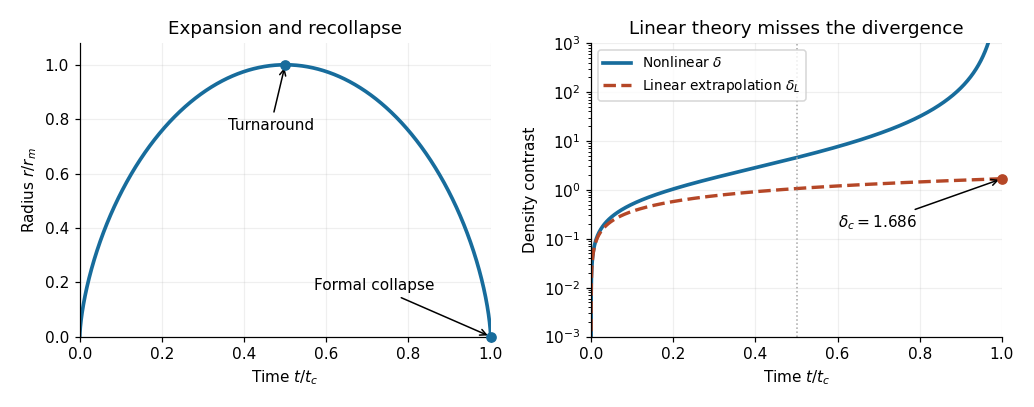
Parametric spherical collapse and the failure of the extrapolated linear density contrast
. Details. 
First retain the exact initial normalization. The scale factor obeys , so the cosmological redshift isAlso and . Using givesThese equations exactly accommodate the finite-time initial conditions in b.
Now neglect and retain leading order in . Since , the cosmological redshift relation reduces toDefine . ThenThe second equality is exact for the ideal common-bang growing-mode spherical-collapse model; it is approximate for the paper's finite-time initial Hubble-velocity data.
The factor has a physical origin. Linear mass conservation gives when the initial local expansion equals the background Hubble flow. The general linear dust solution is . Imposing and yieldsThus is the present extrapolation of the growing component, after neglecting the decaying transient. It is not the exact present value of the full linear solution for finite .
For and , differentiation givesComparison with proves . Substitution into the conserved specific orbital energy gives . ThereforeThese constants exactly reproduce both the initial radius and expanding velocity. The initial parameter obeysIn an Einstein-de Sitter universe whose background big bang is , . Thus the exact required offset isExpanding givesOne cannot set exactly at finite while retaining the stated initial Hubble velocity and background time origin. For example , gives . Shifting to removes the offset from the local orbit, but the background then scales as , not . Setting is justified in the early-initial-time limit for subsequent evolution; the following standard growing-mode formulae use that approximation.
Take the initially expanding branch ; the printed squared velocity alone also permits an initially contracting branch, which would not reach a future maximum radius. Multiply the equation of motion by and integrate. The conserved outer-shell specific orbital energy isThe initial mass follows from the background critical density:ConsequentlyIf means the energy of a test shell of mass , . If it means the total energy of the entire uniform, homologously moving perturbation, direct integration instead gives , andThe common convention of writing the first integral as is therefore an energy per unit shell mass, not the total energy of the sphere.
At spherical-collapse turnaround, , so . HenceAny positive initial density contrast binds this pressureless perturbation in the stated Einstein-de Sitter universe.
Retain the consistent of d. Across a sufficiently thin layer, the neutral hydrogen column density is . The direct stellar continuum acquires optical depth . Define the photon-weighted second momentExpanding the attenuating exponential in the photoionization rate givesThe second cross section moment appears because the radiation both undergoes absorption and is weighted by the photoionization cross section in computing the rate.
In a local plane-parallel approximation that suppresses geometrical dilution, setThen local photoionization equilibrium becomes , soThis gives the requested algebraic dependence, with the corrected definition of . Besides , linear attenuation requires over the frequencies contributing appreciably to the rate. In particular must remain positive.
The source's neglects , which is also first order in layer thickness. A consistent spherical first-order answer uses in the same root. Neglecting dilution relative to absorption additionally requires . As a concrete limiting test, with negligible absorption the source's predicts no change, while inverse-square dilution still decreases and thus .
Let be the photoionization rate per neutral hydrogen atom just outside the empty cavity. With an isotropic central source and no attenuation inside that cavity,The cross section is zero below threshold; this permits the lower integration limit zero. Pure hydrogen with hydrogen ionization fraction has and . Local photoionization equilibrium is thereforeDefine the dimensionless quantity . Solving the resulting quadratic equation, , gives the physical rootThe rationalized form avoids numerical cancellation for small . Strong illumination gives ; weak illumination gives .
Eliminating with the H-alpha luminosity, , yieldsThe printed definition of is inconsistent with the defined radii. The source calls a physical stellar radius, but its factor gives units of length to the fourth power, rather than a dimensionless value. It also omits the physically necessary cavity radius . For a concrete counterexample, double while holding the source, , and fixed: the incident photoionization rate falls by four, so rises by four; the printed expression does not change. The root has the requested form with the corrected above. There is no supplied relation allowing to be replaced by .
An additional atomic input is needed: the total Case B recombination coefficient does not specify the number of H-alpha photons per net radiative recombination. Let , where is the effective recombination coefficient. At the approximately temperature implicit in the supplied , take . The coefficient 2.2 used later in the paper corresponds to , which we use consistently here.
For an unextinguished, fully filled Strömgren sphere with negligible central cavity, the H-alpha luminosity and observed radiative flux satisfySubstitution eliminates and givesConvert the angular diameter to radians: . Also . ThusThe implied hydrogen-ionizing photon production rate is . Using instead gives . These values use the printed milliarcseconds and integrated line observed radiative flux. Assuming one H-alpha photon per recombination would give a different, unjustified distance. An appreciable cavity or a nonunit filling factor must also enter the emitting volume.
The Brackett series consists of transitions ending at , at infrared wavelengths. They suffer much less interstellar extinction than H-alpha, so their corrected observed radiative fluxes can give a more reliable version of the same inference. At fixed measured angular size and number density, the formula has : uncorrected interstellar extinction therefore makes this particular distance estimate too small. Infrared lines are weaker and need their own effective recombination coefficients; their advantage is reduced sensitivity to dust.
Write for the hydrogen-ionizing photon production rate, counting only photons above the hydrogen ionization energy, not all stellar photons. In steady photoionization equilibrium, the external supply balances the volume integral of net Case B recombination:For uniform, almost completely ionized pure hydrogen, . HenceThe final approximation requires . The Strömgren sphere also assumes spherical symmetry, a sharp ionization front, a steady source older than the recombination time, uniform number density and temperature so that is constant, negligible dust absorption of ionizing photons, negligible leakage, and no important helium correction or collisional ionization. Clumping would replace by a volume average of .
A hydrogen recombination line is a discrete spectral line produced when radiative recombination captures an electron into an excited bound level and a subsequent radiative cascade emits photons. The free-to-bound capture itself produces a continuum; the later bound-to-bound transitions produce the recombination lines. For example, H-alpha is the transition in the Balmer series.
For the neutral hydrogen absorbing an ionizing stellar continuum, the principal bound-free transition is photoionization from the ground state into the continuum. Most neutral hydrogen is in its ground state, and the photoionization cross section is largest near its threshold, falling approximately as above it. Dominance of the population-weighted opacity is intended here; this does not mean that every excited-state microscopic cross section is smaller at every frequency.
In an ionization-bounded, optically thick nebula, direct radiative recombination into emits an ionizing photon that promptly photoionizes another hydrogen atom. One ion disappears and another is created: there is no net removal of an ion from the global budget. Case B recombination therefore uses , with local recycling of ground-state recombination photons. This is the on-the-spot approximation, rather than an unconditional property of radiative recombination: if those photons escape, direct capture does produce net neutralization and a Case A treatment is appropriate.
Write for the retained fraction and for an opposite kick. With more than half the mass lost, . A same-direction kick cannot bind the pair, because . An opposite kick can reduce the relative speed enough to leave negative energy:Both endpoints are marginal zero-energy cases. Kicks somewhat larger than can still satisfy this interval, but then the direction of the relative orbital motion is reversed.
At , the two surviving stars have identical instantaneous velocities, so their relative velocity and orbital angular momentum vanish. Their energy is nevertheless negative,They fall radially toward each other from rest in their new centre-of-mass frame. In the point-mass idealization the collision orbit has semimajor axis and zero pericentre; real finite-size stars collide or interact before reaching zero separation. It is not a stable circular binary. Zero relative angular momentum, rather than the negative energy alone, determines this plunge outcome.
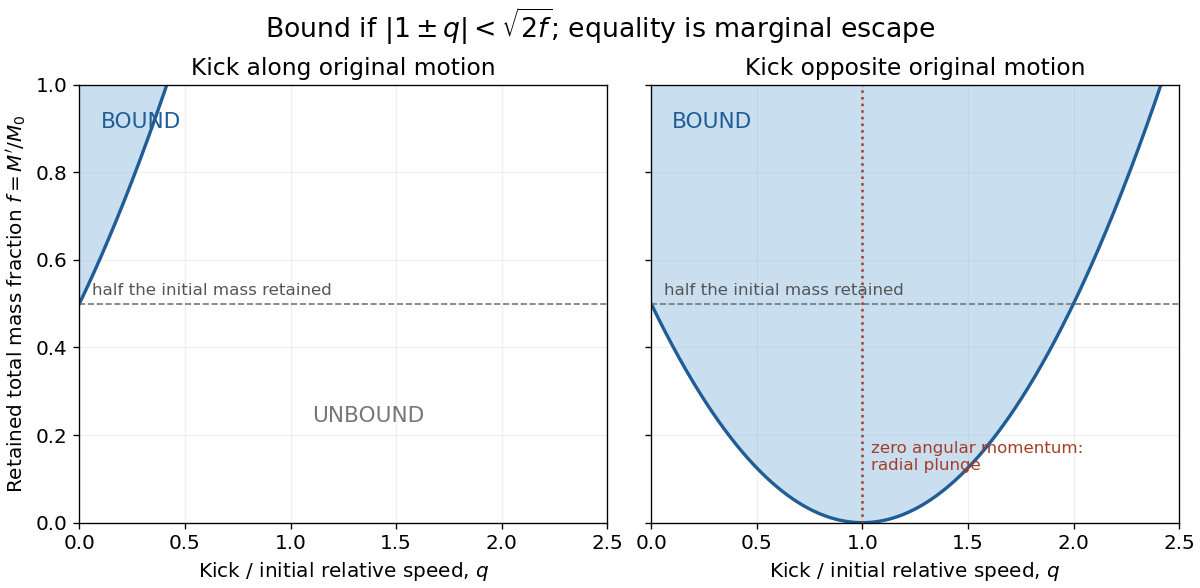
Binding after instantaneous mass loss for parallel and opposite natal kicks
. The retained mass fraction is and the kick magnitude is normalized to the original relative speed. Blue regions have negative orbital energy. The curves mark marginal escape. At an opposite normalized kick of one, the relative angular momentum vanishes and the survivors plunge together. Details.
For a kick parallel or antiparallel to star 1's original velocity, the immediate post-explosion relative speed is . ThusA positive-energy, hyperbolically escaping pair therefore satisfies preciselyThe absolute value is essential when a sufficiently large opposite kick reverses the relative tangential velocity.
Marginal case. Strictly speaking, a pair is gravitationally bound only for . If unbound includes marginal escape, replace the printed strict inequality by . For a concrete counterexample to an unrestricted “if and only if” with , take no kick and . Both sides equal one and the energy is zero: this is not a bound ellipse, although the printed strict inequality is false.
Let , , and let the initial circular separation be . The initial relative speed is , with . Instantaneous symmetric mass loss changes neither the separation nor either surviving star's velocity at that instant. In the new centre-of-mass frame, use the reduced mass ; the orbital energy isConsequentlyLess than half the total initial binary mass lost gives a bound orbit, not necessarily a circular one. Exactly half gives zero orbital energy and the marginal parabolic escape case. The threshold concerns the total mass of both stars, not just the exploding star. Using the old centre-of-mass kinetic energy without subtracting the new systemic motion would give the wrong binding criterion; the relative-velocity form performs that subtraction automatically.
There are unlisted articles, also show them or only show them.