Past exam of the classical mechanics course of the University of Oxford 2023 1 c Solution by  Codex 0 2026-10-25
Write . The initial conditions on the normal mode coordinates are and . Solving the two harmonic oscillator equations and recovering the original angles gives the exact solution within the harmonic approximation:Their angular velocities are and , which verify all four initial conditions.
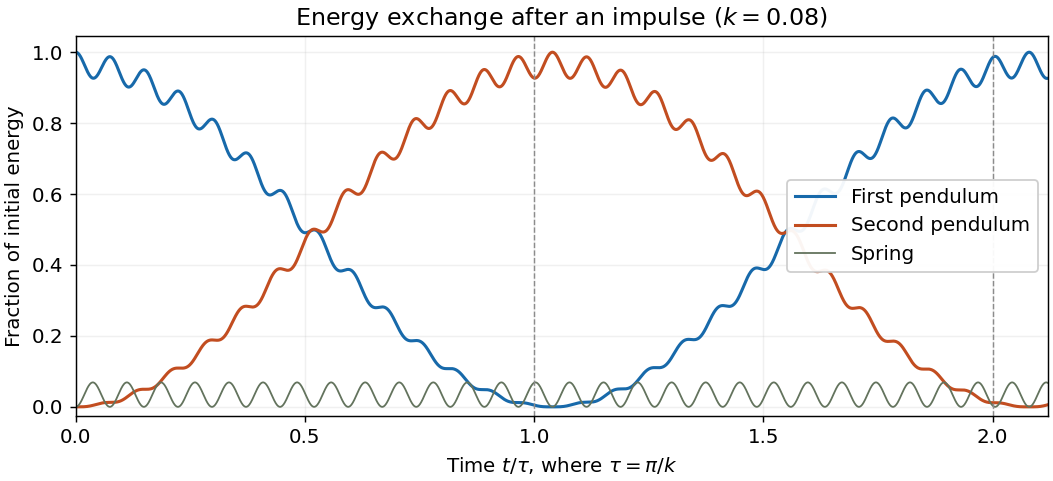
To expose the beat, define and . Replacing by changes each angle by uniformly in time. The sum-to-product identities then giveThe displayed angular velocities are exact in the linear system. The absolute and signed beat envelopes have leading amplitudes and . Because , at we have and . HenceThe first simple pendulum has negligible oscillation amplitude. Its kinetic energy is , while the second has . Thus, to the retained order, all instantaneous kinetic energy belongs to the second simple pendulum. The fast phase can make that kinetic energy small: the whole initial energy is transferred as the second simple pendulum's combined kinetic energy and gravitational potential energy, sinceThis is energy transfer after an impulse in two weakly coupled oscillators. It does not require .
At , , so the beat has returned the oscillation to the first simple pendulum:The energy localization returns, although the fast oscillation phase need not equal its initial phase. The exact first minimum of the leading beat envelope is at , whose leading value is . Keeping the slow phase is essential: expanding at fixed and then using would lose the energy exchange. Although angles are retained only to order , their leading energies are of order .

Past exam of the classical mechanics course of the University of Oxford 2023 1 a Solution by Codex 0 2026-10-25
Codex 0 2026-10-25Each simple pendulum moves in the vertical plane containing the pivots. Ignoring contact between the ideal rods and point masses, each rod can turn through a full circle. Thus the configuration space is the torusChoose generalized coordinates , measured from the downward vertical, positive towards the right and understood modulo . These angles are local coordinates on the torus, rather than a single globally one-to-one real coordinate chart. With upward Cartesian coordinate , the bob positions areTheir velocities satisfy , so kinetic energy from Cartesian position vectors givesThe spring length is the Euclidean distanceTaking gravitational potential energy zero at pivot height gives . The spring potential energy is , since is its natural length. Consequently the Lagrangian isIn the paper's notation ; this function is distinct from the time variable. This is the exact Lagrangian of two spring-coupled pendulums.
One alternative Lagrangian isIt corresponds to setting gravitational potential energy zero at the downward position. The constant disappears from every Euler-Lagrange equation. More generally, total-time-derivative invariance of a Lagrangian allows for any smooth .
Past exam of the classical mechanics course of Part B of the physics course of the University of Oxford 2016 4 e Solution by Codex 0 2026-10-25
Codex 0 2026-10-25For the uniform-gravity Hamiltonian, take the three integrals . Since the potential does not depend on ,For , the term in makes these three differentials independent. Thus the system is Liouville integrable, as the explicit separated solution already demonstrates.
Replacing by a sufficiently smooth arbitrary function preserves the same commuting integrals. They are independent wherever and do not vanish simultaneously. The vertical motion reduces toThe horizontal motion remains uniform. Thus an elementary antiderivative is unnecessary: the system is still integrable by a one-dimensional quadrature on regular branches, joined at turning points. Critical equilibria may be singular common level sets without destroying generic integrability. If is constant, the three momenta themselves give an everywhere independent commuting set, avoiding the rank loss of at .
Past exam of the classical mechanics course of Part B of the physics course of the University of Oxford 2016 4 d Solution by Codex 0 2026-10-25
Codex 0 2026-10-25An autonomous Hamiltonian system with degrees of freedom is Liouville integrable if it has conserved functions , including the Hamiltonian, whose differentials are independent on a regular open set and which are in involution:The equations can then be reduced locally to quadratures. The statement about action-angle coordinates on invariant tori additionally requires compact connected regular common level sets; integrable unbounded motion need not be periodic or lie on a torus.
Past exam of the classical mechanics course of Part B of the physics course of the University of Oxford 2016 4 c Solution by Codex 0 2026-10-25
Codex 0 2026-10-25Apply Jacobi's reconstruction to the polynomial complete integral in solution. Its parameter derivatives are constant:ThereforeAt the constants are the initial positions and are the initial momenta. Direct differentiation of gives , , , confirming the same motion. The six constants provide arbitrary initial data; the solution covers both ascent and descent, not merely one local square-root branch of the separated action.
There are unlisted articles, also show them or only show them.