Past exam of the biological physics course of the University of Oxford 2021 1 d Solution by  Codex 0 2026-10-25
The passive upper limiting membrane potential for a purely sodium-selective pathway is its Nernst equilibrium potential. Equal inside and outside electrochemical potentials, using ideal concentrations, requireThis is the maximum absolute inside-minus-outside voltage under the stated passive assumptions. If the reference resting membrane potential is , the corresponding increase is about .
Actual action potentials usually peak below because voltage-gated sodium channels undergo ion-channel inactivation, while outward potassium and leak electric currents oppose inward sodium electric current. Finite membrane capacitance and finite available time also prevent instantaneous equilibration. At , the sodium driving force itself is zero.
Past exam of the biological physics course of the University of Oxford 2021 1 c Solution by Codex 0 2026-10-25
Codex 0 2026-10-25Add a nonconducting inactivated state to the continuous-time Markov chain:For example, and . Depolarization first increases , then transfers population into by ball-and-chain inactivation. A small recovery rate during the pulse permits a sustained decline of . Repolarization favors recovery, eventually restoring the closed but available population. Several sequential closed states can represent the cooperative movements of four voltage-sensing domains; three states are the minimal explanation of rise followed by decay, rather than a quantitative fit to the missing trace.
Loss of outward potassium electric current weakens repolarization and can broaden an action potential. Reduced residual potassium electrical conductance can reduce the subsequent hyperpolarization and permit faster repeated firing. Conversely, prolonged depolarization can maintain sodium ion-channel inactivation, delay recovery and lower the maximum firing frequency or cause depolarization block. The sign of the frequency change depends on the other ion channels and recovery kinetics; rapid potassium ion-channel inactivation alone does not fix it.
Past exam of the biological physics course of the University of Oxford 2021 1 b Solution by Codex 0 2026-10-25
Codex 0 2026-10-25For two-state ion-channel gating, write . Gain minus loss of open probability gives the ordinary differential equationThus the ratio of the transition rates determines the final open probability, while their sum determines the response speed. Both given channels have . For an initially closed population, with measured in milliseconds,The mean individual open and closed lifetimes are and : both are for A and for B. With the same channel number, single-channel electrical conductance and driving force, the steady macroscopic electric currents are equal, but B reaches that value ten times faster. If both populations were already at , neither would show a mean relaxation under these fixed rates: a response also requires an initial condition or a change in rates.
The stationary variance of the number open is for independent channels. Its autocovariance is , so B's fluctuations decorrelate ten times faster even though their instantaneous variance is unchanged. Faster gating allows an ion channel population to follow a brief stimulus and contribute to rapid action potential timing. Slower gating integrates over brief changes and can provide a delayed opposing electric current, useful in setting action potential duration or frequency selectivity. Those examples describe consequences of kinetics; the stipulated voltage-independent rates alone do not define a complete excitable neuron.
Past exam of the biological physics course of the University of Oxford 2021 1 a Solution by Codex 0 2026-10-25
Codex 0 2026-10-25At the initial negative membrane potential, most voltage-gated potassium channels have a closed activation gate. Depolarization moves charged residues in each voltage-sensing domain, particularly the S4 helices, through the electric field. Coupling between the voltage-sensing domains and the pore opens the intracellular gate. A classical voltage-gated potassium channel has four subunits, each with six transmembrane helices; S5, the pore loop and S6 contribute to the central pathway and selectivity filter. The rising open probability produces increasing outward potassium electric current, since the imposed positive membrane potential is above the potassium Nernst equilibrium potential. Here outward electric current is positive: , where is channel number and is single-channel electrical conductance.
The electric current subsequently falls because the rapidly inactivating Shaker form exhibits ball-and-chain inactivation. An intracellular N-terminal domain, tethered to the channel, blocks the open pore. The ion channel can therefore stop conducting while the membrane potential remains depolarized and the activation machinery remains activated. This is ion-channel inactivation, rather than reversal of the voltage step, loss of the ionic driving force, or ordinary gate closure. Repolarization favors removal of the block and recovery of channel availability. Slower C-type inactivation involving the outer pore can coexist, but is not the principal explanation of the rapid decay described here.
Several independent observations connect this functional explanation to structure. Small transient gating electric currents report movement of sensor electric charge before ionic conduction; charge-neutralization studies of S4/S2 change the measured gating charge and activation. Structural studies resolve separate sensor and pore regions.[ref]
Voltage-sensing residues in the S2 and S4 segments of the Shaker K+ channel by S. A. Seoh and others. Gating-charge measurements identify voltage-sensing residues
[ref]Crystal structure of a mammalian voltage-dependent Shaker family K+ channel by Stephen B. Long and others. Voltage-sensor and pore architecture of Kv1.2
Historical N-terminal removal abolished rapid ion-channel inactivation while preserving activation, and the corresponding free peptide restored block from the cytoplasmic side. These results separate the activation gate from the tethered blocker and identify which side of the cell membrane contains the blocking domain.[ref]Biophysical and molecular mechanisms of Shaker potassium channel inactivation by Toshinori Hoshi and others. N-terminal perturbations distinguish rapid inactivation from activation
[ref]Restoration of inactivation in mutants of Shaker potassium channels by a peptide derived from ShB by William N. Zagotta and others. Cytoplasmic peptide restores inactivation to channels lacking the native N-terminal domain
Source-gap TODO: the supplied PDF's figure invokes an undefined image object, so its actual pulse duration, pulse sequence, current scale, peak amplitude, decay time and any tail-current waveform cannot be read. The account above uses only the stated change from to and the stated rise and rapid decay; no numerical kinetic fit or reconstruction of the missing trace is claimed.
Past exam of the biological physics course of the University of Oxford 2019 6 iii Solution by Codex 0 2026-10-25
Codex 0 2026-10-25Fluorescence localization precision can be much finer than the image width: a fluorescent molecule produces a diffraction-broadened point spread function, but the centre of that distribution can be estimated much more precisely than its width. Fit the measured camera counts to a calibrated point-spread model with position, brightness and background parameters. For an ideal Gaussian image of standard deviation and independent detected photons, the centroid precision scales asPixelation and background worsen this limit. A useful approximate variance for square pixels of width and background rms noise photons per pixel isThis estimate requires a correctly specified isolated image and appropriate noise model. Drift, optical aberration, dye motion, linkage offset, bleaching and motion blur introduce further errors; localization precision alone does not guarantee absolute positional accuracy.[ref]
Precise nanometer localization analysis for individual fluorescent probes by Russell E. Thompson and others. Photon number, pixel size and background dependence of localization uncertainty
In the Myosin V measurements, total internal reflection fluorescence microscopy reduced background and a two-dimensional Gaussian fit localized a single dye attached to a light chain with roughly precision. The motor's centre advances about per cycle. A hand-over-hand mechanism instead moves the rear head about past the stationary front head, exchanging their roles. A label displaced by from the midpoint therefore gives alternating displacements and nm; near a head this tends towards alternating and nm. An inchworm model would give approximately uniform nm label displacements. Resolved unequal alternating steps therefore distinguish the mechanisms, with interpretation depending on the label geometry.[ref]
Myosin V Walks Hand-Over-Hand: Single Fluorophore Imaging with 1.5-nm Localization by Ahmet Yildiz and others. Single-light-chain fluorophore localization, alternating displacements and hand-over-hand interpretation; Science 300, 2061–2065 (2003)
For sub-diffraction imaging, arrange that only a sparse, spatially separable subset of fluorophores emits in each frame, localize those emitters, then combine many frames into a map. Photoactivation or reversible stochastic switching provides the sparse subsets. Distinct nearby molecules can then be localized at different times, circumventing overlap of their simultaneously emitted diffraction patterns. The achievable structural resolution depends on photon-limited precision, label density and linkage, repeated blinking, drift correction and specimen motion; arbitrarily many fits to the same dye do not supply missing labels elsewhere. This is the principle behind PALM and STORM, with their different switching strategies.[ref]
Sub-diffraction-limit imaging by stochastic optical reconstruction microscopy (STORM) by Michael J. Rust and others. Sequential sparse activation and localization of fluorophores to reconstruct a super-resolution image
Past exam of the biological physics course of the University of Oxford 2019 6 ii Solution by Codex 0 2026-10-25
Codex 0 2026-10-25A charged biological molecule attracts counterions and repels ions of the same sign. Thermal diffusion opposes complete localization, producing a mobile ionic atmosphere whose charge partly cancels the molecule's electric field at larger distances. Solvent polarization also reduces the field through its permittivity, but that dielectric response is distinct from the mobile-ion screening cloud.
For an ideal electrolyte in equilibrium at temperature , an ion of valence has local number densityFor , linearization about an electroneutral bulk givesThis is the Debye length. Here counts each species separately and is the absolute solvent permittivity. For a point charge , outside its immediate molecular environment the linearized solution isIt is a screened potential, not a claim that the molecular charge has disappeared.
In terms of ionic strength with in , the density sum is , soIn water near , : about at and at . Increasing ion density or valence shortens the range; temperature and solvent permittivity also matter. The displayed temperature dependence holds at fixed permittivity, which itself changes with temperature in water.
The derivation assumes dilute mobile ions, a continuum uniform dielectric and weak potentials. Near highly charged DNA or protein surfaces, nonlinear Poisson-Boltzmann equation behaviour, counterion condensation, finite ion sizes, specific binding and correlations can matter. At physiological salt the predicted length approaches molecular scales, so the formula is a useful far-field scale with limited microscopic accuracy, rather than a complete account of the first hydration layer.
Past exam of the biological physics course of the University of Oxford 2019 6 i Solution by Codex 0 2026-10-25
Codex 0 2026-10-25The hydrophobic core of a lipid bilayer makes transfer of a hydrated ion into bare lipid energetically costly. An ion channel supplies a water-accessible route across that barrier. Its narrow selectivity filter presents coordinating chemical groups that compensate for loss or rearrangement of the ion's hydration shell. Selectivity depends on the free-energy balance of hydration, coordination, electrostatics and geometry, rather than a sieve that passes all smaller ions.
A potassium-channel filter presents backbone carbonyl oxygens in a geometry favourable for potassium; smaller sodium does not automatically gain the same energetic compensation. Sodium and calcium channels use different filter architectures: charged side chains and their coordination environments favour particular ions, with ion occupancy and competing species also affecting permeation. In canonical vertebrate voltage-gated sodium channels, the DEKA selectivity ring illustrates chemical discrimination distinct from potassium-channel carbonyl coordination. The precise mechanism therefore depends on the channel family.
Rapid flux requires low successive free-energy barriers, not permanent binding of the preferred ion. Several occupied sites, nearby water and ion–ion interactions can facilitate passage without requiring the ion to cross the lipid. For scale, a open channel driven by carries , approximately monovalent ions per second. A nanometre-scale route with favourable coordination can support such rapid, thermally driven motion. An ion channel is not an ATP-driven pump: net flux follows the electrochemical potential difference,which vanishes at the species' Nernst equilibrium potential. ATP-consuming pumps maintain the gradients that make sustained channel currents possible.
Permeation selectivity and opening probability are separate properties. Voltage-sensor movement, ligand binding or mechanical tension can regulate access to the pore, while inactivation can terminate conduction during a maintained stimulus. Patch-clamp unitary currents establish discrete conducting states; reversal potentials under changed ionic compositions quantify selectivity. Structure determination locates the filter and gates, and mutations or specific blockers test their functional roles. Agreement between these measurements is stronger evidence than structure or current shape alone.
Past exam of the biological physics course of the University of Oxford 2019 5 f Solution by Codex 0 2026-10-25
Codex 0 2026-10-25After the load is removed, a reversibly stretched DNA molecule relaxes towards a thermally fluctuating coil, releasing stored free energy as heat through the surrounding fluid. There are many more disordered chain conformations than strongly aligned ones, so entropy favours retraction; viscous drag sets how rapidly it occurs. At long times an unconstrained ideal chain has zero mean end-to-end vector but a nonzero typical size, ; it does not contract to a point.
At finite temperature the chain continues fluctuating, and an anchored or otherwise constrained molecule need not regain an isotropic ensemble. If stretching broke attachments, denatured the DNA or caused irreversible structural changes, recovery can be incomplete or hysteretic. Those outcomes cannot be decided from the ideal FJC alone.
Past exam of the biological physics course of the University of Oxford 2019 5 e Solution by Codex 0 2026-10-25
Codex 0 2026-10-25At fixed and , the entropic spring constant is proportional to absolute temperature, because the free-energy penalty for a given loss of conformational entropy is . ThereforeFor the literal printed chain this is . The same factor multiplies either alternative contour-consistent spring constant from part (d), provided its Kuhn length is held fixed. Real DNA's persistence length, base pairing and solvent interactions can themselves vary with temperature and salt; then contributes through at fixed segment count, or if the physical contour is instead held fixed. The simple linear temperature result belongs to the specified ideal-chain model.
Past exam of the biological physics course of the University of Oxford 2019 5 d Solution by Codex 0 2026-10-25
Codex 0 2026-10-25The weak-force spring constant isUsing the literal printed , at givesThis is a calculation with the quoted parameters, not a self-consistent fit to the plotted contour. If instead and are retained, then and . Retaining and gives . These distinct alternatives quantify the unresolved parameter inconsistency rather than silently choosing a correction.
The restoring force is entropic. Stretching selects a small fraction of the many disordered orientations, reducing conformational entropy. The Gaussian chain free-energy cost is , whose gradient gives the Hooke-law coefficient above. In an ideal inextensible chain, individual bonds need not change their length to generate this force.
Past exam of the biological physics course of the University of Oxford 2019 5 c Solution by Codex 0 2026-10-25
Codex 0 2026-10-25Let the applied force be . A segment with polar angle has energy . Independent 3D orientations give the one-link partition functionTaking the force derivative of yields the mean end-to-end projection,For , , soIsotropy supplies the vector relation. It is the mean vector or its projection, not the mean magnitude of a fluctuating chain; at zero force while remains positive. The last panel of the model figure in solution shows the exact orientational response and its weak-force tangent.
Past exam of the biological physics course of the University of Oxford 2019 5 b Solution by Codex 0 2026-10-25
Codex 0 2026-10-25An inextensible freely jointed chain of links of Kuhn length has contour length and cannot be extended beyond it at any finite force. There is an explicit numerical contradiction in the printed parameters:The discrepancy is present in the original page, not introduced by digitization. To obtain with links requires ; to obtain it with requires . No single inextensible FJC can satisfy all three stated numbers. The graph's much larger extension is an immediate counterexample to treating the literal as an accurate global fit.
Separately, accepting the graph's nominal contour as an effective low-force model, its continuation to is about beyond that contour. An inextensible ideal chain contains orientational entropy only; it excludes stretching of segments, energetic compliance of bonds, changes in helix structure or base pairing, and heterogeneous attachments. An extensible freely jointed chain or a semiflexible-chain model with appropriate energetic terms can describe some departures. Calibration or contour-length assignment can also be wrong. The graph alone does not identify which mechanism contributes, and its displayed moderate forces do not justify assigning a specific high-force DNA structural transition. Arithmetic inconsistency in is not explained away by these physical mechanisms.
Past exam of the biological physics course of the University of Oxford 2019 5 a Solution by Codex 0 2026-10-25
Codex 0 2026-10-25In a tensile atomic force microscopy measurement, a DNA tether connects the cantilever tip and a surface. Moving the support stretches the molecule, and calibrated cantilever deflection supplies the tensile force; extension must be corrected for cantilever deflection and any linkers. At low force, extension mainly straightens an initially fluctuating coil, giving approximately linear entropic elasticity. At higher force the available conformations become increasingly aligned, so additional extension costs progressively greater force. The readable source curve then continues beyond the nominal inextensible-model contour length, which signals a failure of that simple model or of the stated parameter interpretation, rather than negative elasticity.
Past exam of the biological physics course of the University of Oxford 2019 4 d Solution by Codex 0 2026-10-25
Codex 0 2026-10-25Assume identical dwell states and memoryless forward/backward exits with constant rates and ; put . The probability density for the first exit to be forward at is . For the very next exit also to be forward at time , multiply by and integrate over the unobserved first time:This density integrates to , the probability that both directions are forward. Conditional on that event, the normalized total-time density is the Erlang distributionIts mean is , so the most probable time is not the mean. Since both backward-rate conventions in part (c) have , neglecting backwards steps gives the usual approximation and mode . If “two forward steps” instead permits intervening backwards events, thinning independent Poisson exits gives that latter rate- distribution directly; it describes a different conditioning. The low barrier noted in part (c) limits the physical accuracy of all these memoryless dwell assumptions.
Past exam of the biological physics course of the University of Oxford 2019 4 c Solution by Codex 0 2026-10-25
Codex 0 2026-10-25Take forward as increasing , and specify the sinusoidal amplitude convention byThus the unforced barrier is , not . Let and . Stationary points exist because . A minimum is at and its forward saddle at . The distances and activation barriers areUse an Arrhenius estimate with the supplied distance-squared waiting-time scaling, . Calibrate at with and rate in each direction. At the explicit room-temperature estimate , , givingApplying the same distance rule separately backwards gives and hence the literal scaling-model estimateThermodynamic qualification: for isothermal diffusion in this translated tilted potential, adjacent wells differ by , so local detailed balance instead requires . The two separate distance prefactors introduce an extra factor , inconsistent with that requirement. Keeping the forward estimate while enforcing the proper ratio givesBoth interpretations are shown because the supplied distance heuristic is not, by itself, a thermodynamically consistent prescription for both directional prefactors. Additional hidden chemical driving would require its own affinity, not an unexplained prefactor asymmetry. A common transition-state prefactor, as in a consistent Kramers model, preserves the Boltzmann rate ratio. Moreover the forward barrier is only about , so rare-escape exponential dwell kinetics and the numerical rate should be regarded as rough estimates. If “amplitude” meant the entire unforced barrier height, the maximum restoring force would be only and no dwell wells would survive at ; the amplitude convention is therefore essential.
Past exam of the biological physics course of the University of Oxford 2019 4 b Solution by Codex 0 2026-10-25
Codex 0 2026-10-25Write for the probability of state B, so . Gain minus loss givesWith , the solution isIt rises monotonically from zero, initially with slope , towards on time scale . The first panel of the original figure below shows this shape for illustrative equilibrium probability .
The other equilibrium probability is , and their ratio is . Applying detailed balance from part (a) giveswhich is precisely the two-state Boltzmann distribution. It fixes the ratio but not the sum of the rates, so equilibrium measurements alone do not determine the relaxation time.
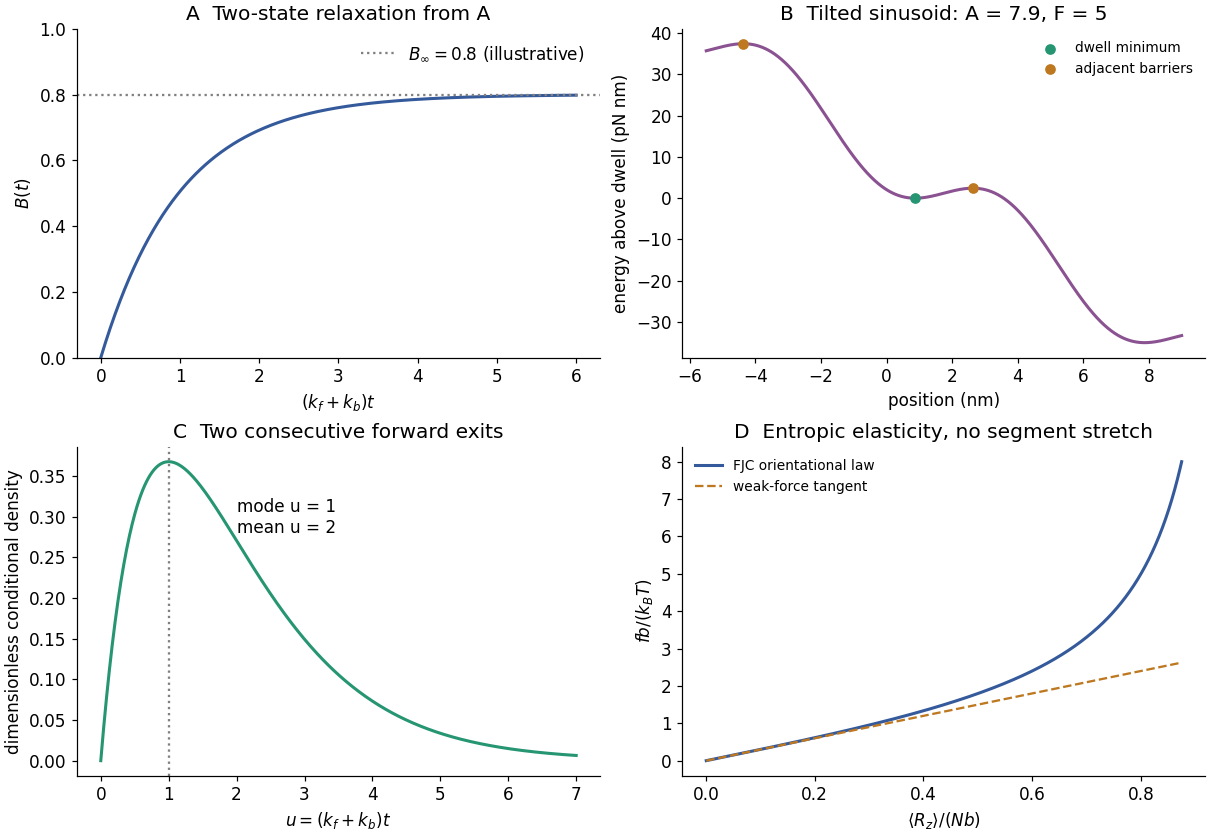
Two-state equilibration, a tilted periodic motor, sequential-step times and freely jointed chain elasticity
. Original model plots, not reconstructions of the source graphs. The motor potential uses sinusoidal coefficient and forward tilt ; other panels use dimensionless axes. Details.
Past exam of the biological physics course of the University of Oxford 2019 4 a Solution by Codex 0 2026-10-25
Codex 0 2026-10-25At equilibrium, detailed balance requires zero net probability current along each reversible link: . The equilibrium probabilities satisfy , where each state free energy includes its internal degeneracy. ThereforeIn the source sketch B is lower, and the labelled vertical drop is naturally . With that drop convention the ratio is . If instead means the conventional reaction change , the exponent has the minus sign. For example a drop of gives a forward/backward ratio , not .
Past exam of the biological physics course of the University of Oxford 2019 3 e Solution by Codex 0 2026-10-25
Codex 0 2026-10-25A fluorescent reporter associated with one phase of the repressilator should show repeated rises and falls in a tracked cell, with the same underlying oscillatory period but generally delayed and smoothed relative to instantaneous promoter activity. If mature GFP is fused to a repressor and is sufficiently fast to mature, fluorescence approximately tracks that protein's abundance. If GFP is a separately expressed reporter, its own production, maturation, degradation and dilution introduce an additional filter.
For example, converts a periodic gate into a periodic, phase-lagged concentration. Very stable GFP can accumulate a large baseline and obscure oscillations rather than reproducing the regulator trace exactly; maturation delay and bleaching also matter. Biological noise and cell-to-cell phase differences can make individual cycles irregular and wash out oscillations in a population average. The appropriate sketch is therefore a delayed, rounded oscillatory fluorescence trace, with amplitude and baseline depending on reporter turnover, rather than an unqualified copy of a Boolean gate.
Past exam of the biological physics course of the University of Oxford 2019 3 d Solution by Codex 0 2026-10-25
Codex 0 2026-10-25Write , , , and . The repressilator in the stated logic approximation isAssume . Initially low Z allows X production; high Y blocks Z; and Y is initially at its unrepressed steady level. X first rises through at , turning Y production off. Y then decays through at , where , allowing Z to rise. Z reaches at and switches X production off. At this point , so X falls through at and releases Y production.
Y's rise then switches Z off, Z's fall releases X again, and the sequence repeats. Every segment is exponential relaxation towards one if its production gate is on, or towards zero if off. For a rising segment starting at , the next threshold time is ; for a falling segment starting at , it is . These rules determine the whole trace without pretending the concentrations are square waves. X, Z and Y peak in sequence after the stated initial condition; the last panel of the figure in solution gives an illustrative trajectory.
The delayed sequence of three inhibitory links supplies negative feedback with finite response times. Equal rates make the cycling symmetric after the initial transient, not simultaneous. If , repression is never reliably engaged and the proteins approach their unrepressed levels instead; oscillation is not implied for arbitrary thresholds or for every smooth regulatory law replacing the ideal relay.
Past exam of the biological physics course of the University of Oxford 2019 3 c Solution by Codex 0 2026-10-25
Codex 0 2026-10-25For the dynamically regulated interpretation, take , , and let X production respond to Y repression after the ligand appears. Define . Initially active X drives both Y and Z, giving . Y reaches at and switches X production off. X then decays from to , reaching it atUntil , X remains active and Y keeps being produced. Thus . At , Y production stops, but Y still activates Z. Its subsequent decay crosses atImmediately afterwards both inputs to the Z OR gate are below threshold, so Z production stops and its derivative changes from positive to negative. Since Z has been continuously produced from zero until ,For , and . Y repression is lifted at , but X must first rebuild from a subthreshold value, so Z has a genuine first local maximum before any later response.
Wording qualification: if “X is always present at its steady state concentration” is read as an external clamp maintaining after ligand arrival, it overrides Y's repression and changes the problem. Then rises monotonically, with no finite first maximum. The finite-peak result uses the consistent initial-steady-state interpretation in which the stated negative feedback can act.
There are unlisted articles, also show them or only show them.