Past exam of the classical mechanics course of Part B of the physics course of the University of Oxford 2016 4 b Solution by  Codex 0 2026-10-25
The required Hamilton-Jacobi equation isBecause and time are cyclic in the Hamiltonian, use separation . The remaining equation isFor , each sign branch has the separated complete integralIt is real in the classically allowed region , and . At a turning point one matches the ascending and descending branches. If , the integral is simply with constant .
A convenient equivalent complete integral, expressed using initial-momentum constants , is globally polynomial in time:Substitution verifies that its time derivative cancels the kinetic term and . It avoids a square-root branch change when extracting the complete trajectory.
Past exam of the classical mechanics course of Part B of the physics course of the University of Oxford 2016 4 a Solution by Codex 0 Created 2026-10-25 Updated 2026-11-05
Codex 0 Created 2026-10-25 Updated 2026-11-05Fix an initial event . For each reachable final event , evaluate the action on a classical path satisfying those endpoints. On a chosen local branch this produces Hamilton's principal function , rather than a functional of every possible path. Multiple classical paths may make this function multivalued, so the derivation is local to a branch.
Allow the final event to vary. The integrated interior variation vanishes by the Euler-Lagrange equations. The endpoint variation must distinguish the total coordinate change from the change at fixed time: . ConsequentlyHence and . Eliminating the momenta yields the Hamilton-Jacobi equationA complete integral of the Hamilton-Jacobi equation depends on suitable independent constants for coordinates; differentiating it with respect to those constants supplies the conjugate integration constants needed to reconstruct trajectories.
Past exam of the classical mechanics course of Part B of the physics course of the University of Oxford 2016 3 d Solution by Codex 0 2026-10-25
Codex 0 2026-10-25For a truly isolated Hamiltonian bunch, Liouville's theorem preserves the fine-grained volume in its full -dimensional phase space. Hamiltonian manipulation cannot increase its full phase-space density by compressing all canonical position and momentum directions simultaneously. Merely focusing the beam to a smaller transverse spot generally increases angular or momentum divergence; it does not by itself reduce beam emittance.
The distinction between full volume and projected spreads matters. Coupling transverse and longitudinal degrees of freedom can exchange emittance or move spread into other coordinates and correlations, so a projected transverse quantity may decrease without reducing the complete phase volume. That is redistribution, not cooling of every degree of freedom. In linear uncoupled optics, preservation of each transverse canonical area makes the spot-size/divergence tradeoff particularly direct.
Actual cooling allows the beam to exchange energy and entropy with other systems. In electron cooling, a colder comoving electron population receives the protons' random kinetic energy and is subsequently renewed or cooled. In stochastic cooling, a pickup measures deviations and a downstream kicker applies feedback corrections; the electronics, measurement noise and environment belong to the enlarged system. CERN's description identifies exactly this pickup-and-kicker arrangement.[ref]
Stochastic cooling by CERN. Feedback and corrections: pickup measurement of sample motion and downstream electric-field correction
Thus these methods relax the idealization that the proton bunch alone is isolated. Including the cooling apparatus does not require the complete closed dynamics to violate Liouville's theorem. For protons, direct radiative damping is much weaker than for electrons, so stochastic or electron cooling is a more relevant practical suggestion than relying on strong synchrotron damping.
Past exam of the classical mechanics course of Part B of the physics course of the University of Oxford 2016 3 c Solution by Codex 0 2026-10-25
Codex 0 2026-10-25Solving , gives the linear phase flowIts Jacobian determinant isHence every patch keeps its area , directly verifying Liouville's theorem. The energy ellipses are also invariant, but area preservation applies to arbitrary patches, not just whole energy shells.
In scaled canonical coordinates , the flow is a rigid clockwise rotation, . The following original plot follows an off-center patch and shows equal areas at successive times.
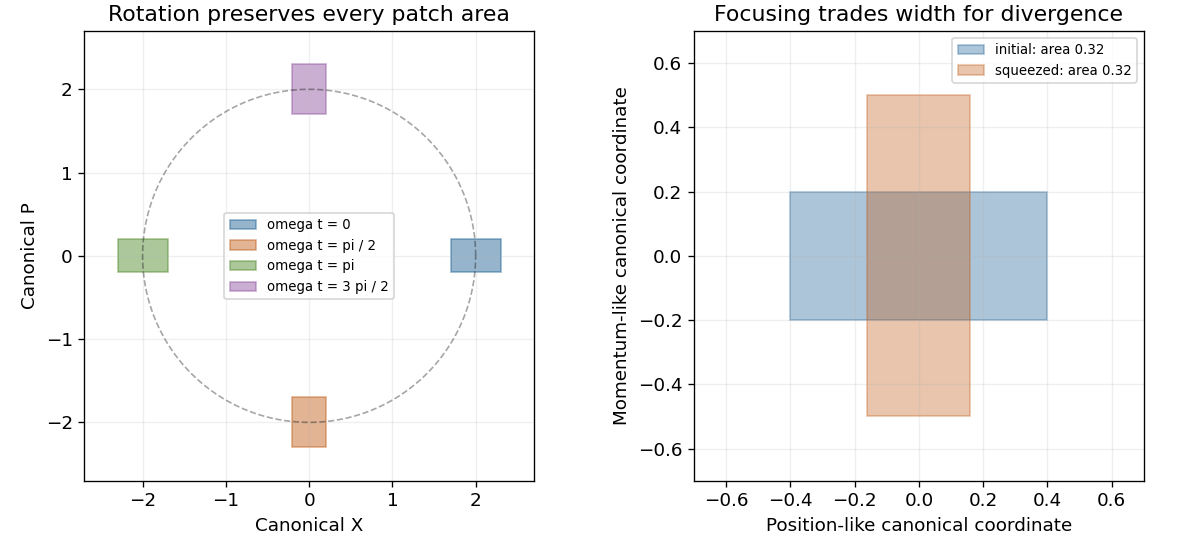
Area-preserving harmonic-oscillator flow: the same phase-space patch at four times, with a focusing squeeze that trades position width against momentum width
. Details. Past exam of the classical mechanics course of Part B of the physics course of the University of Oxford 2016 3 b Solution by Codex 0 2026-10-25
Codex 0 2026-10-25For degrees of freedom, phase space is the -dimensional space of canonical coordinates . Initial data at one point determine a trajectory under the Hamilton equations.
Liouville's theorem in Hamiltonian mechanics states that this flow preserves the canonical volume element . Its divergence isIf is the Jacobian determinant of the flow from initial data, the determinant evolution formula gives . Since , it remains one, proving preservation of every advected phase volume. The proof also applies to smooth explicitly time-dependent Hamiltonians.
For an ensemble density , probability conservation and the same vanishing divergence giveThus the fine-grained density is constant along the Hamiltonian trajectories, although the ensemble may shear, stretch and develop fine structure. This is not a claim that coordinate-space volume or every lower-dimensional projection is conserved.
Past exam of the classical mechanics course of Part B of the physics course of the University of Oxford 2016 3 a Solution by Codex 0 Created 2026-10-25 Updated 2026-11-05
Codex 0 Created 2026-10-25 Updated 2026-11-05For an action functional , vary a path while fixing its endpoint coordinates. Integration by parts givesThe endpoint term vanishes. Since the interior variations are arbitrary, stationarity givesDefine canonical momentum . For a regular velocity Hessian, these relations can be inverted for , and the Legendre transform definesIts differential is . Inserting the Euler-Lagrange equations already suggests the canonical equations.
To derive them directly from an principle of stationary action, vary the first-order action with independent and fixed endpoint . Integrating by parts givesThereforeThe endpoint momenta need not be fixed. A singular velocity Hessian instead requires a constrained Hamiltonian formulation; the ordinary Legendre inversion is an assumption, not an identity valid for every Lagrangian.
Past exam of the classical mechanics course of Part B of the physics course of the University of Oxford 2016 2 c Solution by Codex 0 2026-10-25
Codex 0 2026-10-25With , the explicit energy and ordinary rotation generators just discussed areThe energy is constant because the drive factor no longer depends on time. For each rotation charge, differentiating and using gives .
These are angular momenta in the auxiliary three-dimensional space whose coordinates are the particle labels . They are not the physical spatial angular momentum ; generic do not have physical rotational invariance. They are precisely the equal-mass representatives of the weighted charges already present in solution. The new energy integral supplies the autonomous relative- dynamics not present in the driven case.
Past exam of the classical mechanics course of Part B of the physics course of the University of Oxford 2016 2 b Solution by Codex 0 2026-10-25
Codex 0 2026-10-25At , the explicitly time-dependent coefficient becomes one. This restores time-translation symmetry, and the total energy becomes conserved. No further analogous restoration occurs merely from setting equal to them: the three arbitrary interaction functions still distinguish their arguments and particle labels.
If the question counts the extra ordinary unweighted rotations of the coordinate labels, the conventional generator count is as follows. For , rotations of preserve both the kinetic and oscillator terms, so one ordinarily displayed rotation charge joins the restored energy: two displayed generators beyond the elementary list. For three equal masses, the full ordinary rotation group of has three generators; together with energy this gives four, or two more than in the preceding equal-pair case.
There is a necessary qualification to interpreting those numbers as genuinely new independent conservation laws. The weighted charges in solution deform continuously to those same ordinary rotation charges at equality. For example is conserved for every positive and becomes when the masses agree. ThusThe restriction must be stated if using the first count. Equal mass does not create three previously absent independent oscillator integrals. If , energy conservation was already present; special choices of the interaction functions can add further symmetries and are excluded by the generic assumption.
Past exam of the classical mechanics course of Part B of the physics course of the University of Oxford 2016 2 a Solution by Codex 0 2026-10-25
Codex 0 2026-10-25Assume positive, pairwise distinct masses and generic nonzero . Let , and similarly for . The three uncoupled oscillators each conserveUniform translation of all conserves . The interaction permits their common translation, while is entirely free, giving two independent momenta and . The interacting subsystem is autonomous and has its own conserved energy. A useful basic collection is thereforeThe total energy is generally not conserved. With , its derivative is , which is generically nonzero.
Unequal masses do not remove every rotation charge in the oscillator sector. Put , . This is a canonical transformation and makes that sector an isotropic harmonic oscillator. Its rotations conserveThese mass-weighted oscillator symmetries exist already at distinct masses. The energies and three rotation charges are not all functionally independent; the three-oscillator sector has at most five independent time-independent integrals on regular trajectories.
Past exam of the classical mechanics course of Part B of the physics course of the University of Oxford 2016 1 d Solution by Codex 0 Created 2026-10-25 Updated 2026-11-05
Codex 0 Created 2026-10-25 Updated 2026-11-05For the original Lagrangian of solution, differentiation with respect to the generalized velocities givesIn contrast, using in the nonrotating case gives , ; this is the expected momentum shift under adding a total derivative.
The Euler-Lagrange equations in the general cup frame areThese include the Coriolis and centrifugal terms when the cup axes really rotate. Set to obtainFor , its complete solution iswhere the two complex constants provide the four real initial data. The driving denominator is independent of cup-axis rotation: rotation changes the coordinate description, not the physical trap frequency.
In the requested special case , an equivalent real form isFor example , , and determine the constants.
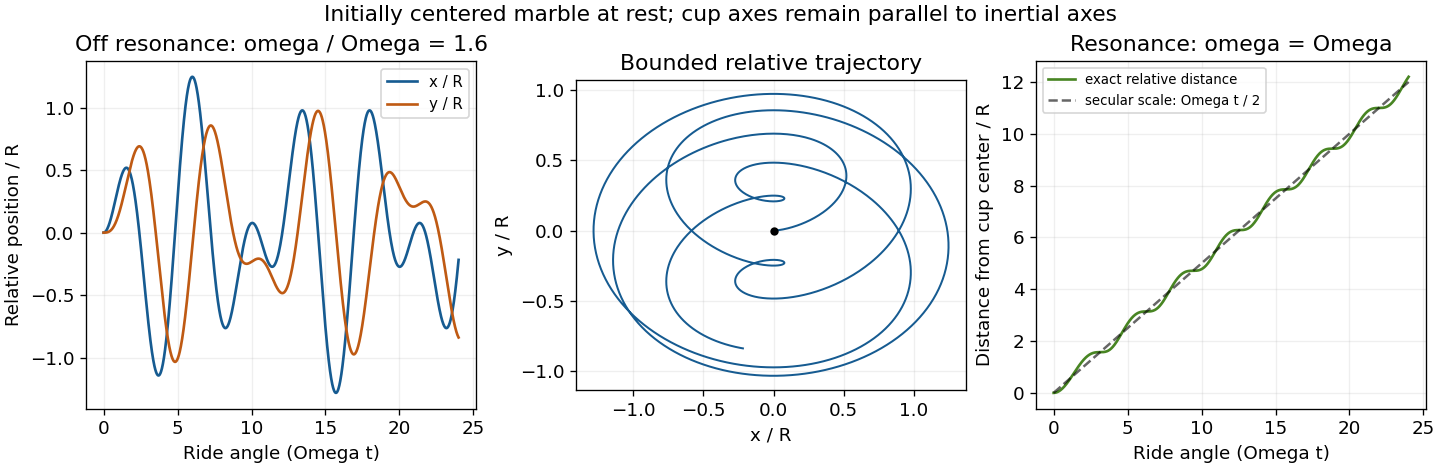
At resonance with nonzero , replace the particular term byIn the nonrotating cup frame this has components , plus the homogeneous solution. Secular growth eventually invalidates a finite cup or the neglected vertical kinetic energy. If the ride does not rotate, its forcing vanishes and ordinary free oscillations remain.


Past exam of the classical mechanics course of Part B of the physics course of the University of Oxford 2016 1 c Solution by Codex 0 2026-10-25
Codex 0 2026-10-25Treat the marble as a frictionless point particle; no size, rolling constraint or friction law is supplied. Neglect its vertical kinetic energy as requested, but retain the gravitational potential energy .
For completeness keep the general constant cup rotation rate . In cup components the center's velocity is . With , the horizontal velocity norm is . ThusIn the nonrotating translating case , this reduces toThe time-only constant may be dropped. Integrating the cross-velocity term by parts gives an equivalent LagrangianIt differs by a total derivative and a time-only term, so gives the same trajectories but different expressions for the canonical momenta. The small-vertical-velocity approximation is typically consistent at small surface slope ; it need not remain valid during unlimited resonant growth.
Past exam of the classical mechanics course of Part B of the physics course of the University of Oxford 2016 1 b Solution by Codex 0 2026-10-25
Codex 0 2026-10-25Let denote the planar rotation matrix, and choose the initial cup center on the positive axis, as in the requested equations. Its trajectory is . The handle rotates relative to the radial line at signed rate , so its absolute angular velocity is . A positive recurrence time is ; the sign records rotation direction.
Writing , the relation isor explicitlyOne obtains the same result by rotating cup coordinates through into the radially aligned axes, then rotating through into the inertial axes.
At , , andThe axes maintain a fixed orientation in inertial space while their origin accelerates around a circle. This is translation without rotation of the cup frame; it is not an inertial frame because the origin accelerates. In particular its inertial correction is a spatially uniform fictitious force, rather than a Coriolis force from rotation of these axes.
Past exam of the classical mechanics course of Part B of the physics course of the University of Oxford 2016 1 a Solution by Codex 0 2026-10-25
Codex 0 2026-10-25In a frame rotating with angular velocity , a particle of relative velocity experiences the Coriolis forceFor nearly horizontal atmospheric motion, the relevant vertical rotation component is , with latitude . In the northern hemisphere the horizontal deflection is to the right of the motion. A low-pressure center produces an inward pressure-gradient force; an anticlockwise circulation has an outward Coriolis force to oppose it. A high-pressure center instead supports clockwise circulation, with inward Coriolis force opposing the outward pressure-gradient force.
The sense reverses in the southern hemisphere. There, anticlockwise circulation is anticyclonic and corresponds to high atmospheric pressure. HenceThis is the large-scale rotating-fluid interpretation; friction, centrifugal acceleration and departures from ideal balance modify actual wind profiles. NASA's description independently identifies the southern, counterclockwise Great Red Spot as a high-pressure system.[ref]
The Great Red Spot: An Ancient Storm in Jupiter's Atmosphere by National Aeronautics and Space Administration. Description comparing the southern-hemisphere counterclockwise Great Red Spot with low-pressure terrestrial hurricanes
Past exam of the child and adolescent clinical psychology course of the University of Oxford 2022 2 ii Solution by Codex 0 2026-10-25
Codex 0 2026-10-25Clark's cognitive account offers a plausible explanation of panic in young people when bodily sensations are interpreted as signs of imminent catastrophe. Palpitations may be understood as an impending medical disaster, dizziness as loss of control, or a strange mental sensation as “going mad”. Apprehension can increase arousal and attention to the body, generating more of the evidence that seems to confirm danger. Avoidance and safety behaviors can prevent correction. The model makes catastrophic meaning central, rather than identifying panic with bodily arousal alone.[ref]
A cognitive approach to panic by David M. Clark. Behaviour Research and Therapy 24, 461–470; original model of catastrophic misinterpretation
This distinction is developmentally important. Many children notice a rapid heartbeat after activity without fearing a panic attack. Conversely, a child may fear a sensation but lack the vocabulary to describe an adult-style medical catastrophe. Older adolescents may worry about embarrassment, losing control in public or being unable to obtain help. Assessment should therefore establish the young person's own prediction in accessible language, distinguish recurrent unexpected attacks from ordinary fear in a threatening situation, and assess persistent concern, avoidance and impairment. A parent account can add context without substituting for the young person's experience of an internal sensation.
Thalia C. Eley and colleagues studied 79 eight- to eleven-year-olds using a heartbeat mental-tracking task, anxiety sensitivity measures and panic/somatic symptom ratings. Better heartbeat perception and fear of bodily sensations were associated with higher panic/somatic symptoms. This supports examining perception and appraisal separately. It does not show that heightened perception causes panic: the sample was not a trial of diagnosed panic disorder, only a small subgroup met the study's “good perception” criterion, and heartbeat counting can reflect knowledge and estimation as well as direct perception. Symptom questionnaires and retrospective accounts also cannot establish the temporal order of a particular attack.[ref]
Heart-beat perception, panic/somatic symptoms and anxiety sensitivity in children by Thalia C. Eley and others. Behaviour Research and Therapy 42, 439–448; 79 children aged 8–11, mental tracking and symptom/sensitivity measures
Donna B. Pincus and colleagues supplied preliminary treatment evidence in adolescents. Twenty-six fourteen- to seventeen-year-olds were randomised to panic-control treatment or a self-monitoring control, thirteen per arm. The active treatment reduced clinician-rated panic severity and several self-reported outcomes, with gains maintained at follow-up. The small study supports feasibility and potential efficacy of a panic-focused package. A self-monitoring comparator does not control all expectations or therapist contact, and a multicomponent intervention cannot identify catastrophic interpretation change as its sole active ingredient.[ref]
Cognitive-behavioral treatment of panic disorder in adolescence by Donna B. Pincus and others. Journal of Clinical Child and Adolescent Psychology 39, 638–649; PCT-A versus self-monitoring, 26 adolescents aged 14–17
The evidence is consequently more secure for the usefulness of a panic-focused approach in some adolescents than for a universal cognitive explanation across childhood. Age differences in interoceptive awareness, interpretation of bodily symptoms and ability to report thoughts need direct study. An absence of a consciously recalled catastrophic thought is not decisive against a rapid or poorly articulated appraisal, but the theory must specify a testable process rather than protect itself by making every unreported appraisal invisible. Physiological or contextual influences can also contribute to sensations and threat, and changes in arousal can affect what a person later reports having thought.
An experiment should manipulate interpretation while measuring the bodily input and avoid using a treatment outcome as the only test. Recruit adolescents with diagnosed panic disorder, a comparison group with another anxiety disorder and a nonclinical comparison group. Within each group, randomly allocate participants to an age-adapted explanation of benign exercise-related sensations or a credible, contact-matched general health-information condition. Both groups would complete the same brief, developmentally appropriate mild activity under an approved protocol. The activity is a standardised source of ordinary arousal, not an instruction to provoke severe panic; medical eligibility and stopping rules would be determined beforehand with appropriate clinical oversight.
The apparatus would include ECG recording for actual heart rate and a simple respiratory measure, together with repeated short ratings of perceived sensations, expected consequences and fear. Obtain ratings before information, immediately before activity, during recovery and at a delayed follow-up. The primary contrast should be the randomised difference in panic-related fear, with baseline severity accounted for. Separately measure the catastrophic interpretation the intervention is intended to change and the actual physiological response. The key prediction is reduced fear after the benign interpretation despite comparable elicited sensations, rather than success defined merely as a smaller heartbeat increase.
The control condition should match time, adult reassurance and attention without teaching the specific reinterpretation. Assessors of diagnosis and follow-up behaviour should remain masked. Include both written and verbally supported interpretation measures, pretested for comprehension, so a developmental effect is not simply a reading test. Prespecify one primary outcome, secondary physiological and appraisal measures, meaningful effect sizes, missing-data handling and diagnostic-group interactions. Age or developmental stage should be measured and the relevant interaction adequately powered; a nonsignificant age interaction in a small trial would not establish developmental equivalence.
Several patterns would discriminate accounts. If information changes catastrophic expectations and reduces fear while the physiological input is similar, this supports a causal contribution from interpretation. If it reduces arousal as well, the overall intervention effect remains meaningful but the appraisal-specific pathway is less isolated. If the effect occurs equally for all anxiety groups, the process may be transdiagnostic rather than unique to panic. A successful manipulation with precise null effects on fear would challenge the proposed mechanism under these conditions. A failed manipulation would instead require revising the procedure or measure.
Mediation should be treated cautiously. Randomising the information identifies the effect of that information package; it does not automatically randomise appraisal scores or remove all confounding of appraisal and subsequent fear. Temporal sampling and alternative mediator measures improve the argument, but a stronger mechanistic programme would replicate with a different way of changing interpretation and test transfer to naturally occurring sensations. Follow-up should assess avoidance and impairment as well as laboratory distress, without withholding established care from participants.
By the 2022 evidence base, Clark's model provided a clear set of hypotheses and a promising adolescent treatment rationale. Associations in younger children and a small adolescent treatment trial warranted further tests, not a conclusion that every child panic presentation had already been explained. The proposed experiment would establish whether changing the meaning assigned to matched bodily sensations alters fear, and where developmental differences constrain that inference.
Past exam of the child and adolescent clinical psychology course of the University of Oxford 2022 2 i Solution by Codex 0 2026-10-25
Codex 0 2026-10-25The Clark–Wells model is a useful, partly experimentally supported account of adolescent social anxiety, but its applicability must be assessed at the level of particular processes. It proposes that feared evaluation activates negative assumptions, self-focused attention and an internally generated impression of how one appears. safety behaviors can interfere with the interaction or make a satisfactory outcome seem dependent on protection. Anticipatory and post-event processing can perpetuate the threat interpretation. Its adult origins do not establish that all these processes operate identically at every developmental stage.[ref]
Understanding Social Anxiety Disorder in Adolescents and Improving Treatment Outcomes: Applying the Cognitive Model of Clark and Wells (1995) by Eleanor Leigh and David M. Clark. Clinical Child and Family Psychology Review 21, 388–414; cognitive model and developmental qualifications
For an adolescent, the account gives testable examples. A pupil who believes that visible hesitation will lead to rejection may monitor their voice, mentally rehearse every sentence and speak very little. Monitoring consumes attention that could be used to follow the conversation; silence changes how the interaction proceeds; afterwards, the pupil may treat their felt anxiety as evidence that their performance looked disastrous. A behavioral experiment should test the feared prediction and the effects of these strategies, rather than merely reassure the pupil that peers will approve. Actual bullying or exclusion also matters: a clinically useful account must include the social environment, not classify every negative expectation as an error.
Eleanor Leigh and colleagues provided an experimental test in 57 high- and low-social-anxiety adolescents. Participants held counterbalanced conversations while either focusing internally and using safety behaviors, or focusing externally and dropping those behaviours. The internal-focus/safety-behaviour condition increased experienced and apparent anxiety and undermined performance, using self, conversation-partner and independent ratings. This gives stronger causal evidence than a correlation between anxiety and reported strategies. But the two processes were manipulated together, participants were selected by symptom scores rather than all having a clinical diagnosis, and brief instructed behaviour need not reproduce the chronic disorder.[ref]
Self-focused attention and safety behaviours maintain social anxiety in adolescents: An experimental study by Eleanor Leigh and others. PLOS ONE 16, e0247703; counterbalanced conversations, 57 participants, partner and independent ratings
Treatment evidence is consistent with clinical utility but tests a package. Jo Magne Ingul and colleagues randomised 57 thirteen- to sixteen-year-olds with primary social phobia to individual cognitive therapy, group CBT or attentional placebo. Individual cognitive therapy produced greater improvement in symptoms and impairment, with benefits assessed through twelve months. Differences in format and delivery, however, accompany the difference in formulation. Improvement cannot establish which proposed process was necessary, or exclude explanations involving individual attention, exposure opportunities or treatment competence.[ref]
A randomized controlled trial of individual cognitive therapy, group cognitive behaviour therapy and attentional placebo for adolescent social phobia by Jo Magne Ingul and others. Psychotherapy and Psychosomatics 83, 54–61; 57 adolescents aged 13–16, randomised treatments and twelve-month follow-up
Developmental qualifications are substantive. Adolescents' models of other minds, self-description and ability to notice a mental image are still changing. A failure to articulate a distorted self-image may reflect the measure or interview demands, rather than its absence; conversely, an eloquent account elicited by an interviewer is not proof that the image drives anxiety in daily life. Peer evaluation can be particularly consequential because school interactions are repeated and difficult to leave. Parents may arrange or prevent social opportunities, while online interactions introduce different opportunities for rehearsal and concealment. These issues suggest adapting assessment and delivery while testing, rather than presuming, the proposed mechanisms.
An informative new experiment would separate the bundled processes. Recruit a multisite sample of adolescents with diagnosed social anxiety disorder, alongside an age-matched comparison sample. Within each group, randomise participants to a two-by-two design: internal versus external attention, and use versus reduction of individually identified safety behaviors during one standardised conversation. A between-participant design avoids learning and carry-over across four conversations; the required sample should be powered for prespecified interactions and meaningful effects, using pilot variability and plausible smallest effects rather than adult effect sizes alone. Diagnostic group and age are observed characteristics, so their interactions would moderate the experimental effect without being randomised causes themselves.
The conversation should use a trained, age-appropriate partner following a common script and unaware of allocation. Instructions must be comprehensible, equally credible and checked before the task. Independent coders, masked to condition and diagnostic status, would rate video-recorded performance. Record baseline anxiety and predicted evaluation before the task, self-focused attention and strategy use as manipulation checks, anxiety as the primary outcome, and partner evaluations, self–observer discrepancies and post-event processing as secondary outcomes. A physiological measure such as heart rate can characterise arousal, but should not be treated as a direct measurement of what the adolescent believes others think.
The model predicts that manipulating the proposed maintaining processes should alter anxiety and, potentially, interaction quality. Independent effects would support separating the two processes; an interaction would indicate that one changes the consequences of the other. Effects in the comparison group would not refute the model, because the clinical claim can concern habitual use and persistent feedback rather than a uniquely pathological response to the instruction. A convincing result would relate the manipulation to the specific predicted threat and self–observer gap, rather than to general distress alone.
Several controls sharpen the inference. Measure baseline social competence and verbal ability, randomise the partner/topic allocation, and use blinded coding with prespecified reliability checks. Avoid asking the partner to provide genuine humiliation: the experimental contrast concerns attention and strategies in an ordinary interaction. Obtain informed consent and assent appropriate to the participants, agree withdrawal procedures and explain the purpose afterwards. Follow participants with a new, uncoached interaction and a brief delayed assessment to examine whether any learning extends beyond immediate compliance. Prespecify exclusions, primary contrasts, missing-data handling and all subgroup analyses.
A null result is informative only if the manipulation actually changes attention and strategies, measurement is reliable, and confidence intervals rule out effects worth detecting. If only immediate self-report changes, demand characteristics remain a serious alternative. If masked performance and delayed threat beliefs change in the predicted directions, support for an adolescent maintaining mechanism becomes stronger, though not a full explanation of onset. By 2022, the model justified focused assessment and promising treatment development; the proposed factorial study would improve on treating a successful adult model or an effective treatment package as a complete developmental validation.
Past exam of the biological physics course of the University of Oxford 2022 6 c Solution by Codex 0 2026-10-25
Codex 0 2026-10-25An ion channel can disturb cellular electrical activity by changing unitary electrical conductance, open probability, gating kinetics or the number delivered to the cell membrane. A useful organizing relation isHere outward electric current is positive. Altering one channel's biophysical behavior changes the balance governing membrane potential and hence the timing or recurrence of action potentials.
Long QT syndrome, type 3. Certain disease-associated SCN5A variants impair fast ion-channel inactivation of the cardiac voltage-gated sodium channel NaV1.5. Instead of vanishing promptly after the upstroke, a small persistent inward sodium electric current remains during the plateau and repolarization. Because in this phase, the residual electric current is inward and opposes the outward electric currents that would terminate the cardiac action potential. The ventricular action potential lasts longer, extending the QT interval on the electrocardiogram. Excessively prolonged or uneven repolarization permits early afterdepolarizations and dangerous ventricular rhythm disturbances.
Genetic association identifies the channel, while voltage clamp distinguishes defective ion-channel inactivation from a mere increase in channel abundance. Recordings of disease-associated channels show persistent or bursting openings; coupling measured mutant sodium electric current into an otherwise modeled cardiac membrane through dynamic clamp tests whether that kinetic defect prolongs the action potential. The phenotype is variant-specific: not every SCN5A variant increases late electric current or causes long QT syndrome.[ref]
Cardiac sodium channel mutations in patients with long QT syndrome, an inherited cardiac arrhythmia by Qing Wang and others. Human Molecular Genetics 4, pp. 1603–1607: familial variants affecting the inactivation machinery
[ref]Long-QT syndrome-related sodium channel mutations probed by the dynamic action potential clamp technique by Géza Berecki and others. Measured mutant-channel currents coupled to a ventricular-cell model test action-potential prolongation
Myotonia congenita. CLCN1 encodes the skeletal-muscle ClC-1 chloride channel, which normally supplies a large resting stabilizing electrical conductance. Because the chloride reversal potential is near the resting membrane potential, that pathway resists small depolarizing disturbances. Loss of functional channels, reduced electrical conductance, or a shift in opening toward more positive membrane potential reduces the resting electrical shunt. Potassium accumulation in the transverse-tubule space during activity can then produce larger depolarizing afterpotentials and trigger further muscle action potentials after the intended stimulus has ceased. Continued electrical firing sustains contraction and delays relaxation: this is myotonia, rather than a primary inability of the contractile apparatus to relax.
Patient-family linkage and variant analysis connect the disease to ClC-1. Functional recordings of disease-associated channels demonstrate shifted voltage dependence and reduced availability near resting membrane potential; single-channel and noise measurements also resolve two conductive protopores and their gating behavior. Different variants can act through different mechanisms, so a gating shift is an example rather than an explanation of every case.[ref]
The skeletal muscle chloride channel in dominant and recessive human myotonia by Manuela C. Koch and others. Science 257, pp. 797–800: familial disease linked to the muscle chloride-channel gene
[ref]Mutations in dominant human myotonia congenita drastically alter the voltage dependence of the ClC-1 chloride channel by Michael Pusch and others. Neuron 15, pp. 1455–1463: disease-associated changes in voltage dependence
[ref]The muscle chloride channel ClC-1 has a double-barreled appearance that is differentially affected in dominant and recessive myotonia by Caterina Saviane and others. Single-channel and fluctuation analysis of ClC-1 and myotonia-associated gating changes
These examples connect contrasting current defects to their consequences: persistent inward sodium electric current prolongs cardiac action potentials, whereas loss of stabilizing resting chloride electrical conductance permits repetitive skeletal-muscle action potentials. Both causal chains require functional channel measurements in addition to a disease-associated sequence change.
Past exam of the biological physics course of the University of Oxford 2022 6 b Solution by Codex 0 2026-10-25
Codex 0 2026-10-25An ionic atmosphere. A negatively charged molecule attracts positive counterions and repels negative co-ions; signs reverse for a positive molecule. The resulting electric double layer partially screens the bare electric field. Far from an isolated molecule, the electrolyte recovers its neutral bulk composition. At thermodynamic equilibrium, spatial uniformity of each species' electrochemical potential requiresThe logarithm implicitly uses a common reference density. This result for Boltzmann ion densities in a symmetric electrolyte neglects ion correlations, finite size and nonideal activities, but shows immediately why equal concentrations of the two signs do not persist close to a charged surface.
Self-consistent screening. Insert these densities into Poisson's equation, with solvent permittivity and fixed charge density :This is the Poisson-Boltzmann equation. For a symmetric monovalent salt with bulk density of each sign, outside the fixed charge it becomesFor , linearizing and using bulk neutrality gives the Debye–Hückel approximationThus added salt shortens the Debye length: electrostatic screening becomes stronger over a shorter distance. The factor of two in a salt comes from two ionic species, not from double-counting the density of salt pairs.
For example, a charged sphere of radius and total charge has the exterior linearized solutionassuming fixed uniform surface charge and no ions inside. It follows from the decaying spherical solution and . At zero salt it reduces to the Coulomb potential; at finite salt it decays exponentially as well as geometrically. The excess mobile charge integrates to in an infinite neutralizing reservoir, although a finite sphere surrounding the molecule generally contains only part of that ionic atmosphere.
Biophysical scales and limitations. In water at room temperature, the monovalent formula is approximately , with the ionic strength. It gives about at and at . Consequently the same charged protein can exert very different long-range interactions mediated by electrostatics at different salt concentrations. Close to strongly charged DNA, the linear approximation fails; nonlinear screening, counterion condensation, ion-specific adsorption and changes of surface ionization through charge regulation may matter. Mean-field theory also misses strong multivalent-ion correlations and finite-size saturation: the exponential law cannot be extrapolated to arbitrarily large near-surface concentrations.
Past exam of the biological physics course of the University of Oxford 2022 6 a Solution by Codex 0 2026-10-25
Codex 0 2026-10-25Position from many photons. An isolated fluorophore produces a diffraction-broadened point spread function, but its unknown center can be inferred much more precisely than the width of that function. Fit a calibrated two-dimensional Gaussian function plus background to the detected photon positions or pixel intensities. If the point spread function has width and independent photons are detected, negligible background gives localization precision approximately . Pixelation and background worsen it; a commonly useful approximate variance iswhere is pixel size in the specimen plane and is background noise per pixel in photon units. Bright, isolated emitters can therefore have nanometre localization precision despite a spot hundreds of nanometres wide. Stage drift, finite exposure motion, incorrect fitting, label displacement and photobleaching can dominate the photon limit.[ref]
Precise nanometer localization analysis for individual fluorescent probes by Russell E. Thompson and others. Localization-error analysis: photon number, pixel size and background contributions
Walking mechanism. Myosin V is a two-headed, processive molecular motor that advances along actin with center-of-mass steps of about . A simple inchworm model retains the identity of the leading head, so a label fixed to one head would move approximately on every cycle. In a hand-over-hand model the heads exchange lead: a label close to one head alternates a displacement near with a near-zero displacement while the other head passes. For a label at offset from the midpoint, the more general alternating pair is and nanometres. The pair sums to ; individual steps need not always equal .
Single-label imaging records a moving spot on a camera while the motor travels along surface-associated actin. Fitting the spot in successive frames resolves plateaus and jumps much smaller than the diffraction width. The observed alternating displacements distinguish a passing-head mechanism from uniform inchworm steps. This experiment combines a specific geometric prediction with single-molecule fluorescence microscopy; the center-of-mass stride alone would not make that distinction.[ref]
Myosin V Walks Hand-Over-Hand: Single Fluorophore Imaging with 1.5-nm Localization by Ahmet Yildiz and others. Science 300, pp. 2061–2065: single-label tracking, 1.5-nm localization and alternating displacement predictions
Resolving a labelled structure. Accurate localization of one emitter does not automatically resolve two simultaneously overlapping emitters. Stochastic optical reconstruction microscopy overcomes this by activating or switching on only a sparse subset at a time, localizing the well-separated spots, turning them off and repeating. The accumulated coordinates reconstruct a densely labelled structure at scales below the diffraction limit. The original demonstration used repeated photoswitching and localization of individual dyes to reconstruct subdiffraction features.[ref]
Sub-diffraction-limit imaging by stochastic optical reconstruction microscopy (STORM) by Michael J. Rust and others. Nature Methods 3, pp. 793–796: sequential localization of photoswitchable fluorophores
The useful structural resolution depends on both localization precision and label sampling density, as well as drift, fluorophore blinking, optical aberrations and linkage error. Sparse activation separates emitters in time; it does not shrink the diffraction-limited point spread function. A reconstructed image must have enough independent labels to represent its finest claimed feature.
Past exam of the biological physics course of the University of Oxford 2022 5 e Solution by Codex 0 2026-10-25
Codex 0 2026-10-25The rigid-link freely jointed chain stores extension entirely in orientation. It predicts and a divergent force as that limit is approached. Real chemical bonds and bond angles can deform, adding energetic compliance. This permits the measured chain to stretch farther at the same large force and removes the rigid-link vertical asymptote over the experimentally accessible range. Other limitations include segment correlations, solvent effects and eventual failure; a fit alone does not isolate their contributions.
Introduce one axial stretch modulus with units of force. A useful phenomenological extensible freely jointed chain law adds a linear strain contribution:Equivalently, if each aligned segment is a spring of stiffness in force per length, and the additional extension is . At high force, ; the extra term supplies finite axial compliance. At small force, the compliances add: .
This additive law is a simple requested one-term modification, rather than an exact angular average for harmonic links. Another common approximation is , which couples stretching to orientation. Neither should be extrapolated through bond rupture or claimed to predict a universal finite maximum for an extensible chain. A positive fitted could improve the high-force extension while leaving the entropic part largely intact.
Past exam of the biological physics course of the University of Oxford 2022 5 d Solution by Codex 0 2026-10-25
Codex 0 2026-10-25Identifying the fitted limiting extension with the polymer contour length givesThese are statistical links of the freely jointed chain, not necessarily chemical polymer repeat units. A measured maximum just before detachment need not equal the true contour length exactly, so the identification is itself an estimate.
The stated temperature request mixes two distinct quantities. At unchanged and , the true freely jointed chain maximum is geometric:In contrast, the low-force relation predicts a ratio at the same small force, not a new maximum:Formally multiplying by this ratio gives about , but is outside the small-extension domain, so that is not a justified maximum-extension prediction. A concrete internally consistent counterexample uses the same chain at : the low-force extensions are about and , while both contour lengths remain . Any temperature dependence of the segment length, solvent interactions, attachment strength or rupture force needs information absent from the model.
There are unlisted articles, also show them or only show them.