Past exam of the electromagnetism and optics course of the University of Oxford 2016 4 Solution by  Codex 0 2026-10-25
Snell's law is , with both angles measured from the interface normal vector. Let be the meridional ray's angle to the optical axis inside the core and let be the incident medium's refractive index. At the entrance face,At the cylindrical wall the angle of incidence is . For , the critical angle for total internal reflection satisfies . At the limiting accepted ray,Consequently the optical fiber acceptance angle obeysThe requested expression follows for incidence from air, , provided the right-hand side is at most one. Strict total internal reflection occurs inside this limiting cone. The derivation uses the standard meridional ray model; skew launches need additional geometry.
If , every forward entrance angle allowed by this ideal model meets the side-wall condition, and the limiting half-angle is , rather than an undefined inverse sine. For example, , , gives . Thus the unsaturated printed formula is not valid for every possible pair of refractive indices.
Past exam of the electromagnetism and optics course of the University of Oxford 2016 3 Solution by Codex 0 2026-10-25
Codex 0 2026-10-25Take as the centre-to-centre separation and . Use the ideal lossless two-conductor transmission line model, with nonmagnetic surroundings and negligible internal-wire inductance. Opposite line charges and approximate the cylindrical conductors when . Integrating their electric fields, or adding their logarithmic electric potentials, gives the potential differenceThis is the two-wire capacitance at large separation. For opposite electric currents and , the magnetic fields between the wires add. The linked magnetic flux per unit length is approximatelyThus the external inductance of a thin two-wire line is . The lossless telegrapher's equations give a forward wave with , so its characteristic impedance isThe product also gives the propagation speed , an independent consistency check. The exact ideal external-field geometry replaces by . If the wire separation were specified between surfaces, its centre separation would be , with the same leading large-separation result. Finite electrical conductivity and internal-wire magnetic energy require a more detailed line model.
Past exam of the electromagnetism and optics course of the University of Oxford 2016 2 Solution by Codex 0 2026-10-25
Codex 0 2026-10-25Let be the mean path length in the core. Neglect leakage and fringing across the narrow air gap, and assume a cross-section small compared with . Continuity of normal magnetic flux density then gives the same tangential magnetic field magnitude in the core and gap. Ampère's circuital law for the magnetic field strength isFor a linear core, and , givingHere follows the winding's right-hand rule. The gap has much larger than the core when , although is approximately continuous. Equivalently, the core and gap magnetic reluctances add in series.
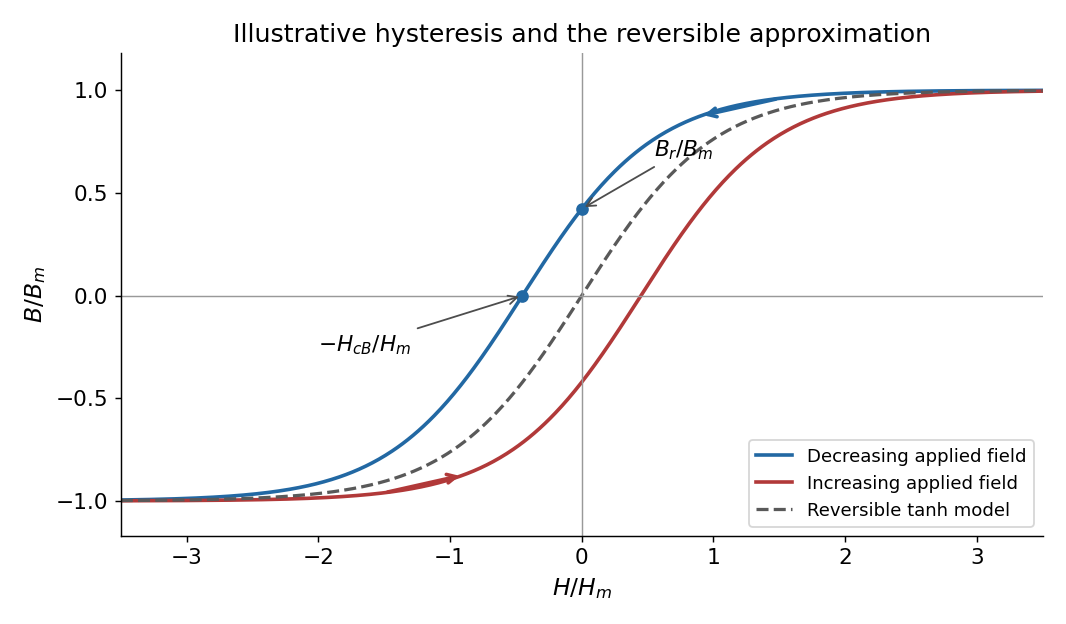
On a magnetic hysteresis loop, remanence is the nonzero remaining at after magnetizing the sample. The normal magnetic coercivity is the magnitude of reverse at which on that branch. The intrinsic magnetic coercivity instead refers to zero magnetization; these two conventions should not be confused. A comparison of coercive with remanent requires a unit conversion or a specified constitutive scale, because their SI units differ. A soft ferromagnet is understood here to have a narrow loop and small coercive field.
Magnetic hysteresis and the reversible tanh approximation
. Original illustrative magnetic hysteresis loop with the remanent magnetic field and normal coercive magnetic field strength marked. The dashed single-valued curve is the reversible approximation used in the calculation, rather than a hysteresis branch. Details.
Use the stated single-valued constitutive equation for the calculation. Inverting it gives , soSince , the small-signal response of a gapped magnetic core isThe small-field core magnetic permeability is . Strictly, is a reversible approximation: at it has , so it cannot itself model nonzero remanence. The displayed loop and this constitutive approximation serve different purposes. Keeping a genuinely remanent branch would generally add a history-dependent offset; it would not imply through the origin.
Past exam of the electromagnetism and optics course of the University of Oxford 2016 10 Solution by Codex 0 2026-10-25
Codex 0 2026-10-25Place the two slits at transverse coordinates and . Let the source point have coordinate and the observation point coordinate , both measured in the same transverse direction. The total lower-slit path minus upper-slit path isThe last line uses the paraxial approximation at both source and screen. The source assumptions give ; the screen expression also assumes . Reversing the source-coordinate orientation would change the sign of , without changing the uniform-source result.
At the slits, the differential path delay from a source element is . Across the full filament its range is . Keeping all these phases nearly equal therefore requiresThis is a sufficient near-unit-spatial coherence condition, rather than a necessary condition for any observable interference. That distinction follows quantitatively below.
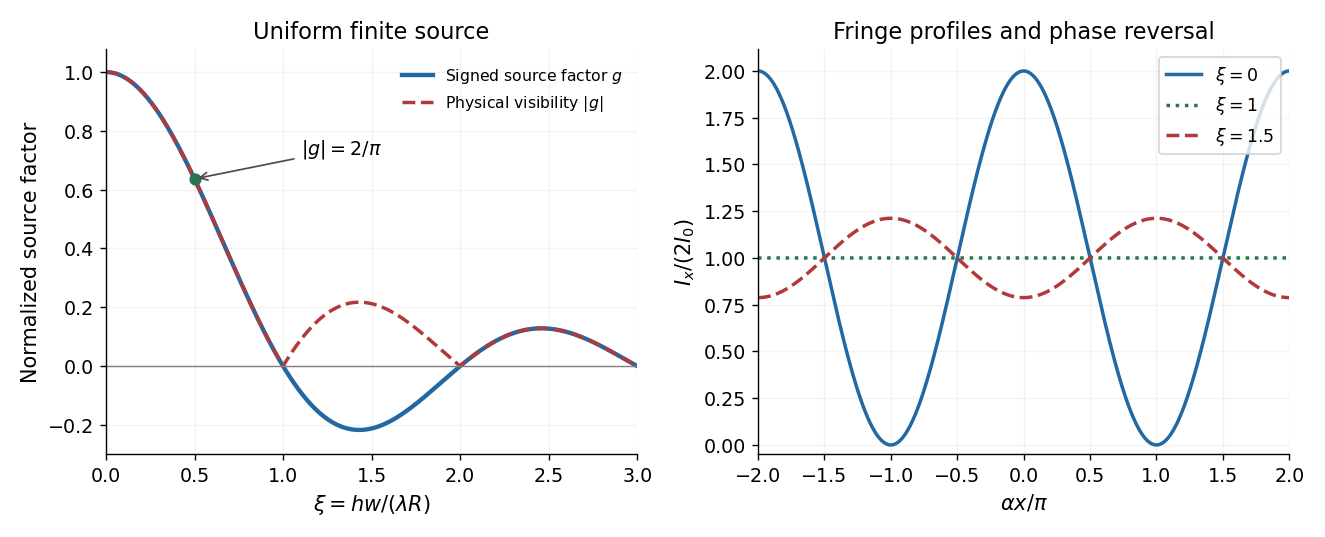
Different small elements of a thermal filament are mutually incoherent, so their wave intensities add. The two paths from one element are coherent. If that element supplies the same intensity through each slit, the superposition principle giveswhereIntegrating intensities over the incoherent source givesAdding complex amplitudes across different source elements instead would incorrectly assume mutual optical coherence of the entire filament.
The printed is a signed local modulation, not the usual fringe visibility. From the maximum and minimum of this scanned fringe pattern, the interferometric visibility isIt is independent of the screen's fringe phase and is nonnegative. For a concrete distinction, take and : the printed is zero at that observation point, while the pattern has contrast . The same example has , which is not much smaller than , yet substantial interference survives. When the signed coherence factor is negative, bright and dark fringe positions interchange; the contrast remains its absolute value. This is the distinction between signed coherence and fringe visibility.
Finite source width changes fringe contrast and can reverse fringe phase
. Original uniform-filament calculation. The signed source factor and its absolute value differ; the latter is the standard interferometric visibility. The fringe traces illustrate high contrast, vanishing contrast, and phase reversal. Details.
Past exam of the electromagnetism and optics course of the University of Oxford 2016 1 Solution by Codex 0 2026-10-25
Codex 0 2026-10-25In a contractible region, the Maxwell equations and the Poincaré lemma imply the existence of a magnetic vector potential such that . Faraday's law of induction then givesThe expression in parentheses is a gradient there, so a scalar electric potential can be chosen withThese statements are local, or global when the domain has the required topology and the electromagnetic fields are regular. A nonzero flux through a topologically nontrivial closed surface can obstruct a single globally defined vector potential, even though local expressions remain valid. The electric potential and magnetic vector potential are not unique: and leave both electromagnetic fields unchanged.
For the Lorenz gauge condition , Gauss's law becomesThe Ampere-Maxwell law givesCancel the two gradient terms using the Lorenz gauge condition. HenceBoth potential equations have the same d'Alembert operator, with their respective charge density and current density sources. In a source-free region these are homogeneous wave equations with propagation speed .
There are unlisted articles, also show them or only show them.