Past exam of the emotion: extending appraisal and feedback approaches course of the University of Oxford 2022 4 Solution by  Codex 0 2026-10-25
Appraisal is a powerful explanation of emotional differentiation, but a universal claim is empirically useful only if appraisal and emotion are defined and measured independently enough to permit failure. The hypothesis should not be evaluated as though it required a conscious sentence before every feeling. In Richard S. Lazarus's 1984 account, a primitive evaluation of what an event means for well-being can count as cognitive appraisal. Such evaluation can be rapid and unavailable to verbal report. His argument also concerns what qualifies as an emotional episode: an immediate sensory preference need not meet his definition of emotion.[ref]
On the primacy of cognition by Richard S. Lazarus. 1984, pp. 124–126, definitions of emotion and primitive evaluative cognition
The proposal explains why the same physical event can yield different feelings. A difficult task may threaten an important goal, offer an opportunity, or have little personal significance. Primary appraisal concerns that relevance and potential benefit or harm; secondary appraisal concerns coping possibilities and control. These distinguish evaluative contents rather than requiring two slow, sequential verbal decisions. Anger at an obstruction and fear of an uncontrollable threat can therefore differ even when both involve unpleasantness and bodily activation. The explanatory gain is a link between the person's goals, interpretation and response, rather than a label attached to a stimulus after the fact.
An informative experiment would hold aversive visual material constant while varying its interpreted significance: commentary might emphasize personal harm or encourage a detached interpretation. Independent measures of cognitive appraisal, felt emotion and autonomic responses would then test the predicted differences. This is a proposed contrast, not a new empirical result. A successful manipulation would show that appraisal can influence an emotional response, not that every emotional episode requires it. Commentary might also change attention or expectations, which a more selective design should address. Historically, Richard S. Lazarus explicitly allowed automatic defensive processing: in his 1991 account, an evaluation of threat could trigger coping without a fully developed conscious emotional episode. This illustrates why the theory's evaluative process cannot be equated with a later verbal judgment.[ref]
Cognition and motivation in emotion by Richard S. Lazarus. 1991, discussion of unconscious appraisal and short-circuiting of threat
The universal claim is stronger than this modulatory evidence. Let denote an emotional episode, and an event-specific evaluation of significance. Necessity asserts that no occurs without an appropriate . Temporal priority further asserts that the relevant occurs before the emotional response whose dependence it explains. Showing many followed by cannot establish this universal proposition; a convincing instance of without prior would challenge it. Furthermore, evaluation need not be sufficient: a person can understand that an event is threatening without currently feeling the corresponding fear. The strength of necessity and the strength of sufficiency must be assessed separately.
The historical primacy debate exposes a difficulty in interpreting apparent counterexamples. W. R. Kunst-Wilson and Robert Zajonc presented irregular octagons under severely degraded exposure conditions and later compared preference with explicit recognition memory. Previously exposed shapes could be preferred despite unsuccessful explicit recognition. The apparatus separated exposure, later preference and recognition tasks; it demonstrated that reportable recognition is not a necessary mediator of every preference effect. It did not establish the absence of all evaluation of significance, and preference is not automatically the full emotional phenomenon that Lazarus intended to explain.[ref]
Affective discrimination of stimuli that cannot be recognized by W. R. Kunst-Wilson and others. 1980, pp. 557–558, degraded exposure and preference–recognition dissociation
The same reasoning applies to visual masking, rapid bodily responses and animals unable to verbalize an evaluation. Lack of awareness of a stimulus does not imply lack of processing, and a fast response does not show that its evaluation was slower. Conversely, a muscle response or autonomic change does not by itself establish felt emotion. These are genuine methodological distinctions, but they become evasions if used to preserve the theory after every conceivable result. If any emotional response is defined as proof that an otherwise undetectable appraisal must have happened, then the universal claim is protected by definition rather than evidence.
For falsifiability, a formulation must therefore constrain both sides. One could preregister an independently specified appraisal content, such as goal obstruction, and a process or neural representation that carries it, without defining its presence by the eventual emotion score. The experiment should verify that a targeted manipulation substantially changes that evaluative processing while preserving sensory access, report ability and the relevant alternative pathways. It should measure an emotional outcome independently and with adequate temporal resolution. Preserved emotional responses despite a validated disruption would count against the specified dependency. It would not, by itself, refute every possible appraisal process: that broader inference needs a justified claim that the disrupted process exhausts the relevant evaluations.
Timing needs similar discipline. Earlier skin conductance than a later verbal judgment is not proof that feeling precedes appraisal, because the two measures have different delays and the report may follow an unreported evaluation. A null appraisal measure needs demonstrated statistical power and sensitivity to the proposed content; a null result is not evidence of absolute absence without a bound on what the apparatus could have detected. Multiple measures and interventions provide a stronger test than timing alone. Finally, once feeling begins it can change subsequent evaluation, so evidence for recurrent interaction is compatible with appraisal contributions while challenging an unnecessarily rigid single-pass sequence.
A precisely specified appraisal mechanism is testable and can fail. The unrestricted assertion that every emotion implies some prior, potentially unmeasurable appraisal is weakly falsifiable at best; when appraisal is inferred solely from emotion, it is circular. The evidence supports important appraisal processes more clearly than it establishes their universal temporal necessity.
Past exam of the emotion: extending appraisal and feedback approaches course of the University of Oxford 2022 3 Solution by Codex 0 2026-10-25
Codex 0 2026-10-25Small, variable effects support a limited influence of facial activity on reported feeling; they do not identify a single feedback mechanism or establish that facial feedback is necessary for emotion. This conclusion separates the experimental contrast from its proposed explanation. Randomly assigning a facial task estimates the effect of that task, including every change the task produces. It does not automatically isolate sensory feedback from the face.
Nicholas A. Coles, Jeff T. Larsen and Heather C. Lench synthesized 286 effect sizes from 138 studies using a random-effects approach with robust variance estimates. Their overall estimate combined outcomes, so the more relevant result for experienced emotion is the emotional-experience subgroup: standardized mean difference , with 95% confidence interval . Affective judgments of stimuli had a larger estimate. The reported moderators included outcome type and properties of the eliciting stimuli. These are comparisons among existing studies, not randomized assignments of the proposed moderators.[ref]
A meta-analysis of the facial feedback literature by Nicholas A. Coles and others. 2019, abstract, pp. 637–639 and Table 3, outcome-specific estimates and moderators
The distinction between outcome types is theoretically important. Rating a cartoon's objective funniness asks for an evaluative judgment about a stimulus; rating one's own amusement asks about experience. Either can change through inference, expectations or response interpretation. Treating both as direct measures of feeling would make the evidence seem more decisive about the facial feedback hypothesis than it is. Equally, a small average change in experience is compatible with a real contributory mechanism: emotion ordinarily has many inputs, so no single input need dominate.
The classic apparatus illustrates both the ingenuity and the ambiguity. Fritz Strack and colleagues in 1988 had participants hold a pen in ways that facilitated or inhibited smile-related activity, without explicitly instructing them to look happy. They reported differences in humor responses to cartoons. Avoiding an instruction to act happy reduces an obvious route through deliberate category labeling. It does not equate effort, discomfort, attention, interpretation of the task or the sensory consequences of the postures.[ref]
Inhibiting and facilitating conditions of the human smile by Fritz Strack and others. 1988, pp. 768–777, pen positions and humor responses
A subsequent preregistered replication coordinated by Eric-Jan Wagenmakers and colleagues used 17 laboratories and 1,894 analyzed participants and did not reproduce the original difference. That directly limits confidence in the robustness of this particular procedure. It is not a test of every possible facial manipulation, and it should not be counted as evidence independent of a later synthesis that includes those replication studies.[ref]
Registered Replication Report on facial feedback by Eric-Jan Wagenmakers and others. 2016, pp. 917–928, preregistration, pooled sample and replication outcome
There are several possible causal routes. First, information generated by muscle activity or associated bodily changes might contribute to felt emotion. Second, a person might use their own posture as evidence when interpreting an ambiguous state: a self-inference route could be stronger when other emotional information is weak. Third, producing a posture might activate learned associations without an explicit inference. Fourth, the task might change breathing, effort, discomfort or attention. Fifth, demand characteristics might change the report while leaving experience relatively unchanged. Social responses to a visible face are another possible route in interactive settings, but cannot explain a truly isolated participant's immediate response through an actual partner's reaction. These alternatives are hypotheses, not findings established by the meta-analysis.
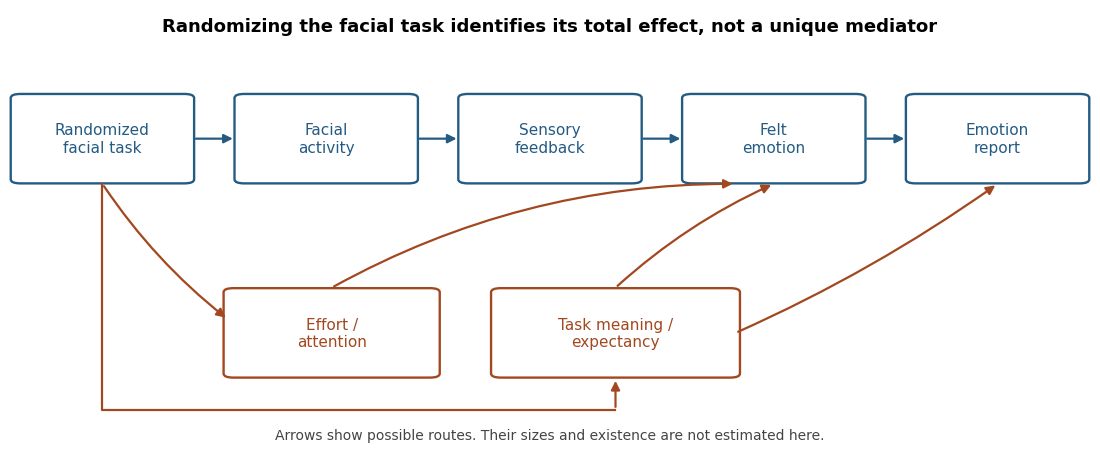
The logical problem can be stated without assuming that any route is absent. Write assignment as , facial activity as , sensory feedback as and the report as . The chain and a model with plus an expectancy route can produce the same association between assignment, movement and report. Randomization of removes preassignment confounding of its total effect, but does not randomize or eliminate . Establishing causal mediation therefore requires additional interventions or justified assumptions, not simply a significant total effect.
Heterogeneity also has a limited interpretation. A simple random-effects meta-analysis writes , with between-study variance and sampling variance . Under independent errors the variance of is . Nonzero means that true effects differ under the model; it does not specify whether the difference comes from sensory mechanisms, expectations, populations or measurement. Dependent estimates require further treatment, which is why a naive analysis counting every effect as an independent study is inappropriate. Small effects and noisy measurement also make individual studies unstable. Selecting a plausible moderator after a failed experiment is insufficient unless it predicts results in a new test.
Useful follow-up work would preregister a factorial design that varies actual facial activity separately from participants' beliefs about its emotional meaning, with matched effort controls and separate reports of felt state and stimulus judgment. Facial electromyography can verify the motor manipulation, but not certify its psychological mediator. A test of a sensory route also needs a defensible manipulation of that route that leaves the relevant alternatives adequately controlled. Masked hypotheses, automated instructions and timing measures reduce particular ambiguities rather than providing a universal guarantee. A necessary-role claim would require evidence that reducing the relevant feedback prevents an otherwise expected emotional response; an initiation claim requires an effect without the external emotional elicitor, while accounting for the task's own meaning.
Past exam of the emotion: extending appraisal and feedback approaches course of the University of Oxford 2022 2 Solution by Codex 0 2026-10-25
Codex 0 2026-10-25Naturalistic facial evidence supports biological and social regularities, but gives limited support to a universal one-to-one code for basic emotions. The relevant contrast is between describing a facial movement and inferring its cause. The same visible action can accompany an emotional episode, communicate affiliation or serve a task. A strong basic emotion theory needs independent evidence linking a category of felt emotion to a characteristic pattern across situations, rather than defining the category by the pattern it is supposed to explain.
Posed photographs are useful controlled stimuli, but agreement about them answers a different question from why people move their faces in ordinary life. Forced-choice emotion recognition supplies observers with labels and alternatives; it can encourage consensus even when spontaneous descriptions would differ. Recognition of a prototype also does not establish that its full configuration occurs frequently in lived episodes. Naturalistic studies should therefore code movements independently of a category judgment, record the social setting, and obtain an independent indicator of experience where possible. The Facial Action Coding System helps separate visible actions from their interpretation; anatomical coding is not itself a measurement of feeling.
Robert E. Kraut and colleagues' 1979 observations make the methodological issue concrete. At a bowling alley, bowlers were especially likely to smile while socially engaged, including when facing companions, rather than simply after a successful delivery. Observations in other settings also implicated social engagement. Bowling supplies identifiable outcome events and changes of orientation towards an audience, so it offers a useful setting for separating success from immediate social contact. However, a good score is an imperfect indicator of what that individual feels at that instant; the study cannot infer the absence of happiness merely from a lack of smiles.[ref]
Social and emotional messages of smiling by Robert E. Kraut and others. 1979, naturalistic bowling studies and discussion of social messages
María-Ángeles Ruiz-Belda and colleagues addressed this limitation in 2003 by adding reports of feeling in field studies of bowlers and soccer fans. Among those reporting happiness, smiling was much more probable during social interaction than outside it. The key contribution is the separation of reported happiness from the presence of a smile, not merely the observation that social people smile. Reports still have timing and reconstruction limitations, and social interaction can itself alter felt intensity. Nevertheless, these observations are difficult to reconcile with the simple claim that happiness reliably releases a smile regardless of audience.[ref]
Spontaneous facial expressions of happy bowlers and soccer fans by María-Ángeles Ruiz-Belda and others. 2003, abstract and two field studies, reported happiness and social interaction
The evidence does not require treating biological expression and communication as mutually exclusive. An inherited movement repertoire could become selectively deployed towards partners. Conversely, describing a smile as communicative does not show that its producer lacks happiness. A display rule may suppress or amplify a response. But if every absent expression is retrospectively called suppression and every unexpected expression is called a disguise, the claim loses predictive content. A useful version must specify the circumstances of suppression independently and predict differences before seeing the faces.
Evidence from blindness strengthens the case for a biological contribution without settling the strong universality claim. David Matsumoto and colleagues compared spontaneous expressions of congenitally blind, noncongenitally blind and sighted athletes. Similarities show that visual imitation is not necessary for all features of the observed repertoire. They do not remove social experience, other sensory learning, shared anatomy or competition-related goals. Nor do they establish a unique correspondence between each movement and a consciously felt category.[ref]
Spontaneous facial expressions of emotion of congenitally and noncongenitally blind individuals by David Matsumoto and others. 2009, comparison groups and spontaneous competition-related expressions
A complementary result concerns interpretation rather than natural production. Rachael E. Jack and colleagues used generated dynamic faces and reverse correlation to estimate observers' category representations. Cultural differences in those representations challenge a single universal observer code. This is not direct evidence that the same cultural groups make different spontaneous movements in every emotional situation. Production and interpretation require separate tests.[ref]
Facial expressions of emotion are not culturally universal by Rachael E. Jack and others. 2012, Figures 1–3, dynamic stimulus generation and category representations
A decisive programme would sample episodes rather than only successful examples, include nonsocial and social periods within the same people, and obtain time-linked reports without prompting a fixed inventory of categories. Facial coders should be blind to reports and outcomes; analyses should distinguish within-person effects from differences between people. Researchers should test the entire distribution: how often a movement occurs without the proposed feeling, and how often the feeling occurs without the movement. A distinctive expression might still be informative without being necessary or sufficient. To establish a specifically basic category, the pattern must also outperform alternatives based on emotional valence, emotional arousal, action and social intention.
Past exam of the emotion: extending appraisal and feedback approaches course of the University of Oxford 2022 1 Solution by Codex 0 2026-10-25
Codex 0 2026-10-25Autonomic recordings can support probabilistic discrimination of emotional states under specified conditions; they do not establish a person's experienced emotion with certainty. The distinction matters because a physiological response, an experimenter's induction label and a subjective feeling are different things. A useful psychophysiology study must justify how its labels relate to experience before assessing how well a bodily measure predicts them.
The autonomic nervous system regulates organs and glands through interacting pathways, including the sympathetic nervous system and parasympathetic nervous system. An electrocardiogram supplies cardiac timing and hence heart rate; heart rate variability describes variation in successive intervals. Electrodermal activity can be recorded with skin electrodes, while a temperature sensor supplies peripheral temperature. Breathing and blood-pressure measurements add other information. These measurements differ in what generates them and in their temporal response. In particular, sweat-related skin conductance provides information about sympathetic sudomotor activity, whereas a faster heart rate can reflect several autonomic influences and physical demands. Facial electromyography is useful complementary evidence, but records skeletal muscle activity through the somatic nervous system; it should not be counted as another autonomic channel.
Historically, the question was not simply whether the body changes during emotion, but whether bodily patterns distinguish categories. Paul Ekman and colleagues in 1983 used muscle-by-muscle facial instructions and reliving of past episodes. They reported autonomic differentiation among some negative states as well as between positive and negative states. This challenges the claim that autonomic activity is entirely undifferentiated. It does not show that the same pattern is a necessary and sufficient marker in every spontaneous episode: posing, recollection and the selection of categories constrain the result.[ref]
Autonomic nervous system activity distinguishes among emotions by Paul Ekman and others. 1983, pp. 1208–1210, induction procedures and autonomic differentiation
Joint patterns can carry information that a single measure misses. Philip A. Kragel and colleagues combined electrodermal, cardiac, respiratory and gastric measures during film- and music-induced states. Their 2013 study reported 58.0% autonomic classification accuracy across six induced categories and a neutral condition, with training and testing on separate participant subsets, above its chance benchmark. This supports multivariate information about the tested states. It does not establish invariant bodily essences: a classifier can exploit overlapping distributions whose average patterns differ.[ref]
Multivariate pattern classification reveals autonomic and experiential representations of discrete emotions by Philip A. Kragel and others. 2013, abstract and methods, classification of induced states
Conversely, Erika H. Siegel and colleagues' 2018 synthesis found substantial within-category variation, and mean autonomic patterns that did not clearly separate the categories. Its laboratory adult samples do not exhaust every possible real-world measurement. Nevertheless, a universal fingerprint claim should generalize across episodes, and the observed variation is a substantial problem for that strong claim. Failure to establish a fingerprint does not imply that physiology contains zero predictive information; distributions can overlap without being identical.[ref]
Emotion fingerprints or emotion populations by Erika H. Siegel and others. 2018, abstract and Discussion, autonomic variation within and between categories
Several alternative explanations must therefore be tested. A film may make participants breathe differently because of its pacing; imagined confrontation may prepare action; an emotional task may differ from a neutral task in movement or attention. Exercise, room temperature, medication and individual baselines can change the recorded variables without a change in discrete emotional category. A classifier that recognizes the stimulus or task is not necessarily recognizing the feeling. Splitting trials while retaining the same people and clips in training and test sets can also overstate generalization. Appropriate cross-validation should hold out the people or inductions required by the intended claim, with preprocessing and feature selection fitted only to training data. Mixed feelings and changing episodes should be allowed rather than forced into one mutually exclusive label.
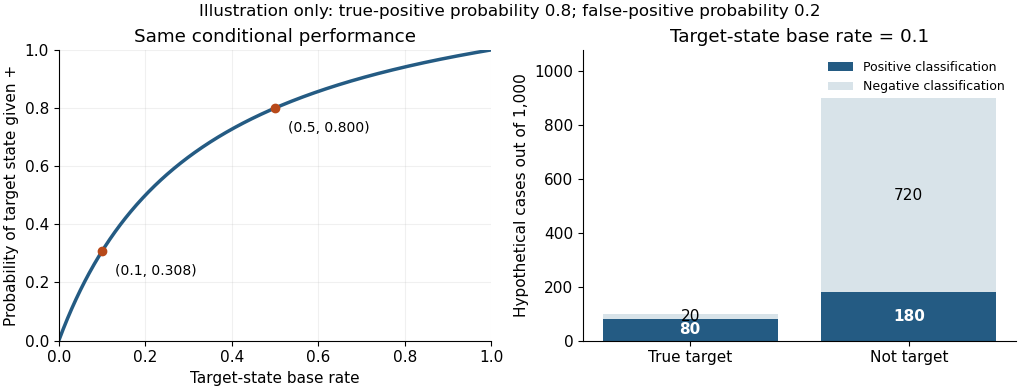
Even genuine conditional discrimination does not determine the reliability of a particular classification. Let denote one independently defined target state and a positive classifier result. Partitioning the positive results into target and nontarget cases and applying Bayes' theorem givesFor an explicitly hypothetical classifier with true-positive probability and false-positive probability , a target base rate of produces . At a base rate of , the same conditional performance produces . The positive predictive value therefore depends on the setting as well as the instrument. This calculation illustrates a limit on inference; it is not an estimate from either study.


The strongest conclusion combines measures while respecting their different roles. Repeated self-report helps establish experienced feeling, independently coded behavior establishes action, and autonomic recording establishes bodily regulation. None is error-free, and agreement must be demonstrated. Psychophysiologists can estimate how much an autonomic pattern changes the probability of a reported or independently characterized state, with an explicit uncertainty and domain of validation. They can establish useful evidence about experienced emotion, but autonomic activity alone supplies a conditional inference rather than a uniquely identifying emotional signature.
Past exam of the electromagnetism and optics course of the University of Oxford 2016 9 Solution by Codex 0 2026-10-25
Codex 0 2026-10-25Let be the single-mirror power reflectivity and the propagation angle inside the gas. Define as the vacuum wavelength. Successive transmitted complex amplitudes differ by a round-trip factor , where, for real dielectric reflection coefficients whose product has positive sign,The cosine arises by comparing successive emerging rays on the same outgoing wavefront; it is not the literal zigzag distance . Equivalently, the round-trip phase is . If the source's is the angle in external air, Snell's law gives andIf denotes the internal angle, simply set .
For identical lossless mirrors, their power transmission is . In an energy-normalized amplitude convention this is ; more general interface amplitudes require the corresponding wave impedance factors. The geometric series of transmitted amplitudes givesHenceThis is Fabry–Pérot transmission from multiple reflections.[ref]
Fabry-Perot Interferometer, University of Washington Physics 331. Theory equations (1)–(2), including the coefficient of finesse
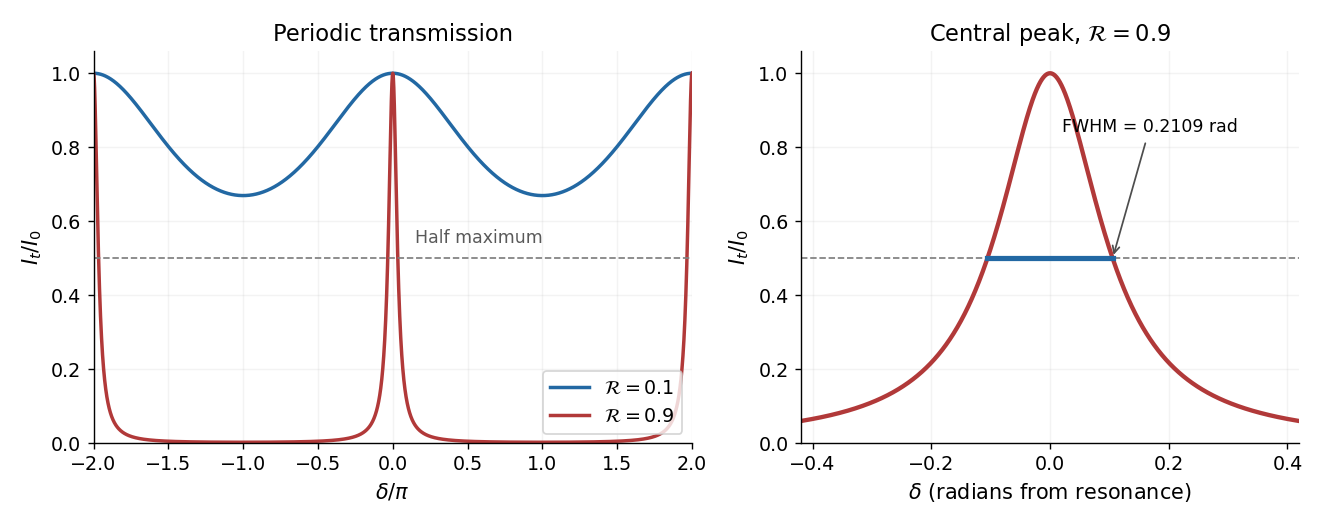
At normal incidence, for nondispersive and zero net reflection phase modulo , the resonance condition is . The resonance frequencies and free spectral range areFor finite the resonances have finite width, and transmission away from them is nonzero. Thus “only discrete frequencies” is an ideal high-reflectivity description of the selected resonances, not an exact statement about the support of the transmitted spectrum. For example, at still gives .
At half the unit peak, . Measuring the phase displacement from a resonance yieldsThe last expression is the high-reflectivity approximation, with finesse . At , the full phase width is about radians and . At , the minimum transmission is , so the trace never reaches half the peak and this full width at half maximum is not defined. The exact half-maximum condition requires .

For the absorbing Fabry–Pérot mirror phase and transmission, write and let be the power transmission of one mirror. Optical absorption makes . The transmitted intensity becomesHere the phase formula is at normal incidence. The peak is reduced below unity, while a change in changes the width. The complex reflection phase also moves the resonances: if is approximately constant,If either or depends on frequency, this is an implicit condition and the free spectral range need not be constant. No numerical shift is determined without the mirrors' optical response.
Past exam of the electromagnetism and optics course of the University of Oxford 2016 8 Solution by Codex 0 2026-10-25
Codex 0 2026-10-25Let be the uniform charge density and take . Rigid rotation produces current density . The magnetic dipole moment isSpherical symmetry gives , while . ThereforeIt is parallel to the angular velocity for positive and antiparallel for negative . The fully signed magnitude statement is ; the printed magnitude assumes positive and positive angular speed.
Axisymmetry permits a purely azimuthal magnetic vector potential, , with . For the source's associated Legendre function convention, , since its definition omits the Condon–Shortley phase. The given differential operator reduces toInside the sphere, . Since the radial operator maps to , the particular coefficient is . Regularity at the origin and decay at infinity giveThere is no surface sheet electric current, so both normal and tangential magnetic field components are continuous at . Usingthis is equivalent to continuity of and . The two equations give and . ThusIn the homogeneous expansion, , in their respective interior and exterior regions; all higher angular orders vanish. Indeed, matching the regular and decaying terms with zero source at forces both coefficients to zero. The outside magnetic field is exactly the magnetic dipole field of , not merely its leading far-field approximation. For a positive moment along , , which is the printed cross-product magnitude expression.
For the flux coupling of a rotating charged sphere to a circular loop, take a loop of radius in the equatorial plane and use Stokes theorem on the regular full vector potential, evaluated around the rim. Its linked magnetic flux isWith , the mutual inductance defined using this effective electric current isIntegrating an ideal magnetic dipole field through the entire disk would incorrectly use its singular expression inside the actual sphere; the rim calculation avoids that error.
For the prescribed time dependence, the quasistatic Faraday's law of induction result and the purely resistive loop approximation givePositive loop electric current is defined to produce a positive magnetic dipole moment, so the minus sign is Lenz's law. This assumes negligible retardation and , where is the loop's self-inductance. If that is not negligible, the governing equation is instead ; alone is insufficient for the exact dynamic response.
Past exam of the electromagnetism and optics course of the University of Oxford 2016 7 Solution by Codex 0 2026-10-25
Codex 0 2026-10-25Write and for homogeneous scalar material constants, and use . Taking the curl of Faraday's law of induction and substituting the Ampere-Maxwell law givesThe vector calculus identity for a double curl therefore yieldsThe second term represents electric current response, rather than displacement current. A dispersive is used in the frequency domain; its general time-domain counterpart is a temporal response convolution.
For the convention , the plane wave equation isDecompose the electric field into components parallel and perpendicular to . With , the longitudinal eigenvalue is and each transverse eigenvalue is ; thus the determinant is . For a transverse electromagnetic wave, andwhen and the background . A real dissipative electrical conductivity generally makes complex, with the decaying branch chosen for a passive medium.
For a cold, collisionless, unmagnetized plasma, treat ions as stationary and write for the magnitude of the elementary charge. The electron equation of motion is , soThis reactive response includes no collision-induced Joule heating. Substitution into the transverse dispersion relation givesThe quantity is the electron plasma frequency. The refractive index is real above this cutoff; below it, the wave is evanescent. The electron response is represented here by , so it must not also be counted a second time in the background permittivity.
For a nonzero longitudinal component, taking the dot product of the matrix equation with instead gives . The same cold plasma response makes , henceAt nonzero , the remaining equation forces to be parallel to , and Faraday's law of induction gives . These are electrostatic Langmuir waves, with no dependence of angular frequency in the zero-temperature model. Equilibrium neutrality does not forbid their perturbed charge density; Gauss's law requires such a density when .
Past exam of the electromagnetism and optics course of the University of Oxford 2016 6 Solution by Codex 0 2026-10-25
Codex 0 2026-10-25Put the plate behind the slit at transverse coordinate , and let positive screen coordinate point toward that slit. The extra optical path length isIn the paraxial approximation, the covered path minus the uncovered path has total optical path difference . Its zero determines the shifted central interference fringe:toward the slit covered by the plate. Moving toward that slit shortens its geometric path and compensates the extra delay in the plate.
More generally, the phase difference is , so every interference fringe translates by the same in this approximation. The spacing is unchanged, and the shift corresponds to fringe periods. For an ideal uniform transparent plate that changes only the wave phase, the envelope and interferometric visibility are unchanged. Reflection losses or unequal transmission through a real plate could additionally reduce the interferometric visibility; those are separate amplitude effects. No numerical wavelength is needed for the physical displacement of the zero-order fringe.
Past exam of the electromagnetism and optics course of the University of Oxford 2016 5 Solution by Codex 0 2026-10-25
Codex 0 2026-10-25Use the thin lens sign convention in which a real object on the incident side has positive object distance, a real image on the outgoing side has positive image distance, and a converging lens has positive focal length. The first image distance isFor the image distance for two separated thin lenses, the second lens has object distance , which can be negative when its intermediate object is virtual. Applying the thin lens equation again givesThe image is beyond the second lens when ; denotes a virtual image on its incident side. A vanishing denominator with nonzero numerator denotes an image at infinity. The rational expression also supplies appropriate limits when the first image is at infinity; for example, gives for finite nonzero focal lengths.
As , the effective focal length is andFor a real incident object, , and positive , the real-image condition is exactly , yielding the requested inequality. This includes two converging lenses. The positivity assumption matters: with and , one has and , but is virtual. If , the touching pair has zero net optical power and produces no real image of this real object in the ideal thin lens model.
There are unlisted articles, also show them or only show them.