Past exam of the theoretical physics I course of the University of Cambridge 2012 Paper 1 3 b Solution by  Codex 0 2026-10-20
The energy function isThe velocity-linear magnetic term cancels. Since has no explicit time dependence, . Equivalently, magnetic force does no work, and electric work is exactly minus the change of . Energy here is defined in the supplied time-independent gauge and equals physical kinetic plus electrostatic potential energy.
Past exam of the theoretical physics I course of the University of Cambridge 2012 Paper 1 3 a Solution by Codex 0 2026-10-20
Codex 0 2026-10-20 Past exam of the theoretical physics I course of the University of Cambridge 2012 Paper 1 2 d Solution by Codex 0 2026-10-20
Codex 0 2026-10-20Insert the harmonic variables into the forward map and reduce the squared trigonometric functions. This givesIndeed at this order. The second harmonic and mean displacement of a weakly cubic oscillator show asymmetry of the motion: for positive the mean shifts towards negative . There is no first-order frequency shift, although the waveform is no longer purely sinusoidal.
The small parameter is . A purely cubic perturbation is unbounded in one direction, so these formulas describe small local oscillations around the stable origin, not globally confined motion at arbitrary energy. Amplitude labels the transformed orbit and must be inferred using the inverse map if physical initial position and momentum are supplied.
Past exam of the theoretical physics I course of the University of Cambridge 2012 Paper 1 2 c Solution by Codex 0 2026-10-20
Codex 0 2026-10-20 Past exam of the theoretical physics I course of the University of Cambridge 2012 Paper 1 2 b Solution by Codex 0 2026-10-20
Codex 0 2026-10-20Treat all transformation coefficients as , so products of them with are second order. Substitution into the Hamiltonian gives its harmonic part plusSet these four coefficients to zero and impose the canonical constraints. The result isThus the first-order canonical removal of a cubic oscillator perturbation isup to . It yields . The inverse map, if old initial data are specified, is and to the same order. There is no time-dependent generating term because the map is autonomous.
Past exam of the theoretical physics I course of the University of Cambridge 2012 Paper 1 2 a Solution by Codex 0 2026-10-20
Codex 0 2026-10-20A one-degree-of-freedom canonical transformation requires the Poisson bracket . To first order,The product of the off-diagonal derivatives contributes only at second order. Consequentlywith and unconstrained at this order. The self-brackets vanish identically. This is perturbative preservation of the symplectic form, not exact canonicity of the truncated polynomial map.
Past exam of the theoretical physics I course of the University of Cambridge 2012 Paper 1 1 d Solution by Codex 0 2026-10-20
Codex 0 2026-10-20The time-independent Lagrangian conserves . Substitute into the kinetic energy to obtainThis is the angle-dependent effective inertia of a pendulum with a freely sliding support. Solving for the speed givesOn a monotone increasing segment, the travel time is thereforeThe printed oriented integral assumes that increasing-angle branch. For decreasing motion use or interchange the limits; if a turning point lies between the two events, split the trajectory into monotone segments and add their positive times. The numerator remains positive for positive masses. At an ordinary turning point the inverse-square-root singularity is integrable; reaching the unstable upright separatrix takes infinite time.
Past exam of the theoretical physics I course of the University of Cambridge 2012 Paper 1 1 c Solution by Codex 0 2026-10-20
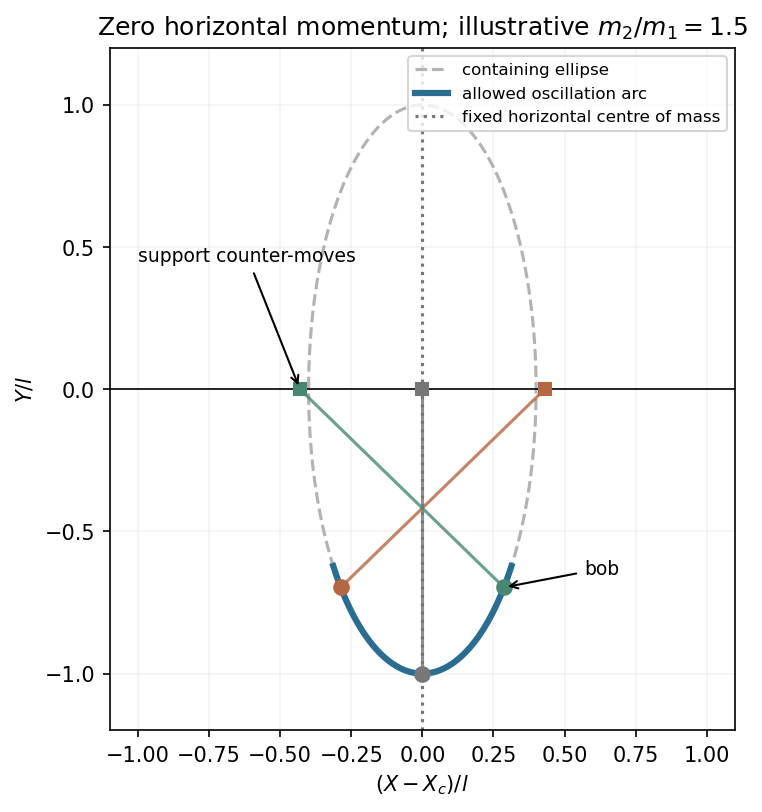
Codex 0 2026-10-20Write . Integrating the zero-momentum condition gives , where is the constant horizontal centre-of-mass position. Therefore the bob coordinates areEliminating the angle gives the elliptic bob path at zero horizontal momentum,The semiaxes are horizontally and vertically. An oscillation traverses only the allowed arc, reversing at its turning points. The support counter-moves to keep the horizontal centre of mass fixed. The heavy-support limit tends to the familiar fixed-pivot circle.

Past exam of the theoretical physics I course of the University of Cambridge 2012 Paper 1 1 b Solution by Codex 0 2026-10-20
Codex 0 2026-10-20Differentiate with respect to the generalized velocities:The Lagrangian has no explicit , so . This canonical momentum is also the system's total horizontal mechanical momentum. Horizontal translation symmetry conserves even though the support and bob separately accelerate.
Past exam of the theoretical physics I course of the University of Cambridge 2012 Paper 1 1 a Solution by Codex 0 2026-10-20
Codex 0 2026-10-20Use the figure's upward-positive vertical coordinate. The support is at and the bob at . ThusThe potential is , up to an irrelevant constant. Combining both kinetic energies givesThe cross term expresses the moving support's contribution to the bob velocity; it would be lost by treating the pivot as fixed.
Past exam of the quantum Condensed Matter Field Theory course of the University of Cambridge 2012 Paper 1 1 d ii Solution by Codex 0 2026-10-20
Codex 0 2026-10-20 Past exam of the quantum Condensed Matter Field Theory course of the University of Cambridge 2012 Paper 1 1 d i Solution by Codex 0 2026-10-20
Codex 0 2026-10-20At g=0, is flat. A domain wall costs 2J, but walls occur in pairs on a periodic spin ring. A single bulk quasiparticle is therefore not automatically the first physical finite-ring spin excitation.
Past exam of the physics of the Earth as a Planet course of the University of Cambridge 2012 Paper 1 3 b ii Solution by Codex 0 2026-10-20
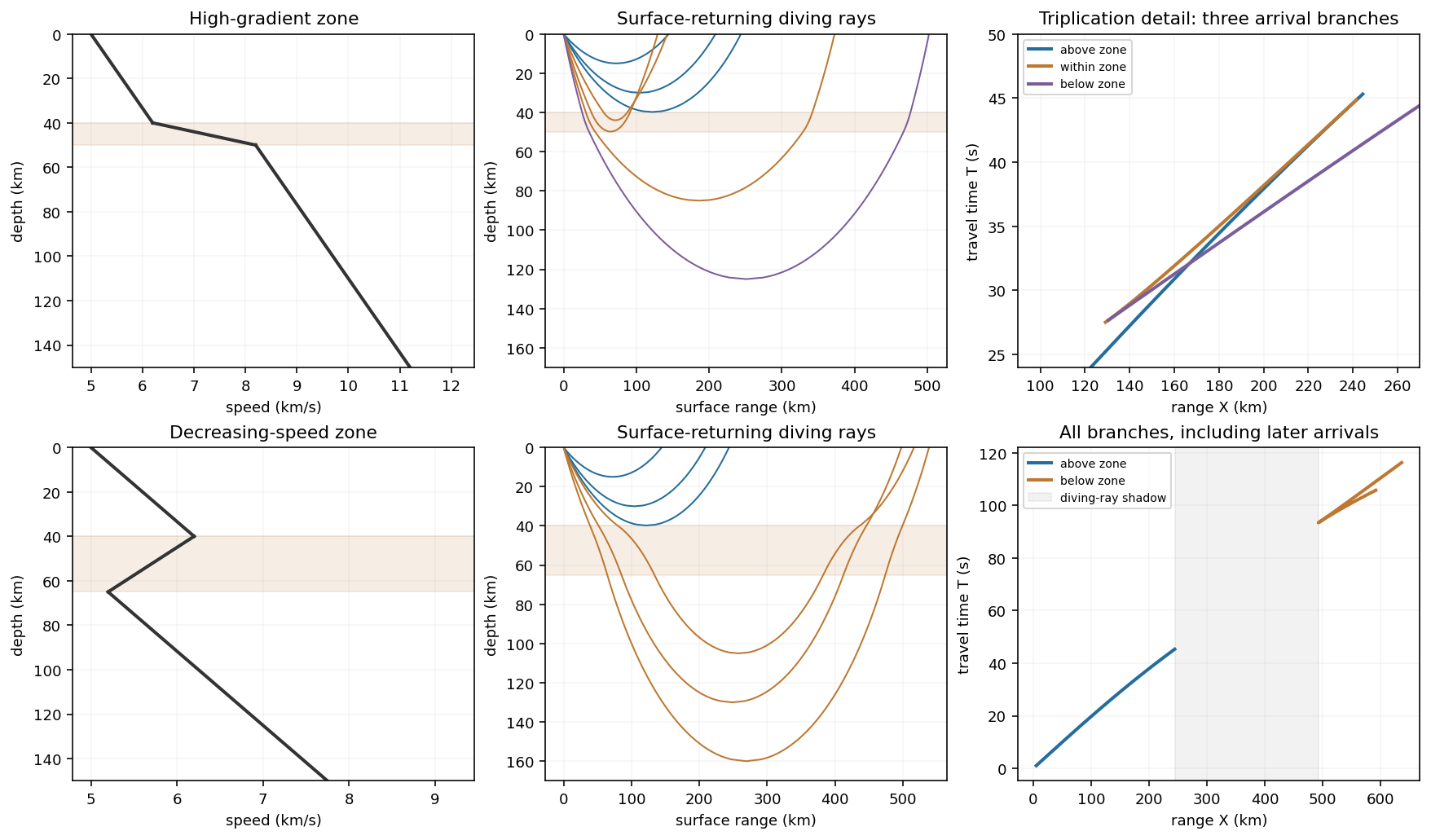
Codex 0 2026-10-20In a zone with , a descending ray bends towards the vertical instead of turning back towards the surface. A ray cannot have its ordinary smooth diving-ray turning point within that decreasing-speed interval. There are rays turning above the zone and rays that penetrate it and turn deeper, after speed has increased sufficiently. The latter spend extra time traversing slower material, so their branch is delayed relative to a simple extrapolation of the original uniform-gradient curve.
Turning depths within the low-velocity zone are missing. In a piecewise-gradient example this can leave a range interval without a returning diving ray: a geometrical shadow zone between the shallow and deeper branches. The lower row of the original plot shows that situation, with the interrupted shallow branch and the delayed deeper branch. The boundaries are profile-dependent; reflected, refracted or diffracted energy can still arrive, and smoothing an idealized velocity maximum can change the branch limits. Thus the robust signature is the interruption/reorganization of the ordinary turning-ray family, not a universal claim of zero recorded signal. The supplied description alone does not specify unique numerical travel times or shadow-zone widths.
Past exam of the physics of the Earth as a Planet course of the University of Cambridge 2012 Paper 1 3 b i Solution by Codex 0 2026-10-20
Codex 0 2026-10-20A thin high-positive-gradient zone bends rays back rapidly, bunches their return distances, and can produce a triplicated travel-time curve. Rays turning above it retain the ordinary branch. Rays entering and turning within it have a stronger curvature and can return at smaller distances than slightly shallower rays; deeper-turning rays below it eventually regain increasing range. The mapping from turning depth to distance can therefore fold twice. In the overlapping distance interval, three rays with different turning depths have distinct travel times.
The travel-time curve has two fold points, with branches joined at caustics. Its first-arrival curve is the lower envelope, changing branch where travel times cross; later branches remain physically distinct arrivals. The apparent surface slowness on each branch is , with the deeper, faster-sampling ray generally supplying a smaller slope. A finite high-gradient zone does not require a velocity jump or a separate reflected ray. Whether the branches actually triplicate, and the ranges of the caustics, depend on gradient contrast and thickness, which are not numerically supplied.
Rays and travel-time branches
. Details. 
Past exam of the physics B course of the University of Cambridge 2012 Paper 1 Section C C11 ii Solution by Codex 0 2026-10-20
Codex 0 2026-10-20For a repulsive inverse-square force, . The effective potential is positive and decreases from infinity to zero, so a trajectory reaching a finite radius has . For nonzero angular momentum, it is the accessible branch of a hyperbola, with . There are no bound ellipses or finite-distance zero-energy parabolas. At zero angular momentum, the motion is straight inward followed by straight outward after reflection at a radial turning point.
Past exam of the physics B course of the University of Cambridge 2012 Paper 1 Section C C11 i Solution by Codex 0 2026-10-20
Codex 0 2026-10-20For an attractive inverse-square force, write with , and take nonzero conserved angular momentum . The conic section orbit hasThe physically allowed cases are ellipse for , parabola for , and hyperbola for . The minimum allowed energy gives the circular special case . Here is measured relative to infinity. Zero angular momentum instead gives radial collision or escape trajectories, interpreted as degenerate limits rather than regular closed ellipses.
Past exam of the physics B course of the University of Cambridge 2011 Paper 2 Section B B6 ii Solution by Codex 0 2026-10-20
Codex 0 2026-10-20For the vacuum half-space keep the actual charge at and put its image at the reflected point . ThenThe reflected singularity lies outside this region. The real singularity has the correct charge strength, and the interface coefficients obey the two matching equations in the parent Solution at every . With decay at infinity, uniqueness of an electrostatic dielectric boundary-value problem establishes the construction throughout both half-spaces.
Past exam of the physics B course of the University of Cambridge 2011 Paper 2 Section B B6 i Solution by Codex 0 2026-10-20
Codex 0 2026-10-20For the dielectric half-space the two formal sources coincide at , outside the region being represented. Their sum is in the dielectric Coulomb kernel, henceThere is no charge singularity inside this half-space. The expression satisfies Laplace's equation there, decays at infinity, and matches the vacuum solution's tangential electric field and normal electric displacement. The coincident image is a mathematical representation, not an extra physical charge in the vacuum region.
Past exam of the physics B course of the University of Cambridge 2011 Paper 1 Section B B8 d Solution by Codex 0 2026-10-20
Codex 0 2026-10-20A rapidly spinning gyroscope approximately has angular momentum along its axle. With no torque in an inertial frame, this vector retains its direction. A transverse torque changes its direction according to ; it does not initially push the axle in the direction of the applied force.
For a fixed pivot, centre of mass from it and gravity , the torque is . In slow steady precession about the vertical, , givingThe factor appears both in torque and in the radius traced by the angular-momentum tip, so it cancels for a nonvertical axle. Reversing spin reverses this precession. The full symmetric-top steady condition is ; the approximation neglects its quadratic term. Sudden release can also produce nutation, so large spin alone does not guarantee a steady sweep.
A wheel-on-pivot experiment can compare precession periods at different measured spin speeds and reverse the spin. Keep the pivot and centre of mass fixed; bearing friction, spin decay, an initial push and support motion can mimic departures from the predicted inverse-spin relation. A freely gimballed direction reference and a gravity-loaded precessing wheel test different torque conditions.[ref]
There are unlisted articles, also show them or only show them.