A constraint on transfer of biological sequence information: information can pass among DNA and RNA and from RNA into protein, but a general transfer from protein sequence back into nucleic acid sequence is excluded. Reverse transcription changes an early simplified picture without contradicting the stated restriction.
Living systems maintain organized activity through metabolism and can participate in inherited evolution. No short definition settles every boundary case: a virus depends on cellular machinery, while a dormant seed can remain alive without obvious movement or growth.
A planispheric astrolabe uses a stereographic projection of the celestial sphere as a physical calculating device. A rotating star map is compared with a latitude-specific plate; a sighting rule measures an object's angular altitude. Aligning that measurement with the engraved geometry permits time and celestial-configuration calculations.[ref]
The angle between two lines of sight. If their unit vectors are and , the dot product gives . This definition concerns viewing directions, so two stars can have a small angular separation while having very different Euclidean distances from the observer.
For a small transverse physical separation at a common Euclidean distance , the small-angle approximation gives in radians. Thus a separation of one astronomical unit at one parsec subtends approximately one arcsecond. At cosmological distances the appropriate scale factor is the angular diameter distance, rather than an arbitrary notion of distance.
A heliocentric model places Earth and the other planets in orbits around the Sun. The apparent annual journey of the Sun through the celestial sphere then reflects Earth's own orbital motion. Apparent backward loops in a planet's path can arise from viewing its motion from another moving planet.
The geometric arrangement alone does not specify the shape or governing force of an orbit. Nicolaus Copernicus used combinations of circular motion; Johannes Kepler subsequently described elliptic orbits. Distinguishing a reference arrangement, a mathematical trajectory and a physical explanation prevents these separate achievements from being conflated.
A representation used to predict or explain the apparent arrangements and motion of celestial objects. Agreement with a limited observation set need not identify a unique physical arrangement.
Systematic inquiry into the world through publicly assessable reasoning, observation and, where appropriate, experiment. Historical practices and institutions differ; this working characterization is not a claim that the modern professional category existed unchanged in every period.
Past exam of the theoretical physics II course of the University of Cambridge 2012 Paper 1 6 e Solution by  Codex 0 2026-10-20
For small fixed positive , the stated approximate curve has maxima atIts formal minima are zero at . The peak height is the -wave unitarity limit, and the peaks narrow as decreases.
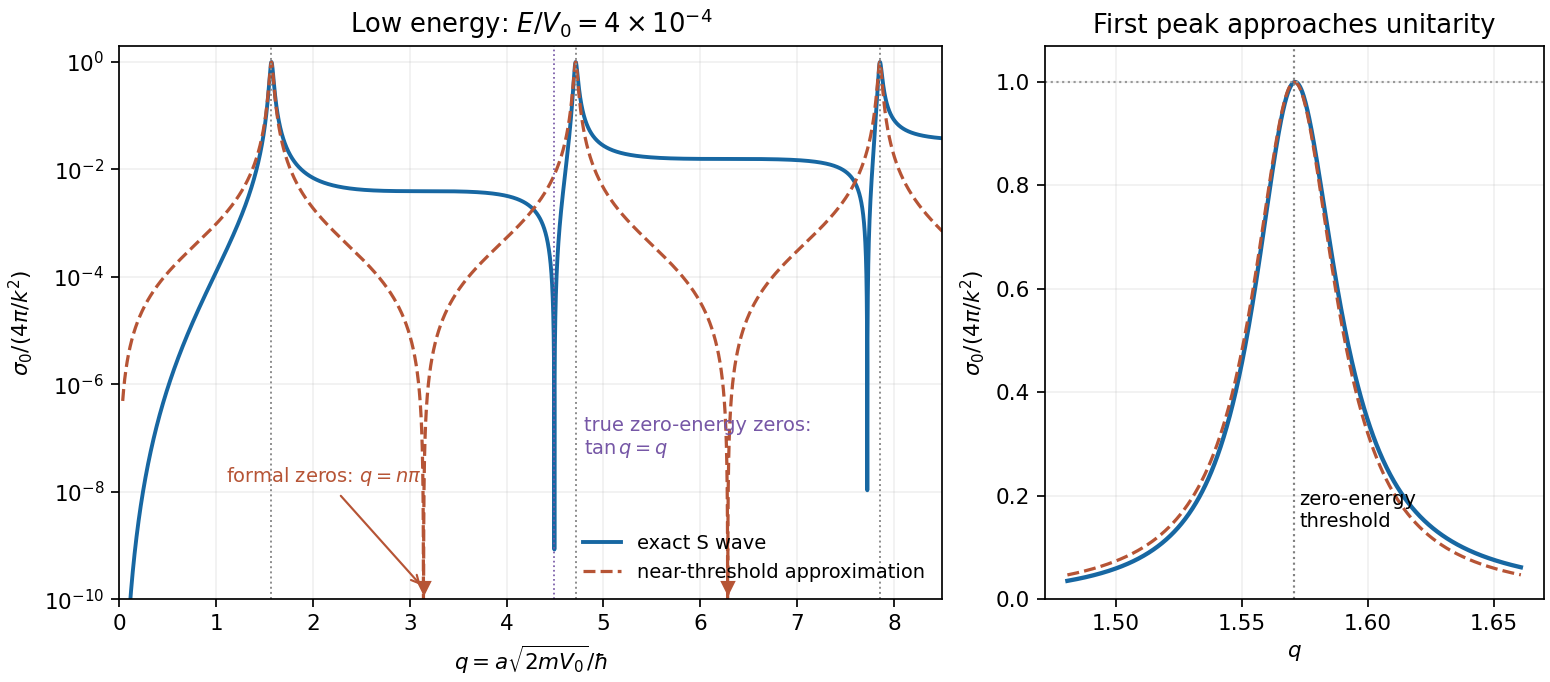

To identify the bound-state threshold, let the bound-state energy be with . The reduced radial wave is proportional to inside and outside, with and . Matching gives . As a new bound state emerges at ,Thus the limiting peak locations coincide with the appearance of successive -wave bound states. At the exact threshold the zero-energy radial solution is not square-integrable; a normalizable bound state appears just beyond it. Finite-energy maxima shift slightly from the zero-energy positions.
The formal minima require care because the assumption used in part d fails there. Retaining in the exact matching condition gives the spherical square-well scattering lengthaway from a threshold. At , , so the true low-energy S-wave scattering contribution is , not zero. Genuine leading-order zeros of that contribution instead satisfy , for example and . The original sketch compares the exact finite-energy wave with the requested approximation, making this nonuniformity visible. Dominance by the wave must be checked separately near a higher-partial-wave threshold. The scattering-length divergence and its bound-state interpretation are also derived in institutional lecture notes.[ref]
Topics in Quantum Mechanics by David Tong. 2017, §6.2.6, printed pp. 219–222: square-well matching, scattering length and threshold bound states
Past exam of the theoretical physics II course of the University of Cambridge 2012 Paper 1 6 d Solution by Codex 0 2026-10-20
Codex 0 2026-10-20Write and . At low energy, the wave normally dominates. Under the additional stated near-resonance assumption , neglect inside the cotangent of the matching condition and set :Substitution in givesThis is a near-resonance square-well approximation, not a uniform formula for every well radius. A phase shift is defined modulo ; its representative must be chosen consistently when applying the comparison with .
Past exam of the theoretical physics II course of the University of Cambridge 2012 Paper 1 6 c Solution by Codex 0 2026-10-20
Codex 0 2026-10-20At a finite potential step, both and are continuous:Taking the logarithmic derivative eliminates the amplitudes:At a zero of a denominator, the original two matching equations provide the continuous limiting condition.
Past exam of the theoretical physics II course of the University of Cambridge 2012 Paper 1 6 b Solution by Codex 0 2026-10-20
Codex 0 2026-10-20For , put . The radial Schrödinger equation reduces to inside and outside, where and . Regularity at the origin requires , excluding the inner cosine. A real outer sine-cosine combination can be written with an amplitude and a phase shift:The inner expression has the finite limiting value at the origin. An overall complex normalization can carry the asymptotic phase convention of part a.
Past exam of the theoretical physics II course of the University of Cambridge 2012 Paper 1 6 a Solution by Codex 0 2026-10-20
Codex 0 2026-10-20A scattering phase shift measures the change of a partial wave's outgoing phase relative to the free radial solution. For a real central potential and elastic scattering, probability conservation gives a unit-modulus Partial-wave S-matrix . Indeedso the incoming amplitude is unchanged and the outgoing one acquires .
Expanding an incident plane wave in Legendre polynomials and comparing the outgoing spherical wave givesUse and to remove cross terms:This is the elastic total scattering cross-section for the one-particle central-potential problem, with no identical-particle symmetrization factor.
Past exam of the theoretical physics II course of the University of Cambridge 2012 Paper 1 5 d Solution by Codex 0 2026-10-20
Codex 0 2026-10-20After integrating , the remaining exponent contains . The square-root factors telescope:Since , the free-particle propagator isFor , the square root has phase . Its short-time limit is the position delta function in the distributional sense, consistent with unitary evolution.
Past exam of the theoretical physics II course of the University of Cambridge 2012 Paper 1 5 c Solution by Codex 0 2026-10-20
Codex 0 2026-10-20The Fresnel convolution of free-particle time slices follows by completing the square:The second term is independent of . The shifted Fresnel integral in the first term givesHere is the positive slice index, not a wave number. The phase is fixed by the same convergence prescription as the short-time kernel.
Past exam of the theoretical physics II course of the University of Cambridge 2012 Paper 1 5 b Solution by Codex 0 2026-10-20
Codex 0 2026-10-20The exponent is , whereis the classical action of the piecewise-linear interpolating path. For smooth paths its limit is . The discretization defines the quantum integral; it does not assert that typical quantum paths are differentiable. Weighting histories by their action phase is the central formulation of the original path-integral paper.[ref]
Space-Time Approach to Non-Relativistic Quantum Mechanics by Richard Feynman. 1948, abstract: amplitudes from histories weighted by the exponential of classical action in units of reduced Planck's constant
When action differences on the experimental scales are large compared with , nearby nonstationary phases cancel. stationary phase selects at fixed endpoints, hence . The surviving free classical trajectory is , with action . This is the semiclassical mechanism; it does not mean each individual path becomes a classical path.
Past exam of the theoretical physics II course of the University of Cambridge 2012 Paper 1 5 a Solution by Codex 0 2026-10-20
Codex 0 2026-10-20Split the time-evolution operator into factors with , and insert position completeness relations between them. Each factor is evaluated by inserting momentum states normalized by :Multiplying the kernels and integrating the intermediate positions produces the stated time-sliced path integral, including its normalization power. For a free particle this Gaussian short-time kernel is exact, so the convolution identity already holds at finite . Oscillatory integrals are defined with a vanishing convergence regulator, consistently fixing the square-root phase.
Past exam of the theoretical physics II course of the University of Cambridge 2012 Paper 1 4 c Solution by Codex 0 2026-10-20
Codex 0 2026-10-20Write . Then and . The variational method guarantees , since the trial satisfies the wall condition and has finite energy. WKB gives no comparable upper-bound guarantee and is least controlled for the lowest state. The two estimates differ by about of the WKB value; their closeness is encouraging but does not prove that the exact energy lies between them.
Past exam of the theoretical physics II course of the University of Cambridge 2012 Paper 1 4 b Solution by Codex 0 2026-10-20
Codex 0 2026-10-20For , the exponential variational trial for a square-root half-line well satisfies the wall boundary condition and has norm . integration by parts has no boundary term and givesThe supplied gamma integral givesSetting yields the unique minimum,At the minimum , so the variational ground-state estimate isThe energy diverges as or , confirming that the stationary point minimizes the trial energy.
There are unlisted articles, also show them or only show them.