Past exam of the theoretical physics II course of the University of Cambridge 2012 Paper 1 4 a Solution by  Codex 0 2026-10-20
The half-line square-root potential well is confining for , which is assumed here. The hard wall imposes and the smooth turning point is . With , the WKB action becomesThe hard-wall and soft-turning-point WKB quantization condition therefore givesThe coefficient here denotes the potential strength, not the integration limit in the generic quantization formula.
The WKB approximation is reliable in the interior where , but fails near the soft turning point where ; a connection formula supplies its phase. The hard wall also requires its boundary condition, and makes the local slow-variation condition fail sufficiently close to zero. Higher-energy states have a larger action relative to , with smaller relative endpoint regions, so the leading WKB spectrum is generally more reliable at large than for the ground state.
Past exam of the theoretical physics II course of the University of Cambridge 2012 Paper 1 3 d Solution by Codex 0 2026-10-20
Codex 0 2026-10-20Introduce the dimensionless width . Multiplying the variances givesThe minimum holds at all times precisely when , the oscillator ground-state width. For any other , it is still attained at the isolated quarter-period times , including zero. At a fixed generic time, minimizing over again selects .
The excess product has a covariance interpretation:Thus the breathing Gaussian state in a harmonic oscillator saturates the Robertson-Schrödinger uncertainty relation throughout, even when its position-momentum product exceeds the lower bound in the Heisenberg uncertainty principle.
Past exam of the theoretical physics II course of the University of Cambridge 2012 Paper 1 3 c Solution by Codex 0 2026-10-20
Codex 0 2026-10-20Square the operator solutions, retaining the symmetrized cross term rather than treating and as commuting variables. The initial symmetrized expectation vanishes, soThe means remain zero. These are also the variances. Unless , the Gaussian state breathes: its position and momentum widths exchange periodically while the mean energy remains constant.
Past exam of the theoretical physics II course of the University of Cambridge 2012 Paper 1 3 b Solution by Codex 0 2026-10-20
Codex 0 2026-10-20The normalized initial Gaussian wave packet is real and even, so the integrands for and are odd. Its second position moment is the elementary Gaussian integral . Since and ,Moreover and . Thus
Past exam of the theoretical physics II course of the University of Cambridge 2012 Paper 1 3 a Solution by Codex 0 2026-10-20
Codex 0 2026-10-20The canonical commutation relation and hamiltonian giveSubstitution in the Heisenberg equation of motion yields and . Differentiating once more gives the harmonic-oscillator equation for each operator. Its initial-value solution isDifferentiating these expressions at zero verifies both prescribed initial derivatives. They also preserve .
Past exam of the theoretical physics II course of the University of Cambridge 2012 Paper 1 2 e Solution by Codex 0 2026-10-20
Codex 0 2026-10-20The original Von Neumann entropy depends on its eigenvalues, with defined by continuity:After rank-one dephasing, the eigenvalues are the retained diagonal populations , givingdephasing removes coherences in the specified basis, increasing the system's mixedness while preserving those measurement probabilities. It cannot be a closed-system unitary transformation, since the eigenvalues change. The subsystem entropy increase does not by itself assert an increase in the entropy of a closed system plus its environment.
Past exam of the theoretical physics II course of the University of Cambridge 2012 Paper 1 2 d Solution by Codex 0 2026-10-20
Codex 0 2026-10-20The given real symmetric matrix is Hermitian and has trace one. A spectral decomposition supplies its positivity without relying on diagonal entries alone:The remaining normalized eigenvector is with eigenvalue zero. Consequently the spectrum is , every eigenvalue is nonnegative, and the matrix is permissible. Its purity is , so it is mixed.
Past exam of the theoretical physics II course of the University of Cambridge 2012 Paper 1 2 c Solution by Codex 0 2026-10-20
Codex 0 2026-10-20A normalized pure state has , and thereforeConversely, diagonalize a permissible density operator. Its eigenvalues obey and , soEquality requires every eigenvalue to be zero or one; exactly one is one. Thus the idempotent matrix condition and purity one both characterize a pure state. A mixed state has at least two positive eigenvalues, and . In dimension its purity is at least .
Past exam of the theoretical physics II course of the University of Cambridge 2012 Paper 1 2 b Solution by Codex 0 2026-10-20
Codex 0 2026-10-20Each term is a Hermitian rank-one projection and is real, so . Using the rank-one trace,The remaining admissibility condition follows from : is positive semidefinite.
Past exam of the theoretical physics II course of the University of Cambridge 2012 Paper 1 2 a Solution by Codex 0 2026-10-20
Codex 0 2026-10-20An ensemble of normalized quantum states with probabilities is represented by the density operatorIt determines every observable expectation value through . The ensemble decomposition need not be unique; the operator specifies the measurement statistics.
Past exam of the theoretical physics II course of the University of Cambridge 2012 Paper 1 1 e Solution by Codex 0 2026-10-20
Codex 0 2026-10-20Set . The product rule givesMultiplying by the integrating factor and integrating yields the commutator of an operator with an exponential:Equivalently, differentiate directly; its derivative is the integrand and it vanishes at zero. The argument is exact for finite matrices, and for bounded operators with their norm-convergent exponentials; unbounded linear operators require an appropriate common domain.
Past exam of the theoretical physics II course of the University of Cambridge 2012 Paper 1 1 d Solution by Codex 0 2026-10-20
Codex 0 2026-10-20 Past exam of the theoretical physics II course of the University of Cambridge 2012 Paper 1 1 c Solution by Codex 0 2026-10-20
Codex 0 2026-10-20In a finite-dimensional basis, interchange the two finite sums:This cyclic property of the trace does not assert or permit arbitrary reordering of three factors. For infinite-dimensional linear operators, the traces and rearrangements need hypotheses, for example one trace-class operator and one bounded operator; an arbitrary pair of unbounded linear operators is not covered.
Past exam of the theoretical physics II course of the University of Cambridge 2012 Paper 1 1 b Solution by Codex 0 2026-10-20
Codex 0 2026-10-20Take an orthonormal basis and insert its completeness relation:No normalization or orthogonality of is required. This is the trace of a rank-one operator; in a Hilbert space the sum converges by the Cauchy-Schwarz inequality.
Past exam of the theoretical physics II course of the University of Cambridge 2012 Paper 1 1 a Solution by Codex 0 2026-10-20
Codex 0 2026-10-20For a differentiable family of invertible linear operators, differentiate the identity without changing the factor order:Multiplication on the right by gives the derivative of matrix inversion,Commuting past the derivative would generally be invalid.
Past exam of the theoretical physics I course of the University of Cambridge 2012 Paper 1 6 b Solution by Codex 0 2026-10-20
Codex 0 2026-10-20The spatial transform of is . Convolution with the impulsive source and the inverse transform therefore give simply . Take without loss of generality and set .
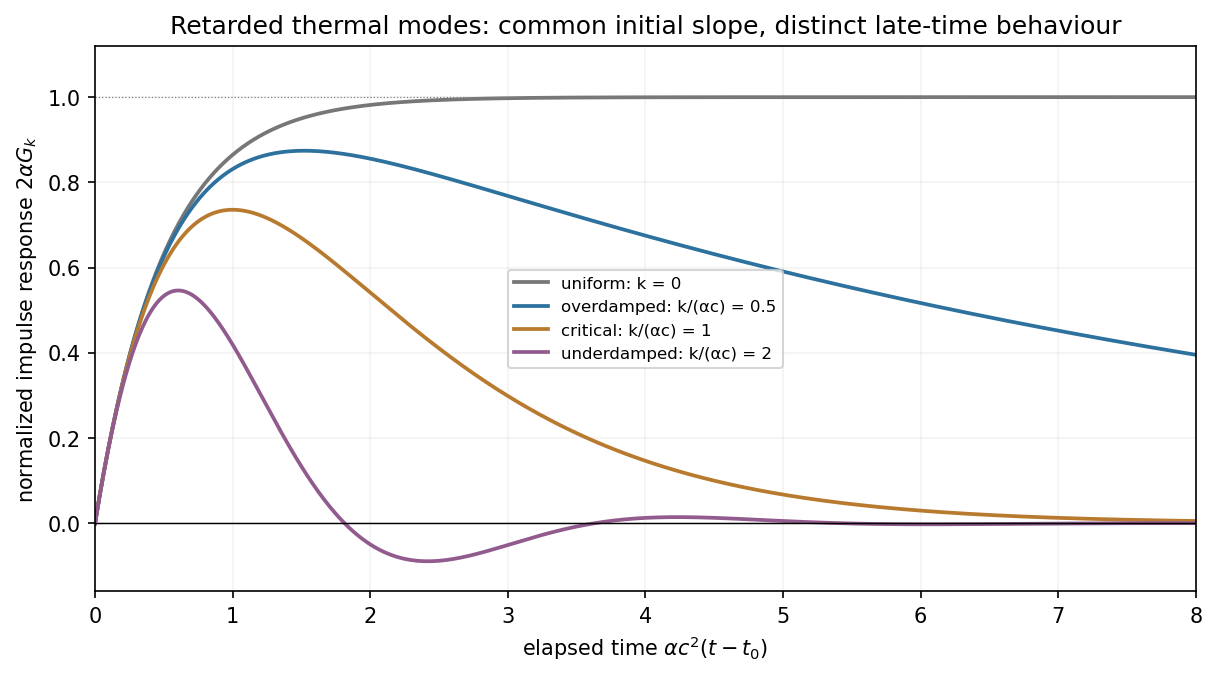
For , let . ThenFor , let . ThenBoth satisfy and , so the impulse changes the time derivative rather than discontinuously changing temperature. The first case rises and then relaxes without sign oscillations for a nonzero mode; the second oscillates as its amplitude decays. The limiting equality gives , and gives the nondecaying uniform increment discussed above.
A cosine source has both positive and negative regions, so this linear solution can be understood as a temperature perturbation about a background; its negative values are not assertions of negative absolute temperature. The temporal oscillations arise from the second-time-derivative term. Dropping that term changes the initial-jump structure as well as removing the underdamped regime.

Past exam of the theoretical physics I course of the University of Cambridge 2012 Paper 1 6 a Solution by Codex 0 2026-10-20
Codex 0 2026-10-20Use the forward spatial transform and inverse . The retarded transformed Green function obeysIt vanishes for negative . Continuity at zero excludes an unwanted term; integrating across zero then fixes . Define and . The two homogeneous exponents are . Imposing the two matching conditions gives the Fourier-mode Green function of the telegraph equation,For an explicit time-Fourier route, use . ThenFor , both poles lie below the real axis. Closing above for gives zero; closing below for is clockwise, giving times the residue sum. Since , this iswhich reduces to the same damped sine or hyperbolic sine above. The pole on the real axis is interpreted by the retarded limiting prescription, or directly by the initial-value matching above.
For the response is overdamped and nonoscillatory. For , put ; analytic continuation gives , a real damped oscillation. At equality the finite limit is .
All nonzero Fourier modes decay. The uniform mode instead has for positive time, leaving a constant temperature increment. At small wavenumber the slow decay exponent is , so the diffusion limit of the damped heat-transmission equation has diffusivity . The full hyperbolic equation has finite propagation speed , unlike the limiting parabolic heat equation.
Past exam of the theoretical physics I course of the University of Cambridge 2012 Paper 1 3 e Solution by Codex 0 2026-10-20
Codex 0 2026-10-20For the specified parameter relation,Thus there are axial oscillations per transverse revolution, and the nondegenerate three-dimensional trajectory closes after . Since , the integer is excluded; changing its sign changes nothing. More generally commensurate cyclotron and axial oscillations close for any rational frequency ratio, whereas irrational ratios give quasiperiodic motion when both components are present. An integer ratio is sufficient, not the only closure condition. The same frequency argument also applies to transverse cyclotron circles centred away from the chosen cylindrical origin.
Past exam of the theoretical physics I course of the University of Cambridge 2012 Paper 1 3 d Solution by Codex 0 2026-10-20
Codex 0 2026-10-20For constant , the radial equation requires . Select the stipulated nonzero angular velocity and define the positive cyclotron frequency . ThenThis is a circle in the transverse plane combined with an independent axial oscillation, as in uniform magnetic field with axial harmonic confinement. Viewed from positive , positive charge rotates clockwise. Its three-dimensional path lies on the cylinder and reverses its vertical motion; it is generally not a constant-pitch helix. For it is a horizontal circle. This orbit has .
Past exam of the theoretical physics I course of the University of Cambridge 2012 Paper 1 3 c Solution by Codex 0 2026-10-20
Codex 0 2026-10-20The coordinate is cyclic. Its conjugate momentum is therefore a second conserved quantity,It differs from mechanical angular momentum . The magnetic contribution is essential to the rotational Noether charge in this axisymmetric gauge.
There are unlisted articles, also show them or only show them.