Past exam of the particle and nuclear physics course of the University of Cambridge 2013 Paper 1 2 c Solution by  Codex 0 2026-10-20
The electroweak gauge group is . Left-handed fermions form weak-isospin doublets and right-handed charged fermions are singlets under . Before symmetry breaking the gauge fields are and , with couplings . A Higgs-doublet vacuum expectation value breaks the symmetry to electromagnetic .
In units , the physical combinations and tree-level relations areThe photon remains massless. charged currents change members of weak doublets, whereas the mediates weak neutral currents with parity-dependent couplings. At low energies exchange reduces to the Fermi contact interaction, ; the apparent weak suppression reflects the massive mediator. This unifies the gauge description, not the numerical equality of all low-energy couplings.[ref]
A Model of Leptons by Steven Weinberg. 1967, gauge structure, symmetry breaking and vector-boson mass relations
Neutral-current neutrino interactions and subsequent observation of massive weak vector bosons tested this structure. In a neutral-current neutrino experiment, an isolated hadronic interaction without an accompanying charged lepton is a candidate signal; entering neutral hadrons and missed charged-current leptons are important backgrounds. Gargamelle's neutral-current evidence supplied a direct experimental check beyond ordinary beta decay.[ref]
Past exam of the particle and nuclear physics course of the University of Cambridge 2013 Paper 1 2 b Solution by Codex 0 2026-10-20
Codex 0 2026-10-20parity reverses spatial coordinates and polar vectors such as momentum, while leaving axial vectors such as angular momentum unchanged. The correlation is therefore parity odd. For polarized beta-emitting nuclei one can measurewhere is measured from nuclear polarization, its magnitude and a decay-dependent coefficient. A nonzero spin–momentum asymmetry is incompatible with parity invariance.
The cobalt-60 experiment polarized nuclei at low temperature and compared beta emission along and opposite the polarization axis. Preferential emission on one side established weak-interaction parity violation. Reversing polarization tests whether the asymmetry follows nuclear orientation; warming the sample removes polarization, while gamma anisotropy monitors its loss. Detector acceptance, backgrounds and magnetic deflection of charged particles must be separated from a true emission asymmetry.[ref]
Experimental Test of Parity Conservation in Beta Decay by Chien-Shiung Wu and others. 1957, polarized cobalt-60 experiment and temperature/polarization checks
In the modern weak charged current, the V-A interaction couples to left-chiral fermion fields. In the massless limit this selects left-helicity neutrinos and right-helicity antineutrinos. Massive charged leptons need not be pure-helicity states, consistent with the factor . Strong and electromagnetic interactions conserve parity to the usual experimental approximation; parity violation alone should not be confused with CP violation or a failure of CPT.
Past exam of the particle and nuclear physics course of the University of Cambridge 2013 Paper 1 2 a Solution by Codex 0 2026-10-20
Codex 0 2026-10-20A nuclear excited state has internal energy above its ground state, with levels labelled by spin and parity and, where useful, approximate isospin. In the shell model, nucleons occupy orbitals split by spin-orbit coupling; nuclear particle-hole excitation and broken pairs produce excited configurations. An orbital has parity , and an even-even paired ground state is commonly . Residual interactions mix configurations, so shell spacings are not a complete spectrum.
Collective motion gives distinct patterns. A deformed nucleus can have a rotational band with , so a simple even-even band has . Near spherical shape, a quadrupole vibration gives a one-phonon excitation; two such phonons can couple to near twice that energy in the harmonic limit. Anharmonicity and coupling to single-particle motion modify these ideal patterns.
De-excitation occurs by gamma emission, internal conversion, or particle emission if energetically open. photon multipolarity must satisfy the angular-momentum triangle rule. Electric multipoles change parity by and magnetic multipoles by ; a single photon cannot connect . Large multipolarity or a small transition matrix element can make a long-lived nuclear isomer. Gamma energies, coincidence cascades, angular correlations and lifetimes constrain level schemes; inelastic scattering and transfer reactions supply complementary spin/configuration information. One observed line alone need not identify a unique level assignment.
Past exam of the particle and nuclear physics course of the University of Cambridge 2013 Paper 1 1 c Solution by Codex 0 2026-10-20
Codex 0 2026-10-20For a pure sample, nuclei. radioactive activity is with . Using a year of 365.25 days,The mass number supplies the approximate molar mass in grams per mole. This is initial parent activity; no daughter activity or isotope mixture has been assumed.
Past exam of the particle and nuclear physics course of the University of Cambridge 2013 Paper 1 1 b Solution by Codex 0 2026-10-20
Codex 0 2026-10-20For the neutral strange B meson, a charged-current tree amplitude has followed by , while the initial is a spectator. The pair forms the J/psi meson and the pair forms the phi meson. Charge and quark flavour flow are conserved at each vertex except for the permitted weak flavour change. antiquark arrows point opposite their physical propagation direction.
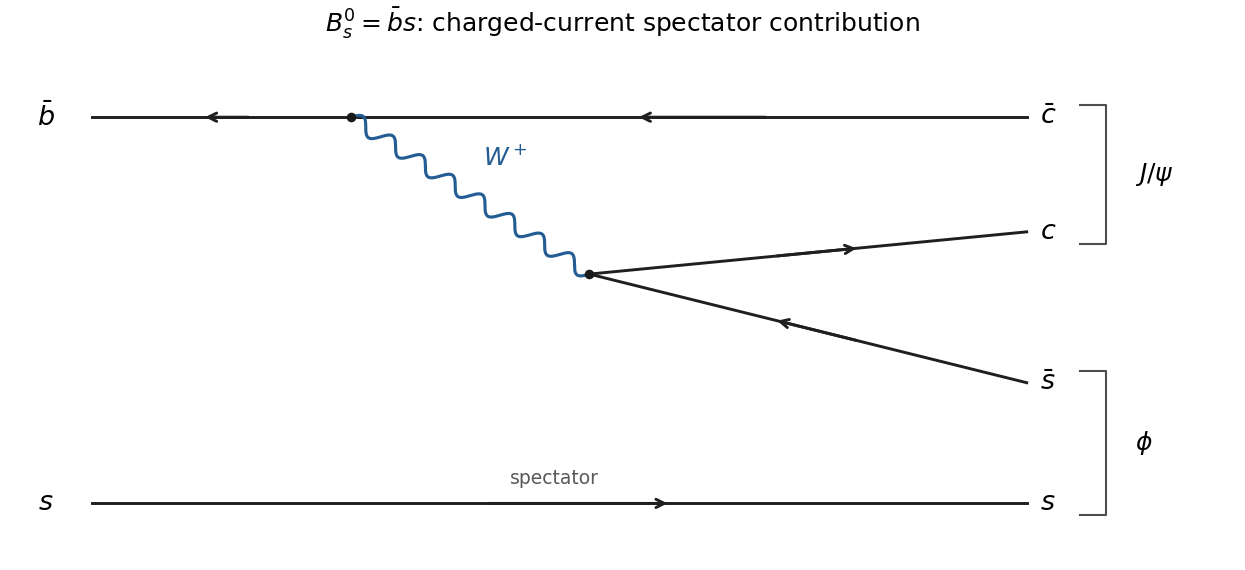
Original quark-level charged-current contribution to the neutral strange B-meson decay; arrows show fermion flow
. Details. Useful reconstruction modes are or , through a virtual photon, and , a strong decay. The latter is the largest individual mode, with also important. For the , the inclusive branching fraction versus reconstruction mode distinction matters: hadronic decays dominate inclusively, principally through three gluons; each charged-lepton pair accounts for about 6%, not most decays. The charm pair lies below open-charm threshold. These distinctions are confirmed by the official particle listings.[ref]
Past exam of the particle and nuclear physics course of the University of Cambridge 2013 Paper 1 1 a Solution by Codex 0 2026-10-20
Codex 0 2026-10-20The diphoton invariant mass follows by adding the two photon four-momenta: . ThusFor correlated diphoton mass resolution, at fixed angle, . If the two quoted fractional errors are independent one-standard-deviation uncertainties,An unknown common energy-scale error would be correlated: with correlation coefficient , the fractional variance is . Fully correlated scale errors give 10%, rather than 7.1%. A mass consistent with a candidate is not by itself evidence establishing its identity.
Past exam of the optics and electrodynamics course of the University of Cambridge 2016 Paper 1 4 d Solution by Codex 0 2026-10-20
Codex 0 2026-10-20Unpolarized incident light has equal, mutually incoherent - and -polarized intensities. Both components scatter into the same direction , so their coherency matrices add toThis matrix has rank one when the signal is nonzero. The light is therefore fully linearly polarized along , withA fixed highly anisotropic needle can act as a polarizing scatterer even for unpolarized input. The equality of total intensities with (c) does not mean the incident states were identical. These conclusions use the leading longitudinal-polarizability approximation; finite transverse response can change the polarization purity.
Past exam of the optics and electrodynamics course of the University of Cambridge 2016 Paper 1 4 c Solution by Codex 0 2026-10-20
Codex 0 2026-10-20Choose one circular convention as with time dependence . Reversing the handedness convention changes the sign of but not the result here. The scattered complex amplitude isThe scalar factor contributes a common phase to both output components. Consequently the scattered wave is linearly polarized along , rather than circular or elliptical, withThe dominant longitudinal needle response has rank one, so both incident circular components emerge in the same real output direction.
Past exam of the optics and electrodynamics course of the University of Cambridge 2016 Paper 1 4 b Solution by Codex 0 2026-10-20
Codex 0 2026-10-20Now , soWhenever nonzero, the scattered light has the same linear polarization along as in (a). Although the incident field points toward the observer, the tilted anisotropic needle can induce a dipole component perpendicular to that direction. An isotropic sphere would instead have an axial radiation zero for this incident polarization.
Past exam of the optics and electrodynamics course of the University of Cambridge 2016 Paper 1 4 a Solution by Codex 0 2026-10-20
Codex 0 2026-10-20Using the needle definitions in the question-level solution, . The scattered field is parallel to , andThe light is linearly polarized along the needle's projection into the observation plane. Its Jones vector in the basis is whenever the intensity is nonzero. A needle perpendicular to the incident electric field, or pointing directly at the observer, has zero leading-order signal.
Past exam of the optics and electrodynamics course of the University of Cambridge 2016 Paper 1 2 c Solution by Codex 0 2026-10-20
Codex 0 2026-10-20A photonic crystal has a spatially periodic dielectric response on the scale of the optical wavelength. For a nonmagnetic, lossless, nondispersive dielectric, the source-free Maxwell equations can be written as the eigenproblemThe Bloch theorem gives with periodic . The allowed frequencies form photonic band structures. Coupling of counterpropagating waves near a Brillouin zone boundary opens a stop band. A one-dimensional dielectric multilayer is a simple example; two-dimensional hole arrays and three-dimensional dielectric networks allow more extensive control.
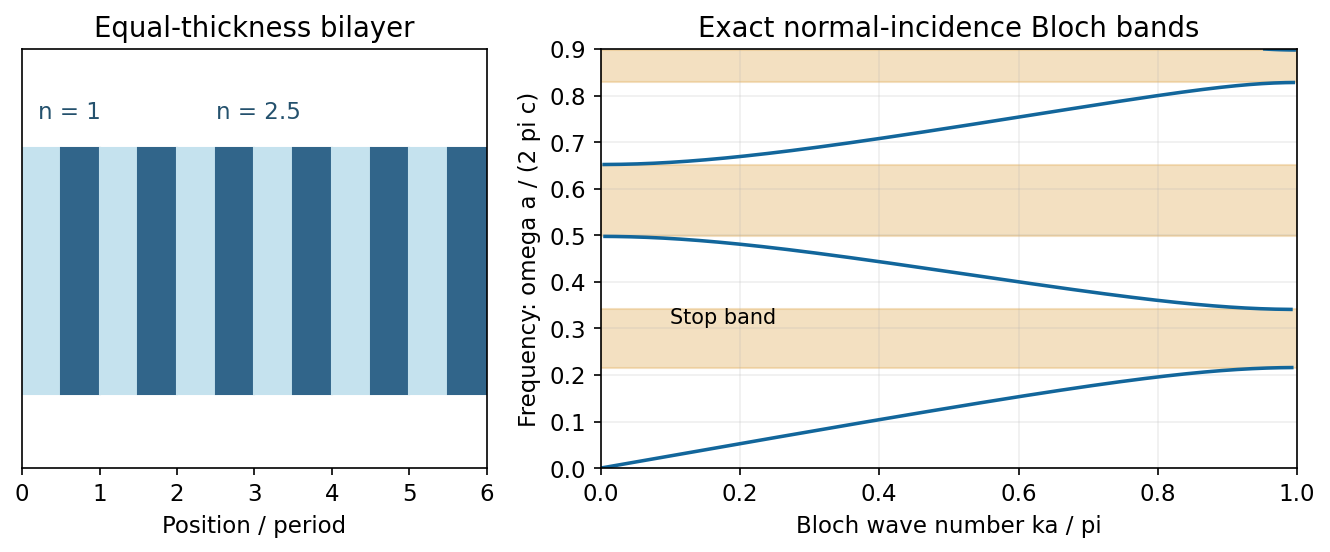
A complete photonic band gap excludes bulk propagating modes for every direction and polarization in a frequency interval. Periodicity alone does not guarantee such a gap: dimensionality, symmetry and refractive-index contrast matter. A missing or altered element can support a localized defect state in the gap, making a cavity; a line defect can guide light. Finite crystals have leakage and wavelength-dependent transmission rather than an infinitely sharp exclusion. Applications include selective mirrors, optical filters, small resonators and integrated waveguides.[ref]
Mathematical Methods in Nanophotonics, MIT 18.369, Spring 2016 by Steven G. Johnson. Lecture 2: Maxwell eigenproblem; lectures 9–14: Bloch states, one-dimensional gaps and defect localization
Past exam of the optics and electrodynamics course of the University of Cambridge 2016 Paper 1 2 b Solution by Codex 0 2026-10-20
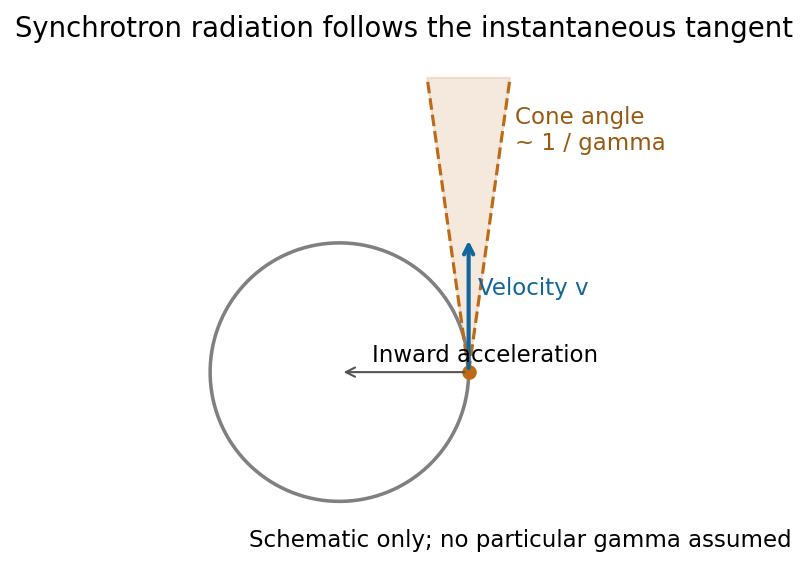
Codex 0 2026-10-20Synchrotron radiation is radiation from relativistic charges undergoing transverse acceleration, for example electrons bent by a magnetic field. Relativistic aberration concentrates the radiation within an angle of order about the instantaneous velocity. An observer sees short pulses as this cone sweeps past; synchrotron pulse compression produces a broad spectrum extending far above the orbital frequency.
For an ultrarelativistic circular trajectory of curvature radius , the characteristic scales are[ref]
Synchrotron Radiation in the Geant4 Physics Reference Manual by Geant4 Collaboration. Critical energy and critical mode number
The synchrotron critical frequency sets the spectral turnover; it is not a sharp upper cutoff. The transverse-acceleration Lienard formula givesThe strong energy dependence is a major loss mechanism in electron storage rings. Radiation observed in the orbital plane is linearly polarized in that plane; away from it the two components generally produce elliptical polarization, with opposite handedness on opposite sides. Accelerator light sources exploit its brightness, broad tunable spectrum and pulsed timing. At low speeds the relativistic beaming and high-frequency extension disappear, approaching ordinary cyclotron radiation.[ref]Synchrotron Radiation by Richard Fitzpatrick. Relativistic radiation cone, pulse compression and synchrotron spectrum
Past exam of the optics and electrodynamics course of the University of Cambridge 2016 Paper 1 2 a Solution by Codex 0 2026-10-20
Codex 0 2026-10-20Birefringence is polarization-dependent propagation in an optically anisotropic medium. Its permittivity tensor relates to . In a lossless uniaxial dielectric, take the optic axis along and the principal relative permittivities as . For a wave vector making angle with that axis, the ordinary mode has index , while the extraordinary phase-index angular dependence isThe ordinary electric field is perpendicular to the plane containing the wave vector and optic axis. The extraordinary electric displacement field lies in that plane and is perpendicular to the wave vector, but its electric field need not be. Its energy-flow direction can therefore differ from the wave-normal direction: birefringent walk-off. Along the optic axis the two indices coincide. Refraction generally splits an incident beam into two differently polarized rays, producing double images, as in calcite.
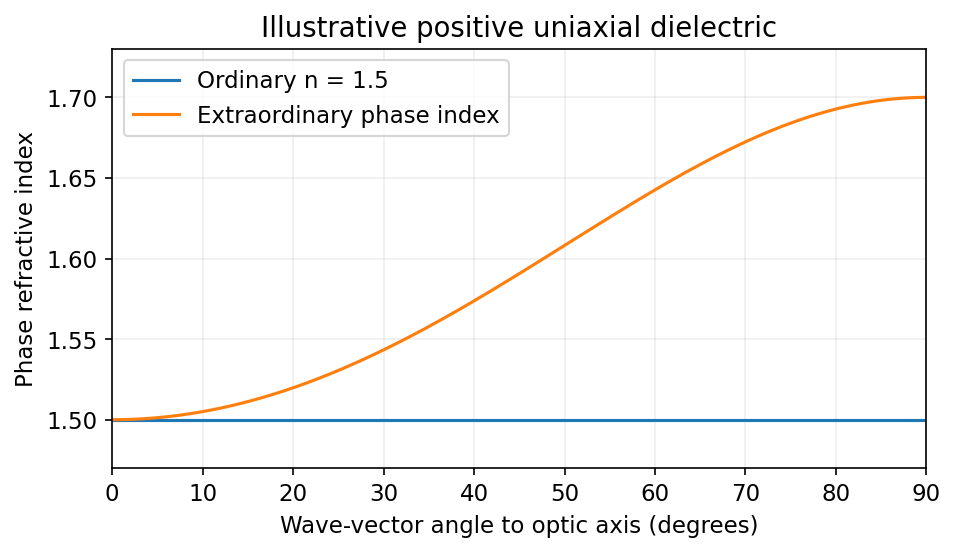
Illustrative positive-uniaxial ordinary and extraordinary phase indices coincide along the optic axis
. Source. Details. A waveplate instead uses the relative phase of two eigenpolarizations. With the axes chosen for the propagation direction, the retardance is . A quarter-wave plate gives modulo and converts equal-amplitude orthogonal components between linear and circular polarization. A half-wave plate gives and rotates a linear polarization. This is a phase effect; unequal absorption is a separate property.[ref]
Polarisation by Sander Konijnenberg, Aurèle J.L. Adam and H. Paul Urbach. Creating Different Polarisation States; wave plates and relative phase
Past exam of the optics and electrodynamics course of the University of Cambridge 2016 Paper 1 1 c Solution by Codex 0 2026-10-20
Codex 0 2026-10-20Write . For a slowly evolving circular Coulomb orbit, force balance and the mechanical energy giveThe supplied Larmor formula therefore yieldsSet . Since ,Thus the classical radiation collapse of a Coulomb orbit obeysThe decreasing mechanical energy means a more tightly bound orbit, not a smaller speed. The formal collapse time is . The nonrelativistic, small-loss-per-orbit approximation eventually fails; the result demonstrates the classical instability rather than describing an actual hydrogen atom.
Past exam of the optics and electrodynamics course of the University of Cambridge 2016 Paper 1 1 b Solution by Codex 0 2026-10-20
Codex 0 2026-10-20The transverse spatial coherence width is much larger than the longitudinal coherence length. The longitudinal scale is controlled by spectral bandwidth:For broad, unfiltered visible sunlight it is of order a wavelength to a few wavelengths, roughly . This is an order-of-magnitude scale, not a uniquely defined solar constant; the precise value depends on spectral response and the coherence-width convention.
The Sun subtends angular diameter at one astronomical unit.[ref]
Sun Fact Sheet by National Aeronautics and Space Administration. Sun Observational Parameters: apparent diameter at 1 A.U.
Consequently the sunlight coherence comparison gives a transverse scaleusing only as an illustrative visible wavelength. The uniform-disk spatial coherence model has first coherence zero at , about at that wavelength. The small angular size permits coherence across tens of micrometres, while the broad spectrum destroys coherence over much shorter path differences. Spectral filtering increases ; spatial filtering changes the transverse scale.[ref]Interference and Coherence by Sander Konijnenberg, Aurèle J.L. Adam and H. Paul Urbach. Coherence of Light Sources; More on Spatial Coherence
Past exam of the optics and electrodynamics course of the University of Cambridge 2016 Paper 1 1 a Solution by Codex 0 2026-10-20
Codex 0 2026-10-20Interpreting the cone as Cherenkov radiation, its angle gives the speed, not directly the mass:Combining this with the relativistic kinetic energy gives the Cherenkov mass inferenceThe material must be transparent at the observed frequency, is its phase refractive index there, and . For this requires for a massive particle above threshold. Radiation of an unspecified other origin would not determine the mass from these data alone.
Past exam of the optics and electrodynamics course of the University of Cambridge 2015 Paper 1 2 c Solution by Codex 0 2026-10-20
Codex 0 2026-10-20Both Thomson scattering and Rayleigh scattering can be understood as radiation from a dipole driven by the incident electric field. Their different frequency dependences come from the response of a free charge compared with a bound charge.
For a free particle of charge and mass , a harmonic field gives , hence . The radiated field contains two time derivatives of , cancelling the response's . The Thomson cross section is consequently independent of frequency in the classical low-recoil regime:For incident linear polarization with unit polarization , summing over outgoing polarizations gives . Radiation vanishes along the acceleration and is strongest perpendicular to it. Averaging an incident unpolarized light beam giveswhere is the scattering angle. Scattering through is fully linearly polarized perpendicular to the scattering plane for this ideal isotropic dipole model. The electron case dominates over equally charged heavier particles because the cross section scales as . recoil corrections become necessary when photon energy is no longer small compared with .
For a bound charge with natural frequency and damping rate ,Far below resonance, is approximately constant, soThis is Rayleigh scattering. It requires a scatterer small compared with the wavelength and, for the simple expression, an isotropic linear dipole response. Atoms, molecules and small dielectric particles provide examples. The stronger scattering of shorter visible wavelengths explains blue skylight; absorption and the nonuniform solar spectrum prevent treating that simple scaling as a complete color calculation.[ref]
Rayleigh Scattering by Richard Fitzpatrick. section 9.6, bound-charge response and low-frequency limit
For isotropic electric scatterers the normalized angular and polarization patterns are the same as in Thomson scattering. The frequency scaling distinguishes their limits: a free charge has a displacement proportional to , whereas a tightly bound charge has an approximately frequency-independent displacement. Near resonance, far outside the small-particle limit, or with anisotropic polarizability, the simple Rayleigh formula must be modified. In particular, the electric-only pattern must not silently be applied to a perfectly conducting sphere whose magnetic dipole response is also retained.
A scattering measurement should subtract stray-light and detector backgrounds, control scatterer density and optical thickness, and calibrate detector response and incident power when comparing wavelengths. A polarization analyzer at tests the dipole pattern; multiple scattering or unresolved nonisotropic contributions can reduce its polarization.
Past exam of the optics and electrodynamics course of the University of Cambridge 2015 Paper 1 2 b Solution by Codex 0 2026-10-20
Codex 0 2026-10-20A spectral line has finite width when the emitted or absorbed field loses coherence, or when different emitters have different transition frequencies. It is useful to distinguish homogeneous spectral broadening of each emitter from inhomogeneous spectral broadening across the ensemble.
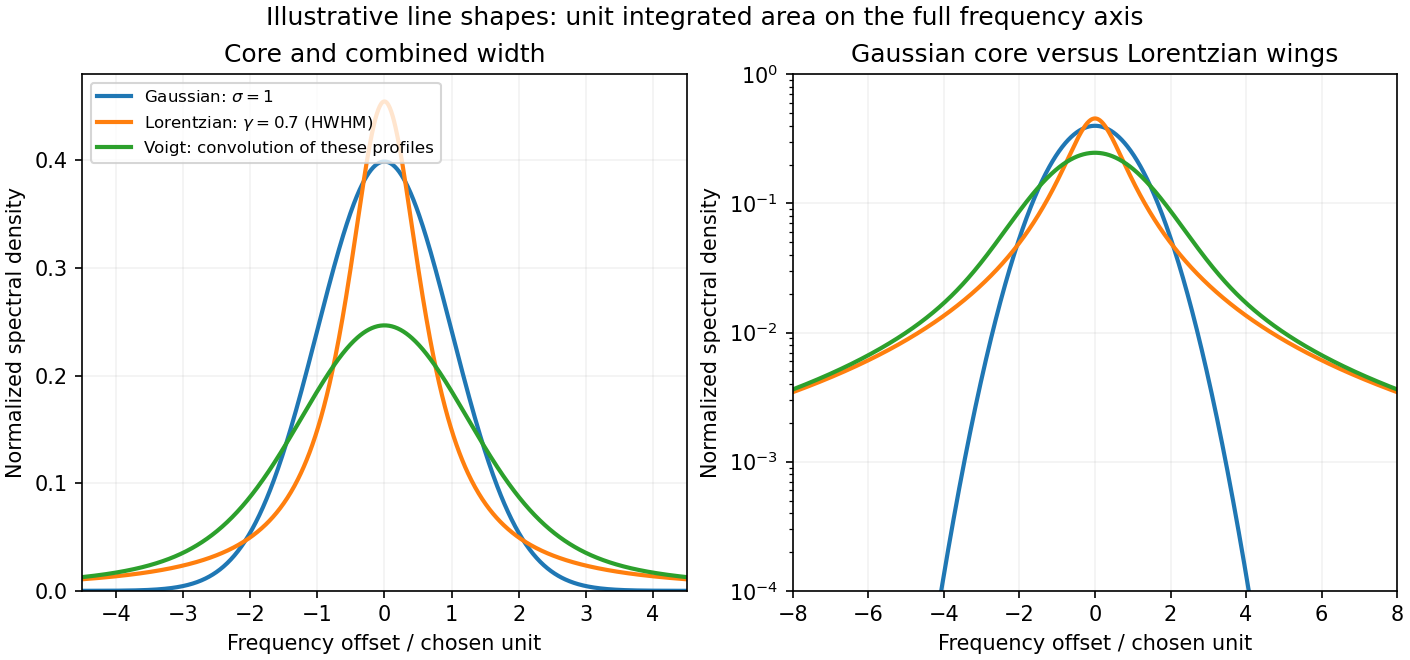
Finite lifetime and dephasing. For an upper-state population lifetime and a stable lower state, the radiating amplitude decays as . Its Fourier spectrum is Lorentzian, with full width at half maximumMore generally, an optical coherence time gives . Both level lifetimes and pure dephasing can contribute to . Distinguishing population lifetime from amplitude coherence time prevents the usual factor-of-two error.
Thermal motion. To first order in velocity, . A Maxwell-Boltzmann velocity distribution therefore produces a Gaussian profile, withThis is inhomogeneous doppler broadening: different velocity classes have different resonance frequencies. A distribution of bulk velocities can add further broadening, while a common bulk velocity shifts the line.
Interactions with the surroundings. Collisions can interrupt the dipole wave phase and perturb the energy levels, producing pressure broadening and shifts. In the impact approximation, approximately exponential wave phase relaxation produces a Lorentzian contribution; its rate increases with perturber density times an appropriate velocity-averaged collision cross section. Slowly varying electric microfields can instead produce non-Lorentzian Stark profiles. Neutral perturbers, charged perturbers and resonance interactions need not produce the same line shape. These mechanisms and the Gaussian thermal limit are distinguished in NIST's atomic-spectroscopy compendium.[ref]
Atomic Spectroscopy - A Compendium of Basic Ideas, Notation, Data, and Formulas by William C. Martin and Wolfgang Wiese. section 20, Spectral Line Shapes, Widths, and Shifts: Doppler and pressure broadening
Finite observation time limits coherence; transit-time broadening also occurs for particles crossing a narrow optical beam. Strong resonant excitation causes power broadening: for an ideal lifetime-limited two-level transition, with population decay rate and saturation parameter . Unresolved fine structure, hyperfine structure, isotope components, or spatially varying Zeeman and Stark shifts may look like a single broadened feature even though several frequencies are present.
The observed spectrum is additionally convolved with the instrument response. A Gaussian Doppler contribution convolved with Lorentzian homogeneous broadening gives a Voigt profile; their full widths do not generally add in quadrature. An informative experiment varies temperature, perturber pressure and excitation intensity separately, calibrates the spectrometer response with a narrower reference, and checks optical thickness or self-absorption. Extrapolation to weak excitation and low pressure helps isolate the lifetime contribution, while a Doppler-free technique is needed if velocity spread still dominates.


Past exam of the optics and electrodynamics course of the University of Cambridge 2015 Paper 1 2 a Solution by Codex 0 2026-10-20
Codex 0 2026-10-20The Faraday effect rotates the plane of linear polarization when light propagates through a material with a magnetic field component along the ray. In the weak-field transparent regime,with a stated propagation and transverse-basis convention; is the Verdet constant. For a uniform longitudinal field and sample length , the magnitude is . A scalar intensity change without a corresponding polarization analysis would not establish this effect.
The microscopic field breaks the equivalence of the two circular polarization modes: the Lorentz force and the Zeeman shifts of optical transitions produce different susceptibilities for their opposite senses of rotation. A linearly polarized wave is an equal-amplitude superposition of these two modes. If their real refractive refractive indices are , their relative wave phase after the sample is . Recombination rotates the line byEqual transmitted circular amplitudes preserve linear polarization. Unequal absorption produces circular dichroism and generally elliptical polarization as well, so pure rotation is an approximation appropriate away from strong absorption.
A modern motivating experiment sends polarized laser light through a glass rod inside a solenoid, then through a rotatable analyzer onto a photodiode. Scan the analyzer first to calibrate its angular response. Driving the solenoid sinusoidally and recording the detector synchronously separates a small rotation signal from unsynchronized noise; the conversion to angle still requires the analyzer slope and the magnetic-field integral through the rod. A first-party William & Mary laboratory manual specifies this apparatus and measurement procedure.[ref]
Physics 251: Experimental Atomic Physics, Fall 2019. Faraday Rotation laboratory chapter, pp. 2–7: solenoid, glass rod, analyzer calibration and synchronized readout
Additional controls are equal-magnitude field reversals, zero-field readings before and after each pair, and a blocked-beam pickup test. The odd-in-field rotation is ; a fixed analyzer offset cancels. Heating, stressed-glass birefringence, source drift and field-dependent transmission need separate checks. A single reading near crossed extinction loses the sign because its leading response is quadratic; an analyzer near gives a linear small-rotation response.
Faraday rotation is nonreciprocal. With the magnetic bias held fixed, retracing the path adds rotation in the same laboratory sense rather than undoing it, unlike reciprocal natural optical activity. This permits an optical isolator with a Faraday rotator between appropriately oriented polarizers. One must compare the returned polarization in a consistently defined laboratory basis; merely reversing the sign of while retaining the old ray-basis convention gives an incorrect cancellation.
Past exam of the optics and electrodynamics course of the University of Cambridge 2015 Paper 1 1 c Solution by Codex 0 2026-10-20
Codex 0 2026-10-20wave phase labels the stage of a physical oscillation at a spacetime event. Two observers comparing the same event must identify the same crest, trough or intermediate stage: a change of coordinates cannot change the number of completed cycles between physically specified wavefronts. The continuous wave phase can therefore be treated as a Lorentz scalar, up to a common choice of wave phase origin. This does not assert invariance of the measured angular frequency, which is the rate of change of that wave phase along the observer's trajectory.
For Lorentz invariance of plane-wave phase, writeusing the metric with signature . The gradient transforms as a covector because is a scalar. Raising its index therefore gives the four-wavevector. Explicitly, substituting the inverse boost , givesThese are exactly the Lorentz transformation laws for . In vacuum, ; the Doppler effect and aberration of light are two consequences of transforming the same four-vector.
There are unlisted articles, also show them or only show them.