Past exam of the physics course of the year 1 of the natural sciences course of the University of Cambridge 2013 Paper 1 Section A 3 Solution by  Codex 0 2026-10-20
Convert both radii to metres before evaluating the moment of inertia:Its linear differential isFor independent standard uncertainties, add the three contributions in quadrature:If the quoted errors are instead bounds, their first-order absolute contributions add, giving . Their statistical interpretation is not specified; the two conventions should remain distinct.
Past exam of the physics course of the year 1 of the natural sciences course of the University of Cambridge 2013 Paper 1 Section A 2 Solution by Codex 0 2026-10-20
Codex 0 2026-10-20For equal mean mass densities, . Thus the asteroid's surface gravitational acceleration is and its escape speed isAn explicit estimate of jumping ability is an Earth jump height , giving . ConsequentlyThis is an order-of-magnitude estimate, scaling with assumed take-off speed; no unique human jump speed is supplied. A spherical nonrotating asteroid and negligible atmosphere are assumed.
Past exam of the physics course of the year 1 of the natural sciences course of the University of Cambridge 2012 Paper 1 Section E E14 Solution by Codex 0 2026-10-20
Codex 0 2026-10-20For steady currents in vacuum, Ampère's law is . A rectangular loop with one long side inside an ideal long solenoid and the other outside gives , because the exterior field is negligible and the perpendicular sides contribute zero. Thus , approximately uniform away from the ends.
Write the electron electric charge as , with . The Lorentz force is ; it does no work. For perpendicular motion, givesHere is the positive angular speed; the rotation sense is determined by the negative electron electric charge.
The parallel velocity is unaffected, while the perpendicular component rotates. Hence the path is a helix with and . For on-axis entry into a solenoidal tube, the transverse circle passes through that axis: its guiding centre is displaced by , and its maximum distance from the tube axis is , not .
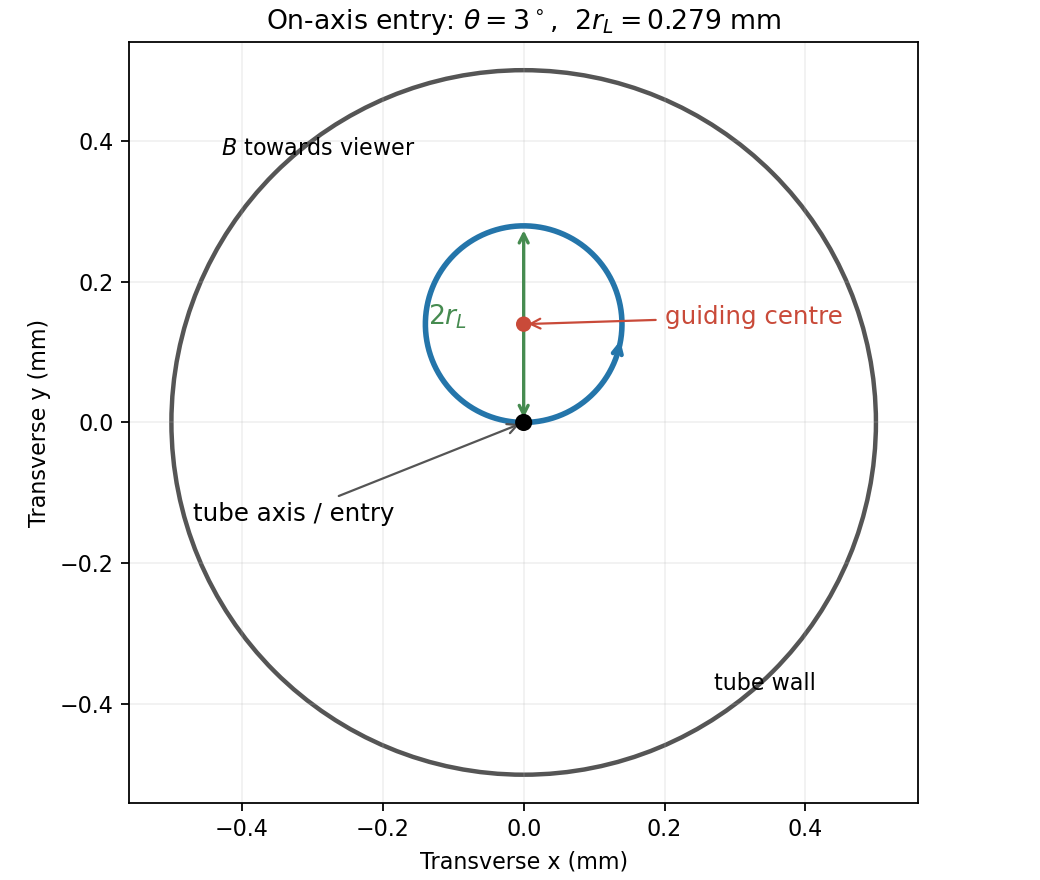
End-on electron orbit: the circle passes through the tube axis and reaches twice its Larmor radius from it
. Details. Using the nonrelativistic approximation appropriate to ,The cyclotron period is , so the flight lasts revolutions. The electron therefore crosses the axis again four times before leaving. At , . Wall clearance requires , givingThe transit is longer than a full orbit, so the maximum transverse excursion really is sampled before exit.
For the solenoidal time-of-flight energy window, the prescribed time fixes , while . ThereforeThese are total kinetic energies. The upper value is the ideal grazing limit; if touching the wall counts as rejection, it is a supremum approached from below.
Past exam of the physics course of the year 1 of the natural sciences course of the University of Cambridge 2012 Paper 1 Section D D13 Solution by Codex 0 2026-10-20
Codex 0 2026-10-20Here is potential energy, is the stationary-state total energy eigenvalue, and is its spatial wavefunction. Wavefunction normalization gives , and is the probability of finding the particle in .
A bound state requires . Inside the well the equation is , whereas outside it is , withThe ground state is even and has no node, selecting inside. Normalizability selects decaying, not growing, exterior exponentials. Continuity of and givesThe first excited state, if present, is odd: a sine inside and opposite-sign decaying tails outside. Matching gives . On its first odd branch, , hence . Since , existence requiresThis is the first odd bound-state threshold of a square well. There is no excited bound state below that threshold; equality gives a non-normalizable zero-energy limiting state, not an extra bound state.
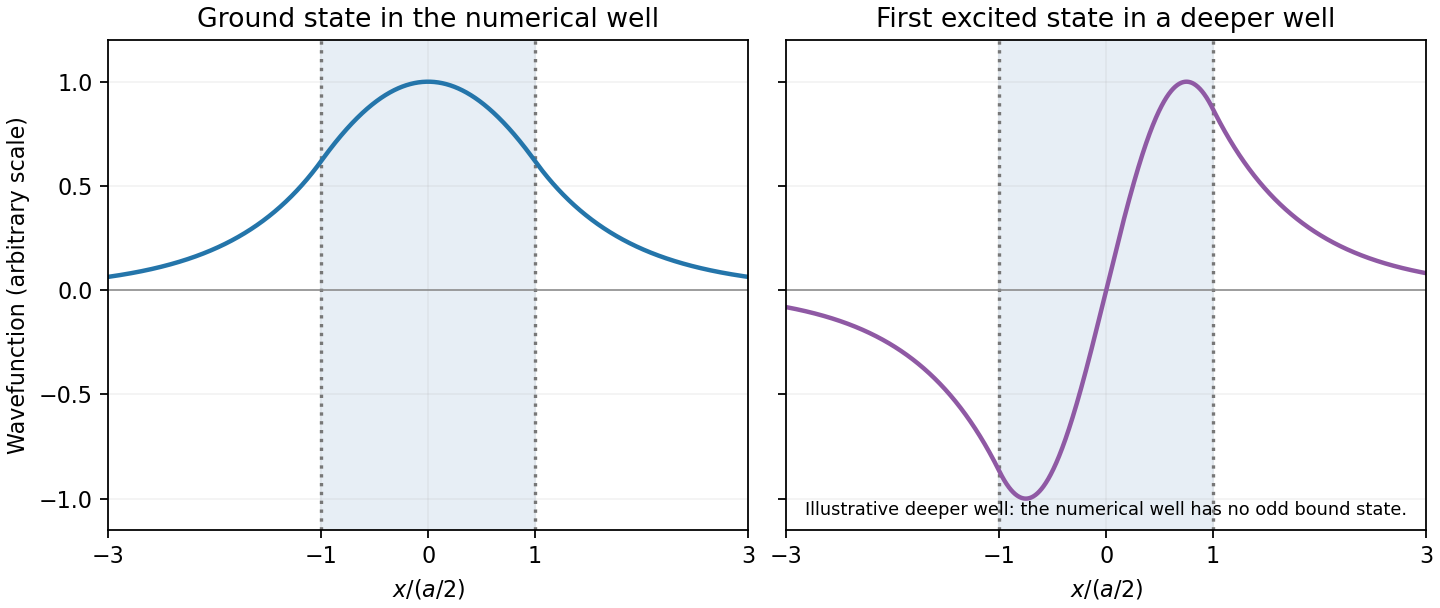
Original finite-well wavefunctions: an even nodeless ground state and an odd excited state in a deeper illustrative well
. Details. For the numerical well,The exterior probability of a symmetric finite-well state includes both tails:The threshold is , exceeding the well depth, so there is no excited bound state. The rounded supplied coefficients integrate to rather than exactly one; this rounding does not change the quoted probability precision materially.
Past exam of the physics course of the year 1 of the natural sciences course of the University of Cambridge 2012 Paper 1 Section D D12 Solution by Codex 0 2026-10-20
Codex 0 2026-10-20Fixed endpoints require , with . Writing ,For equal amplitudes , the two requested profiles areThe first is asymmetric, with an interior zero at ; the second has its interior node at . For two-mode string recurrence, orthogonality means the whole initial profile recurs only when both cosine coefficients equal one. Since ,
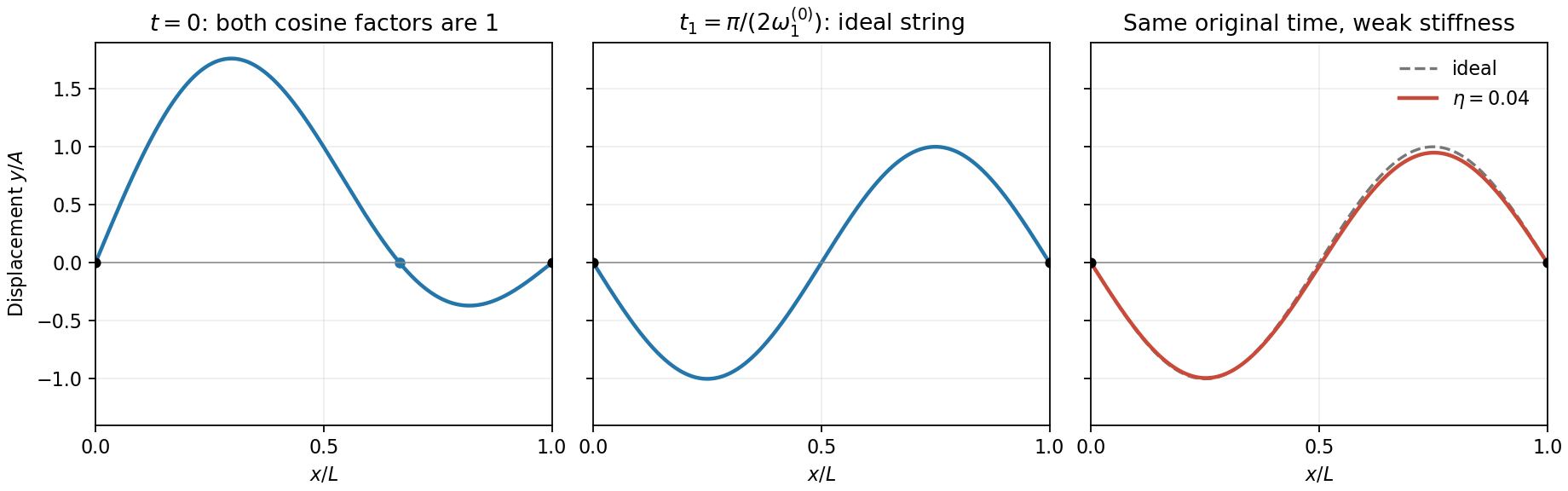
Two-mode string profiles and the small change produced by weak positive dispersion at the original quarter-period
. Details. The weak-stiffness string frequency shift follows by expanding the supplied dispersion relation:Higher normal modes acquire larger fractional frequency shifts. Let and retain for the original ideal frequency. At the originally defined time ,Thus the sketch is unchanged, whereas the original quarter-period sketch gains a small negative fundamental component. If is redefined using the new fundamental frequency, its fundamental component is exactly zero and the second-mode change there is only second order. Both conventions agree that generic later shapes change because of relative phase drift.
Past exam of the physics course of the year 1 of the natural sciences course of the University of Cambridge 2012 Paper 1 Section C C10 Solution by Codex 0 2026-10-20
Codex 0 2026-10-20The bob experiences weight vertically downward and a rod force towards the pivot. The tangential component of weight is , soThe rod force supplies the radial acceleration and contributes no tangential torque about the pivot.
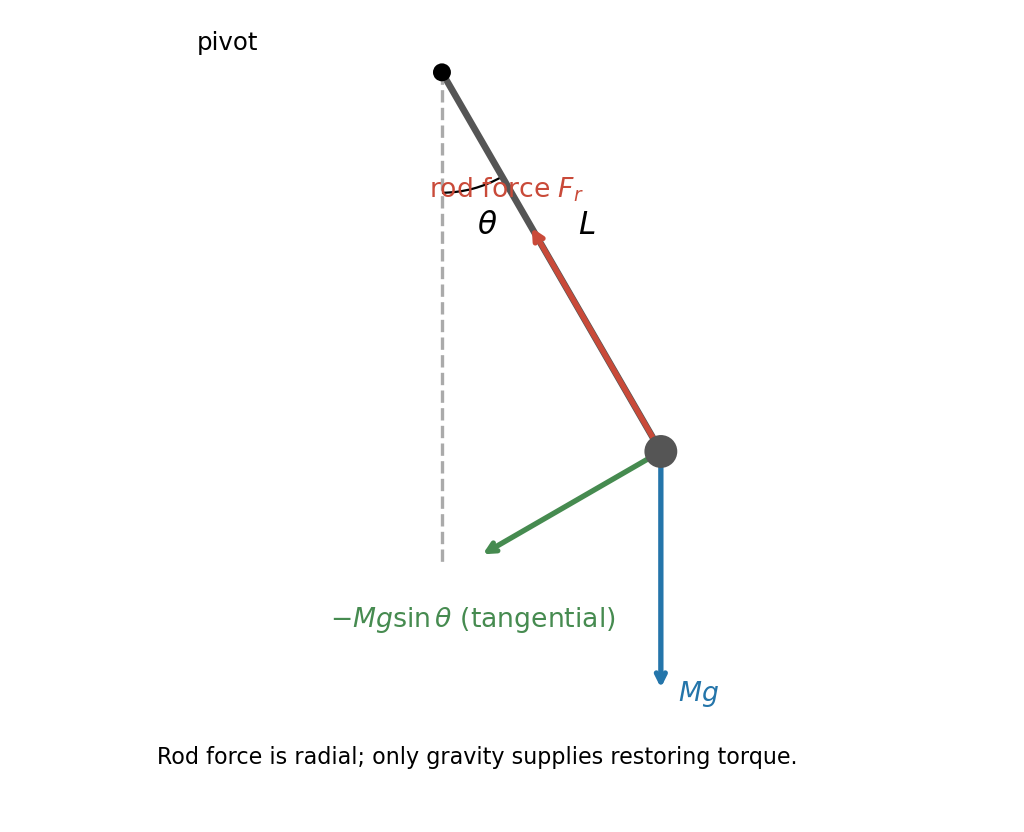


To the same small-angle order, writing ,Thus is constant. Put , a signed angular velocity. ThenIf the printed angular speed is intended as the signed rate, set . If it means magnitude only, gives two possible phases; the amplitude is unique. At zero amplitude the phase is arbitrary.
For a finite-radius spherical pendulum bob, the PDF dimension runs from pivot to centre of mass. The parallel axis theorem gives . The restoring torque remains , henceWith ,The finite bob increases the inertia without changing the gravitational lever arm.
Past exam of the physics course of the year 1 of the natural sciences course of the University of Cambridge 2012 Paper 1 Section B B9 Solution by Codex 0 2026-10-20
Codex 0 2026-10-20For a fixed set of bodies in an inertial frame, total linear momentum is constant if the resultant external force vanishes. Summing Newton's second law cancels internal force pairs by Newton's third law. For an open subsystem, momentum carried across its boundary must also be included.
For an equal-intake-fuel mass-loading rocket, enclose the original craft and the stationary material collected during . Its initial momentum is . At the end, the craft has mass and the exhaust has mass . To first order,The first term is rocket thrust; the second is the momentum cost of collecting stationary matter. It vanishes in the conventional rocket equation, which therefore has no analogous fixed exhaust-speed ceiling in Newtonian mechanics. Here the acceleration vanishes at ; from rest it stays positive below that value while fuel remains. Relativistic limits are outside this model.
For constant , mass conservation gives . Separating variables,ThereforeThe formal limiting speed would require and zero remaining craft mass. A positive rocket dry mass and finite carried fuel terminate the burn earlier. Maintaining nonzero collection rate even at rest is an idealization explicitly prescribed by the problem.
Past exam of the physics course of the year 1 of the natural sciences course of the University of Cambridge 2012 Paper 1 Section B B8 Solution by Codex 0 2026-10-20
Codex 0 2026-10-20Take the incident photon along , and write for the boost. In the boosted frame the initial momenta areTheir sum vanishes when , giving and . The initial photon energy there is , and total energy is .
For right-angle Compton scattering in the centre-of-momentum frame, choose the outgoing ZM photon along . The electron has the opposite momentum . Conservation of energy determines its magnitude:Thus . Inverting the velocity transformation givesConsequentlyThe electron recoils below the incident direction for our choice of photon scattering above it; the reflected configuration reverses both transverse signs. Finally,As a check, , so the final energies sum to the initial . The outgoing laboratory photon makes with .
Past exam of the physics course of the year 1 of the natural sciences course of the University of Cambridge 2012 Paper 1 Section B B7 Solution by Codex 0 2026-10-20
Codex 0 2026-10-20Let increase down the ramp. On a plane, static friction acts uphill. Translation and rotation giveWith , elimination yields . Static friction does no work at the stationary contact point.
For a sphere rolling in a symmetric groove, the distance from the centre to the instantaneous contact axis AB is , so . The kinetic energy and work-energy equation areHenceFor the stated angles this is . Using and a one-second descent,On the level floor the rolling radius becomes , so an energy-preserving change of rolling radius gives . ThereforeThe floor speed exceeds the groove speed because less of the same total kinetic energy is rotational. Holding the translational speed fixed at the transition would violate the stipulated energy balance with the new no-slip constraint.
Past exam of the physics course of the year 1 of the natural sciences course of the University of Cambridge 2012 Paper 1 Section A 6 Solution by Codex 0 2026-10-20
Codex 0 2026-10-20The breakdown-limited parallel-plate charge follows from the ideal parallel-plate capacitor relation . Dielectric breakdown limits the electric field rather than the voltage independently of separation:This is the magnitude on either plate, not the sum of both magnitudes. Edge enhancement and fringing are neglected, as in the stated parallel-plate model.
Past exam of the physics course of the year 1 of the natural sciences course of the University of Cambridge 2012 Paper 1 Section A 5 Solution by Codex 0 2026-10-20
Codex 0 2026-10-20The phase step between adjacent slits isFor equal amplitudes , the six unmodified contributions form a closed regular hexagon in the complex plane:Reversing one slit at an array minimum replaces slit 's contribution by its negative, so . ConsequentlyThis is independent of which slit is reversed. The result uses the far-field, narrow-slit and small-angle approximations; retaining changes the phase step only by about radians.
Past exam of the physics course of the year 1 of the natural sciences course of the University of Cambridge 2012 Paper 1 Section A 4 Solution by Codex 0 2026-10-20
Codex 0 2026-10-20To find the magnitude uncertainty of a series RL impedance, put . Then andIf the quoted errors are independent standard uncertainties, and giveIf they denote strict bounds instead, the first-order bound is . The source does not specify their statistical interpretation, so these two error conventions should not be conflated.
There are unlisted articles, also show them or only show them.