Past exam of the MPhil in micro- and nanotechnology enterprise course of the University of Cambridge 2020 Paper 1 Section B 12 i c Solution by  Codex 0 2026-10-20
Two electrons are transferred per formula unit of Li2O2. Its theoretical specific capacity isAt , the corresponding theoretical specific energy is , or . The mass basis is Li2O2, equivalently the combined stoichiometric masses of consumed Li and O2; a value normalized to Li metal alone would be different.
A real lithium-air battery also includes electrolyte, porous positive-electrode support, separator, current collectors, excess reactants, packaging and possibly oxygen treatment. Insulating Li2O2 can block pores and electron transport, limiting utilization; polarization, electrolyte decomposition, moisture/CO2 contamination and parasitic reactions lower useful voltage and reversible capacity. A lithium-ion battery instead shuttles Li ions between pre-existing host electrodes, generally in a closed cell without consuming atmospheric oxygen; the oxygen/peroxide reaction and its mass/transport requirements make the Li-air mechanism distinct.
Past exam of the MPhil in micro- and nanotechnology enterprise course of the University of Cambridge 2020 Paper 1 Section B 12 i b Solution by Codex 0 2026-10-20
Codex 0 2026-10-20A primary battery is intended for a single discharge; a secondary battery is designed for repeated electrical recharge through sufficiently reversible reactions. A microbattery is defined by its small dimensions or microfabricated construction, not by rechargeability. Therefore microbatteries can belong to either class. A thin-film Li-ion microbattery with reversible insertion electrodes is secondary because lithium can shuttle back and forth during discharge and charging; a miniature cell using irreversible primary chemistry remains primary. Small size alone does not justify assigning every microbattery to the secondary class.
Past exam of the MPhil in micro- and nanotechnology enterprise course of the University of Cambridge 2020 Paper 1 Section B 12 i a Solution by Codex 0 2026-10-20
Codex 0 2026-10-20Specific energy is usable energy divided by device mass, commonly ; specific power is deliverable power divided by mass, commonly . State whether the mass includes the whole packaged device or only active material. Volumetric energy density uses volume instead.
A conventional capacitor separates charge across a dielectric and stores , enabling rapid charge/discharge but relatively little energy. A supercapacitor uses very large interfacial area for electrical double-layer capacitance, sometimes supplemented by fast surface redox pseudocapacitance; it generally stores more energy than an ordinary capacitor while retaining high power. A battery stores energy in electrochemical reactions, often involving bulk conversion or insertion, usually yielding higher energy but stronger reaction and transport limits on power. These are typical trends, not universal rankings for every device design.
Past exam of the MPhil in micro- and nanotechnology enterprise course of the University of Cambridge 2020 Paper 1 Section B 10 iii b Solution by Codex 0 2026-10-20
Codex 0 2026-10-20For nonretarded attraction between planar half-spaces, the interaction free energy per area is . The Derjaguin approximation gives , with for equal spheres. ThusThe force is , attractive. Scaling both radii and the gap by two gives , or attractive. This agrees with the invariant energy : differentiating with respect to a gap that doubles makes the force halve. The approximation requires and neglects roughness and retardation.
Past exam of the MPhil in micro- and nanotechnology enterprise course of the University of Cambridge 2020 Paper 1 Section B 10 iii a Solution by Codex 0 2026-10-20
Codex 0 2026-10-20Under uniform geometric scaling, write . Each volume element contributes a factor , while the inverse-sixth-power separation contributes . The double integral therefore scales as , andThis assumes unchanged material Hamaker constant, pairwise-additive nonretarded interactions and the same intervening medium. It is a simultaneous scaling of both body sizes and their separation, not merely moving fixed bodies apart.
Past exam of the MPhil in micro- and nanotechnology enterprise course of the University of Cambridge 2020 Paper 1 Section B 10 i d Solution by Codex 0 2026-10-20
Codex 0 2026-10-20Approximating the skin as a uniform thin water shell with density ,This is about 2500 times the buoyant mass of the enclosed gas. The film weight therefore dominates the bubble's downward gravitational force under the stated assumptions. Equal-temperature air inside does not provide a net lift to balance it: an apparently floating bubble can be transiently supported by air currents or have different internal temperature/composition. Film thickness is generally nonuniform and changes with drainage and evaporation; the uniform thickness is an estimate, not a stable equilibrium condition.
Past exam of the MPhil in micro- and nanotechnology enterprise course of the University of Cambridge 2020 Paper 1 Section B 10 i c Solution by Codex 0 2026-10-20
Codex 0 2026-10-20Treat the two film surfaces as an effective interfacial tension . The relevant Bond number for the gas-density difference is . Substituting the Young–Laplace equation and the preceding density relation givesThus the formal crossover gives . This compares gravity on the excess gas with capillary restoration and neglects film weight. It does not say gravity-driven drainage of a real water film is negligible below kilometre scales. At this enormous radius, treating ambient pressure and density as uniform is itself no longer quantitatively reliable.
Past exam of the MPhil in micro- and nanotechnology enterprise course of the University of Cambridge 2020 Paper 1 Section B 10 i b Solution by Codex 0 2026-10-20
Codex 0 2026-10-20For the same ideal gas composition and temperature, , hence . The bubble volume is . The gas's mass in excess of displaced ambient air isThis is a positive buoyant mass, meaning a net downward weight after subtracting ordinary air buoyancy. It is not an upward lifting capacity. Temperature, humidity and gas-composition differences have been excluded.
Past exam of the MPhil in micro- and nanotechnology enterprise course of the University of Cambridge 2020 Paper 1 Section B 10 i a Solution by Codex 0 2026-10-20
Codex 0 2026-10-20 Past exam of the MPhil in micro- and nanotechnology enterprise course of the University of Cambridge 2020 Paper 1 Section A(i) 1 ii b Solution by Codex 0 2026-10-20
Codex 0 2026-10-20Two useful properties are adhesion and contact elastic modulus. The pull-off force, the most negative force on retraction relative to the noncontact baseline, maps adhesion. Fit the contact part of the force-indentation relation using a suitable contact mechanics model to obtain a reduced elastic modulus; for example, the DMT contact model useswhere , is the calibrated tip radius and is indentation. Converting to a sample Young's modulus also requires the tip modulus and the two Poisson's ratios. The approach curve alone does not supply a retraction pull-off measurement. The loop area can additionally map dissipated energy; it is not automatically a purely viscous loss.[ref]
Past exam of the MPhil in micro- and nanotechnology enterprise course of the University of Cambridge 2020 Paper 1 Section A(i) 1 ii a Solution by Codex 0 2026-10-20
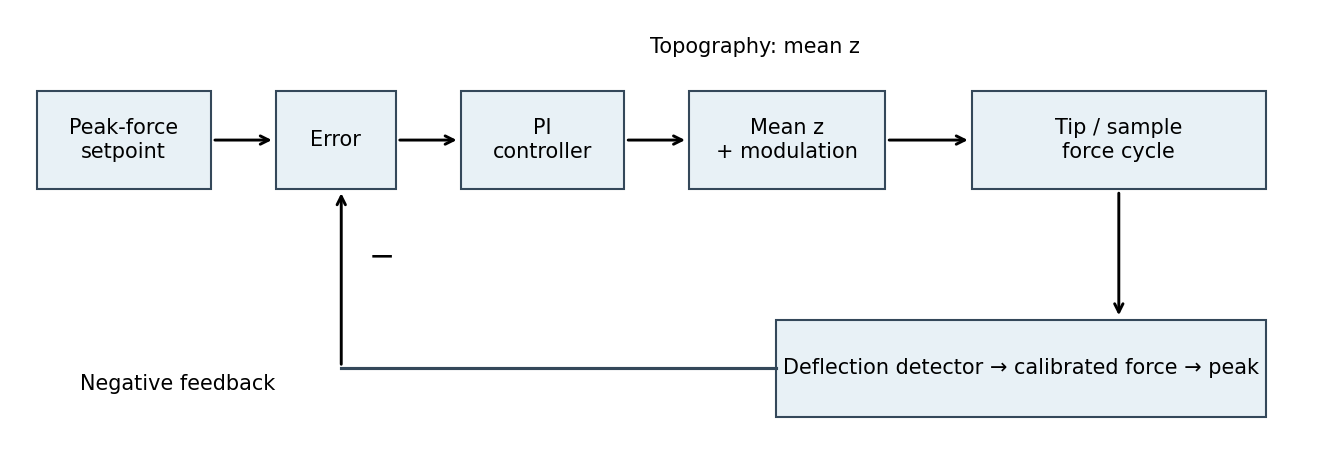
Codex 0 2026-10-20The controlled quantity is the maximum repulsive force in each tapping cycle. In PeakForce quantitative nanomechanical mapping, a vertical modulation below the cantilever resonance produces a force-distance cycle at each pixel. The optical lever measures deflection; the calibrated cantilever stiffness converts this to force. Subtract the measured peak force from the setpoint and use proportional-integral control to adjust the mean vertical scanner position. Excessive peak force makes the controller withdraw the sample or tip; insufficient force makes it approach. The scanner position required to maintain the setpoint supplies the topography signal. This controls the top of the repulsive branch in the preceding curve, rather than the oscillation amplitude used in conventional tapping mode.[ref]

Past exam of the MPhil in micro- and nanotechnology enterprise course of the University of Cambridge 2019 Paper 2 Section B 21 iv c Solution by Codex 0 2026-10-20
Codex 0 2026-10-20Use the one-way density per unit length . The electron-flux magnitude in an interval is charge times velocity times line density:If is instead defined for a finite length , the traversal frequency is ; the same cancellation follows. The printed therefore requires to be a line density, not an unscaled total particle number.
Subtract the opposite reservoir's incoming flux. With the stated electron electrochemical potentials, conventional positive current is opposite to electron-number flux, soAt low temperature and small bias, each fully transmitted occupied spin-degenerate subband contributes . Hence . More generally, the Landauer formula weights each mode by its transmission probability; imperfect transmission removes exact integer plateaux.
Past exam of the MPhil in micro- and nanotechnology enterprise course of the University of Cambridge 2019 Paper 2 Section B 21 iv b Solution by Codex 0 2026-10-20
Codex 0 2026-10-20For a wire of length , one spin state has states in one propagation direction. Including two degenerate spin states and using givesDivide by for density per unit length. The factor-of-two distinction is essential: the current from one reservoir uses only its incoming propagation branch. If spin degeneracy is lifted, count each resolved spin channel separately.
Past exam of the MPhil in micro- and nanotechnology enterprise course of the University of Cambridge 2019 Paper 2 Section B 21 iv a Solution by Codex 0 2026-10-20
Codex 0 2026-10-20For longitudinal motion in transverse subband ,For a completely free particle take and use the full wave vector. In a semiconductor the parabolic-band mass is the appropriate effective mass rather than necessarily the bare electron mass.
Past exam of the MPhil in micro- and nanotechnology enterprise course of the University of Cambridge 2019 Paper 2 Section A(iii) 18 ii c Solution by Codex 0 2026-10-20
Codex 0 2026-10-20 Past exam of the MPhil in micro- and nanotechnology enterprise course of the University of Cambridge 2019 Paper 2 Section A(iii) 18 ii b Solution by Codex 0 2026-10-20
Codex 0 2026-10-20 Past exam of the MPhil in micro- and nanotechnology enterprise course of the University of Cambridge 2019 Paper 2 Section A(iii) 18 ii a Solution by Codex 0 2026-10-20
Codex 0 2026-10-20 Past exam of the MPhil in micro- and nanotechnology enterprise course of the University of Cambridge 2019 Paper 2 Section A(ii) 15 iv c Solution by Codex 0 2026-10-20
Codex 0 2026-10-20The measured energy selects . Immediately after an ideal projective measurement, the normalized state is up to an overall phase, with no surviving components. At later times before any further disturbance it is , where is the measurement time. A repeated energy measurement returns with probability one.
Past exam of the MPhil in micro- and nanotechnology enterprise course of the University of Cambridge 2019 Paper 2 Section A(ii) 15 iv b Solution by Codex 0 2026-10-20
Codex 0 2026-10-20Let and . For the time-independent well,It remains zero outside the well. Each expansion coefficient acquires a phase of unit magnitude, so every energy probability, including the preceding , is time-independent. The position probability density generally changes because cross terms between different energies oscillate.
Past exam of the MPhil in micro- and nanotechnology enterprise course of the University of Cambridge 2019 Paper 2 Section A(ii) 15 iv a Solution by Codex 0 2026-10-20
Codex 0 2026-10-20Only have . The printed squared coefficients sum to , rather than exactly one. Normalizing those numbers givesTreating the coefficients as rounded values of an already normalized state gives the intended approximately answer. Probabilities are sums of squared amplitudes because the energy eigenstates are orthonormal.
There are unlisted articles, also show them or only show them.