Guanosine triphosphate is a nucleotide consisting of guanine, ribose, and three phosphate groups, abbreviated GTP. It is a precursor for RNA synthesis and an energy-coupling substrate in processes such as translation.
GTP-binding proteins also use the difference between GTP- and GDP-bound states as part of molecular switching. Hydrolysis changes the bound nucleotide state; regulatory proteins determine when that switch is activated and reset.
The initial minus final rest energy in a nuclear reaction; positive values represent energy available for outgoing kinetic energy in addition to the incident kinetic energy.
The effective area for a specified nuclear reaction channel at given incident energy. Multiplying incident particle flux, target count and this cross section gives an ideal event rate; target losses and detection efficiency require separate corrections.
Although the pion has spin zero, one-pion exchange depends on nucleon spin and isospin and includes a nuclear tensor force. Shorter-range and multiple-nucleon interactions also matter. The scalar Yukawa potential isolates a range mechanism rather than specifying the complete nuclear force.[ref]
Modern Theory of Nuclear Forces by Evgeny Epelbaum and others. Modern Theory of Nuclear Forces, inspected preprint sections I.B and II.B, especially equation (2.11) and Fig. 12
In 1935, Hideki Yukawa proposed a new massive exchange quantum to explain nucleon binding. His paper began with the inadequacy of an electron–neutrino exchange description of the binding strength. It then required a potential energy falling faster with distance than a Coulomb potential, introduced an exponentially decaying field, and related its inverse range to the exchange particle's rest mass. This was a theoretical proposal, not a detection with an apparatus of his own.[ref]
On the Interaction of Elementary Particles. I by Hideki Yukawa. On the Interaction of Elementary Particles. I, opening motivation, equations (1)–(3) and (12); text inspected in a retypeset mirror
The crucial idea is that a finite rest mass supplies a length scale even in empty space. In a scalar model, the static limit of a Klein-Gordon equation produces the modified Helmholtz equation. Its decaying Green's function gives the Yukawa potential. The derivation below isolates this range mechanism; one-pion exchange also carries spin and isospin structure.
The nuclear emulsion track experiment used developed photographic emulsions exposed to cosmic rays and inspected microscopically. Stopping pions gave daughter muon tracks with closely grouped ranges. Comparing penetrating muons with pion-induced nuclear breakup distinguished their interactions; this was not a direct static force measurement. The muon is a lepton, not Yukawa's strongly interacting meson.[ref]
The Cosmic Radiation by Cecil Frank Powell. The Cosmic Radiation, printed pp. 144–145 and 151–152, especially Fig. 5; inspected in the Columbia-hosted Nobel volume
A nuclear reactor sustains and controls a nuclear chain reaction to produce heat or a useful neutron field. Nuclear fission supplies fresh neutrons; absorption and neutron leakage remove them. A steady neutron population requires a balance between production and losses, the condition of nuclear criticality.
The functions of its components are different. Fuel supplies fissioning atomic nuclei; control rods change neutron absorption; coolant transports heat. In a thermal reactor, a neutron moderator reduces neutron energies before subsequent reactions. Slowing neutrons and cooling the fuel are separate physical functions even when the same material performs both.
Chicago Pile-1 demonstrated a controlled self-sustaining chain reaction in 1942 using a uranium–graphite assembly and neutron-absorbing controls. The decisive observation was the neutron population's response to changing absorption, rather than generation of useful electrical power.[ref]
The first nuclear reactor, explained by University of Chicago. Chicago Pile-1 demonstration on 2 December 1942 and qualitative experimental apparatus
A power reactor adds heat-transfer and conversion equipment; decay heat persists after the chain reaction is stopped.For two spherical fragments with the same proton fraction as the parent, let and . In the semi-empirical mass formula without nuclear pairing, nucleon rest energies, the volume term and the nuclear symmetry energy cancel in the parent-minus-fragment mass difference. The remaining Q value is the displayed competition between increased surface energy and reduced nuclear Coulomb energy. Its symmetric value is positive whenThis is an energy-release condition, not the disappearance of a fission barrier or a prediction of a short mean lifetime.
The increase in a nucleus's collective deformation potential energy between a local minimum and a saddle on a path toward separated fragments. A positive final-state Q value does not remove this intermediate barrier. A nucleus can cross it after sufficient excitation energy, or undergo quantum tunnelling. The relevant barrier for neutron-induced fission belongs to the compound nucleus formed after capture, not automatically to the target before capture.
Nuclear fission without an incoming particle supplying the activation energy. A metastable atomic nucleus can tunnel through a fission barrier along collective deformation coordinates. The rate depends exponentially on a barrier action involving its height, width and collective inertia, so positive liquid-drop fission energy alone does not imply an observable rate.
The yield of fragments as a function of fragment mass number or mass fraction. Low-excitation actinide nuclear fission commonly gives two peaks, corresponding to complementary lighter and heavier fragments. Smooth liquid-drop fission energy by itself does not predict this yield: nuclear-shell structure and the dynamics of the descent toward scission matter. Increasing excitation can weaken shell effects and change the distribution. A two-peaked illustrative curve is therefore not a universal measured spectrum.
In a simple compound-nucleus picture, compare the neutron-capture excitation energy to the fission barrier of the capture product. If its neutron separation energy already exceeds the barrier, slow-neutron capture can lead to prompt fission without a positive kinetic-energy threshold. If it lies below, finite neutron kinetic energy is needed for appreciable over-barrier fission; sub-barrier tunnelling and detailed resonance widths soften a literal sharp-threshold picture.
Material capable of sustaining a nuclear chain reaction with slow neutrons in a suitable configuration. Fissility involves capture and fission probabilities, neutron production and losses, rather than positive fission Q value alone. Uranium-235 and plutonium-239 are common examples; fissile is more specific than fissionable by sufficiently energetic neutrons.
Material convertible into a fissile material by neutron capture followed by nuclear transformations. A central example is uranium-238 capturing a neutron and undergoing two beta-minus decays to plutonium-239. Fertile does not mean that thermal-neutron capture immediately causes fission.
A nuclear chain reaction is a sequence in which particles released by one nuclear reaction induce further nuclear reactions. In a neutron-driven nuclear fission chain, emitted neutrons can cause new nuclear fission, be absorbed without causing nuclear fission, or leave the material.
In a simple generation model, let be the mean number of chain-carrying neutrons in generation , and let be their effective reproduction ratio. Then . For the mean chain dies away; gives a steady mean population; and gives growth in this fixed-coefficient model. Thus a steady chain has reproduction ratio one, while a growing chain is also self-sustaining in the mean. This elementary generation model does not describe every timescale or spatial change.
Whether material is fissile material depends on reaction probabilities, neutron production and losses in a specified setting. A positive nuclear fission Q value establishes that the final products can release energy, but does not by itself establish the neutron balance.
In 1947, Cesare Lattes, Hugh Muirhead, Giuseppe Occhialini and Cecil Frank Powell reported charged particle tracks in which a stopping particle was followed by a secondary particle. Their paper treated the interpretation as provisional.[ref]
Processes Involving Charged Mesons by Cesare Mansueto Giulio Lattes and others. Lattes, Muirhead, Occhialini and Powell, Processes Involving Charged Mesons, Nature 159 (24 May 1947), pp. 694–697, abstract and byline
The eventual distinction between pions and muons made a striking use of photography: a tiny permanent record could distinguish particles by how they slowed and transformed.The method already had a history. In their jointly authored 1937 report, Marietta Blau and Hertha Wambacher described photographic plates exposed for five months at Hafelekar, above sea level.[ref]
Disintegration Processes by Cosmic Rays with the Simultaneous Emission of Several Heavy Particles by Marietta Blau and Hertha Wambacher. Blau and Wambacher, Disintegration Processes by Cosmic Rays with the Simultaneous Emission of Several Heavy Particles, Nature 140 (1937), p. 585, opening paragraph and joint byline
Neither shared the 1950 Nobel Prize in Physics, awarded to Cecil Frank Powell.[ref]Research Profile: Cecil Powell by Luisa Bonolis. Opening award statement: Powell's 1950 prize concerned development of the method and meson discoveries
This was a development of photographic particle detection, with earlier contributors, rather than its invention by one person.In his own later account, Cesare Lattes recalls calibrating emulsion shrinkage and the particle range–energy relation with accelerator-produced particles. Giuseppe Occhialini took borax-treated and untreated plates to Pic du Midi for about a month. The untreated plates provided a control; the treated plates retained more events because latent image fading was reduced. Later, Cesare Lattes exposed plates at the higher Chacaltaya station in Bolivia and obtained more candidate events.[ref]
Meu Trabalho em Física de Mésons com Emulsões Nucleares by Cesare Mansueto Giulio Lattes. Lattes, Meu trabalho em física de mésons com emulsões nucleares, 1984 recollection in Portuguese translation, paragraphs beginning “Foi-me dada a tarefa”, “Occhialini e eu decidimos”, “Quando Occhialini revelou” and “Assim, propus”; the recollection's altitude estimate is not adopted here
The Pic du Midi cosmic ray exposure was roughly above sea level.[ref]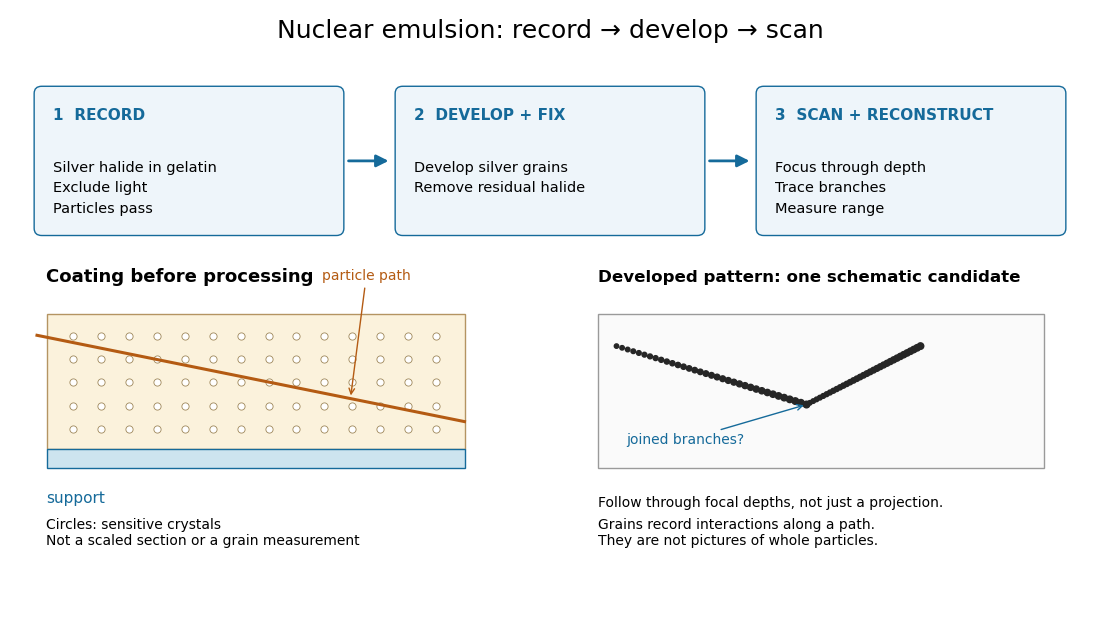

Nomenclature of Carbohydrates (Recommendations 1996) by Alan D. McNaught 2-Carb-6. Anomeric forms; use of α and β by  Codex 0 2026-10-18
Section of Nomenclature of Carbohydrates (Recommendations 1996) by Alan D. McNaught. The printed document was prepared by Alan D. McNaught; G. P. Moss prepared its web version. No separate section byline or section publication or revision date is established.
Official text: iupac.qmul.ac.uk/2carb/06n07.html
Nomenclature of Carbohydrates (Recommendations 1996) by Alan D. McNaught 2-Carb-5. Cyclic forms and their representation by Codex 0 2026-10-18
Codex 0 2026-10-18Section of Nomenclature of Carbohydrates (Recommendations 1996) by Alan D. McNaught. The printed document was prepared by Alan D. McNaught; G. P. Moss prepared its web version. No separate section byline or section publication or revision date is established.
Official text: iupac.qmul.ac.uk/2carb/05.html
Work by Nomenclature Committee of the International Union of Biochemistry by Codex 0 Created 2026-10-18 Updated 2026-11-05
Codex 0 Created 2026-10-18 Updated 2026-11-05 There are unlisted articles, also show them or only show them.