A tunnel diode is a p-n junction with sufficiently heavy semiconductor doping on both sides to make a thin depletion region and permit substantial interband tunnelling. The neutral regions are degenerate semiconductors. Its distinctive forward current-voltage characteristic contains a peak followed by a valley: over part of the curve, increasing the applied electric potential difference decreases the electric current. The Esaki tunnel-diode experiment made this behavior experimentally concrete.
The useful quantity is the local slope, not the ratio of total voltage to total electric current. With conventional electric current entering the positive-voltage terminal, defineNegative differential resistance means , hence where defined. A forward operating point can still have , and absorbed power . A small voltage increase then gives a negative current increment; this does not make the total electric current negative or turn the device into an unlimited source of energy. The external supply sets the operating point and supplies the energy available for an electronic amplifier.
An original idealized construction explains the shape. Put the n-type semiconductor on the left and the p-type semiconductor on the right. Take as the elementary charge and . Increasing forward bias lowers the right-hand electron energy levels relative to the left. Denote the two reservoir electrochemical potentials by , so that . At zero temperature, occupied left-hand conduction band states extend up to ; empty right-hand valence band states start at . For transfer conserving electron energy, the available interval isIt is nonempty only when its upper endpoint exceeds its lower endpoint. Both an occupied initial quantum state and an empty final quantum state must exist at the same energy. The Pauli exclusion principle prevents transfer into an already occupied final quantum state.
For the original diagram, choose arbitrary energy units with , , and , where is in those units. The available interval has widthThus , , , and . Initially forward bias opens a transfer window; further forward bias closes it by moving the right-hand valence band edge below the left-hand conduction band edge. This is a state-counting illustration, not a formula for a measured electric current.
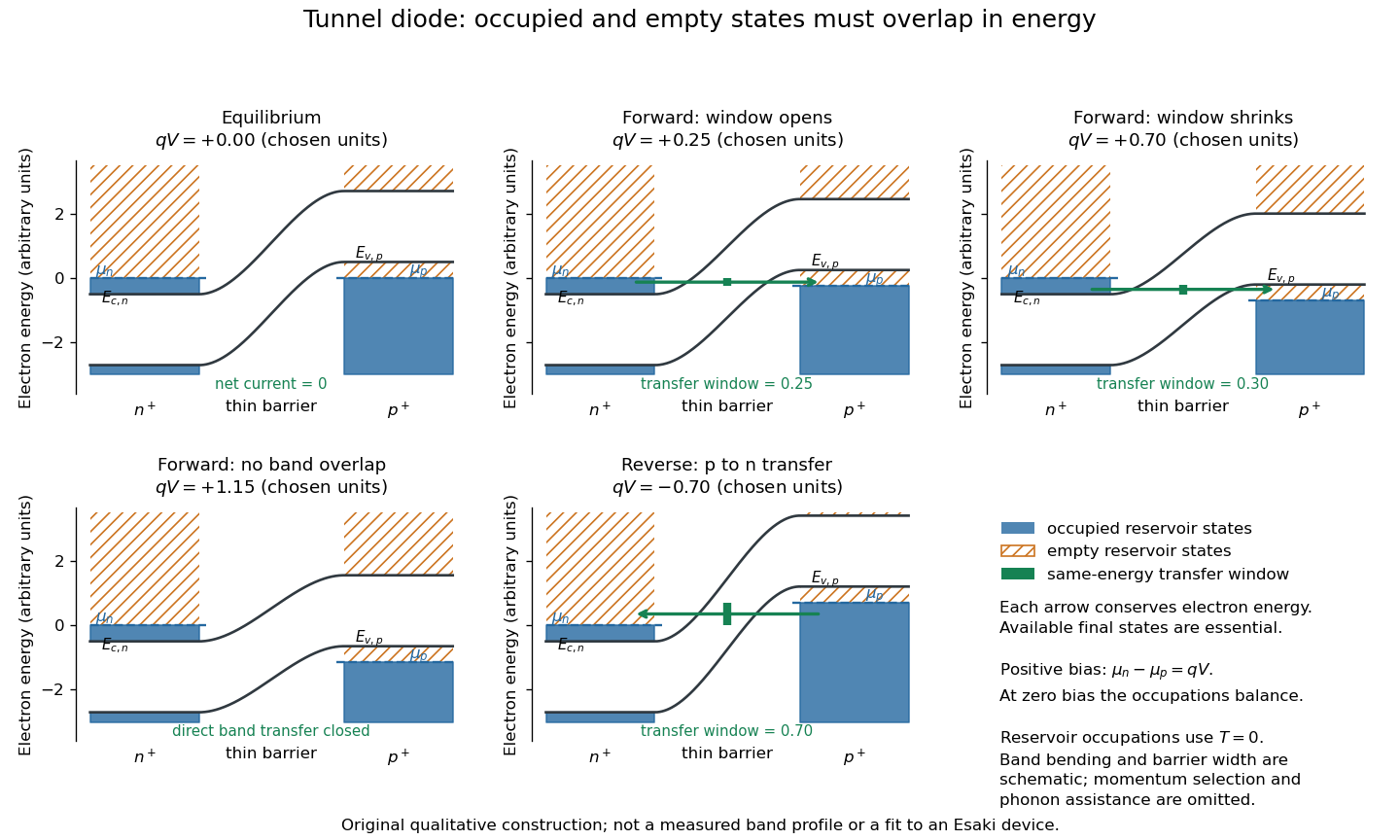
Tunnel diode: energy band alignment and occupied-to-empty state overlap
. Original chosen energy band construction, with n-type semiconductor on the left and p-type semiconductor on the right. Blue shading denotes occupied reservoir states; orange hatching denotes empty reservoir states. Green arrows mark equal-energy transfer. The central barrier and band bending are schematic; all energies are arbitrary, and the drawing is not an experimental image or measured band profile. Source. Details.
For reverse bias, the transfer direction changes: occupied right-hand valence band states can feed empty left-hand conduction band states. In the same construction, opens the interval for this reverse transfer. A narrow depletion region allows a large reverse quantum tunnelling electric current at small electric potential difference, whereas the ordinary Shockley diode equation predicts only a small reverse saturation electric current before diode reverse breakdown. At zero biasing, equal reservoir occupations give zero net electric current; quantum tunnelling does not require a net equilibrium flow.
A finite-temperature refinement replaces sharp occupation cutoffs with the Fermi-Dirac distribution. An illustrative weak-transfer expression isHere describes allowed initial/final quantum states and their coupling, and are Fermi-Dirac distributions with the respective electrochemical potentials. The occupation difference follows by subtracting the reverse transfer factor from the forward one: . An overlap interval alone does not determine : transmission probability, density of states, crystal momentum selection and phonons can matter. A complete germanium calculation is more demanding than multiplying two constant density of states factors. At larger forward bias, ordinary carrier injection and diffusion supply a rising current branch even after direct band overlap is lost.
The built-in potential of a p-n junction is the electrostatic potential difference established when carrier diffusion exposes ionized dopants until the opposing drift and diffusion currents balance. The equilibrium electrochemical potential is constant even though the electric potential and band edges vary. In a nondegenerate homojunction with neutral-edge majority densities , . This is band bending within the same material, not necessarily a discontinuous offset of different materials' band edges.
A linearly graded p-n junction has net ionized doping near the metallurgical junction. In the depletion approximation, . With vanishing external field, neutrality places the depletion edges at and integration of Poisson equation givesThe field points from n to p and has largest magnitude at . The potential is cubic inside the layer.
Section of Organic Chemistry by John McMurry by the whole-book author John McMurry. OpenStax publishes and hosts the book. Whole-book publication: 20 September 2023; no separate section author or revision date is established.
Online text: openstax.org/books/organic-chemistry/pages/27-2-soap
Cited passages: §27.2 opening chemical definition and fat hydrolysis equation; §27.2 paragraphs on ionic carboxylate heads, hydrocarbon tails and grease removal; Publisher citation information.
Section of Organic Chemistry by John McMurry by the whole-book author John McMurry. OpenStax publishes and hosts the book. Whole-book publication: 20 September 2023; no separate section author or revision date is established.
Cited passages: §21.6 Conversion of Esters into Carboxylic Acids: Hydrolysis, paragraphs surrounding Figure 21.8; Publisher citation information: author, book title, publisher and publication date.
Organic Chemistry by John McMurry 25.5 Cyclic Structures of Monosaccharides: Anomers by  Codex 0 2026-10-18
Section of Organic Chemistry by John McMurry. John McMurry is the whole-book author; no separate chapter byline is established. OpenStax publishes and hosts the book. The publication date is 20 September 2023; no separate section revision date is established.
Official text: openstax.org/books/organic-chemistry/pages/25-5-cyclic-structures-of-monosaccharides-anomers
Inspected locators: §25.5, intramolecular hemiacetal formation, anomers and final mutarotation discussion; publisher citation information.
Organic Chemistry by John McMurry 25.1 Classification of Carbohydrates by Codex 0 Created 2026-10-18 Updated 2026-10-31
Codex 0 Created 2026-10-18 Updated 2026-10-31Section of Organic Chemistry by John McMurry. John McMurry is the whole-book author; no separate chapter byline is established. OpenStax publishes and hosts the book. The publication date is 20 September 2023; no separate section revision date is established.
Inspected locators: §25.1, simple and complex carbohydrates; aldose, ketose and carbon-count classification; publisher citation information.
An endosome is a membrane-enclosed sorting compartment in the endocytosis pathway. Cargo may return to the cell membrane or proceed toward lysosomes; entry therefore does not by itself establish a digestive fate.[ref]
A lysosome is an acidic digestive and recycling organelle: one surrounding lipid bilayer encloses a lysosomal lumen containing acid hydrolases. These enzymes break down proteins, nucleic acids, carbohydrates and lipids by hydrolysis. Cargo can originate outside the biological cell, entering through endocytosis, or within its own cytoplasm, delivered through autophagy. Digestion therefore serves both disposal and reuse.[ref]
Lysosomes. The Cell: A Molecular Approach, 2nd edition by Geoffrey M. Cooper; Cooper, The Cell, 2nd edition (2000), Lysosomes: opening paragraph; Lysosomal Acid Hydrolases; Phagocytosis and Autophagy, Figure 9.37
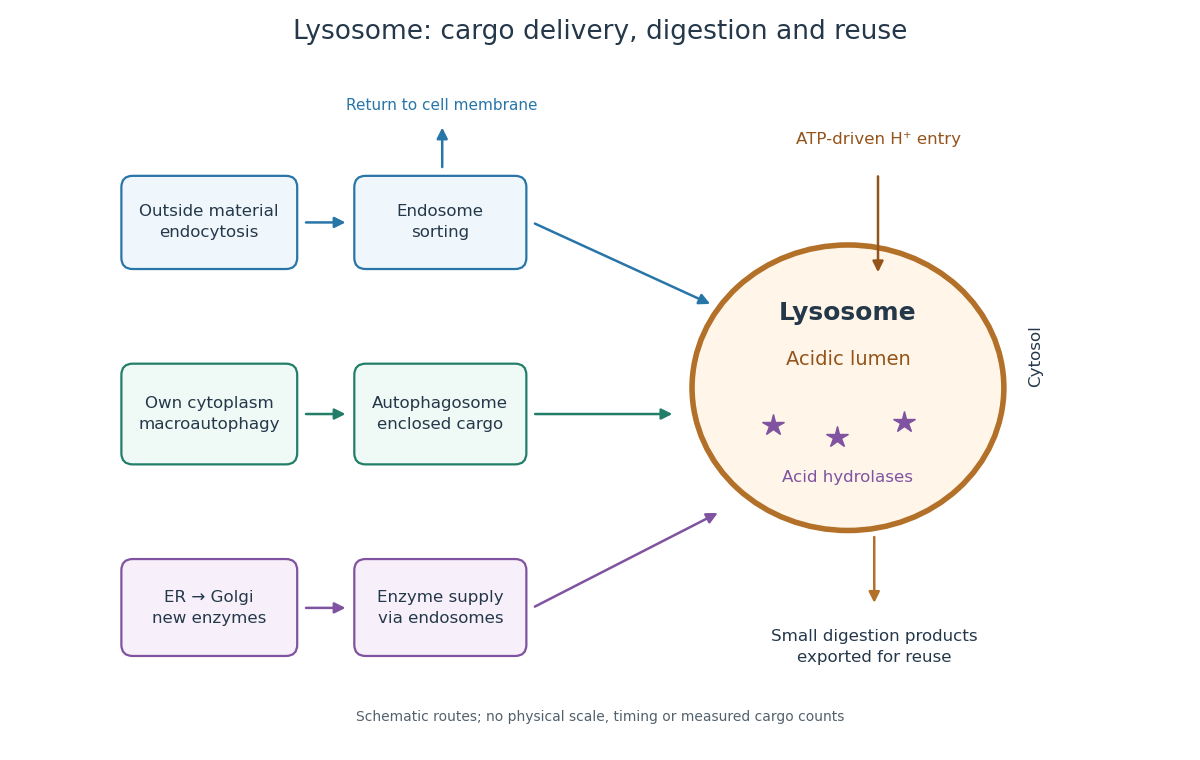

An endosome sorts endocytosed cargo: some returns to the cell membrane, while some proceeds toward lysosomes. An autophagosome instead encloses material already in the cytoplasm. Both routes bring cargo into contact with digestive enzymes; neither implies that every internalized molecule is destroyed.[ref]
Transport from the Trans Golgi Network to Lysosomes. Alberts and others, Molecular Biology of the Cell, 4th edition (2002), Multiple Pathways Deliver Materials to Lysosomes, Figure 13-35
Enzyme supply is a different itinerary from cargo disposal. Secretory protein routing and protein targeting deliver newly made digestive enzymes through the endoplasmic reticulum, Golgi apparatus and trans-Golgi network toward lysosomes.[ref]
The Golgi Apparatus. The Cell: A Molecular Approach, 2nd edition by Geoffrey M. Cooper; Protein Sorting and Export from the Golgi Apparatus, lysosomal enzyme targeting
The existing membrane transport and differential centrifugation articles explain the boundary-crossing and separation principles used below.A proteasome is a different digestive machine: a protein complex without a surrounding lipid bilayer, acting on individual proteins in the cytosol and cell nucleus. Many targets carry ubiquitin chains. A lysosome accepts a much broader range of cargo, including material delivered inside an autophagosome. Thus an unwanted soluble protein and an unwanted mitochondrion pose different disposal problems; a proteasome does not swallow an intact mitochondrion.[ref]
Protein Degradation. The Cell: A Molecular Approach, 2nd edition by Geoffrey M. Cooper; Cooper, The Cell, 2nd edition (2000), The Ubiquitin-Proteasome Pathway, Figure 7.39; Lysosomal Proteolysis, Figure 7.41
A transport vesicle is a membrane-bounded carrier that moves cargo between cellular compartments. Budding and fusion preserve the distinction between lumen-facing and cytosol-facing membrane surfaces.
The Golgi apparatus modifies and sorts cargo arriving from the endoplasmic reticulum for delivery to other cellular destinations. The eponym refers to Camillo Golgi.
Its usual stacked organization is polarized: cargo enters on the cis side, encounters medial processing regions, and leaves through the trans side and trans-Golgi network. Golgi cisternae enclose a Golgi lumen separated from the surrounding cytosol. Processing changes cargo; sorting selects its destination.[ref]
The Golgi Apparatus. The Cell: A Molecular Approach, 2nd edition by Geoffrey M. Cooper; Organization of the Golgi, Figures 9.22–9.23; Protein Sorting and Export from the Golgi Apparatus
This division of labor explains why reaching the Golgi apparatus does not imply being secreted: cargo can take different onward routes, while resident enzymes continue working there. The conventional route discussed here is part of secretory protein routing; many cytosol proteins never enter it.
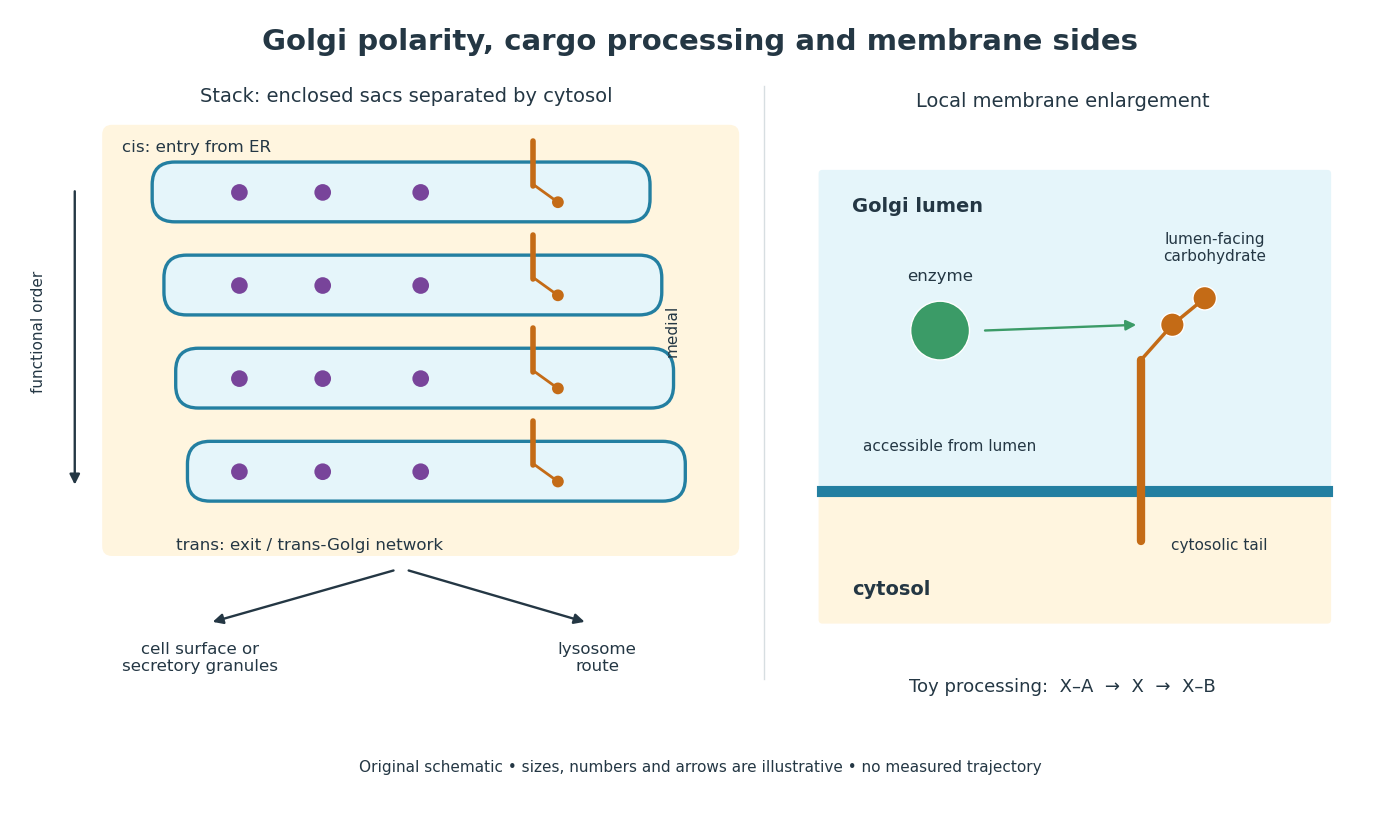
Golgi apparatus polarity, processing and membrane sides
. Original schematic of a stack and a local membrane enlargement. The spaces between Golgi cisternae contain cytosol, while each enclosed sac contains Golgi lumen. Purple cargo is soluble; the orange membrane protein has a lumen-facing carbohydrate chain and a cytosolic tail. Arrows show functional ordering, not a measured trajectory or a universal carrier mechanism. The chain-processing symbols are a constructed example. Details.
There are unlisted articles, also show them or only show them.