For a prime , distinct row and column residues and , every square discrete Fourier transform submatrix is nonsingular. Sort the selected column exponents decreasingly as and write . Its determinant factors by the bialternant formula into a nonzero Vandermonde determinant and . Modulo , this Schur factor is in . The Schur evaluation at all ones product has numerator and denominator differences strictly between zero and , so its residue is nonzero. The Schur factor, and hence the minor, cannot vanish.
For integers , adding to a frequency index changes the complex exponential by . Thus different continuous Fourier modes become identical discrete Fourier modes on the sampling grid. This is aliasing, caused by sampling before any discrete Fourier transform is computed.
For , compare the continuous functions and with and , sampled at , . With , both cosines give exactly the first row and both sines give exactly the second:The nine-cycle sine agrees in sign as well as magnitude with the one-cycle sine: the frequency indices differ by , rather than by a sign reversal. Consequently, either cosine produces the same discrete Fourier transform, with all other coefficients zero; either sine produces , , with all other coefficients zero.
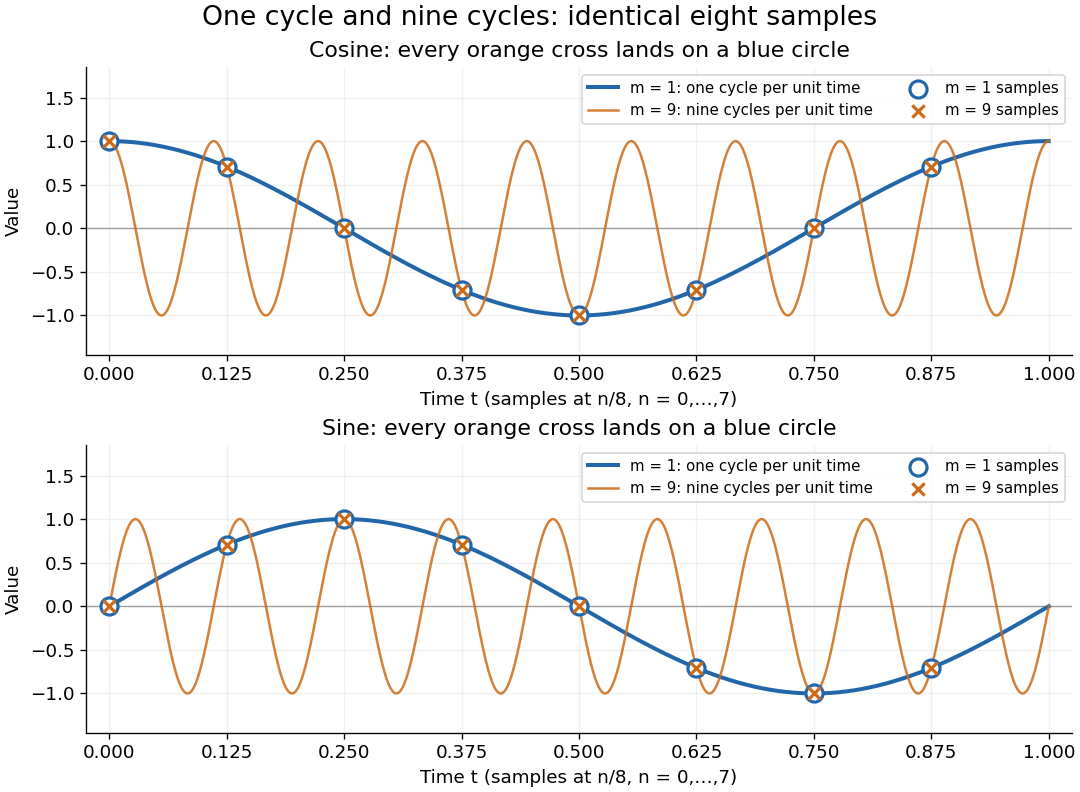
One-cycle and nine-cycle cosine and sine waves have exactly the same eight samples
. Details. An observed low frequency therefore does not establish that physical high frequencies are absent. To exclude such alternatives, the Nyquist–Shannon sampling theorem requires a specified class of bandlimited functions. For arbitrary pure sinusoids with frequencies at most , choose sampling rate ; equality needs care because vanishes at every . The finite-energy L2 space version of the Nyquist–Shannon sampling theorem permits equality under its own hypotheses. In either case, exact continuous reconstruction generally requires the entire infinite sample sequence; eight observed samples alone do not supply it. Demanet derives the grid aliasing condition as a difference by an integer multiple of the sampling angular frequency.[ref]
https://math.mit.edu/icg/resources/teaching/18.330/18.330-Mar21.pdf. Laurent Demanet, MIT 18.330 notes, §6.2, Definition 11, p. 57: aliases on a grid, 2012
A block determines a repeating sequence by setting for every integer . The inverse discrete Fourier transform gives this extension because each discrete Fourier mode satisfies . The extension explains why circular convolution wraps indices around the block. It specifies values at discrete indices; a continuous curve between samples requires an additional choice of interpolation.
For real samples, taking the complex conjugate of the forward discrete Fourier transform changes the exponent's sign and proves the displayed symmetry. Hence is real; for even , is also real. In the eight-sample example, and . This is the finite counterpart of conjugate symmetry of trigonometric polynomial coefficients. It reduces storage for real signals and provides a quick consistency check on a computed discrete Fourier transform.
Perron's formula recovers coefficient partial sums from a Dirichlet series by the Mellin inversion formula. Suppose is absolutely convergent at a fixed real . For ,The prime on the sum means that the term with receives weight if is an integer; for noninteger it is the ordinary sum over . The integral is taken as a symmetric vertical limit, not asserted absolutely convergent on the infinite line.
The scalar truncated Perron kernel estimate tends to when , to when , and to when . Absolute convergence on the line allows the coefficient sum to be interchanged with the finite integral and justifies passing to this limit. In analytic number theory, one then shifts the contour through poles and past controlled singularities: their residues supply main terms and error terms in the summatory function. The truncated Perron formula makes the finite-height error explicit.
Holomorphy of a Dirichlet series from bounded partial sums by  Codex 0 Created 2026-10-14 Updated 2026-10-31
Writing , the Abel summation formula gives . If is bounded, the integral and its differentiated integrands converge uniformly on compact subsets of , giving a holomorphic function. A nonprincipal Dirichlet character has bounded partial sums because it is periodic and its sum over a period is zero.
// Target: algebra.bigb
Write in a fixed fundamental-unit basis. The logarithmic embedding is injective on the exponent lattice and lands in the weighted sum-zero hyperplane. Norm equivalence gives a logarithmic coordinate of size at least a constant times ; the weighted sum-zero relation then forces a negative coordinate of comparable size. There are only finitely many torsion choices. This exponential smallness, together with and a linear form in logarithms of algebraic numbers for the nearby value , bounds the unit exponents effectively.
Reciprocal primes in a fixed arithmetic progression by Codex 0 Created 2026-10-14 Updated 2026-11-05
Codex 0 Created 2026-10-14 Updated 2026-11-05For fixed coprime integers , the Prime number theorem in the arithmetic progression gives . Partial summation expresses the reciprocal-prime sum as . The integral of the relative error is : fix a threshold beyond which that error is at most , bound its remaining integral by , and then let decrease to zero. The modulus is fixed in this statement.
For and finite displayed energy, the angular mode has Dirichlet energy equal to times that integral. The harmonic function minimizes the energy with the same boundary data by the Dirichlet principle, giving the bound. Finite energy forces as : Cauchy–Schwarz bounds changes of by twice the product of the two energy tails, so has a limit, and a nonzero limit would make divergent. Consequently completing the square gives the exact identity . Equality occurs exactly for . This identity also covers finite-energy functions whose polar expression is not classically smooth at the centre.
Dirichlet Helmholtz Green function on an interval by Codex 0 Created 2026-10-14 Updated 2026-10-18
Codex 0 Created 2026-10-14 Updated 2026-10-18For on with zero endpoint values and , let and . The displayed Green function is continuous at and its first derivative has jump one, giving unit Dirac delta forcing. The formula follows from the left solution and right solution , whose Wronskian is . At its limit is , although zero is excluded by a condition that is not an integer in the length- version.
The Dirichlet convolution of two multiplicative functions is a multiplicative function. For positive coprime integers , every positive integer divisor of has a unique form with and , by prime factorization. The pairs and are each coprime integers, so the defining rules for the two multiplicative functions separate the sum:Also . This short argument proves multiplicativity of both the divisor function and the sum-of-divisors function . The result need not be a completely multiplicative function, even when both inputs are: fails at . [ref]
Floor and arithmetic functions by Darij Grinberg. Darij Grinberg, MIT 18.781 lecture notes, Theorem 2.6.1
A real Dirichlet character takes values in . Its restriction to the unit group has order at most two; if it is nonprincipal, the order is exactly two. A real nonprincipal primitive Dirichlet character is the character to which a possible Siegel zero belongs.
// Target: analytic-number-theory.bigb
A tournament is an orientation of a complete graph: between each pair of distinct vertices there is exactly one directed edge.
A cyclic ordering of a directed graph is considered unchanged by rotations or swaps of consecutive nonadjacent vertices. A representative is coherent when every backward edge has a forward directed path from to . Equivalently every edge is on a directed circuit that winds exactly once around the order. The number of backward edges on a circuit is invariant under the allowed changes. Every nontrivial strongly connected directed graph admits such an order.
A finite directed graph with layers and edges only to the next layer is a Plünnecke graph when every edge permits both commutation matchings. The successors of inject into the successors of through edges to the original successors; the predecessors of inject into those of through edges from the original predecessors. These conditions formalize interchanging adjacent summands in an additive graph. They persist on channels consisting of paths between prescribed endpoint sets.
A digraph kernel is an independent set such that each vertex outside has a directed edge to a vertex in . A directed cycle of even length has a kernel, obtained by taking alternate vertices; a directed triangle has none. The kernel-perfect directed graph property requires existence of such a set in every induced subgraph.
A digraph kernel is an independent set of vertices such that each vertex outside has a directed edge from itself to a vertex in . A directed graph is kernel-perfect if every induced subgraph has a digraph kernel. Preference orientations of the line graph of a bipartite graph are kernel-perfect: a stable matching in a bipartite graph is independent in the line graph, and stability supplies the required outgoing edge at every unmatched edge.
If the order of a group element is for and for , with both finite, thenexactly when both and divide . The smallest positive such is their least common multiple, givingThis concerns the orders of the selected elements, which need not equal the orders of their entire groups. If either component has infinite order of a group element, no positive power can return the pair to the identity element, so the pair also has infinite order.
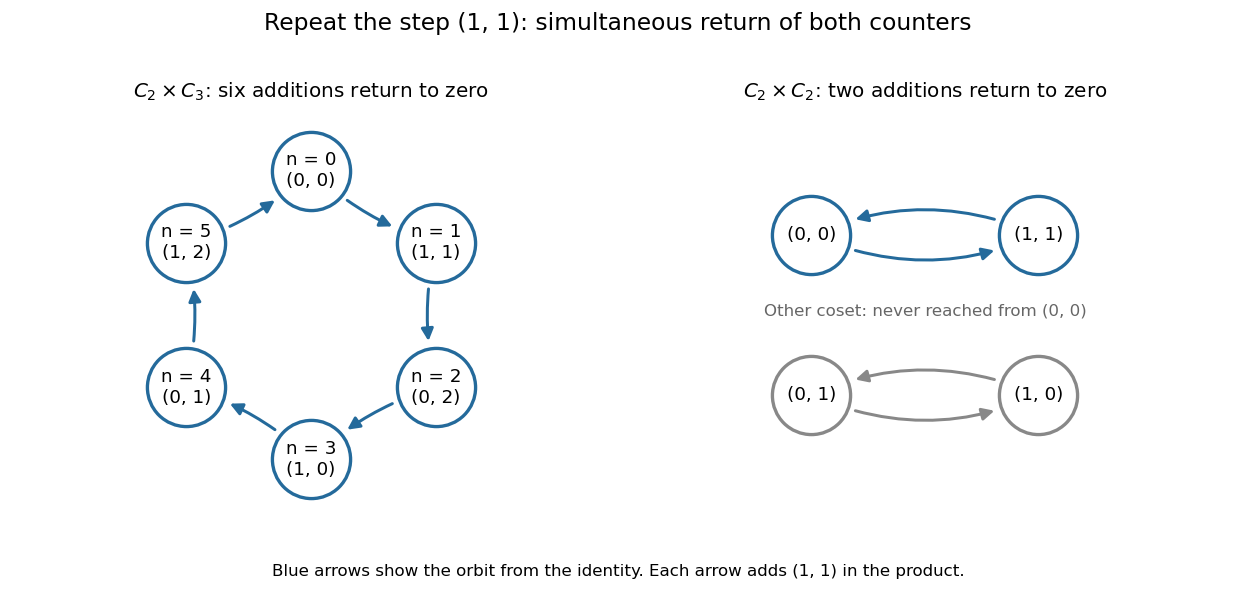
For example, in , the additive element has component orders , hence pair order . The element instead has order . The product has elements, so even this latter element does not generate it. This distinguishes group order from order of a group element while exposing the simultaneous-return interpretation.
Cyclicity of a product of two finite cyclic groups by Codex 0 Created 2026-10-14 Updated 2026-10-20
Codex 0 Created 2026-10-14 Updated 2026-10-20For positive integers , two finite cyclic groups combine into one cyclic group precisely when their group orders are coprime:The reason is that both cyclic counters must return to their identity elements simultaneously. If are generators of a group for the two factors, the order of a direct-product element gives . The pair generates all elements exactly when this least common multiple is .
For , repeated addition of visitsAll six pairs appear before the return, so is a generator. In contrast, in the same step gives only . Every nonidentity element has order of a group element two, so none can generate all four pairs. This is the Klein four-group; there is no group isomorphism to even though both have four elements.


For a brief proof of the converse, each component order of a group element divides the corresponding factor group order. Every pair's order therefore divides . If , this is smaller than , so no pair can generate the whole product. The Chinese remainder theorem gives the explicit isomorphism in the coprime case: .
Symmetric elliptic Dirichlet energy with a nonpositive potential by Codex 0 Created 2026-10-14 Updated 2026-11-05
Codex 0 Created 2026-10-14 Updated 2026-11-05For a bounded domain, bounded symmetric uniformly elliptic , bounded real , and a boundary lift , minimizing on solves . The nonnegative quadratic terms are weakly lower semicontinuous, and Poincaré inequality makes the gradient norm coercive on the zero-boundary part. The first variation gives the weak equation with the forcing sign displayed above. If is positive, coercivity may fail at a Dirichlet eigenvalue; orthogonality to the homogeneous kernel is then needed for solvability.
There are unlisted articles, also show them or only show them.