
Photodetachment removes an electron from an anion using a photon. For chlorine, the reaction is . Measuring the minimum photon energy for the specified final quantum state gives a photodetachment threshold and hence an electron affinity.
An electron attachment enthalpy is the signed molar enthalpy change for a stated attachment reaction,For favourable attachment such as chlorine's first attachment, the electron attachment enthalpy is negative. Its leading isolated-ground-state energy contribution is , where is the Avogadro constant. At finite temperature, consistent thermal populations, translational contributions and the term in enthalpy must also be included, together with the same gaseous-electron reference used in the corresponding ionization energy term. Consequently a measured spectroscopic electron affinity is not automatically an exact attachment enthalpy with a minus sign. A Born-Haber cycle must use compatible enthalpies throughout.
For an aperture normal to , let be its tangential electric field traces extended by zero outside the aperture. With the outgoing branch of , the Weyl plane-wave representation and the curl aperture integral give a spectrum proportional to . Each wave is transverse to . The longitudinal electric component is regenerated by oblique diffraction even when it vanishes at the input. For and a unit prefactor on the stated curl integral, the spectrum has an overall factor ; a doubled half-space Green kernel gives factor one. The normalization must follow the chosen Green kernel and equivalent-current convention.
For dependence , a Helmholtz equation generates transverse-magnetic fields , , , , for . The conducting wall requires a Dirichlet boundary condition on . A transverse-electric representation is , , , , with a Neumann boundary condition. These are families of modes, not a completeness assertion for multiply connected guides and their possible TEM fields.
A retarded potential evaluates each source at the event on the source's past light cone. This accounts for propagation at the speed of light and enforces causality.
A cryogenic radiometer uses low-temperature operation to improve electrical substitution radiometry through particular material and thermal properties. Lower heat capacity of a copper receiver permits a substantial cavity without proportionately slow relaxation; cold shields reduce unwanted thermal radiation, and heater leads with superconductivity can suppress resistive lead heating. These features do not make radiometric absorptance exactly one or abolish optical-electrical heating non-equivalence.[ref]
Spectroradiometric Detector Measurements: Ultraviolet, Visible, and Near-Infrared Detectors for Spectral Power by Thomas C. Larason and others. §5.2, printed pp. 30–32: cryogenic advantages and remaining window/non-equivalence corrections
Cold surroundings matter as much as a cold receiver. In a simplified gray-surface model, net outward thermal radiation is , using emissivity , area , shield temperature and the Stefan-Boltzmann constant . Cold shields reduce the incoming term as well as the receiver's emission; cooling the receiver alone while leaving it exposed to warm surroundings does not remove incoming radiation. An entrance window still provides an optical and thermal path. Vacuum reduces gas-mediated heat transfer, while an intentional radiometer thermal link remains necessary. This model explains specific losses, rather than promising a universal improvement factor or perfect accuracy.
Electrical reactance is the signed imaginary part of electrical impedance , measured in ohms. It describes the part of the terminal electric potential difference in phase quadrature with the electric current in a sinusoidal steady state. In the convention, an ideal inductor has and an ideal capacitor has for . A large reduces electric current at fixed applied voltage, but an ideal purely reactive component returns the energy it receives over each cycle. This is why electrical reactance and electrical resistance have the same units yet describe different physical behavior. [ref]
https://www.feynmanlectures.caltech.edu/II_22.html#Ch22-S5. Feynman, Leighton and Sands, The Feynman Lectures on Physics, II.22.5: resistance, reactance and energy loss
.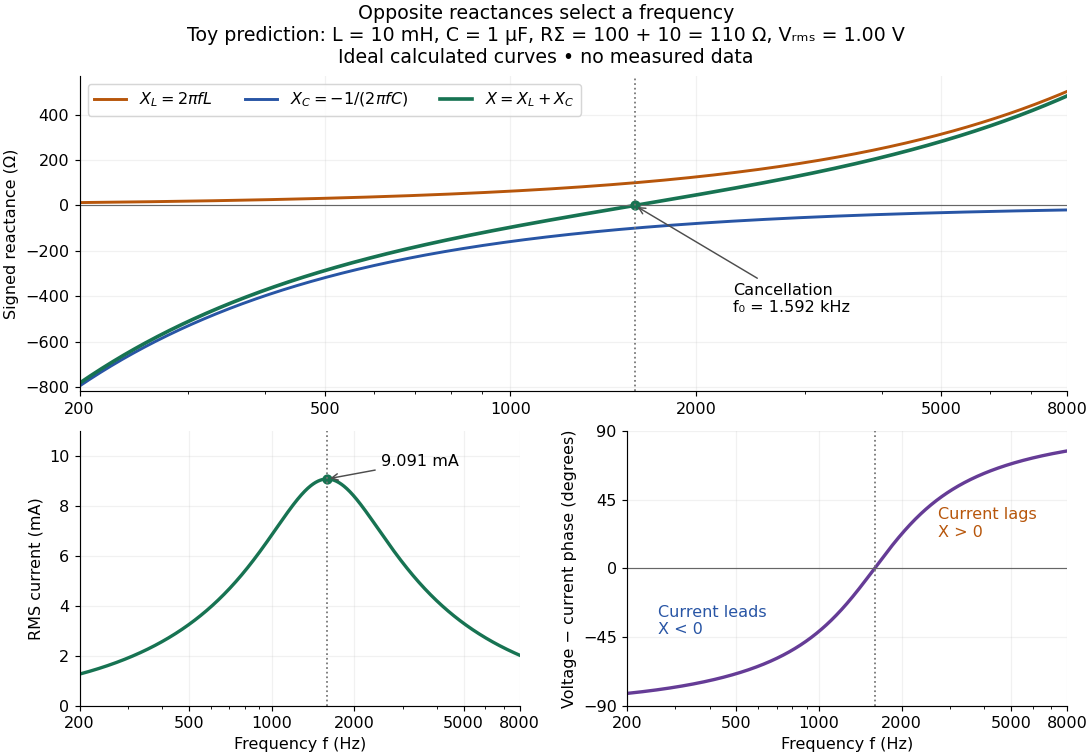

In a series RLC circuit, electrical impedances add because the same electric current passes through every component. For ideal positive inductance , capacitance , and total electrical resistance ,Here is voltage wave phase minus current wave phase. Below , and electric current leads terminal voltage; above it, and electric current lags. At , the two signed electrical reactances cancel, leaving and the maximum electric current at fixed terminal voltage. This is the resonant series RLC response. Electrical resistance does not cancel: the toy circuit gives and there. These numbers follow directly from the stipulated component values. [ref]
University Physics Volume 2 by Samuel J. Ling and others. Ling, Moebs and Sanny, University Physics 2, §15.3: series impedance and resonance
.Cancellation concerns terminal voltage, not the disappearance of stored energy. In the toy circuit at resonance, the individual inductor and capacitor voltages are each in root mean square magnitude, with opposite wave phases, while their sum is zero. Their peak stored magnetic energy and capacitor energy are each , attained at different times. With smaller positive , either component voltage can exceed the applied voltage. This ability to select a frequency while sustaining internal energy exchange connects electrical reactance to tuning and frequency response.
For an ideal inductor or capacitor, the absorbed instantaneous power equals the rate of change of stored energy:Positive power stores energy; negative power returns it. Over a periodic steady state, each stored energy returns to its initial value, so its cycle-averaged absorbed power is zero. An ideal resistor instead has , transferring energy into Joule heating. More generally, the average terminal power of this series RLC circuit isZero average power in an ideal reactive component does not imply zero instantaneous power, zero electric current, or zero stored energy. Real coils and capacitors have losses, so zero ideal reactive loss is a model assumption rather than a claim about every component. [ref]
University Physics Volume 2 by Samuel J. Ling and others. Ling, Moebs and Sanny, University Physics 2, §15.4: instantaneous and average AC power
.For two electrostatic potentials satisfying the Poisson equation , Green's second identity yields the displayed reciprocity formula. The product rule for divergence applied to cancels the cross-gradient terms. The normal points outward from the integration region; for an exterior region this means inward toward the excluded object on its inner boundary. Boundary terms may be removed only under suitable decay or boundary conditions.
A particle constrained to a surface can have a stable minimum of electrostatic potential restricted to that surface even when the unrestricted equilibrium is unstable. Away from source charges, Laplace's equation makes the full potential Hessian matrix trace zero, which rules out a positive-definite three-dimensional Hessian but does not rule out a positive-definite restriction to two dimensions. Equal positive charges at the corners of a square give a planar minimum at its centre and an unstable perpendicular direction.
An electrical reference potential fixes the arbitrary additive constant of an electric potential. Assigning zero to ground makes other potentials differences from that baseline; it does not assert that the electric field vanishes there. If a source calculation gives and relative to infinity, choosing as the zero instead gives and , with the same electric potential difference. Grounding an electrical conductor additionally connects it to a reservoir that can exchange electric charge to maintain the prescribed electric potential; that physical boundary condition differs from merely relabeling an unchanged solution.[ref]; [ref]
https://www.feynmanlectures.caltech.edu/II_06.html#Ch6-S8. Feynman lectures II.6, §6–8: a grounded conducting plane
.Conductive-paper electric potential mapping uses a resistive sheet as a two-dimensional analog of an electrostatic boundary-value problem. Painted or taped conducting electrodes impose selected electric potentials. One voltmeter contact stays at a reference electrode while a movable contact locates points at the same electric potential; joining those points gives an equipotential map.
The analogy follows from steady electric charge conservation and local Ohm's law. In a source-free sheet of uniform isotropic electrical conductivity ,The measured potential therefore satisfies Laplace's equation. In-plane electric field components follow from ; more closely spaced equal-potential contours indicate a larger local field magnitude. Nonuniform conductivity, electrode contacts and voltmeter loading can alter the inferred solution. The apparatus models a two-dimensional geometry, not every finite three-dimensional electrode arrangement. [ref]
A voltmeter measures an electric potential difference between two contacts; its finite input electrical resistance can cause voltmeter loading.
The trace-free electric quadrupole moment is a symmetric tensor measuring the second-order term in an electric multipole expansion. For a localized charge distribution its contribution to the far-field electrostatic potential is , with summation over indices. The moment may be nonzero even when the total electric charge or electric dipole moment is nonzero; it should not be confused with an electric quadrupole whose lower moments vanish. Changing the origin generally changes the tensor when lower moments are nonzero.
For an ohmic element, electrical resistance is and conductance is its reciprocal . They describe the same voltage-current response using reciprocal units. The relation is Ohm's law.
The ampere is the SI unit of electric current. Since 20 May 2019 its definition fixes the elementary charge exactly at , with . This gives electrical measurements a reference based on a fixed elementary charge. [ref]
https://www.nist.gov/si-redefinition/ampere-introduction. NIST, Ampere: introduction to the 2019 definition
; [ref].Conventional current uses the direction in which positive electric charge flows. A moving negative electric charge contributes electric current in the opposite direction to its velocity. Thus electrons drifting left produce conventional current to the right; the convention describes signed electric charge transport, without requiring positive charge carriers. [ref]
https://openstax.org/books/university-physics-volume-2/pages/9-1-electrical-current. Ling, Sanny and Moebs, §9.1: conventional current direction
.A galvanometer detects electric current through a mechanical response, such as the deflection of a pointer.[ref]
10.4 Electrical Measuring Instruments. Analog and Digital Meters: current-driven pointer response
A sensitive galvanometer makes a small electric current visible; a calibrated deflection also estimates its magnitude. A center-zero scale distinguishes both signs of electric current. The moving-coil galvanometer rotates a coil in an imposed magnetic field, whereas a moving-magnet galvanometer rotates a magnetic needle in the coil's magnetic field. The spring-balanced model below describes the moving-coil galvanometer, not every instrument called a galvanometer.
An ammeter measures electric current through a branch of an electrical circuit. Connect it in series; its own finite electrical resistance changes the measured branch's electric current unless that effect is negligible or corrected.[ref]
10.4 Electrical Measuring Instruments. Measuring Current with an Ammeter, Figure 10.35 and following paragraph: connection and loading
For real frequency and both vertical wavenumbers , , let , , , and . With traction and particle velocity , each directional P wave/SV-wave field obeys . Direct displacement-potential substitution yields . The Hermitian part of is positive diagonal; thus forward/backward fluxes have opposite signs and mixed directional flux cross terms cancel.
There are unlisted articles, also show them or only show them.