
A researcher whose joint work examined how pulling speed affects antibody recognition. At high loading rates, additional extension peaks signaled partial unfolding, showing that the probe’s mechanical history can change the interaction being measured.[ref]
Antibody-Unfolding and Metastable-State Binding in Force Spectroscopy and Recognition Imaging by Parminder Kaur and others. Force-spectroscopy results: extension peaks and probe history
Coauthored an antibody study using atomic force microscopy to investigate pulling-induced partial unfolding. Reversible probe-history effects supported a metastable antibody state affecting recognition imaging and comparisons with surface plasmon resonance. [ref]
Antibody-Unfolding and Metastable-State Binding in Force Spectroscopy and Recognition Imaging by Parminder Kaur and others. Page 243: printed Qiang-Fu byline and abstract; page 249: Conclusions.
A biophysics researcher whose team found that rapid pulling can partly unfold an antibody. This changes the measured binding behavior, so single-molecule force spectroscopy can probe a mechanically altered molecule rather than its undisturbed state.[ref]
Antibody-Unfolding and Metastable-State Binding in Force Spectroscopy and Recognition Imaging by Parminder Kaur and others. Abstract and force-spectroscopy results: loading-rate-dependent unfolding
A researcher in magnetic measurement whose account of demagnetizing factors distinguishes the field applied to a specimen from the field produced by the specimen’s own magnetization. For a cylinder, that internal field is generally nonuniform, so an instrument sampling the central region and one averaging the entire specimen need not require the same correction. This explains why specimen shape and measurement geometry matter when inferring a material’s magnetic susceptibility.[ref]
Demagnetizing Factors. Printed p. 104, §2: fluxmetric and magnetometric definitions, cylindrical nonuniformity and susceptibility dependence
An astronomical researcher whose work with Beverley J. Wills tested whether a double quasar represented two sources or two lensed images. The similar absorption-line redshifts and line widths supplied evidence for a shared distant source. The analysis also examined differences in brightness and reddening rather than assuming that lensed images must look identical.[ref]
Spectrophotometry of the Double QSO, 0957 + 561 by Beverley J. Wills and D. Wills. Abstract: absorption-line similarities, differential reddening and flux ratios
An astronomer whose joint spectrophotometry of the Twin Quasar compared the spectra along its two apparent light paths. Closely matching absorption-line properties supported gravitational lensing: two visible images can correspond to one distant quasar viewed along paths bent by intervening matter.[ref]
Spectrophotometry of the Double QSO, 0957 + 561 by Beverley J. Wills and D. Wills. Abstract and pp. 1–3: matching absorption spectra and lens interpretation
An astrophysicist whose work develops gravitational lensing as a probe of matter in the Universe. His review derives lensing relations from geodesic deviation and applies them to objects from stars to large-scale structure. Because gravity deflects light regardless of whether the lens emits light, the method can constrain otherwise unseen mass. The point-mass gravitational lens provides a concrete starting example, producing multiple images and a critical alignment that becomes an Einstein ring.[ref]
Gravitational Lensing by Matthias Bartelmann. Abstract and §2.2, Eqs. (100)–(110): point lens, image positions, critical circle and magnification
An astrophysicist whose work connects models of gravity with astronomical observations. His lectures with Matthias Bartelmann develop gravitational lensing from the deflection of individual light rays to images made by galaxies and galaxy clusters. A useful example is the thin gravitational lens equation: an observed image position combines the deflection angle with the geometry between observer, lens and source. This turns a distorted image into information about the intervening mass distribution.[ref]
Lectures on Gravitational Lensing by Ramesh Narayan and Matthias Bartelmann. §2.1.3, Eqs. (13)–(15): lens equation and angular-diameter distances

Portrait of Ramesh Narayan
. Source. A researcher whose joint study of collapsing soap films in the form of a catenoid compared experiments with sequences of idealized shapes. The analysis predicts a cone angle before final pinching, showing how a tractable geometric construction can explain an observable feature of a more complicated fluid motion.[ref]
Geometry of catenoidal soap film collapse induced by boundary deformation by Raymond E. Goldstein and others. Abstract and geometrical-model analysis: shape sequence toward the Goldschmidt configuration and cone angle
An experimental researcher whose team investigated how soap films collapse when their supporting boundaries are moved. Their measurements compared films of different viscosities and found a common cone angle near pinching. The result identifies a reproducible geometric feature within a rapidly changing fluid structure.[ref]
Geometry of catenoidal soap film collapse induced by boundary deformation by Raymond E. Goldstein and others. Abstract and §II: film preparation, contour observations and viscosity-independent cone geometry
A researcher whose joint work on soap film collapse connects linear stability analysis with visible changes of shape. The team analyzed the loss of stability of a catenoid and the evolving modes that follow boundary deformation. This provides a link between an equilibrium minimal surface and its subsequent collapse dynamics.[ref]
Geometry of catenoidal soap film collapse induced by boundary deformation by Raymond E. Goldstein and others. Abstract: linear and weakly nonlinear analysis near the saddle-node instability
A researcher in physical and mathematical modeling whose team studied the collapse of soap films in the form of a catenoid. Moving the supporting boundaries destabilizes the film; the resulting shape develops conical regions before pinching. Comparing experiments with geometric and fluid-dynamical models reveals which features are controlled by geometry rather than liquid viscosity.[ref]
Geometry of catenoidal soap film collapse induced by boundary deformation by Raymond E. Goldstein and others. Abstract and §II: boundary deformation, transient cones, viscosity comparison and physical models
An optical scientist whose work included interferometry, optical testing and ophthalmic instrumentation.[ref]
Professional profile of John E. Greivenkamp at the University of Arizona. Research Interests: interferometry, optical testing and ophthalmic instrumentation
His teaching in radiometry carefully distinguishes radiance from total transmitted power. Across a refracting interface, the invariant quantity in an ideal system is radiance divided by the square of refractive index; accounting for this prevents brightness calculations from confusing a change in the angular spread of rays with a gain of optical power.[ref]Radiative Transfer lecture notes by John E. Greivenkamp. Slides 22-18–22-20: camera equation and invariant basic radiance

Portrait of John E. Greivenkamp
. Source. An optical scientist whose teaching connects etendue with the practical limits of illumination design. Etendue combines the area occupied by a beam with its spread in propagation directions, weighted by refractive index. Its conservation in an ideal optical system constrains how much light a lens or reflector can concentrate. This provides a useful feasibility check before attempting a detailed optical design.[ref]
Étendue (Photon Snacks) by R. John Koshel. pp. 1–3, Eq. (1.1) and Fig. 1: definition, lossless-system restrictions and phase-space interpretation
A physicist whose photonics teaching relates the propagation of electromagnetic waves to the response of an optical material. His treatment of birefringence derives the direction-dependent refractive index of an extraordinary wave and distinguishes the direction of its wavefront propagation from that of its energy flow. This explains optical walk-off: in an anisotropic crystal, a beam’s energy can travel obliquely to its wave vector. Such distinctions matter when aligning and designing crystal-based optical devices.[ref]
Immanuel Bloch coauthored the observation of repeated collapse and revival in a Bose-Einstein condensate. Cold collisions and the quantization of atom number change the phases contributing to a macroscopic matter wave. Measuring the evolving interference pattern showed coherence disappear and return. The experiment connects collective wave behavior with interactions between discrete atoms, providing a direct test of many-body quantum dynamics.[ref]
Collapse and revival of the matter wave field of a Bose-Einstein condensate by Markus Greiner and others. 2002 report, abstract and collapse/revival measurements

Portrait of Immanuel Bloch
. T. Naeser. External portrait hosted by Max Planck Institute of Quantum Optics / Quantum Optics Group. Source.Theodor W. Hänsch developed high-resolution laser spectroscopy, including Doppler-free two-photon measurements of hydrogen. Absorbing one photon from each of two counterpropagating beams can cancel the first-order Doppler shift.
The resulting narrow resonance exposes atomic structure that is hidden inside an ordinary thermally broadened line. Comparing precise transition frequencies with theory tests atomic energy levels and their small corrections. His Nobel lecture also explains how optical frequency combs connect these optical measurements to an accurately countable frequency reference.[ref]
Doppler-Free Two-Photon Spectroscopy of Hydrogen by Theodor W. Hänsch and others. 1975 two-photon experiment
[ref]Passion for Precision by Theodor W. Hänsch. Nobel lecture: precision spectroscopy and frequency-comb measurement
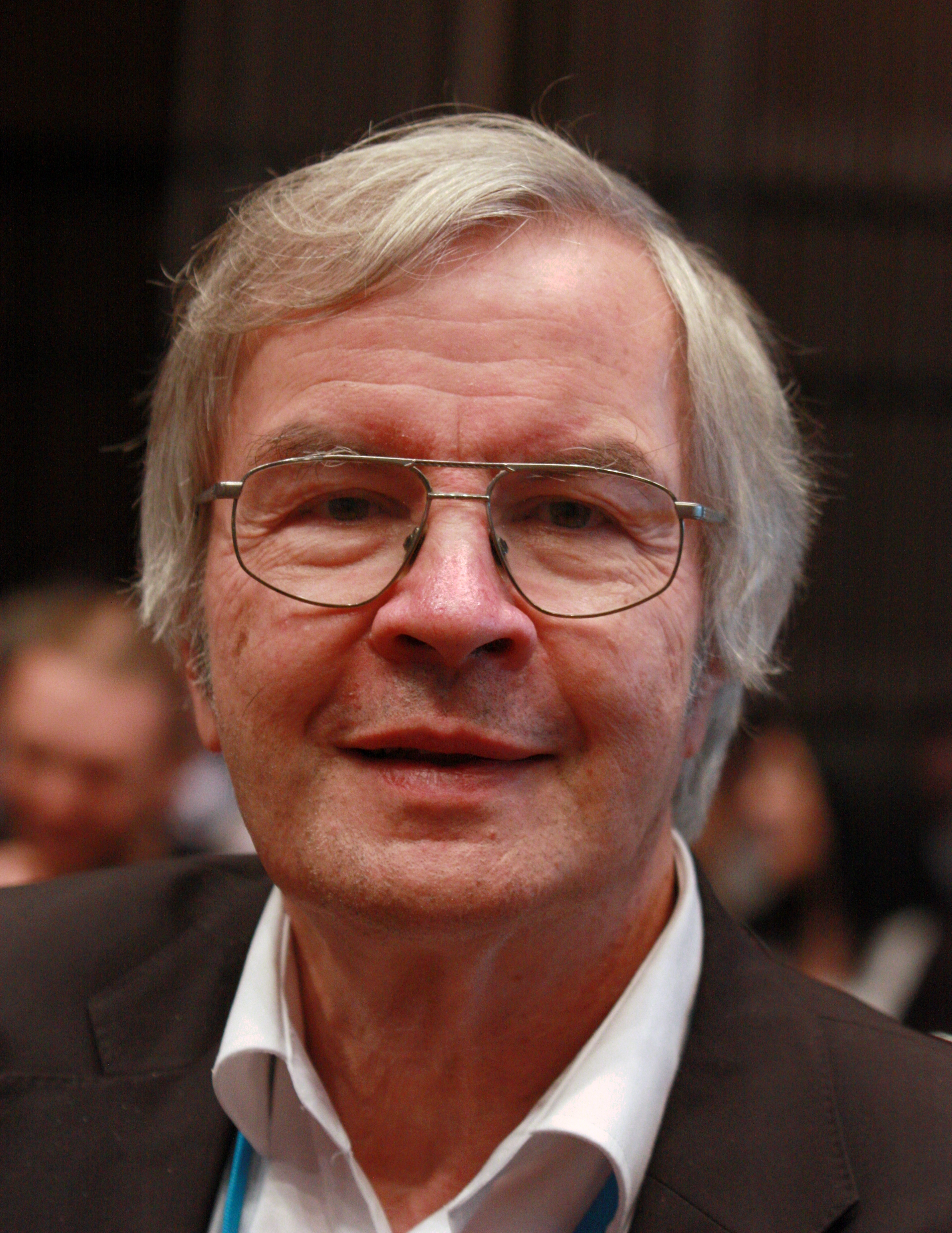
Portrait of Theodor W. Hänsch
. Source. 
An experimental researcher whose team observed the collapse and revival of a Bose-Einstein condensate matter-wave field. Atoms were confined in an optical lattice; interactions caused different occupation-number components to accumulate different phases. Their interference signal weakened and later returned as these phases realigned. The 2002 experiment made the discrete particle content of a coherent matter wave visible through its time-dependent interference, rather than treating the condensate only as a classical wave.[ref]
Collapse and revival of the matter wave field of a Bose-Einstein condensate by Markus Greiner and others. Abstract; manuscript pp. 2–4 and Fig. 2: number-dependent evolution, lattice preparation and interference readout
There are unlisted articles, also show them or only show them.