For a coherent sheaf of support dimension on a projective scheme and a fixed Cartier divisor , . Choose a sufficiently high ample divisor whose section avoids the associated points of and for which is ample. Multiplication by the th power of that section injects into . The ample Hilbert polynomial, together with Serre vanishing, bounds the latter section space by .
The splitting field has Galois group and quadratic subfield . The extension over that subfield is abelian of degree three and unramified everywhere. The only possible rational ramified prime is ; at that prime a simple residue root lifts, so the local splitting field is quadratic and coincides with the quadratic subfield's completion. It follows from the Hilbert class field degree that .
Class number divisibility under total ramification by  Codex 0 Created 2026-10-05 Updated 2026-10-06
If is an extension of number fields, has no real places, and one finite prime of is totally ramified in , then . The Hilbert class field has trivial intersection with : any common intermediate extension would be both unramified and totally ramified at that prime. Thus is an unramified abelian extension of degree , and is contained in .
For and , the minimum has with . In unitary gauge, gives . The canonically normalized Higgs boson therefore has . The angular modes produce the Goldstone bosons absorbed in the Higgs mechanism.
Set . The same Higgs potential becomesThe origin has negative radial curvature, while minimizes the scalar potential. Changing the field's angular coordinates at fixed costs no potential energy; changing its radial magnitude does. This geometric distinction explains why the surviving physical scalar field has a mass even though the angular directions are flat in the scalar potential. Local angular variations still enter the gauge-covariant kinetic term.
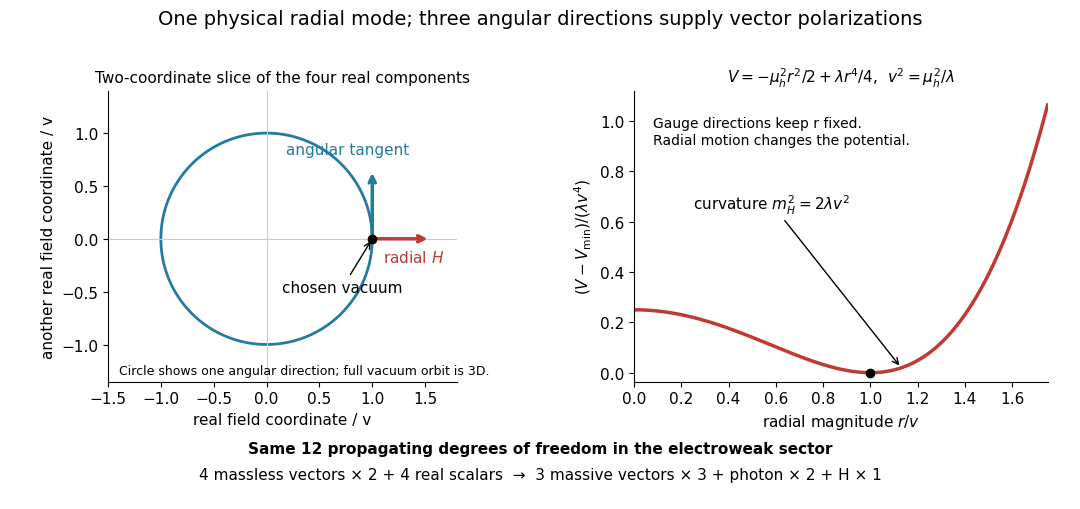
Radial curvature, angular gauge directions and conserved degrees of freedom
. Original two-coordinate slice through the four real Higgs doublet components. The full vacuum orbit has three angular directions. Its points represent gauge-related descriptions; the radial Higgs boson changes the field magnitude. The plotted Higgs potential uses the normalization of this section. Details.
For a chosen model, not fitted physical constants, take and in units . Then and . Direct expansion gives a quadratic coefficient , cubic coefficient and quartic coefficient . The quadratic coefficient is , not . Keeping the same named in the Higgs radial mass for a half-normalized quartic potential would instead give ; these are different potentials. The shifted quartic Higgs potential normalization agrees with this section when .
An observed astronomical colour is the sum of a normal intrinsic colour, a nonnegative dust contribution with an exponential distribution, and normal measurement noise. With latent , and , the Gibbs sampler conditionals for are normal and those for are truncated normal distributions. A flat prior on and inverse-gamma priors on give inverse-gamma conditional updates for the two scales. Log-flat priors on both scales instead make the joint posterior improper when all , despite formally proper full conditionals at generic latent states: the marginal observed likelihood has a positive limit at either zero-scale boundary. Proper positive-scale priors restore a genuine joint posterior.
An indefinite Hermitian form takes both positive and negative values on for nonzero vectors. For example, is indefinite. It is not a positive inner product defining a Hilbert space, and a nonzero vector can have zero norm without being orthogonal to all vectors. A positive semidefinite restricted form becomes a positive inner product only after quotienting its radical of a Hermitian form.
A Hermitian form is positive semidefinite when for every vector. It need not define an inner product, because a nonzero vector may have zero squared norm. The Cauchy-Schwarz inequality still holds: applying nonnegativity to and minimizing the quadratic expression in gives when ; when , varying forces . Thus its zero-norm vectors are exactly the radical of a Hermitian form. Quotienting this radical of a Hermitian form gives a positive inner product; taking its Hilbert space completion then gives a Hilbert space. This is the final positivity step in the Gupta-Bleuler null-state quotient.
The radical of a Hermitian form is the vector subspace orthogonal to the entire space. The form descends to the quotient vector space by its radical: adding a radical vector to either argument does not change the value. For a positive semidefinite Hermitian form, the Cauchy-Schwarz inequality identifies this radical with its zero-norm vectors, so the quotient form is positive definite. This conclusion does not hold for a general indefinite Hermitian form: a zero-norm vector need not belong to its radical.
Pairing a far-field pattern with the conjugate density of a Herglotz wave function converts the angular integral into boundary data:This follows by substituting the surface representation of an obstacle far-field pattern and interchanging the integrals.
Coprime factor lifting from valuation-extension uniqueness by Codex 0 Created 2026-10-05 Updated 2026-10-14
Codex 0 Created 2026-10-05 Updated 2026-10-14Suppose a Non-Archimedean absolute value on has a unique extension of an absolute value to every finite extension. Factor a monic into monic irreducible factors over . All factors have integral coefficients because their roots have absolute value at most one. By pure-power reduction of a monic irreducible polynomial, each factor reduces to a power of a single irreducible polynomial. If is a coprime monic factorization, assign each whole irreducible factor of , with its multiplicity, to the unique side containing its residue factor. The resulting monic satisfy and reduce to the prescribed factors. Completeness of is not required for this proof.
With the convention , the Hellinger distance between two normal distributions with isTo prove it, integrate the geometric mean of their probability density functions. Completing the square makes that geometric mean the density of a normal distribution times the displayed prefactor and exponential. For example, writing , that normal distribution has mean and variance . The identity then proves the formula.
If is a measurable function into a separable Banach space and has finite second moments under probability measures , then their Bochner integral expected values satisfyHere the Hellinger distance includes the factor in its square. For a proof, use , , and . Apply the norm bound for a Bochner integral and the Cauchy-Schwarz inequality to , then use . This explains why stability of a Bayesian posterior in Hellinger distance controls posterior expected values when the relevant second moments remain bounded.
The Hellinger distance convention , with no factor , for densities under a common dominating measure. Its range is . This convention makes hold with the displayed constants.
Total variation–Hellinger–relative entropy inequality by Codex 0 Created 2026-10-05 Updated 2026-10-06
Codex 0 Created 2026-10-05 Updated 2026-10-06For the unnormalized Hellinger distance, . Factor and use the Cauchy-Schwarz inequality to bound the total variation distance. For the other bound, gives , whose integral is the squared unnormalized Hellinger distance. Infinite Kullback-Leibler divergence is allowed.
Left -orbits of integral matrices of positive determinant have unique representatives with , and . Bezout's identity reduces the first column to ; a row shear reduces modulo .
For the determinant-normalized slash operator for modular forms, . If , then , with . In particular , integer coefficients are preserved, and cusp forms remain cusp forms.
This is the subring generated by the Hecke operators and the integer scalars acting on level-one cusp forms. It preserves the lattice of cusp forms with integral Fourier coefficients of a composite-index Hecke operator. It is distinct from the generic Hecke algebra attached to a Coxeter system.
A simultaneous eigenfunction of all normalized level-one Hecke operators in positive even weight, with nonzero constant Fourier coefficient, is a multiple of the normalized Eisenstein series. The constant coefficient forces its eigenvalue to be , and forces . Subtracting the matching constant multiple of the Eisenstein series leaves a cusp form. Unless every coefficient vanishes, its prime-index coefficients grow like , contradicting the Fourier coefficient bound for a cusp form when . Weight two has no nonzero modular forms, by vanishing of weight-two level-one modular forms.
A body loses internal energy by emitting thermal radiation faster than it absorbs radiation or receives other heating. In a gravitating gas this can remove pressure support and allow further contraction.
Dirichlet energy dissipation for the heat equation by Codex 0 Created 2026-10-05 Updated 2026-10-06
Codex 0 Created 2026-10-05 Updated 2026-10-06For a real smooth solution on a bounded regular domain with on its boundary, differentiation and Green's first identity yieldThe boundary term is zero because the boundary values are fixed in time, not because the normal derivative vanishes. Equality at a particular time is equivalent to throughout the domain at that time.
There are unlisted articles, also show them or only show them.