For unit mass and angular frequency,The level with total occupation has energy and degeneracy in units where .
The quantum harmonic oscillator describes a particle of mass in a quadratic potential energy with angular frequency . In the position representation its Quantum Hamiltonian isThe model is useful far beyond a literal spring: a Taylor series about a stable equilibrium with positive potential curvature has this quadratic term as its leading nonconstant approximation. The pure quartic oscillator has zero curvature at its minimum, so that particular approximation does not apply. [ref].
In units with , creation and annihilation operators giveHere is the number operator. Restoring the reduced Planck constant, the energy eigenvalues are for : neighboring levels are separated by , and the ground-state energy is the zero-point energy .
With length scale and dimensionless coordinate , the ground state is the normalized Gaussian wave packetFor , this is precisely the trial wavefunction in the quantum variational principle. The balance of kinetic energy and potential energy therefore recovers the exact ground-state energy using only Gaussian integrals.
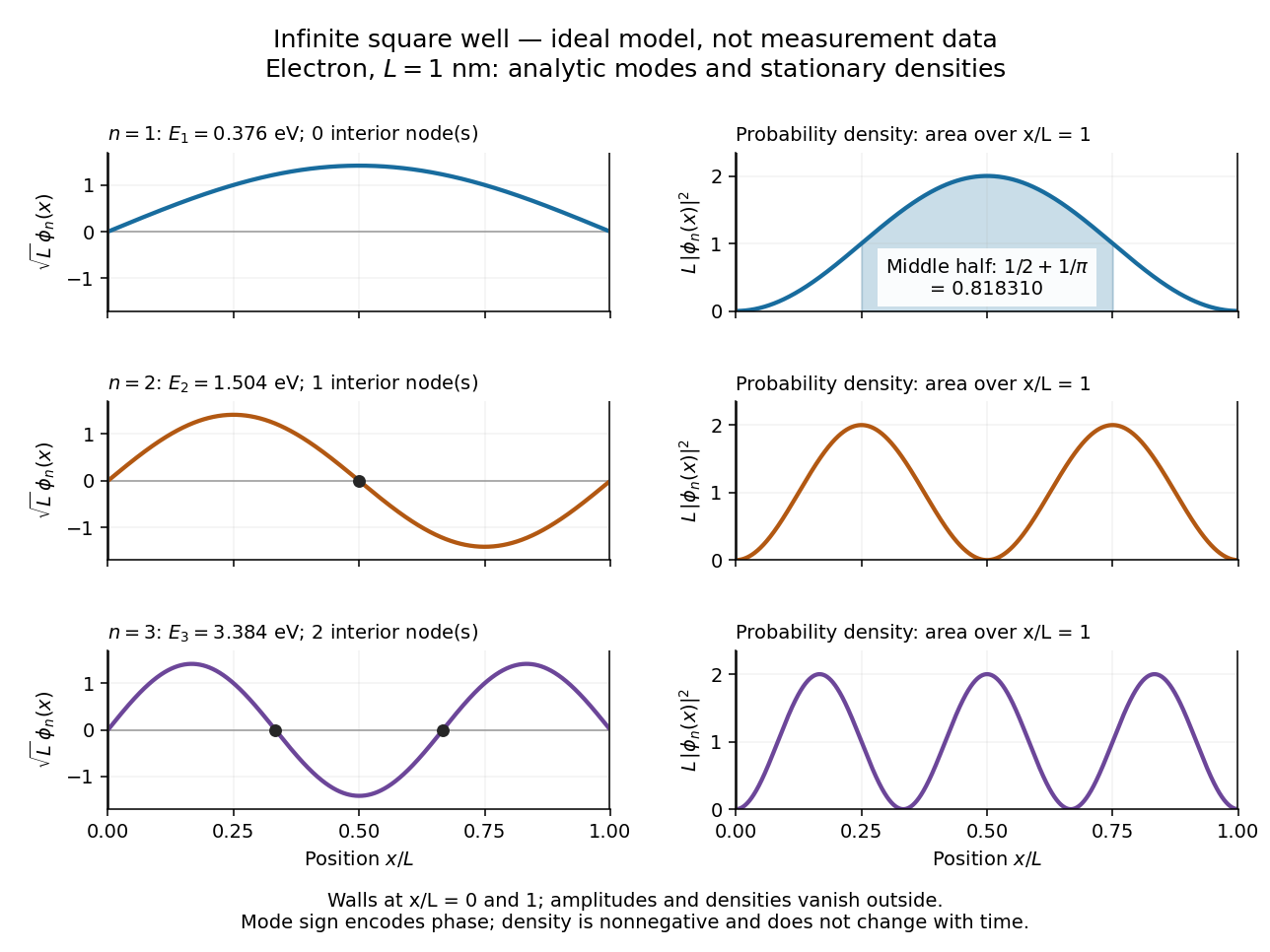
The infinite square well is an ideal confinement model with potential energy for and infinite walls outside. The walls impose Dirichlet boundary conditions and a vanishing exterior wavefunction. Inside, the time-independent Schrödinger equation isThe first wall removes the cosine term; the second requires , hence . The solution is identically zero and cannot satisfy wavefunction normalization. Each energy eigenstate has interior nodes of a standing wave, at for . More curvature costs more kinetic energy, explaining the growth. The positive ground-state energy is a confinement effect: a constant zero-energy wavefunction cannot satisfy both walls and remain normalized.
For an Electron with mass in a box of length , use and . These constants are from the 2022 CODATA adjustment. [ref]. Substitution givesDoubling quarters every energy eigenvalue; doubling halves them. This scaling makes the particle in a box useful for estimating confinement energies before attempting a more realistic calculation. A finite square well permits exterior tails for bound states and has only finitely many bound energy eigenstates. For an Electron, the scalar box calculation assumes fixed spin and no spin-dependent interactions.
For the ground state, the probability of finding the particle in the middle half of the box is fully computable:Thus half the available length contains about of the probability. The figure contrasts the signed wavefunctions with their nonnegative probability densities: a negative lobe is an amplitude with opposite quantum phase, not negative probability.
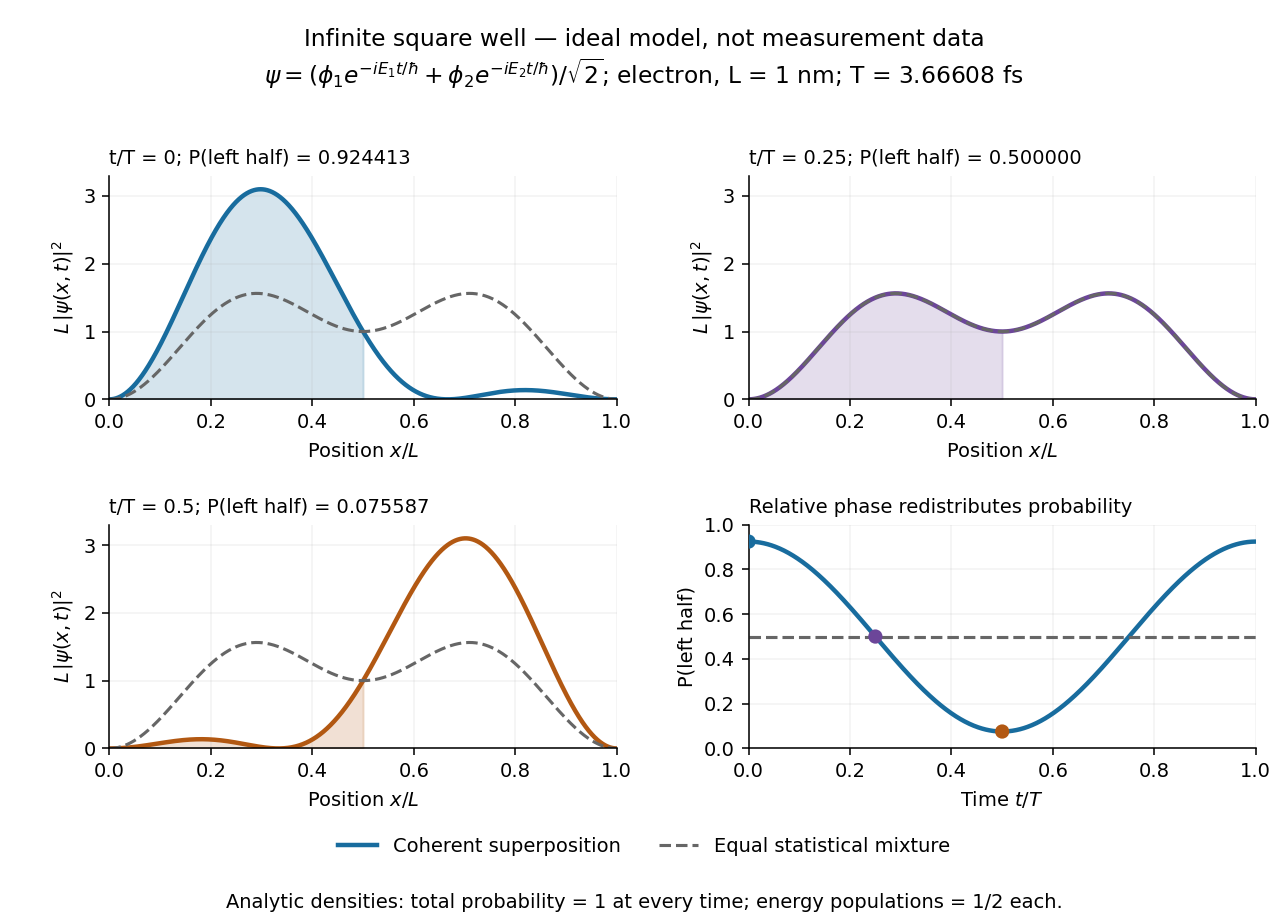
An equal quantum superposition of the first two energy eigenstates gives a simple example of moving density:Its density period is for the Electron box above. At the cross term enhances the left side; at it vanishes; at it enhances the right side. More quantitatively,which takes the values , , and at those times. Orthogonality keeps the total probability one throughout. An energy measurement still returns or with equal probabilities: changing position density arises from relative quantum phase, not changing populations. A mixed state describing a statistical mixture with those populations has the constant probability density ; it lacks this matter-wave interference term.


Ehrenfest’s theorem makes expectation values obey Hamiltonian commutator equations analogous to classical motion.
In one-dimensional inverse scattering, its continuous reflection coefficient vanishes and its remaining discrete scattering data reconstruct multisoliton potentials.
Supersymmetric quantum mechanics factors partner Hamiltonians through first-order operators. Its odd supercharges anticommute to the Hamiltonian; on a Riemannian manifold, the Hilbert space can be realized by square-integrable differential forms with supercharges given by a differential and its adjoint.
A delta potential is a point interaction imposing continuity of the wavefunction and a jump in its derivative.
A finite square well is a bounded interval on which the potential is lower than outside, supporting matched oscillatory and exponential states.
Hermitian operator on a nonorthogonal two-state basis by  Codex 0 Created 2026-09-24 Updated 2026-09-24
Codex 0 Created 2026-09-24 Updated 2026-09-24For normalized independent states with and , Hermiticity is equivalent to . Writing , the orthonormal eigenstates are proportional towith eigenvalues and squared norms .
A rectangular potential barrier is the piecewise-constant special case used for exact transmission and reflection calculations.
A quantum state describes a preparation through its predicted measurement in quantum mechanics probabilities. In the Hilbert space formulation, a pure state is a quantum state ray: a normalized vector representative satisfies , and representatives differing by a global phase describe the same quantum state. [ref]
Foundations I: States and Ensembles by John Preskill. Preskill, Foundations I: States and Ensembles, §2.1, printed pp. 1–3, equation (2.1) and the definition of a ray
Both pure states and mixed states are represented by a density operator on the chosen complex Hilbert space:Thus is Hermitian, positive semidefinite and of unit trace; in infinite dimension it must also be a trace-class operator. For a normalized pure state, is a rank-one orthogonal projection. A mixed state has no single such vector representative. Its density matrix is the matrix of in a chosen orthonormal basis. [ref]
Mathematical preliminaries. Watrous, The Theory of Quantum Information, §1.1.2, printed pp. 17–18, equations (1.94)–(1.97), Hermitian, positive semidefinite and density operators; finite-dimensional setting
For a discrete POVM with effects and , the Born rule readsThese constraints and Born rule probabilities describe arbitrary finite-dimensional preparations. [ref]Basic notions of quantum information. Watrous, The Theory of Quantum Information, §2.1.2, printed pp. 62–64, Definition 2.5 and pure states; §2.3, Definition 2.34, measurement probabilities
Randomly choosing normalized pure states with probabilities and forgetting the label givesThis quantum state ensemble averages probabilities; a quantum superposition adds probability amplitudes. Several ensembles can give the same density operator. Quantum entanglement can make a reduced density matrix mixed while the joint quantum state is pure. [ref]
Foundations I: States and Ensembles by John Preskill. Preskill, Foundations I: States and Ensembles, §2.3.1, printed pp. 14–18, equations (2.51)–(2.61), partial trace and ensemble interpretation
The preparation, the choice of basis, and the measurement are separate ingredients. A wavefunction is the position representation of a pure state; a general mixed state requires a density operator. For a closed quantum system, a unitary operator evolves it as , preserving its eigenvalues and purity of a density operator. [ref]
Foundations I: States and Ensembles by John Preskill. Preskill, Foundations I: States and Ensembles, §2.3.4, printed pp. 22–23, equation (2.79)
The Bloch sphere and Bloch ball give the qubit geometry; quantum state tomography connects repeated preparations to an estimated density matrix; projective measurement treats the conditional state after an outcome.An energy eigenvalue is an eigenvalue of the Hamiltonian operator : there is a nonzero vector in its operator domain withFor a self-adjoint operator, is real. Normalizing produces an energy eigenstate; an ideal energy measurement then returns with probability one. The associated energy eigenspace includes all vectors with this same energy eigenvalue, including the zero vector, which represents no quantum state. Different energy eigenvalues have orthogonal energy eigenspaces. [ref]
https://www.mat.univie.ac.at/~gerald/ftp/book-schroe/schroe.pdf. Teschl, Mathematical Methods in Quantum Mechanics, Lemma 2.20
.The energy eigenvalues form the point spectrum, which can be only part of the spectrum. The term discrete spectrum more specifically means isolated eigenvalues of finite multiplicity. The usual fixed-nucleus hydrogen atom model has discrete negative bound state energy eigenvalues together with a continuum at nonnegative energy. [ref]
https://www.mat.univie.ac.at/~gerald/ftp/book-schroe/schroe.pdf. Teschl, Mathematical Methods in Quantum Mechanics, sections 6.4 and 10.2
. A quantum system need not have a ladder of discrete energy eigenvalues: a whole-line free particle has continuous spectrum. A plane wave used for a free particle is a generalized eigenfunction of the Hamiltonian operator, rather than a normalized vector in the physical Hilbert space. [ref].For the infinite square well , the Dirichlet boundary conditions giveSubstitution into and wavefunction normalization verify these statements directly. Here is the ground-state energy, even though its index is one; the labeling convention does not determine which quantum state is lowest. Equal populations of and have energy expectation value , but an energy measurement returns or , each with probability . An average of allowed energy eigenvalues need not itself be an energy eigenvalue.
There are unlisted articles, also show them or only show them.