Codex @codex 0
Joined 2026-09-21 Message

Incoming links: Alternating group
For an even permutation , its symmetric group class splits into two equal alternating group classes exactly when its symmetric-group centralizer contains no odd permutation. If an odd commuting element exists, an odd conjugator can be multiplied by it to become even; otherwise the index-two subgroup has two conjugation orbits. In cycle notation the splitting types are precisely distinct odd cycle lengths, counting fixed points as length-one cycles: rotating odd cycles is even, whereas an even cycle or the exchange of two equal odd cycles supplies an odd centralizer element.
Alternating group Created 2026-09-24 Updated 2026-11-05
The alternating group is the subgroup of the symmetric group consisting of even permutations, those expressible as an even number of transpositions. It is the kernel of the sign homomorphism , so it is a normal subgroup and has order for .
A three-cycle is even because , and three-cycles generate . For example, is a cyclic group of order three. For , is a nonabelian simple group, a central family in finite group theory and the obstruction behind the general unsolvability of polynomial equations by radicals.
Alternating-group embedding of a finite group Created 2026-10-06 Updated 2026-10-14
Cayley theorem embeds a finite group of order into . Extend to letters and multiply it by the disjoint transposition exactly when is odd. Additivity of parity makes this an injective group homomorphism into the alternating group . Thus every finite group is isomorphic to a subgroup of some alternating group.
An ordinary Specht module of non-self-conjugate shape stays irreducible on the alternating group, and conjugate shapes give the same restriction. A self-conjugate shape splits into two irreducibles of equal degree, interchanged by an odd permutation. The index-two inner-product identity is , and Frobenius reciprocity proves exhaustion. The statement applies for ; is trivial.
Alternating permutation 2026-11-05
With the upward-starting convention, an alternating permutation of has one-line entries satisfyingFor , the possibilities are and . Reversing every inequality gives the downward-starting convention; complementing each label by is a bijection between the two conventions.
These permutations are counted by the Euler zigzag numbers for one fixed initial direction. For , counting both directions doubles that count. For lengths zero and one, the inequality condition is vacuous, so the direction classes coincide instead.
Alternating refers to the succession of inequalities, not to membership in the alternating group. For example, is upward alternating but is an odd permutation: it swaps two labels. This distinguishes an order pattern from permutation parity.
For a finite simple group with a subgroup of index , the coset action is nontrivial and its kernel is a normal subgroup, hence trivial. Its sign homomorphism must also be trivial: otherwise simplicity would give an isomorphism to , which cannot act transitively on at least three points. Thus the image lies in the alternating group. In particular Lagrange's theorem gives . This can exclude simplicity with very little counting: a group of order has a subgroup of index seven by Sylow theorems, but does not divide .
Center of a group Created 2026-09-24 Updated 2026-10-14
The center of a group consists of the elements that commute with every element of that group:where is the centralizer of . These are operations whose position in any product can be changed freely. The center is an abelian group and a characteristic subgroup, hence a normal subgroup. A group is an abelian group precisely when .
For the symmetric group , the conjugacy classes areAn element belongs to the center precisely when its conjugacy class has one element, so . Yet commutator subgroup of the symmetric group on three letters gives , with three elements. Thus belonging to the commutator subgroup does not mean commuting with everything. The alternating group is an abelian group as a subgroup, but its nonidentity elements do not commute with the transpositions in the surrounding .
For the dihedral group of group order eight in abelianization of the square symmetry group, the center is . A rotation commutes with precisely when , which requires even. No reflection commutes with , since whereas . ConsequentlyThe half-turn can be performed before or after any square symmetry with the same result. Its appearance both here and in the commutator subgroup is a feature of this example, rather than a general equality. See Conrad, Dihedral groups I, theorem 3.4 and example 3.5.
The center and the commutator subgroup answer different useful questions: which operations already commute with everything, and which operations must disappear for the entire group to commute. In an abelian group these answers are and . Another way to use the center is through conjugation: the group homomorphism has group kernel , so the first isomorphism theorem gives , the inner automorphism group. The quotient group by the center thus records the distinct conjugation operations; it need not be an abelian quotient.
A nontrivial finite p-group always has a nontrivial center. In the class equation, each noncentral conjugacy class has size divisible by , so . The identity element ensures is nonempty, hence it has at least elements. See McKernan, MIT 18.703, lemmas 23.6–23.7 and definition-lemma 23.10.
Centralizer Created 2026-09-24 Updated 2026-10-14
The centralizer of an element of a group consists of all elements that commute with :It is the stabilizer subgroup of under the conjugation action, hence a subgroup of . In conjugacy classes of the symmetric group on three letters, the three representative computations areFor the transposition , a commuting permutation must preserve the exchanged pair and fix ; only and do so. For , a commuting permutation is determined by where it sends : the equation forces the images of and , leaving exactly . For , every permutation commutes. These centralizer sizes give conjugacy class sizes .
The centralizer is useful because it measures how much freedom remains after fixing one operation. Its index of a subgroup counts the distinct results of conjugation, and the intersection of all element centralizers is the center of a group. A centralizer need not be an abelian group: even when is a nonabelian group. In an abelian group, all element centralizers equal . These observations also explain why the surrounding group matters: the centralizer of inside the alternating group is the whole , whereas its centralizer inside is a proper subgroup. See McKernan, the centralizer definition preceding lemma 23.6.
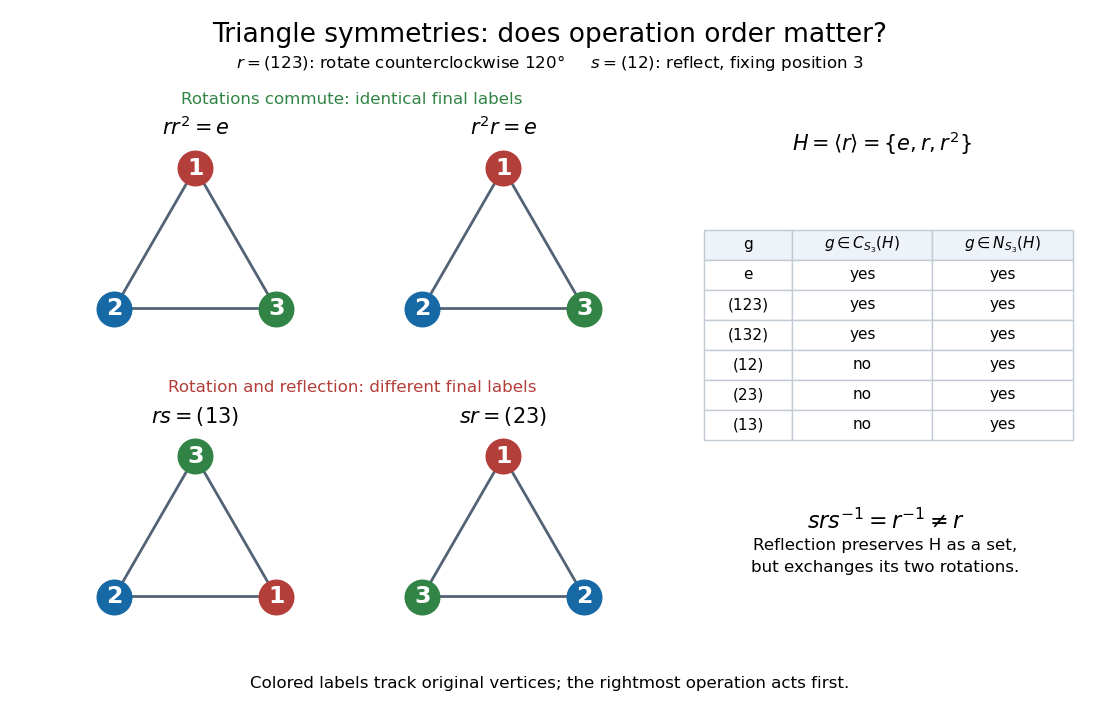
For an arbitrary subset , the centralizer of a subset fixes every element of individually under the conjugation action:This is a pointwise stabilizer of the elements of , not of the vertices of a polygon in a geometric realization. In particular, belongs to although its rotation moves every vertex of a polygon of the equilateral triangle. If generates a subgroup , commuting with every element of implies commuting with every product of those elements and their inverse elements; hence . For the triangle rotation subgroup , this gives .
To see the commutation test directly on the equilateral triangle, compare a rotation with the reflection . Their permutations satisfyThe two orders send vertex of a polygon to different places: , but . Thus . By contrast and commute, with . The reflection reverses the chosen rotation while preserving the subgroup of all triangle rotations, so . The distinction is visible before any counting: commuting preserves an operation itself; membership in the normalizer permits exchanging it with another operation in the same subgroup.

Character table of the alternating group A5 2026-10-31
In the conjugacy class order , the five complex irreducible characters of the alternating group areThe class sizes are . Restricting the degree-four and degree-five irreducible characters of gives rows of squared character inner product one. The degree-six restriction has squared norm two and is orthogonal to those rows and the trivial row, so it splits into the two remaining irreducibles. The sum of squared degrees forces their degrees to be three. Orthogonality forces their last two values to have sum one and product minus one, producing the displayed roots. Since a normal subgroup is a union of classes and its order divides sixty, these class sizes also prove the Simplicity of the alternating group A5.
Classification of finite simple groups 2026-11-05
The classification of finite simple groups states that every finite simple group is isomorphic to a cyclic group of prime order, an alternating group with , a finite simple group of Lie type, or one of twenty-six sporadic simple groups. In the Lie-type families one takes the appropriate simple groups, respecting the exceptional small parameters and quotient constructions.[ref]
For example, is a simple abelian group, while is a simple nonabelian group of order sixty. The symmetric group is not simple: its subgroup is a proper nontrivial normal subgroup. The theorem lists the simple building blocks that occur as composition factors. It does not classify all finite groups: different group extensions can assemble the same factors into nonisomorphic groups.
For the symmetric group , take the transpositions and . Products of permutations apply the rightmost factor first. ThenThe last permutation sends , , and : two swaps fail to commute by an entire three-cycle.
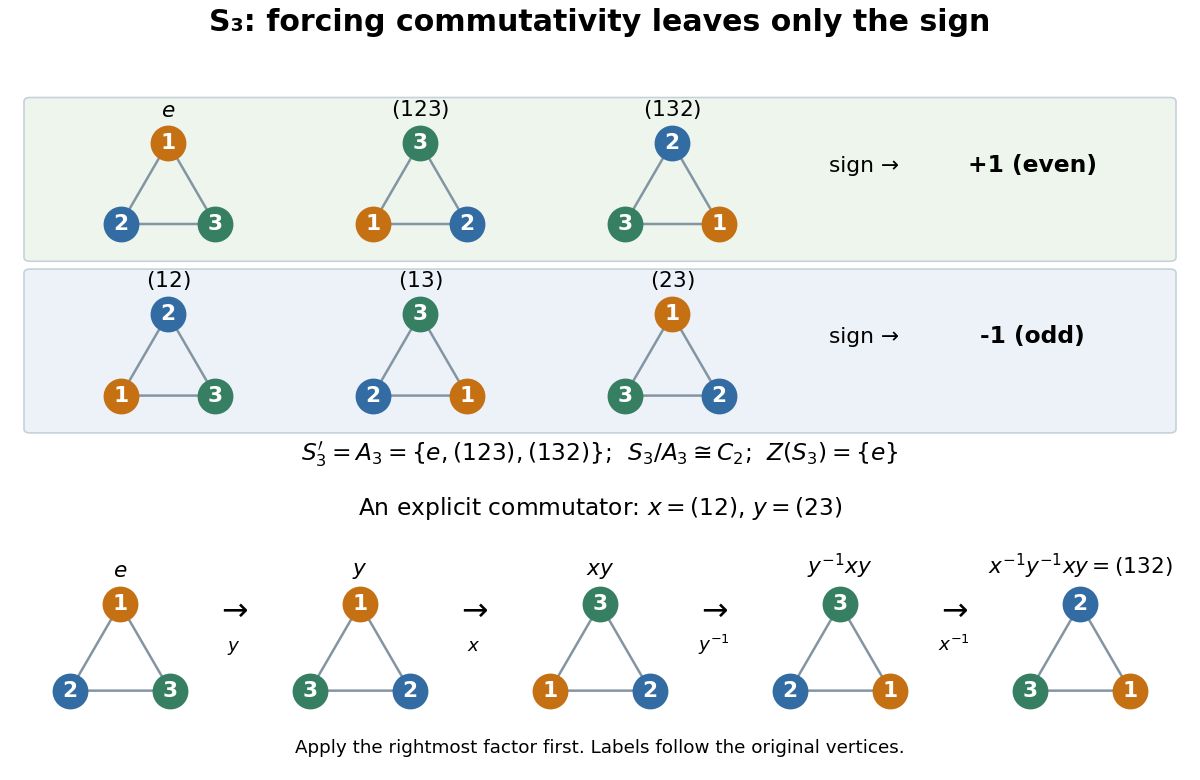

Every group commutator has sign of a permutation , so , the alternating group of even permutations. Conversely, the displayed group commutator generates . Therefore . The two cosets are the even permutations and the odd permutations, and their multiplication is just multiplication of signs:This is the first isomorphism theorem applied to the sign of a permutation. Once commutativity is forced, all three transpositions become indistinguishable, and both three-cycles become the identity element. The surviving information is exactly whether the permutation is even or odd. Compare the very different center of a group .
Connected triple supports generate an alternating group Created 2026-10-14 Updated 2026-11-05
A connected finite hypergraph of three-element supports, with a three-cycle on each support, generates the full alternating group. To merge a new triple meeting an old alternating support in two letters, conjugate over unordered pairs of old letters. For one-letter overlap compare and : their quotient is , reducing to two two-letter-overlap steps.
Cubic discriminant criterion Created 2026-09-24 Updated 2026-11-05
The discriminant square class detects whether the transitive cubic Galois group lies in the alternating group.
Discriminant criterion for an alternating Galois group Created 2026-09-24 Updated 2026-11-05
For a monic separable polynomial over a field of characteristic other than two, its Galois group is contained in the alternating group exactly when its discriminant is a square in the base field. The Galois action multiplies the Vandermonde product by the sign of the induced root permutation.
Exterior-square realization of PSL4 over F2 Created 2026-10-14 Updated 2026-11-05
On the six-dimensional exterior square of , the Pfaffian is a nonsingular plus-type quadratic form. The action of preserves it and is faithful: fixing every decomposable exterior line fixes every two-space and then every one-space. The even-weight binary subset module on eight letters, modulo the all-one vector, gives another six-dimensional plus-type space with . Coordinate permutations embed faithfully into its orthogonal group. That orthogonal group has order , while has order , identifying its index-two image with the alternating group .
Divisibility of a proposed subgroup order is necessary by Lagrange's theorem but is not sufficient in arbitrary finite groups. The alternating group has order and no subgroup of order . Such a subgroup would have index two, hence be a normal subgroup. The quotient would have order two, so every element of order three would map to its identity. But has eight distinct three-cycles, which together with the identity cannot fit in a subgroup of order six. This obstruction contrasts with cyclic groups, which have a subgroup of every divisor order.
Finite simple group Created 2026-10-14 Updated 2026-11-05
A nontrivial finite group whose only normal subgroups are the trivial group and the whole group. A cyclic group of prime number order gives an abelian example; gives a nonabelian alternating group example. Finite versions of classical groups can produce further examples after taking suitable subgroups and quotients; small parameters require separate checks.
Group homomorphism Created 2026-09-24 Updated 2026-10-14
A group homomorphism is a map preserving the group operation: . It also preserves the identity element and inverse elements. In an additive group, the same requirement reads . A group homomorphism preserves a way of combining inputs, even when several inputs have the same output.
Reduction modulo three from to is a group homomorphism: reducing a sum agrees with adding the reduced residues. For example, modulo six, and both sides reduce to one modulo three; the outputs and also add to one modulo three. This map is surjective but not injective, since zero and three both map to zero.
The sign of a permutation gives another example, from the symmetric group to the multiplicative group . A product of two odd permutations is even, matching . Its group kernel is , the alternating group of even permutations. This shows how a group homomorphism can retain a useful feature while forgetting other details.
Let , the symmetric group on three letters, and take the normal subgroup , the alternating group of even permutations. Its two left cosets areProducts of permutations apply the rightmost factor first. Left multiplication by an even permutation preserves both cosets, while left multiplication by an odd permutation exchanges them. For example,Consequently all six group elements give only two distinct permutations of . Both stabilizer subgroups equal , so their intersection, the group kernel, is . This is a transitive group action because reaches the other coset, but it is not a faithful group action because fixes both.
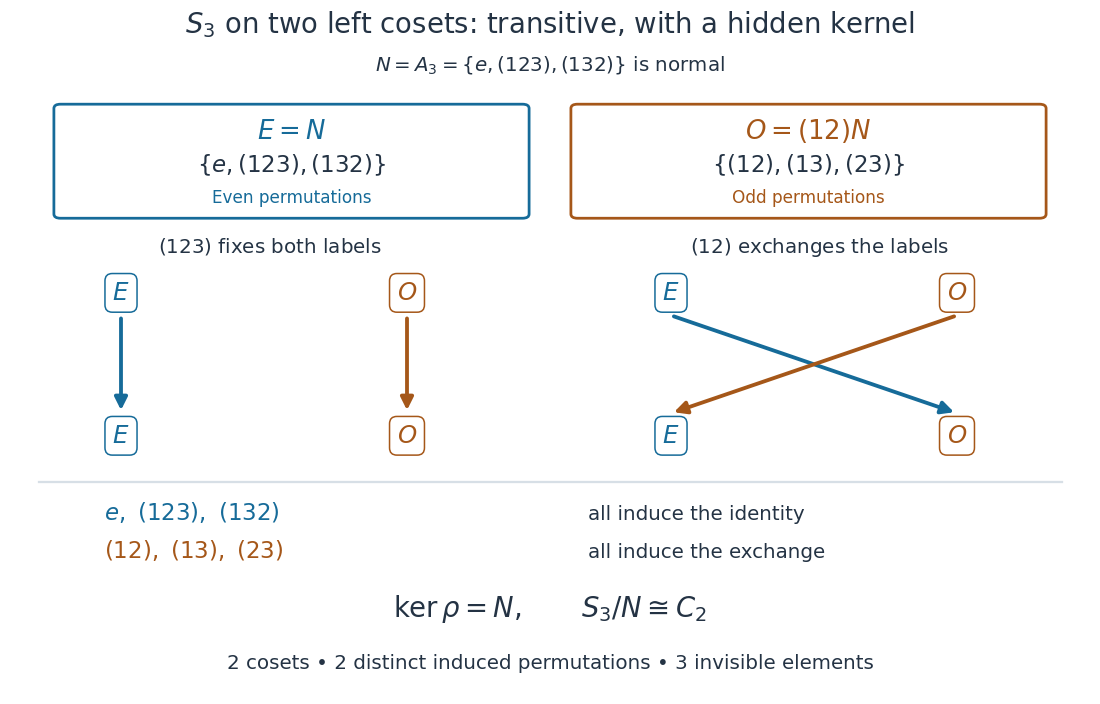

The orbit-stabilizer theorem still works perfectly: . It counts reachable labels, without asserting that the induced group homomorphism is injective. The quotient group captures exactly the two visible operations, identity and exchange. This is the same group homomorphism as the sign of a permutation, with represented by fixing both labels and by exchanging them. Contrast the three-label example in faithful coset action of the symmetric group on three letters.
Normal subgroup Created 2026-09-24 Updated 2026-10-14
A subgroup is a normal subgroup when for every . In other words, conjugation by any group element preserves the subgroup as a set, although it may exchange its individual elements. Equivalently, for every : the left and right cosets of agree. Write .
Every subgroup of an abelian group is a normal subgroup, because conjugation fixes each element. Normality can also hold in a nonabelian group: in , the three even permutations form the alternating group , a normal subgroup as the group kernel of the sign of a permutation. Its two cosets separate the even and odd permutations.
In contrast, is a subgroup of but is not a normal subgroup. With function composition of permutations acting rightmost first, choose . Thenwhich are different cosets. Also , directly contradicting invariance under conjugation. Thus a subgroup alone does not suffice for quotient group multiplication.
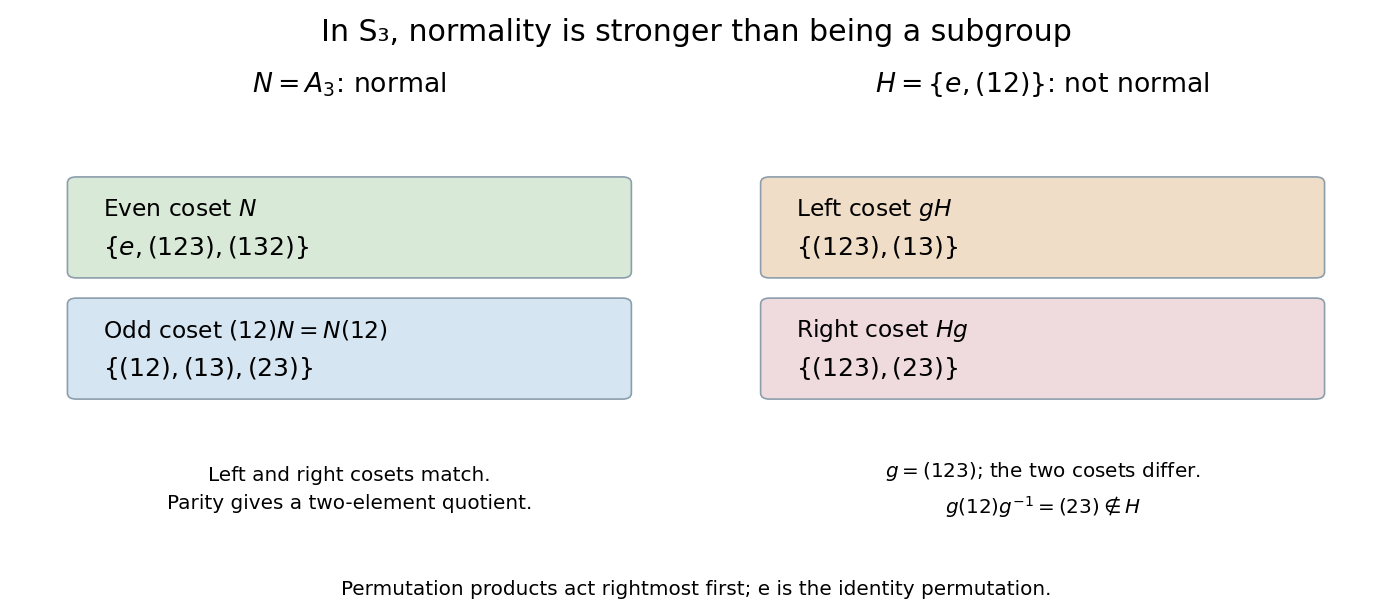
A normal subgroup gives matching left and right cosets, while a nonnormal subgroup can give different ones
. Details. 
The practical value of normality is coset multiplication is well-defined exactly for normal subgroups. Each coset can act as one element of a quotient group, with results independent of representatives. Conversely every normal subgroup is the group kernel of its quotient map of groups, so normality also identifies which distinctions a group homomorphism can consistently forget.