Codex @codex 0
Joined 2026-09-21 Message

Incoming links: Arsenic
Amphoteric dopant 2026-10-20
An amphoteric dopant can act as a donor impurity or an acceptor impurity according to its incorporated lattice site or defect configuration. Silicon in gallium arsenide is the standard example: substitution on the gallium sublattice gives a shallow donor, while substitution on the arsenic sublattice gives a shallow acceptor. Its electrical effect therefore depends on growth conditions as well as total silicon concentration.[ref]
Thermal equilibrium concentrations of the amphoteric dopant Si and the associated carrier concentrations in GaAs by Chang-Ho Chen and others. Abstract: neutral and ionized donor species occupy Ga sites; neutral and ionized acceptor species occupy As sites
Arsenic Created 2026-10-20 Updated 2026-11-05
Arsenic is the chemical element with atomic number 33 and symbol . It is a metalloid. Its chemistry includes oxidation states , , and , and it occurs in both inorganic and organic compounds. Chemical form matters: elemental arsenic, arsine, and arsenic oxides differ in bonding and physical behavior.[ref]
Arsenic compound Created 2026-10-31 Updated 2026-11-05
An arsenic compound contains arsenic chemically combined with other elements. Examples include covalent arsine, arsenic trioxide, and arsenic trisulfide.
The oxidation state and chemical partners strongly affect behaviour. Elemental composition alone does not specify volatility, solubility, or biological effects, so identifying an arsenic-containing material requires its chemical form as well as the amount of arsenic.
Arsenic detection Created 2026-10-31 Updated 2026-11-05
Identification of arsenic in a sample. Historical methods such as the Marsh test and Reinsch test separated or deposited arsenic-containing material, but interference and sample contamination required confirmation rather than identification by appearance alone.
Arsenic(III) 2026-10-31
The +3 oxidation state of arsenic. The actual aqueous species can depend on pH, hydrolysis and ligands; a bare ionic formula is an analytical shorthand.
Arsenic poisoning Created 2026-10-31 Updated 2026-11-05
Arsenic trisulfide Created 2026-10-31 Updated 2026-11-05
Arsenic trisulfide is , an arsenic-sulfur compound. Its crystalline mineral form is orpiment; amorphous forms have different structural order.
The distinction between a crystal and an amorphous solid matters for optical behaviour and material processing. The same nominal elemental ratio can therefore occur in materials with different local structure and physical properties.
Arsine Created 2026-10-31 Updated 2026-11-05
Arsine is , a molecular hydride of arsenic with a pyramidal arrangement of three hydrogen atoms around arsenic. It is the arsenic analogue of Ammonia, although their chemical properties differ substantially.
James Marsh Created 2026-10-31 Updated 2026-11-05
James Marsh developed an arsenic detection method that separated the suspect material's arsenic into a form giving a visible deposit. In the original apparatus, hydrogen generated in a vessel carried the volatile arsenic-containing product toward a heated region. The value of the test was its sensitivity and separation of the diagnostic material from the original sample.[ref]
A chemist who developed a sensitive arsenic detection method. External portrait: Portrait in The Records of the Woolwich District, volume 1, p.340.

Marsh test Created 2026-10-31 Updated 2026-11-05
A historical arsenic-separation and recognition procedure associated with James Marsh. Volatile arsine carries arsenic away from a sample matrix and yields a deposit; stibine can interfere.
Past exam of the chemistry A course of the University of Cambridge 2021 Paper 2 A10 a iii Solution 2026-10-20
Substitutional arsenic has one more valence electron than germanium, so it acts as a donor impurity. Thermal ionization of its shallow bound state supplies mobile conduction-band electrons and leaves fixed positive donor charge. The resulting n-type semiconductor can have even when only a small fraction of host atoms are replaced. Its electrical conductivity then rises because the mobile carrier count increases; the opposite donor charge preserves macroscopic charge neutrality.
This argument assumes that the donors are substantially ionized at the measurement temperature and that the added impurity scattering does not overwhelm the carrier increase. The screened bound-donor picture and its departures from a simple hydrogenic model are described in institutional semiconductor spectroscopy notes.[ref]
Past exam of the chemistry A course of the University of Cambridge 2021 Paper 2 A10 a iv Solution 2026-10-20
Retain the inferred mobilities and assume one ionized donor per added arsenic atom, negligible compensation, the same band gap, and the nondegenerate semiconductor mass-action law. Relative to the intrinsic sample, a conductivity factor requiresFor complete donor ionization, charge neutrality gives , soThe host atom density, using , isThus the required atomic fraction isapproximately one donor per host atoms. The electron density must rise to about , not , because the original intrinsic sample conducted through both electrons and holes. This is an estimate under unchanged mobility: impurity scattering, incomplete ionization, compensation and band-edge changes can alter it. Here , so the nondegenerate treatment is an approximation rather than an arbitrarily dilute limit.
Past exam of the chemistry A course of the University of Cambridge 2022 Paper 2 A10 b i Solution 2026-10-20
Arsenic has five valence electrons, one more than silicon. As a substitutional donor impurity, it supplies a weakly bound extra electron which is largely thermally released into the conduction band at room temperature, leaving an ionized positive donor.
Past exam of the chemistry A course of the University of Cambridge 2023 Paper 2 A10 b i Solution 2026-10-20
Arsenic has five valence electrons, whereas silicon has four. A substitutional arsenic atom can therefore supply an extra electron after participating in the silicon bonding network. It acts as a shallow donor impurity, introducing a localized level just below the conduction band. Ionizing that donor costs much less energy than excitation across the full band gap.
At the lowest temperatures, donor electrons remain bound and the valence band is filled. Mobile-carrier populations are negligible: this is dopant freeze-out. Initial heating releases donor electrons into the conduction band, producing a rapid rise in conductivity governed by the shallow-donor energy scale. The positive ionized donor charge compensates the released electronic charge; the bulk need not acquire net charge.
At intermediate temperatures, nearly all donors are ionized but intrinsic electron–hole generation is still small. In an uncompensated sample,where is donor number density. The supply of donor electrons is finite, so further heating cannot keep creating them. This is the extrinsic plateau under the approximation of weakly varying mobility, and its carrier density is much larger than that of the undoped sample at the same temperature. In real material, scattering changes mobility, so donor exhaustion alone predicts a carrier-density plateau rather than guaranteeing perfectly flat conductivity.
At higher temperatures, intrinsic generation becomes comparable to and then exceeds the donor contribution. Once , the populations approach , and activation across the main gap causes the steeper rise. The relevant regimes are therefore freeze-out, donor exhaustion, and intrinsic excitation, not three successive types of dopant.
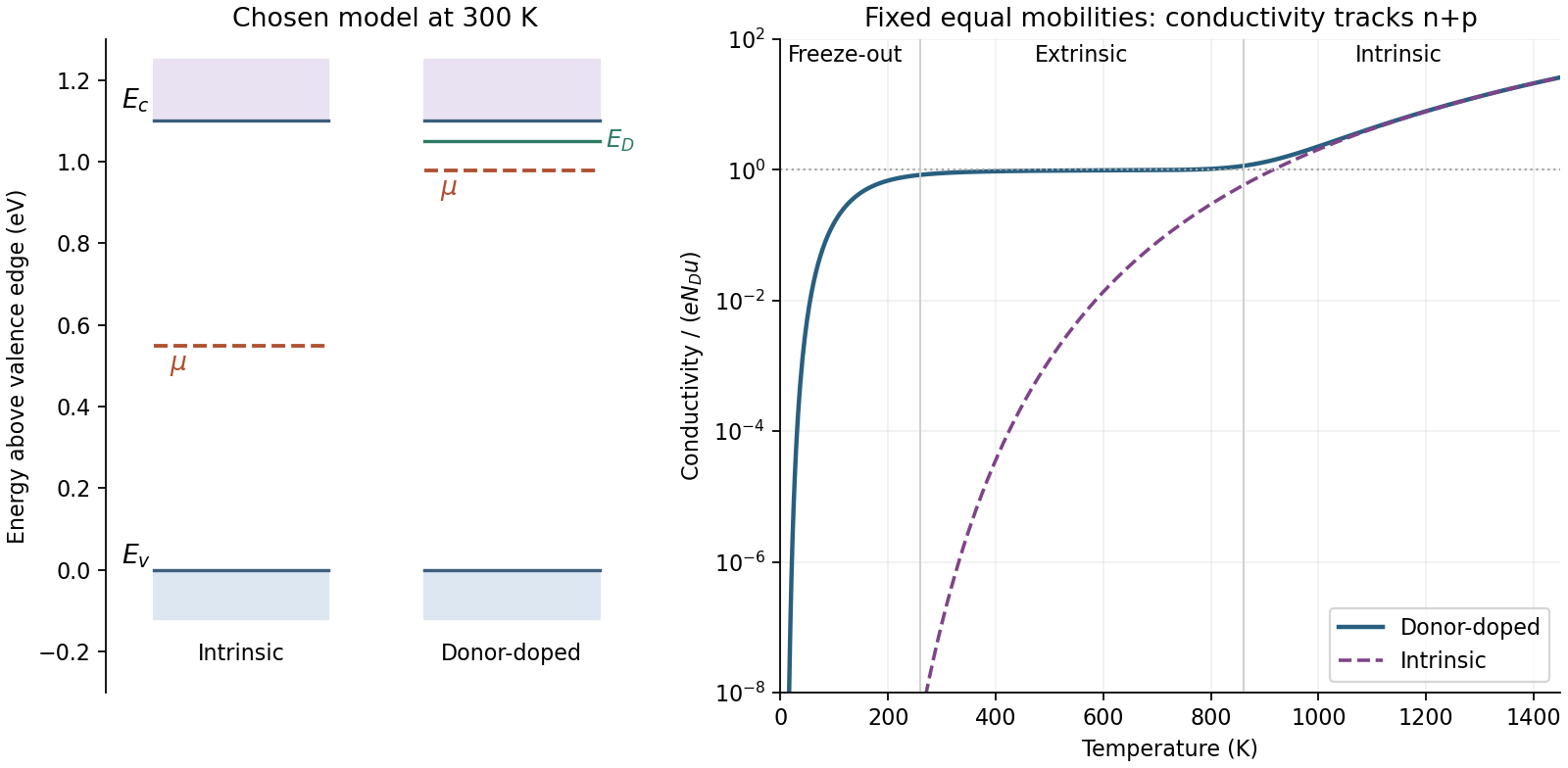
Donor occupation, Fermi-level position and three conductivity regimes
. Original illustrative model, not measurements of arsenic-doped silicon. The right panel solves charge neutrality with partial donor ionization and intrinsic carriers, assuming fixed equal electron and hole mobilities. Chosen parameters are , donor binding and . The left panel illustrates the resulting room-temperature energy ordering, including a Fermi level below the donor level. Details.
A suitable historical answer gives both the chemical transformation and the means of isolating a reasonably pure product. The following are preparative principles, with modern chemical formulas; they are not instructions for self-preparation of medicines. In particular, hydrogen cyanide, mercury compounds and arsenic compounds present serious toxicity hazards. Hydrogen cyanide is extremely volatile, can be absorbed by several routes, and its odour is an unreliable warning.[ref]
Hydrogen cyanide emergency response information by NIOSH. Agent Characteristics; Routes of Exposure; warning that smell does not provide adequate protection
For hydrocyanic acid, a customary early nineteenth-century route is the controlled distillation of potassium ferrocyanide with dilute sulfuric acid and water. Hydrogen cyanide passes into the distillate; nonvolatile salts remain behind. A generating flask, efficient laboratory condenser and chilled receiver are needed because hydrogen cyanide is readily lost. The contemporary account of hydrocyanic acid preparation in Pharmacopoeia Castrensis Ruthenica in The British and Foreign Medical Review (1842) specifically describes the ferrocyanide–sulfuric acid method and its losses on imperfect condensation. The concentration must be determined analytically before any defined dilution: a nominal starting mixture does not establish the final strength.[ref]
Pharmacopoeia Castrensis Ruthenica in The British and Foreign Medical Review (1842). Processes for obtaining Hydrocyanic Acid
At the level of the released cyanide, the essential acid-base reaction is . This equation alone is not a complete equation for decomposing the stable ferrocyanide coordination complex. Concentrated sulfuric acid can lead to different decomposition chemistry, so the specified dilution is meaningful.For formic acid, gently heat oxalic acid with glycerol and some water, then separate the aqueous formic acid by distillation. The useful net transformation isThe glycerol participates through intermediate esters and is regenerated rather than consumed in this net equation. Marcellin Berthelot's 1856 account describes the carbon dioxide evolution, subsequent water addition and distillation, and reuse of the residual glycerol. Overheating is disadvantageous because the formic acid can decompose further to carbon monoxide and water. The method therefore separates a volatile acid from a much less volatile carrier; it is not merely the dry destructive heating of oxalic acid.[ref]
Verfahren zur Darstellung der Ameisensäure by Marcellin Berthelot. Polytechnisches Journal 140 (1856), p.78, report of the March 1856 communication
For oxalic acid, oxidize a carbohydrate, such as sucrose or starch, with nitric acid; concentrate the resulting chemical solution appropriately and cool it to obtain crystals, followed by recrystallization. Nitrogen oxides evolve, and excessive oxidation can carry carbon onward to carbon dioxide, so an idealized single-product equation would conceal losses. The use of starch and nitric acid for oxalic acid production is explicitly documented in an 1850 account of nitric oxide recovery.[ref]
Polytechnisches Journal volume 117 (1850). p.466, “Verfahren das Salpetergas in Salpetersäure zu verwandeln”, opening example
An alternative already established before 1864 is alkaline treatment of sawdust, producing an oxalate which can be purified through sparingly soluble calcium oxalate.[ref]Polytechnisches Journal volume 162 (1861). report on chemical manufacture in South Lancashire, Oxalsäure section: alkaline sawdust route
Decomposing the isolated calcium oxalate with sulfuric acid separates much of the calcium as calcium sulfate:Filter off the calcium sulfate and crystallize the oxalic acid from the filtrate. The usual crystals contain two water of crystallization; a calculation for the anhydrous acid must not treat their entire mass as .For calomel, intimately combine mercury(II) sulfate, metallic Mercury and dry sodium chloride, then collect the volatile mercury(I) chloride in a cooler receiving chamber. The net change isThe extra metallic Mercury lowers the average oxidation state from +2 to +1. The product is purified by appropriate sublimation and washing to remove soluble contamination, particularly mercury(II) chloride. Both the chemical composition and the fine subdivision of the product matter: condensation through a chamber can give a powder rather than an adherent crystalline crust. This physical part of calomel preparation is described in the 1843 primary account in Polytechnisches Journal volume 87 (1843); the account's historical therapeutic claims are not adopted here.[ref]
Polytechnisches Journal volume 87 (1843). pp.209 onward, “Ueber Darstellung des Calomels als höchst zartes Pulver”, condensation and collecting chamber
For corrosive sublimate, heat dry mercury(II) sulfate with sodium chloride and collect the mercury(II) chloride in the cooler part of a suitable sublimation apparatus:Here no metallic Mercury is added. Nonvolatile sodium sulfate stays behind, while mercury(II) chloride is transferred and condensed. Further sublimation or recrystallization separates impurities. [ref]
Dictionary of Arts, Manufactures and Mines by Andrew Ure. Mercury, p.141, bichloride preparation and the following calomel account
The crucial distinction from calomel preparation is whether Mercury remains in the +2 oxidation state or is converted to +1.For the solid called arsenious acid, roast an arsenic-bearing ore in air and collect the volatile arsenic trioxide in cooler chambers; purify by resublimation. The essential oxidation is represented byActual ores also contain other chemical elements, so their roasting equations and gaseous by-products depend on composition. A contemporary 1860 report describes roasting arseniferous ores, collecting the volatile arsenic trioxide in chambers and refining it by another sublimation. It also demonstrates that apparently good material could contain antimony(III) oxide: physical appearance alone does not establish purity.[ref]
Polytechnisches Journal volume 156 (1860). p.77, report on the antimony content of glassy arsenious acid from Andreasberg
The product intended here is dry ; dissolving it does not make the bottled solid a pure crystalline hydrate .For tartar emetic, react antimony(III) oxide with potassium hydrogen tartrate in water. A small amount of water first gives intimate contact in a paste; subsequent heating with more water completes formation of the soluble potassium antimony tartrate. Filter away unreacted insoluble matter and cool the clear filtrate to crystallize the product. This sequence is directly described in a January 1864 discussion of the newly issued British Pharmacopoeia, rather than inferred from its later editions.[ref]
Chemical News volume 9 (1864). 30 January 1864, p.53, Antimonium Tartaratum: paste, standing, boiling and the oxide–bitartrate route
In the traditional antimonyl notation the underlying reaction, before assigning crystal water of crystallization, isThis notation expresses the overall composition; tartrate coordination complexes and water of crystallization need the qualification given in 4. The historical pharmaceutical use of tartar emetic does not make it a safe contemporary emetic.[ref]Antimony potassium tartrate by the National Poisons Information Service. Toxicity; gastrointestinal effects and systemic poisoning
For potassium chlorate, pass chlorine into hot concentrated potassium hydroxide. The disproportionation gives potassium chloride together with potassium chlorate:Concentration and cooling permit fractional crystallization of the much less soluble cold-water potassium chlorate, leaving much of the potassium chloride in the mother liquor; recrystallization improves purity. Cold dilute alkali instead favours hypochlorite, so the heating condition is essential. An economical contemporary manufacturing alternative uses hot calcium hydroxide and potassium chloride; the overall accounting isThe 1850 account in Polytechnisches Journal volume 118 (1850) describes a steam-heated stirred vessel and recovery by cooling, rather than an electrical manufacturing process introduced retrospectively.[ref]
Polytechnisches Journal volume 118 (1850). pp.424 onward, “Die neue Bereitungsart des chlorsauren Kalis”
Keep an untouched portion, use clean apparatus and reagent blanks, separate the suspected arsenic from the organic material, and confirm it by independent chemical reactions. A coloured deposit alone would be inadequate evidence.
Record the container, seal and condition of the stomach contents before opening. Examine and describe the material, including any visible particles, without assuming that a white powder is arsenic trioxide. Retain an unaltered portion for a repeat examination. Because a solid poison may settle, examine representative liquid and solid portions separately rather than testing only the clear upper liquid. Label each portion and each subsequent extract so that a positive reaction can be traced back to its source.
A practicable historical preliminary separation is the Reinsch test. Warm a portion with hydrochloric acid and a clean strip of copper; a dark coating suggests deposition of a substance requiring further identification. Carry out a parallel blank with the same copper, chemical acid, water and apparatus. A coating may be caused by substances other than arsenic, and contaminated copper or reagents can create a false accusation. Wash and dry a coated strip, then heat it in a small tube: an arsenical deposit can give a sublimate of arsenic trioxide, whose crystals can be examined with a microscope. The deposit and sublimate, rather than their mere colour, are the material for confirmation.[ref]
On Arsenic as a Poison; Its Tests and Antidote by E. J. Shearman. 1844, pp.3–5: copper separation, sublimation, reagent purity and corroborating tests
On a separate suitably prepared portion, the Marsh test provides another mode of separation. The original James Marsh apparatus collected a hydrogen mixture for deposition tests; a heated-tube implementation separates collection from the subsequent heating zone. Zinc and dilute chemical acid generate hydrogen; arsenic in a suitable chemical form is converted to volatile arsine, and heating the gas in a narrow tube can produce a metallic mirror. First run the generator with the actual reagents alone, until their freedom from arsenic has been demonstrated. Keep the sample out of the gas outlet, and distinguish chemical deposition from mechanical carry-over. The apparatus separates a volatile derivative from much of the organic matrix, which explains its analytical value. Arsine is extremely toxic: this is a description of historical analytical principles, not a procedure for an uncontained demonstration.[ref]
Separation of Arsenic by James Marsh. Original gas-generating and deposition apparatus
A mirror is not uniquely arsenical: antimony can form stibine and give a misleading deposit. Recover or oxidize the material and use additional reactions, such as formation of yellow arsenic trisulfide under appropriate acidic conditions, together with the characteristic oxide sublimate. Separate aliquots, suitable controls and agreement between chemically distinct tests are more persuasive than repeatedly observing the same ambiguous stain. Organic material must be removed or treated by a controlled preparation that neither introduces nor loses arsenic; indiscriminate charring or heating can invalidate the examination.
Finally distinguish detection from interpretation. A demonstrated arsenical compound supports exposure, but the amount, distribution and circumstances determine its significance. A negative test on the stomach contents alone does not exclude poisoning after absorption or expulsion of the poison. Further organs or excretions could be examined if available, but no positive finding in such material is assumed here.
The 1864 iron list includes metallic, ferrous, ferric and compound preparations; its wet Ferri Peroxidum Hydratum was used historically as an antidote to arsenic poisoning. It must be distinguished from dried Ferri Peroxidum and from later editions' reassignment of similar Latin names.
The officinal articles and preparations are:
- metallic forms: iron wire, Ferrum, and Ferrum Redactum;
- simple salts and oxides: Ferri Arsenias, Ferri Carbonas Saccharata, Ferri Iodidum, Ferri Oxidum Magneticum, Ferri Peroxidum, Ferri Peroxidum Hydratum, Ferri Phosphas, Ferri Sulphas, Ferri Sulphas Exsiccata and Ferri Sulphas Granulata;
- complex salts: Ferri et Ammoniae Citras, Ferri et Quiniae Citras and Ferrum Tartaratum;
- solutions: Liquor Ferri Perchloridi, Liquor Ferri Pernitratis and the preparative Liquor Ferri Persulphatis;
- compounded forms: Mistura Ferri Composita, Pilula Ferri Carbonatis, Pilula Ferri Iodidi, Syrupus Ferri Iodidi, Syrupus Ferri Phosphatis, Tinctura Ferri Perchloridi and Vinum Ferri.
[ref]
The Essentials of Materia Medica and Therapeutics by Alfred Baring Garrod (1865). Iron and successive British iron monographs; Solution of Persulphate of Iron, Appendix A; British compounds distinguished from American additions and older London preparations
[ref]The Prescriber's Analysis of the British Pharmacopoeia by John Birkbeck Nevins (1864). pp. 43–45, iron additions, omissions and names; pp. 55, 63, 67 and 72, compound forms
Prepare the hydrated peroxide by inducing precipitation from the ferric solution with sodium hydroxide, collecting and washing the wet precipitate, and preserving it without drying in a covered vessel. The starting solution is Liquor Ferri Persulphatis, whose “persulphate” here means ferric sulfate, not a modern peroxydisulfate salt. Add the appropriately diluted ferric solution to the alkaline liquor with stirring, allow the precipitate to settle, collect it on a calico filter, and wash with distilled water until the washings no longer give a precipitate with barium chloride. This tests removal of soluble sulfate. The resulting fresh, hydrated material is kept wet; drying gives the separate dried preparation. [ref]
The Essentials of Materia Medica and Therapeutics by Alfred Baring Garrod (1865). Ferri Peroxidum Hydratum; Ferri Peroxidum; Solution of Persulphate of Iron
In modern chemical notation the precipitation can be idealised asThe fresh solid is a hydrated ferric oxide material with variable water content; the equation is not a claim that every pharmaceutical batch is one pure, crystalline iron hydroxide. Its historical use depended on binding dissolved arsenic into less available material in the digestive tract, especially the freshly precipitated, wet state. It was not a universal antidote to every metal or every stage of absorbed arsenic poisoning. Contemporary discussion explicitly identified the new hydrated peroxide as an arsenic antidote. [ref]
The British Pharmacopoeia in Chemical News (1864). 6 February 1864, p. 65, iron preparations and freshly precipitated antidote
[ref]A Manual of Practical Therapeutics by Edward John Waring (1865). §1231, preparation, washings tested with barium chloride, preservation without drying and recent preparation
Modern treatment of significant arsenic poisoning concerns systemic toxicity and may involve specialist-directed chelation therapy; a nineteenth-century ferric paste is not the modern treatment standard. [ref]
Clinician Brief: Arsenic by ATSDR. Patient management, acute exposure and specialist consultation for chelation
An organic substance may also contain nitrogen, sulfur, phosphorus, halogens and, in some cases, metals or other elements. “Organic” does not mean “made of only carbon, hydrogen and oxygen”. Detection generally requires converting a covalently bound element into a species that an appropriate inorganic test can recognize.
A historically available general method is the sodium fusion test. Fusion converts suitable nitrogen-containing material into cyanide, sulfur into sulfide, and chlorine-, bromine- or iodine-containing material into the corresponding soluble halides. The cooled reaction material is worked up to an aqueous extract, with separate portions reserved for separate tests. The transformations are analytical conversion principles, not claims that every nitrogen or sulfur compound must give quantitative recovery under any fusion conditions. Blanks and a known positive material are essential when a negative result is to be interpreted.[ref]
For nitrogen, a suitable cyanide-containing extract is treated with a fresh iron(II) reagent and then brought through the appropriate oxidation and acidification sequence to obtain Prussian blue. Formation of ferrocyanide is represented byThe eventual ferric ferrocyanide material provides the blue observation. It is not sufficient simply to add any iron salt and assume that a positive blue must appear. Another classical principle converts nitrogen in suitable organic materials into Ammonia by heating with alkaline reagents, then recognizes the ammonia in a receiver. That test has substrate-dependent limitations and is not a universal replacement for complete nitrogen analysis. A later specialized nitrogen-digestion protocol must not be silently attributed to 1865.
For sulfur, a sulfide-containing alkaline extract can give black lead sulfide with a suitably introduced lead reagent:The strongly acidic form of the reagent conditions changes the available sulfide, so conditions must be controlled. Oxidizing the material to sulfate and identifying a persistent barium sulfate precipitate supplies another principle, using sulfur-free reagents and excluding pre-existing sulfate contamination. If nitrogen and sulfur occur together, thiocyanate formation can alter a fusion test; failure of the expected cyanide reaction is not conclusive evidence that nitrogen is absent.
For chlorine, bromine and iodine, remove interfering cyanide and sulfide by an appropriate controlled treatment of a separate extract portion, then use silver nitrate under suitable nitric-acid conditions. The precipitates are ordinarily white silver chloride, cream silver bromide and yellow silver iodide. Their differing behaviour with aqueous Ammonia provides corroboration: chloride dissolves relatively readily, bromide requires stronger conditions, and iodide is resistant. Do not use hydrochloric acid to prepare the portion in which original chloride is being sought. Fluorine requires a different recognition method: soluble silver fluoride means this precipitation scheme does not provide an equivalent fluoride test.
For phosphorus, oxidize a suitable portion to phosphate, then apply a phosphate test such as yellow ammonium phosphomolybdate formation under the proper acidic conditions. Arsenic species and other interferences must be excluded when relevant. Mineral ash can reveal metal constituents through their specific precipitation or flame reactions, but oxidation during ashing can change their original chemical form. Absence of a visible ash does not prove absence of every metallic or otherwise volatile element.
A positive result identifies an element or an operationally generated ion; it does not establish which functional group contained it in the original molecule. Conversely, an incomplete conversion can give a false negative. This is why the three-element premise used in the preceding combustion calculation should be checked rather than accepted merely because a substance is described as organic.
The historical Marsh test separates arsenic into a volatile hydride and then into a visible deposit, allowing it to be examined apart from much of the original organic matrix. It requires controls and confirmation because a dark deposit is not unique to arsenic. The test is associated with James Marsh; its primary account explicitly addresses mixtures containing animal and vegetable matter.[ref]
Separation of Arsenic by James Marsh. Opening pages, analytical purpose and hydrogen-generating apparatus
Retain representative material and a control portion before destructive preparation. A complex organic sample can be clarified and, where needed, subjected to a validated wet oxidation that destroys interfering organic matter while retaining the arsenic in the analytical preparation. Avoid uncontrolled heating to dryness or conditions that volatilize an arsenic compound; successful mineralization cannot simply be assumed. The reagent sequence must leave the arsenic in a reducible form and must not leave enough oxidant to defeat the subsequent reduction. A recovery experiment with a known addition is a check on the entire preparation, not merely on the last colour reaction.
In the hydrogen-generating stage, arsenic-free zinc reacts with a suitable dilute acid. The sample's reducible arsenic is converted to arsine, which passes with the carrier gas out of the generating vessel. A representative net reduction balance for arsenic(III) isThis is a reaction balance, not a claim that the old phrase “nascent hydrogen” identifies one uniquely established microscopic mechanism.
The apparatus needs controlled reagent entry, an unobstructed gas path and a means of excluding droplets carried from the sample. In the later heated-tube form, the hydride decomposes at a hot section:Arsenic collects as a mirror on the cooler glass beyond it. Marsh's original flame method deposited material on a cold surface held in relation to the burning jet. The original arrangement and the heated-tube improvement should not be treated as identical apparatus. In either case the useful analytical separation is transfer of the arsenic away from the nonvolatile matrix, not just darkening of that matrix.
Run the complete reagent blank first: contaminated zinc or acid can otherwise make an arsenic-free sample appear positive. A positive known control checks that hydride production and collection work. Antimony can form stibine and a similar dark deposit, so mirror formation alone is not conclusive. Confirm with independent chemistry, for example controlled oxidation of the collected deposit followed by appropriate arsenic tests; the greater susceptibility of an arsenic mirror to suitable hypochlorite treatment supplies an additional historical distinction from an antimony deposit. No single visual resemblance should replace these discriminations.
A negative test is meaningful only relative to the validated preparation, detection limit and controls. Modern arsenic analysis uses instrumental methods with defined recovery and sensitivity; the historical demonstration is not itself a contemporary forensic certification. Arsine is acutely toxic, and the hydrogen-bearing gas stream introduces further apparatus hazards: this account explains the analytical chemistry, not a household procedure.[ref]